
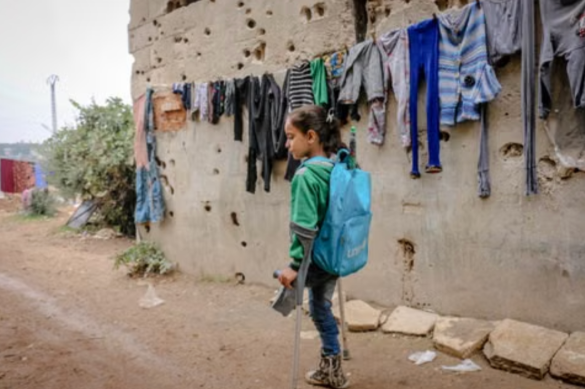
Conflict can close schools and disrupt learning for everyone, but girls may face additional barriers that make returning to education harder. Girls’ education in conflict zones can be affected by safety risks, gender-based violence, child marriage, displacement, household responsibilities, and inadequate school facilities. Girls in conflict- and crisis-affected settings are 2.5 times more likely to be out of school than girls in other contexts, according to the World Bank. Organizations such as War Child USA work to address the wider challenges that can prevent children affected by conflict from accessing education.
These barriers can reinforce one another. A displaced family may lose income and access to its previous school, while insecurity can make travel unsafe or increase pressure on girls to stay home. For girls’ education in conflict zones to continue, education responses need to address these surrounding barriers, not just provide a classroom.
1. Safety risks can prevent girls from reaching or remaining in school.
Conflict can make travel to school unsafe through harassment, sexual violence, abduction, and other protection risks. Schools can also be damaged or attacked, interrupting education and removing spaces where children can access protection and support. The World Bank identifies security concerns as one factor contributing to the disproportionate impact of conflict on girls’ education.
This makes the connection between gender-based violence and schooling particularly important. UNICEF identifies gender-based violence, school safety, poverty, child marriage, and inadequate hygiene and sanitation among the barriers affecting girls’ education.
Making learning environments safer can therefore address both an education barrier and a protection concern.
2. Economic and social pressures can push some girls out of school.
In some conflict and displacement settings, poverty, insecurity, and entrenched gender norms can increase pressure toward child marriage. Child marriage itself can then interrupt education. UNICEF reports that girls who marry before age 18 are less likely to remain in school.
Financial barriers can compound this problem. The World Bank identifies education costs as one factor that can prevent girls from staying in school and highlights reducing financial barriers as part of efforts to address child marriage and girls’ education.
Keeping girls connected to education therefore requires responses that address the economic and social pressures surrounding attendance, rather than treating school access as an isolated issue.
3. Displacement can interrupt schooling and amplify gender-specific barriers.
When families are forced to leave their homes, children can lose access to their previous schools and established support networks. UNICEF reports that more than 50 million children have been forcibly displaced globally, mostly after fleeing armed conflict, and that nearly half of school-age refugee children are out of school.
Displacement affects boys and girls, but girls can experience additional barriers related to safety, restricted mobility, household responsibilities, distance to school, and social expectations. Education responses therefore need to maintain learning during displacement while addressing the specific barriers that can prevent girls from continuing their education.
4. Everyday costs and responsibilities can make attendance harder to sustain.
Conflict can reduce household income while increasing essential expenses. School costs such as uniforms, books, transportation, and other necessities can become difficult for families to manage. A World Bank case study describes a girl who left school after her family could no longer afford these expenses and notes that costs can contribute to girls’ education barriers in fragile and conflict-affected settings.
Girls may also take on household responsibilities or face practical barriers at school. UNICEF identifies household responsibilities, distance to school, marriage, and lack of sanitation as factors associated with girls leaving education.
For adolescent girls, access to appropriate sanitation and menstrual hygiene support can therefore be part of what makes regular attendance possible. UNICEF notes that schools need to meet girls’ safety, hygiene, and sanitation needs.
What Is Being Done to Remove These Barriers?
Effective girls’ education access programs need to connect education with the specific conditions that keep girls out of school.
- Making schools and routes safer.
Safe learning spaces and protection measures can reduce risks that discourage attendance. UNICEF notes that schools and learning spaces can protect children from abuse, exploitation, and recruitment while providing stability and psychosocial support during emergencies. - Reducing the cost of staying in school.
Scholarships and other forms of financial assistance can help families manage education costs. The World Bank identifies financial barriers as an important consideration in improving girls’ access to education in fragile and conflict-affected settings. - Keeping education accessible during displacement.
Temporary learning spaces, flexible education options, and support for displaced children can help prevent displacement from becoming a prolonged interruption to schooling. UNICEF describes education as a critical service for children affected by emergencies and displacement. - Designing schools around girls’ needs.
Safe sanitation, water, menstrual hygiene support, and gender-responsive teaching can address practical barriers affecting girls’ attendance and participation. UNICEF specifically identifies safety, hygiene, sanitation, and gender-responsive teaching among factors relevant to girls’ education. - Combining education with protection and psychosocial support.
Conflict can expose children to violence, loss, and prolonged stress. Education responses that connect learning with protection and psychosocial support can provide stability while helping children cope with crisis. UNICEF notes that learning spaces can provide mental health and psychosocial support alongside education during emergencies.
Closing Thoughts
Girls’ education in conflict zones is not simply a question of whether a school is open. Safety, gender-based violence, child marriage, displacement, poverty, household responsibilities, and school conditions can all determine whether girls are able to continue learning.
Addressing these barriers requires targeted responses that connect education with protection, financial support, accessible learning, and gender-responsive facilities. When these needs are considered together, education responses can do more than restore access: they can help girls remain connected to learning when conflict and displacement disrupt everyday life.