
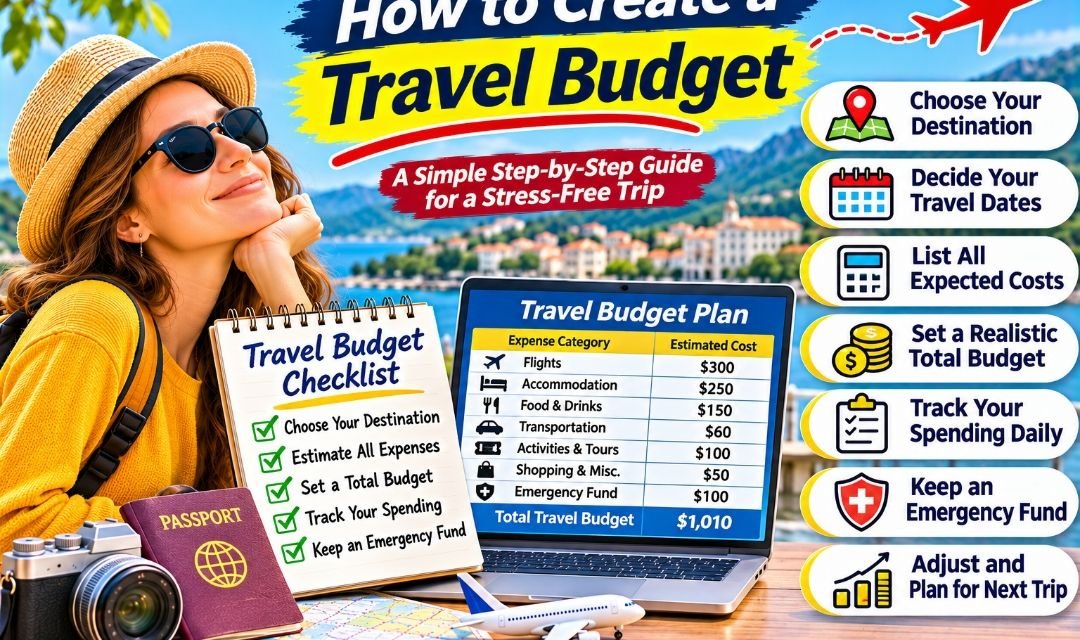
How to create a travel budget is one of the most important things to learn before planning a vacation. Have you ever dreamed of exploring a beautiful destination, staying in a comfortable hotel, or enjoying exciting activities but worried about how much everything would cost? You are not alone. Many travelers struggle to manage vacation expenses because they do not know how to calculate costs or plan their spending.
The good news is that creating a travel budget does not have to be difficult. With a little research and simple financial planning, you can organize your expenses, avoid unexpected charges, and enjoy your vacation without constantly worrying about money.
Imagine booking your flights, choosing suitable accommodation, enjoying delicious local meals, and visiting interesting attractions while knowing exactly how much you can afford to spend. A clear budget helps turn this idea into a realistic travel plan.
Whether you are preparing for a weekend getaway, family vacation, or international adventure, this guide explains how to create a travel budget step by step. You will learn how to estimate expenses, save money, organize daily spending, and prepare for unexpected situations.
Quick Overview: How to Create a Travel Budget
| Budget category | What to include |
|---|---|
| Destination | Choose somewhere within your budget |
| Transportation | Flights, trains, buses, or fuel |
| Accommodation | Hotels, hostels, or vacation rentals |
| Food | Restaurants, groceries, and snacks |
| Local transportation | Taxis, buses, trains, and transfers |
| Activities | Attraction tickets and guided tours |
| Travel documents | Visa and other required fees |
| Insurance | Suitable travel protection |
| Shopping | Souvenirs and personal purchases |
| Emergency fund | Money for unexpected expenses |
| Daily spending | A realistic daily allowance |
| Budget tracking | Record actual expenses |
1. Decide How Much Money You Can Afford to Spend
The first step in learning how to create a travel budget is deciding how much money you can comfortably spend.
Before choosing an expensive destination or booking accommodation, review your available savings.
Your vacation budget should not interfere with essential expenses such as housing, food, bills, or important financial obligations.
Choose an amount that allows you to travel without creating unnecessary financial pressure.
Questions to ask yourself
How much money have I already saved?
How much can I realistically save before departure?
How long do I want to travel?
Will I be traveling alone or with others?
Do I need money for visas or other travel requirements?
How much emergency money should I keep available?
Answering these questions gives you a realistic starting point.
Remember that a successful vacation does not require spending all your savings.
2. Choose a Destination That Matches Your Budget
Your destination has a major influence on travel expenses.
Some cities have expensive hotels, restaurants, and attractions.
Other places offer affordable accommodation, convenient transportation, and low-cost activities.
Before selecting a destination, research the approximate cost of visiting different locations.
A cheap flight to an expensive city may result in a higher overall vacation cost.
Similarly, a destination with slightly higher transportation expenses may offer more affordable daily living costs.
What to research
Average accommodation prices.
Typical restaurant expenses.
Local transportation costs.
Tourist attraction fees.
Seasonal weather conditions.
Currency exchange rates.
Visa requirements.
Choose a destination that offers the experiences you want at a cost you can reasonably afford.
3. Decide Your Travel Dates
Travel dates can affect airfare, accommodation prices, and attraction availability.
Popular destinations often become more expensive during major holidays and busy tourist seasons.
If your schedule allows flexibility, compare several departure dates.
Traveling during quieter periods may help reduce expenses.
Benefits of flexible travel dates
More accommodation choices.
Potentially lower transportation costs.
Fewer crowds at popular attractions.
Greater flexibility when booking activities.
However, off-season travel can involve unfavorable weather or limited tourist services.
Always consider the overall travel experience when selecting dates.
4. Calculate Transportation Expenses
Transportation is often one of the biggest travel expenses.
Depending on your destination, you may travel by airplane, train, bus, or car.
Research the total cost of reaching your destination.
Do not focus only on the advertised ticket price.
Transportation expenses to include
Flights: Ticket prices and baggage charges.
Train or bus: Tickets and reservation fees.
Airport transfers: Transportation between airports and hotels.
Car travel: Fuel, tolls, and parking.
Rental vehicles: Rental charges and applicable insurance.
Additional travel: Connecting transportation services.
Comparing complete costs helps you make better decisions.
5. Estimate Accommodation Costs
Accommodation is another major part of your travel budget.
Hotels, guesthouses, hostels, and vacation rentals offer different prices and facilities.
Start by researching the average cost per night for your preferred accommodation type.
Multiply the nightly cost by the number of nights.
Then add applicable taxes and additional charges.
Example accommodation calculation
If a hotel costs $60 per night and you stay for five nights:
$60 × 5 = $300
If taxes and fees total $40, your accommodation budget becomes $340.
Always check the complete booking price before making a reservation.
A property with a lower nightly rate may become more expensive after additional charges.
6. Plan Your Daily Food Budget
Food expenses can quickly add up during a vacation.
Restaurants, cafés, snacks, and drinks all contribute to daily spending.
Estimate how much you expect to spend on breakfast, lunch, and dinner.
Your food budget should reflect the destination and your personal eating preferences.
Example daily food budget
| Meal | Example cost |
|---|---|
| Breakfast | $8 |
| Lunch | $12 |
| Dinner | $18 |
| Snacks and drinks | $7 |
| Daily food total | $45 |
For a five-day trip, this example would require $225 for food.
These figures are illustrative and will vary by destination.
Ways to reduce food expenses
Explore suitable local restaurants.
Choose accommodation with breakfast included when it offers good value.
Purchase snacks from grocery stores.
Prepare occasional meals when kitchen facilities are available.
Avoid unnecessary purchases in expensive tourist areas.
Always consider food hygiene and safe drinking water.
7. Include Local Transportation Costs
Many travelers budget for flights but forget about transportation after arrival.
Local buses, trains, taxis, and airport transfers can increase expenses.
Research the transportation system at your destination.
Some cities offer affordable daily or weekly passes.
Others rely more heavily on taxis or private vehicles.
Local transportation checklist
Airport transfers.
Public transportation tickets.
Taxi or ride-hailing services.
Rental bicycles or vehicles.
Parking fees.
Road tolls.
Estimate how much transportation you will need each day.
Choosing accommodation near public transportation may help reduce these expenses.
8. Research Attraction and Activity Prices
Sightseeing is one of the most enjoyable parts of traveling.
However, museum tickets, guided tours, theme parks, and other attractions can increase your vacation costs.
Before departure, make a list of activities you want to experience.
Research admission prices and reservation requirements.
Activity budgeting tips
Choose your most important paid attractions.
Look for free museum admission periods.
Check family or student discounts when eligible.
Compare guided tours.
Explore public parks and historical neighborhoods.
Avoid booking activities you are unlikely to enjoy.
A combination of paid and free experiences can make your vacation affordable and memorable.
9. Include Visa and Travel Document Expenses
International travel may require additional documentation.
Depending on your nationality and destination, you may need a visa or electronic travel authorization.
Some applications involve fees.
Other expenses may include required photographs or document preparation.
Check official government or embassy sources for current requirements.
Possible document expenses
Visa application fees.
Travel authorization charges.
Passport renewal costs.
Required document photographs.
Processing services where applicable.
Required travel permits.
Include these costs in your budget before making nonrefundable reservations.
10. Consider Travel Insurance Costs
Travel insurance may be an important part of your vacation budget.
Depending on the policy, it can provide financial protection for certain medical emergencies, cancellations, or travel disruptions.
However, insurance coverage differs between providers.
Before purchasing, review medical limits, deductibles, exclusions, and cancellation conditions.
Some destinations require particular coverage.
Include any suitable insurance premium as a planned expense rather than treating it as an unexpected charge.
11. Create a Complete Travel Budget Table
After estimating individual expenses, combine everything into one budget.
This makes it easier to understand the total cost of your vacation.
Example five-day travel budget
| Expense category | Estimated cost |
|---|---|
| Flights | $300 |
| Accommodation | $250 |
| Food and drinks | $150 |
| Local transportation | $60 |
| Activities | $100 |
| Visa and documents | $40 |
| Travel insurance | $30 |
| Shopping | $50 |
| Emergency fund | $120 |
| Total travel budget | $1,100 |
These numbers are examples, not current destination-specific prices.
A complete budget helps you identify which expenses are essential and which can be adjusted.
12. Divide Your Budget Into Daily Spending Limits
Once you know your total budget, determine how much money is available for daily spending.
Subtract prepaid expenses and money reserved for emergencies.
Then divide the remaining amount by the number of travel days.
Example
Suppose you have $400 available for daily expenses during a five-day trip.
$400 ÷ 5 = $80 per day.
Your average daily spending limit would be $80.
This amount might cover meals, local transportation, activities, and shopping.
Some days may cost more than others.
A daily average is useful for planning, but you do not need to spend exactly the same amount every day.
13. Keep a Separate Emergency Fund
Unexpected situations can happen during any vacation.
Transportation delays, medical needs, or accommodation changes may create additional expenses.
Keeping emergency money separate from regular spending can help.
The appropriate amount depends on your destination, trip duration, and circumstances.
Do not treat your emergency reserve as ordinary shopping money.
You may also want suitable travel insurance, but insurance does not replace the need for accessible funds.
Financial preparation helps you respond more confidently to unexpected problems.
14. Plan for Hidden Travel Expenses
Hidden expenses are costs travelers sometimes forget during initial planning.
These charges may appear small but can increase the total vacation cost.
Common hidden travel costs
Airline baggage fees.
Hotel taxes and resort charges.
Currency exchange fees.
ATM withdrawal charges.
Mobile roaming.
Airport transfers.
Parking expenses.
Tips and service charges.
Additional attraction fees.
Laundry expenses.
Review the full price of each booking.
Research destination-specific costs before departure.
Including these expenses can make your budget more accurate.
15. Create a Travel Savings Plan
If your vacation is several months away, you can prepare a savings plan.
Start by deciding how much money you need.
Then calculate how much to save each month.
Example savings plan
| Monthly savings | Savings after 6 months |
|---|---|
| $50 | $300 |
| $75 | $450 |
| $100 | $600 |
| $150 | $900 |
| $200 | $1,200 |
For example, saving $150 each month for six months creates a $900 travel fund.
Choose an amount that fits your regular budget.
Avoid reducing money needed for essential living expenses.
Small, consistent savings can help make future vacations more affordable.
16. Use a Spreadsheet or Budgeting Application
Organizing your travel budget becomes easier when everything is recorded in one place.
A spreadsheet can help you compare estimated and actual expenses.
You can create columns for expense categories, planned amounts, and money spent.
Simple budget tracking example
| Category | Planned | Actual | Difference |
|---|---|---|---|
| Food | $150 | $135 | $15 under |
| Transportation | $60 | $70 | $10 over |
| Activities | $100 | $85 | $15 under |
| Shopping | $50 | $40 | $10 under |
Recording expenses helps you understand your spending patterns.
You can use a spreadsheet, notebook, or budgeting application.
The best method is one you can update easily during your journey.
17. Reduce Unnecessary Vacation Expenses
Saving money does not always require major sacrifices.
Small changes can reduce travel expenses without affecting your comfort.
For example, choosing accommodation near public transportation may reduce taxi costs.
Eating at suitable local restaurants may also help.
Practical money-saving ideas
Pack light.
Compare transportation prices.
Choose comfortable budget accommodation.
Explore free attractions.
Use public transportation when suitable.
Limit unnecessary shopping.
Avoid repeated small purchases.
Track daily spending.
Focus on reducing expenses that do not add much value to your vacation.
18. Adjust Your Budget for Family or Group Travel
Traveling with several people requires additional planning.
Transportation, accommodation, meals, and activity costs may increase.
However, some expenses can be shared.
For example, a family apartment may provide better value than several hotel rooms.
A group may also divide certain transportation costs.
Family and group budgeting considerations
Number of travelers.
Age-based ticket prices.
Accommodation size.
Food preferences.
Transportation arrangements.
Children’s activities.
Emergency needs.
Agree on shared expenses before departure.
Clear communication can prevent financial misunderstandings during the vacation.
19. Track Your Spending During the Trip
A travel budget should remain useful after your vacation begins.
Record daily expenses to understand where your money goes.
Check whether you are staying within your planned limits.
If you spend more than expected one day, consider choosing lower-cost activities the following day.
Expenses worth tracking
Meals.
Local transportation.
Attraction tickets.
Shopping.
Snacks and drinks.
Unexpected fees.
Compare your actual spending with your budget regularly.
This helps you make adjustments before small expenses become larger problems.
20. Review Your Budget After Returning Home
Travel budgeting is a skill that improves with experience.
After returning from your vacation, compare your estimated expenses with the amounts you actually spent.
Identify categories where you stayed within your budget.
Also look at areas where spending was higher than expected.
Ask yourself what you could do differently next time.
Perhaps transportation cost more than expected.
Maybe your accommodation offered good value.
You may discover that free attractions provided some of your favorite experiences.
Use these lessons when planning your next vacation.
Common Travel Budgeting Mistakes to Avoid
Even organized travelers sometimes make financial planning mistakes.
| Common mistake | Better approach |
|---|---|
| Budgeting only for flights and hotels | Include daily and additional expenses |
| Ignoring hidden fees | Review complete booking prices |
| Choosing an expensive destination | Compare overall travel costs |
| Forgetting emergency money | Maintain a separate reserve |
| Spending without tracking | Record purchases regularly |
| Overestimating savings | Use realistic estimates |
| Ignoring currency conversion fees | Research payment costs |
| Planning too many paid activities | Include free attractions |
| Forgetting local transportation | Estimate daily travel expenses |
| Using emergency funds for shopping | Keep reserve money separate |
Avoiding these mistakes helps create a more realistic and manageable travel budget.
Frequently Asked Questions About How to Create a Travel Budget
How do I create a travel budget for beginners?
Start by deciding how much money you can afford to spend. Research transportation, accommodation, food, and activities. Add hidden expenses and an emergency reserve, then calculate your total budget.
What should be included in a travel budget?
A complete travel budget should include transportation, accommodation, meals, local transportation, attraction tickets, required documents, insurance, shopping, and emergency expenses.
How much money should I save before traveling?
The amount depends on your destination, trip duration, transportation costs, and personal preferences. Estimate your expenses and create a savings plan that fits your finances.
How do I calculate my daily travel budget?
Subtract prepaid expenses and emergency reserves from your total available budget. Divide the remaining spending money by the number of travel days.
How can I travel with a small budget?
Choose an affordable destination, compare transportation and accommodation costs, use suitable public transportation, explore free attractions, and track spending.
What is the biggest travel budgeting mistake?
One common mistake is forgetting additional expenses such as baggage fees, airport transfers, taxes, and daily purchases. These costs can increase the final amount significantly.
Should I keep emergency money while traveling?
Yes. Keeping accessible emergency funds can help manage unexpected expenses. The appropriate amount depends on your destination, travel length, and personal circumstances.
Can families create a travel budget?
Yes. Families can calculate the total cost for every traveler, compare shared accommodation options, plan meals, and set limits for activities and shopping.
Is a spreadsheet useful for travel budgeting?
Yes. A spreadsheet can help organize estimated costs, record actual expenses, and compare spending across categories.
How can I avoid overspending during a vacation?
Set realistic spending limits, track purchases, compare prices, avoid unnecessary shopping, and keep emergency funds separate from regular spending money.
Final Thoughts
Learning how to create a travel budget can make vacation planning easier and more enjoyable. A realistic budget helps you understand your expenses, avoid unexpected charges, and make thoughtful financial decisions.
Start by choosing a destination that matches your available money. Estimate transportation, accommodation, food, and activity costs before making reservations.
Remember to include hidden expenses and maintain an emergency reserve.
Use a simple spreadsheet or budgeting application to monitor spending throughout your trip.
Most importantly, remember that traveling is not about spending as much money as possible. It is about exploring new destinations, enjoying meaningful experiences, and creating lasting memories.
With careful planning, you can enjoy comfortable and exciting adventures without putting unnecessary pressure on your finances.
Plan your budget, save consistently, spend wisely, and enjoy every journey with financial confidence.