
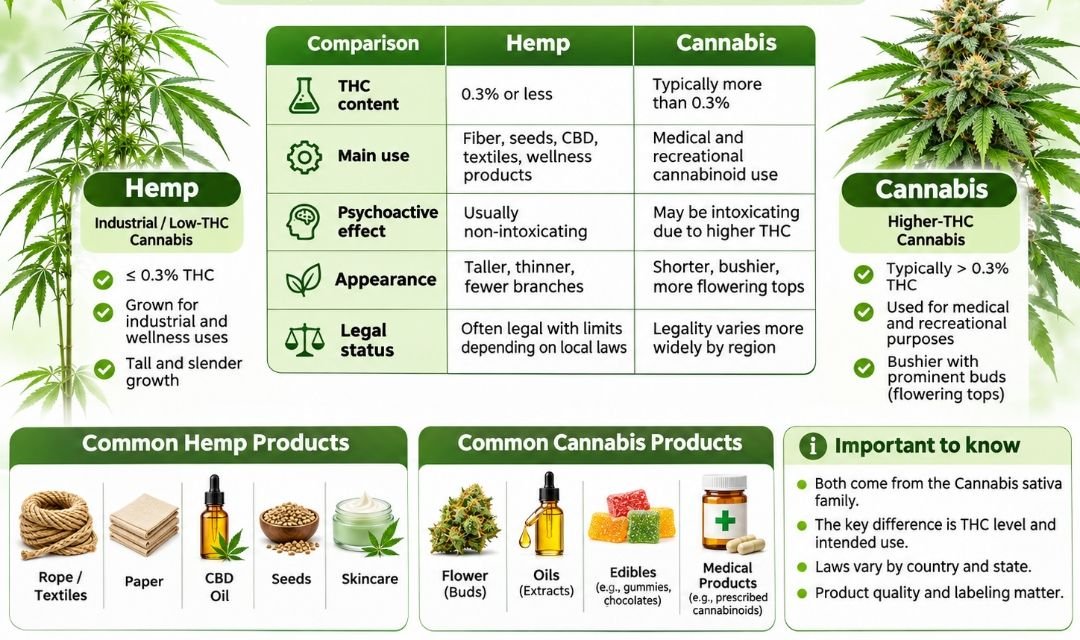
Quick Overview: Cannabis vs Hemp
| Feature | Cannabis | Hemp |
|---|---|---|
| Botanical classification | Cannabis genus | Cannabis cultivated under hemp definitions |
| Plant family | Cannabaceae | Cannabaceae |
| Common purpose | Medical, recreational, agricultural | Industrial, food, fiber, cannabinoid production |
| THC content | Varies widely | Usually legally restricted |
| CBD content | Varies by variety | May be high or low |
| Intoxicating effects | Possible with sufficient THC | Ordinary hemp products are non-intoxicating |
| Common products | Cannabis flower, cannabinoid medicines | Hemp seeds, textiles, hemp seed oil, CBD extracts |
| Physical appearance | Varies by genetics | Varies by genetics and cultivation purpose |
| Legal status | Depends on jurisdiction | Depends on jurisdiction and product |
| Main safety concerns | Impairment, dependence, interactions | Product-specific risks, including cannabinoid exposure |
| Environmental uses | Agricultural and industrial | Textiles, construction, paper, composites |
Hemp and cannabis are often discussed as if they were completely different plants.
However, the distinction is more complicated.
Hemp belongs to the cannabis group.
The real comparison is usually between hemp and higher-THC cannabis commonly called marijuana.
Different cannabis plants can produce different chemical profiles.
Some are cultivated for their seeds and fibers.
Others are cultivated for cannabinoid-containing flowers.
These differences influence their commercial uses, regulations, and possible effects on human health.
What Is Cannabis?
Cannabis is a genus of flowering plants belonging to the Cannabaceae family.
It has been cultivated for thousands of years.
Historically, people used cannabis for rope, textiles, seeds, and traditional preparations.
Today, cannabis is studied for agricultural, industrial, and medical applications.
Cannabis plants contain compounds called cannabinoids.
Two of the most widely discussed are tetrahydrocannabinol (THC) and cannabidiol (CBD).
THC is associated with intoxicating effects.
CBD does not typically produce a THC-like high.
However, both compounds can affect biological processes.
The term cannabis does not automatically indicate how much THC or CBD a particular plant contains.
What Is Hemp?
Hemp refers to cannabis cultivated or classified for agricultural and commercial purposes, often under legal limits on THC concentration.
Hemp is commonly used to produce seeds, fibers, oils, and other materials.
Some hemp varieties are cultivated for cannabinoid extraction.
Others are grown primarily for grain or fiber.
In the United States, federal law has historically defined hemp using a delta-9 THC concentration threshold of no more than 0.3% on a dry-weight basis. Legal definitions and restrictions can change, and other countries may use different standards.
Importantly, meeting a hemp definition does not automatically make every finished hemp-derived product lawful.
Additional rules may apply to cannabinoids, food products, medicines, and intoxicating substances.
Cannabis vs Hemp: The Main Difference
The main difference is not that hemp and cannabis belong to unrelated plant families.
Hemp is cannabis.
The distinction usually involves legal classification, THC content, cultivation purpose, and product use.
For example, industrial hemp may be grown for textile fibers.
Higher-THC cannabis may be cultivated for cannabinoid-containing products.
However, appearance alone cannot reliably establish THC content.
Laboratory testing is needed to determine the actual cannabinoid composition.
Cannabis vs Hemp: THC Content
THC is one of the most important factors in the hemp-versus-marijuana distinction.
Delta-9 THC is the main intoxicating compound commonly associated with cannabis.
It interacts with cannabinoid receptors in the nervous system.
At sufficient exposure, THC can affect mood, perception, memory, judgment, and coordination.
Hemp is generally defined by a low legal THC concentration.
However, THC concentration limits differ between jurisdictions.
Some hemp-derived products can also contain concentrated or chemically modified intoxicating cannabinoids.
Therefore, the label hemp-derived does not guarantee that a product cannot cause intoxication.
Cannabis vs Hemp: CBD Content
CBD stands for cannabidiol.
It is another cannabinoid found in cannabis.
Some hemp varieties are cultivated specifically for CBD production.
However, not every hemp plant contains high levels of CBD.
Fiber and grain hemp varieties may have different cannabinoid profiles.
Likewise, some higher-THC cannabis varieties may also contain CBD.
CBD itself does not typically cause an intoxicating high.
However, CBD can cause side effects and interact with medications.
Cannabis vs Hemp: Chemical Composition
Both hemp and higher-THC cannabis can contain cannabinoids, terpenes, and other plant compounds.
Their chemical profiles depend on genetics and growing conditions.
| Compound | Hemp | Higher-THC cannabis |
|---|---|---|
| CBD | Variable | Variable |
| Delta-9 THC | Legally limited under hemp definitions | Often higher |
| CBG | May be present | May be present |
| CBC | May be present | May be present |
| Terpenes | Present in varying amounts | Present in varying amounts |
| Flavonoids | Present | Present |
This table demonstrates that the plants share many chemical compounds.
The important difference is their concentrations.
Cannabis vs Hemp: Physical Appearance
People sometimes believe hemp and marijuana can always be distinguished by appearance.
This is not reliable.
Cannabis plants vary in height, leaf shape, branching, and flower structure.
Some fiber hemp varieties grow tall with relatively long stems.
Some cannabis varieties cultivated for flowers may be shorter and more heavily branched.
However, these patterns are not universal.
Modern breeding has created considerable variation.
A plant’s appearance cannot reliably determine its legal classification.
Cannabis vs Hemp: Growing Purposes
Hemp and higher-THC cannabis may be cultivated for different purposes.
Industrial hemp is often grown for fiber or grain.
Other hemp varieties are cultivated for cannabinoid extraction.
Higher-THC cannabis may be cultivated for medical or regulated adult-use markets.
Cultivation practices differ according to the intended product.
However, the same broad botanical group supports all these uses.
Cannabis vs Hemp: Industrial Uses
Hemp has a long history of industrial applications.
Its fibers and seeds can be processed into useful materials.
Hemp Textiles
Hemp fibers can be used in clothing, bags, upholstery, and other fabrics.
The durability and texture of the final product depend on processing.
Hemp Rope
Hemp was historically an important material for rope and cordage.
Hemp Paper
Hemp fibers can be processed into paper products.
Hemp Construction Materials
Hemp hurd can be combined with mineral binders to produce hemp-lime construction materials.
Hemp Composites
Hemp fibers may be incorporated into composite materials used in different industries.
These applications are separate from the medical effects of cannabinoids.
Cannabis vs Hemp: Food Products
Hemp seeds are widely used as food ingredients.
They contain protein, unsaturated fats, and minerals.
Common hemp foods include:
-
Hulled hemp seeds
-
Hemp protein powder
-
Hemp seed oil
-
Hemp-based snack products
-
Foods containing hemp seed ingredients
Ordinary hemp seeds generally contain little to no cannabinoids.
However, contamination may occur during harvesting or processing.
Hemp seed foods should not be confused with CBD or THC products.
Hemp Seed Oil vs CBD Oil
Hemp seed oil and CBD oil are different products.
Hemp seed oil is pressed from hemp seeds.
CBD oil contains cannabidiol extracted from cannabinoid-containing cannabis material.
| Feature | Hemp Seed Oil | CBD Oil |
|---|---|---|
| Main source | Hemp seeds | Cannabinoid-containing plant material |
| Main ingredients | Fatty acids and seed nutrients | CBD and carrier ingredients |
| CBD content | Usually little to none | Contains CBD |
| Typical use | Food and cosmetics | Cannabinoid products |
| Main safety concerns | Food quality and allergies | Side effects, interactions, THC contamination |
The phrase hemp oil can be ambiguous.
Consumers should check the ingredient list to understand what a product contains.
Cannabis vs Hemp: Medical Uses
Cannabis-derived compounds have been studied for several medical conditions.
However, evidence varies.
A purified prescription CBD medicine has established uses for certain rare seizure disorders.
Certain prescription THC-related medicines have specific approved applications, including some cases of chemotherapy-related nausea.
Other cannabinoid products have been investigated for chronic pain and multiple sclerosis-related symptoms.
However, these findings cannot automatically be applied to every cannabis or hemp product.
Many commercial health claims remain unproven.
Cannabis vs Hemp: Effects on the Brain
THC and CBD affect the body differently.
THC can activate CB1 cannabinoid receptors.
These receptors are abundant in parts of the nervous system.
THC can cause intoxication and impair attention, memory, and coordination.
CBD interacts with several biological pathways.
It does not typically produce the same intoxicating effects.
However, CBD can still cause drowsiness and other adverse reactions.
A product’s effects depend on its actual chemical composition rather than whether it is marketed as cannabis or hemp.
Cannabis vs Hemp: Side Effects
Both THC-containing and CBD-containing products can cause side effects.
However, their risk profiles differ.
| Potential effect | THC-containing products | CBD products |
|---|---|---|
| Intoxication | Possible | Not typical with pure CBD |
| Drowsiness | Possible | Possible |
| Dizziness | Possible | Possible |
| Anxiety | Possible | May occur; evidence varies |
| Impaired coordination | Possible | Less typical |
| Medication interactions | Possible | Possible |
| Liver-related concerns | Product-dependent | Important at certain exposures |
| Dependence | Possible | Lower abuse potential for purified CBD |
These are general comparisons.
Individual responses and product compositions vary.
Can Hemp Make You High?
Ordinary hemp seeds, hemp textiles, and hemp seed oil are not expected to cause intoxication.
However, some hemp-derived cannabinoid products contain THC or related compounds.
These products may cause intoxicating effects.
For example, certain delta-8 THC products are manufactured using hemp-derived CBD.
Delta-8 THC can produce intoxication.
Therefore, consumers should not assume that every product labeled hemp is non-intoxicating.
What Is Delta-8 THC?
Delta-8 THC is a cannabinoid chemically related to delta-9 THC.
It can produce psychoactive effects.
Some commercial delta-8 products are manufactured through chemical conversion processes.
These processes may introduce impurities or unwanted byproducts.
The safety of many commercial delta-8 products is not well established.
They should not be confused with ordinary hemp foods or purified CBD.
Cannabis vs Hemp: Drug Testing
Drug tests commonly screen for THC-related metabolites.
Hemp seed foods are different from concentrated cannabinoid products.
However, some CBD products contain THC.
Repeated exposure may lead to positive drug test results.
Full-spectrum CBD products may contain THC.
Broad-spectrum products may contain trace amounts.
Even CBD isolate products can be mislabeled or contaminated.
No commercial cannabinoid product can guarantee a negative drug test.
Cannabis vs Hemp: Legal Differences
Legal classification is one of the biggest differences between hemp and higher-THC cannabis.
Some jurisdictions permit industrial hemp cultivation under licensing systems.
Higher-THC cannabis may be regulated separately.
However, the rules vary.
In the United States, federal hemp definitions do not automatically authorize all hemp-derived products.
Food, drug, consumer protection, and state laws may apply.
Other countries have different THC limits and product restrictions.
Consumers and businesses should verify current local laws.
Cannabis vs Hemp: Environmental Impact
Hemp is often promoted as an environmentally friendly crop.
It can provide fibers and other raw materials.
However, environmental outcomes depend on cultivation and processing.
Water use, fertilizers, energy requirements, transportation, and manufacturing all matter.
Indoor cannabis cultivation can require substantial energy for lighting and climate control.
Outdoor cultivation has different environmental considerations.
Hemp is not automatically sustainable in every application.
A complete environmental assessment should consider the full product lifecycle.
Cannabis vs Hemp: Economic Uses
Hemp and cannabis support different commercial activities.
Industrial hemp may be used in agriculture, textiles, food production, and construction materials.
Regulated cannabis markets may focus on pharmaceutical or cannabinoid-containing products.
However, economic outcomes depend on demand, regulation, production costs, and manufacturing infrastructure.
The two markets also overlap in CBD production.
Common Myths About Cannabis vs Hemp
Myth 1: Hemp and Cannabis Are Completely Different Plants
Hemp belongs to the cannabis group.
Myth 2: All Cannabis Plants Contain High THC
Cannabis plants can have very different cannabinoid profiles.
Myth 3: Every Hemp Product Is THC-Free
Some hemp-derived products contain THC or related cannabinoids.
Myth 4: Hemp Seed Oil Is the Same as CBD Oil
They are different products.
Myth 5: CBD Cannot Cause Side Effects
CBD can cause adverse effects and medication interactions.
Myth 6: Hemp Is Legal Everywhere
Hemp laws differ between jurisdictions.
Myth 7: Hemp Is Always Better for the Environment
Environmental performance depends on farming and manufacturing practices.
Myth 8: All Cannabis Products Have Proven Medical Benefits
Evidence varies significantly between products and medical conditions.
How to Understand Hemp and Cannabis Product Labels
Labels can help consumers identify product composition.
However, marketing language may be confusing.
Important information includes the actual ingredients, cannabinoid concentrations, and product category.
For cannabinoid products, independent laboratory testing may provide additional information.
A certificate of analysis may report CBD and THC concentrations.
It may also include contaminant testing.
However, a certificate does not prove that a product is medically effective or completely safe.
Why Product Quality Matters
Cannabis and hemp-derived products can vary in quality.
Some may contain inaccurate cannabinoid concentrations.
Others may contain pesticides, heavy metals, residual solvents, or microbial contaminants.
Reliable manufacturing and testing standards are important.
However, quality testing does not eliminate every medical or legal risk.
Future of Cannabis and Hemp in 2026 and Beyond
Research into cannabis and hemp continues.
Scientists are studying cannabinoids for specific medical applications.
Agricultural researchers are exploring hemp fibers, seeds, and other materials.
Manufacturers are also investigating hemp-based composites and construction products.
However, the future depends on regulation, scientific evidence, and economic feasibility.
Medical claims require rigorous clinical testing.
Environmental claims require reliable lifecycle assessments.
Improved consumer education may also help people distinguish ordinary hemp products from intoxicating cannabinoid products.
Frequently Asked Questions About Cannabis vs Hemp
1. What is the main difference between cannabis and hemp?
Hemp is a type of cannabis commonly distinguished by legal THC limits and agricultural uses.
2. Is hemp the same plant as cannabis?
Hemp belongs to the cannabis genus.
3. Is hemp the same as marijuana?
Both are cannabis, but marijuana commonly refers to higher-THC cannabis.
4. Does hemp contain THC?
Hemp may contain low concentrations of THC, depending on the plant and legal definition.
5. Does cannabis always contain high THC?
No. Cannabis varieties can have different cannabinoid concentrations.
6. Does hemp contain CBD?
Some hemp varieties contain CBD, but not all are cultivated for CBD production.
7. Can hemp make you high?
Ordinary hemp foods do not. Some hemp-derived cannabinoid products may cause intoxication.
8. What is CBD?
CBD is a cannabinoid that does not typically cause a THC-like high.
9. What is THC?
THC is the principal intoxicating cannabinoid commonly associated with cannabis.
10. Is hemp seed oil the same as CBD oil?
No. Hemp seed oil is produced from seeds, while CBD oil contains extracted cannabidiol.
11. What are hemp seeds used for?
They are used in food products and nutritional ingredients.
12. Can hemp be used in clothing?
Yes. Hemp fibers can be processed into textiles.
13. Can hemp be used in construction?
Yes. Hemp-based materials are used in certain building applications.
14. Is hemp environmentally friendly?
It may offer benefits in some applications, but environmental impact depends on production methods.
15. Are hemp products safe?
Safety depends on the product. Ordinary hemp foods and cannabinoid extracts have different risks.
16. Can CBD cause side effects?
Yes. CBD can cause drowsiness, digestive symptoms, liver-related effects, and medication interactions.
17. Can THC cause addiction?
THC-containing cannabis can lead to cannabis use disorder.
18. Can hemp-derived CBD cause a positive drug test?
Yes, if a product contains enough THC.
19. Is hemp legal everywhere?
No. Laws differ between countries and jurisdictions.
20. Is marijuana legal everywhere?
No. Legal status varies.
21. Can cannabis be used medically?
Certain prescription cannabinoid medicines have established medical uses.
22. Does hemp cure diseases?
There is no reliable evidence that hemp products cure diseases generally.
23. What is delta-8 THC?
It is an intoxicating cannabinoid that may be found in some hemp-derived products.
24. Can hemp and cannabis look similar?
Yes. Appearance alone cannot reliably establish cannabinoid content.
25. Why is laboratory testing important?
It helps identify cannabinoid concentrations and certain contaminants.
Final Thoughts
Cannabis vs hemp differences are easier to understand once the terminology is clear.
Hemp is cannabis.
The distinction usually involves THC concentration, legal definitions, cultivation purposes, and product uses.
Industrial hemp is widely used for seeds, fibers, oils, and other materials.
Higher-THC cannabis is commonly associated with cannabinoid-containing products used in medical or regulated adult-use settings.
However, hemp-derived products can sometimes contain intoxicating cannabinoids.
Likewise, not every cannabis product has the same chemical composition.
CBD and THC have different effects and safety concerns.
Consumers should avoid assuming that natural or hemp-derived products are automatically safe.
Accurate labeling, reliable testing, scientific evidence, and local legal requirements remain important.
Understanding these differences helps readers evaluate cannabis-related information without relying on misleading marketing claims.
For more cannabis education, CBD guides, hemp product information, wellness topics, and beginner-friendly science articles, visit Picanto Magazine.
Disclaimer: This article is for educational purposes only and does not provide personalized medical or legal advice. Cannabis and cannabinoid products may cause side effects, impairment, dependence, or medication interactions. Consult qualified professionals about medical concerns and applicable laws.