
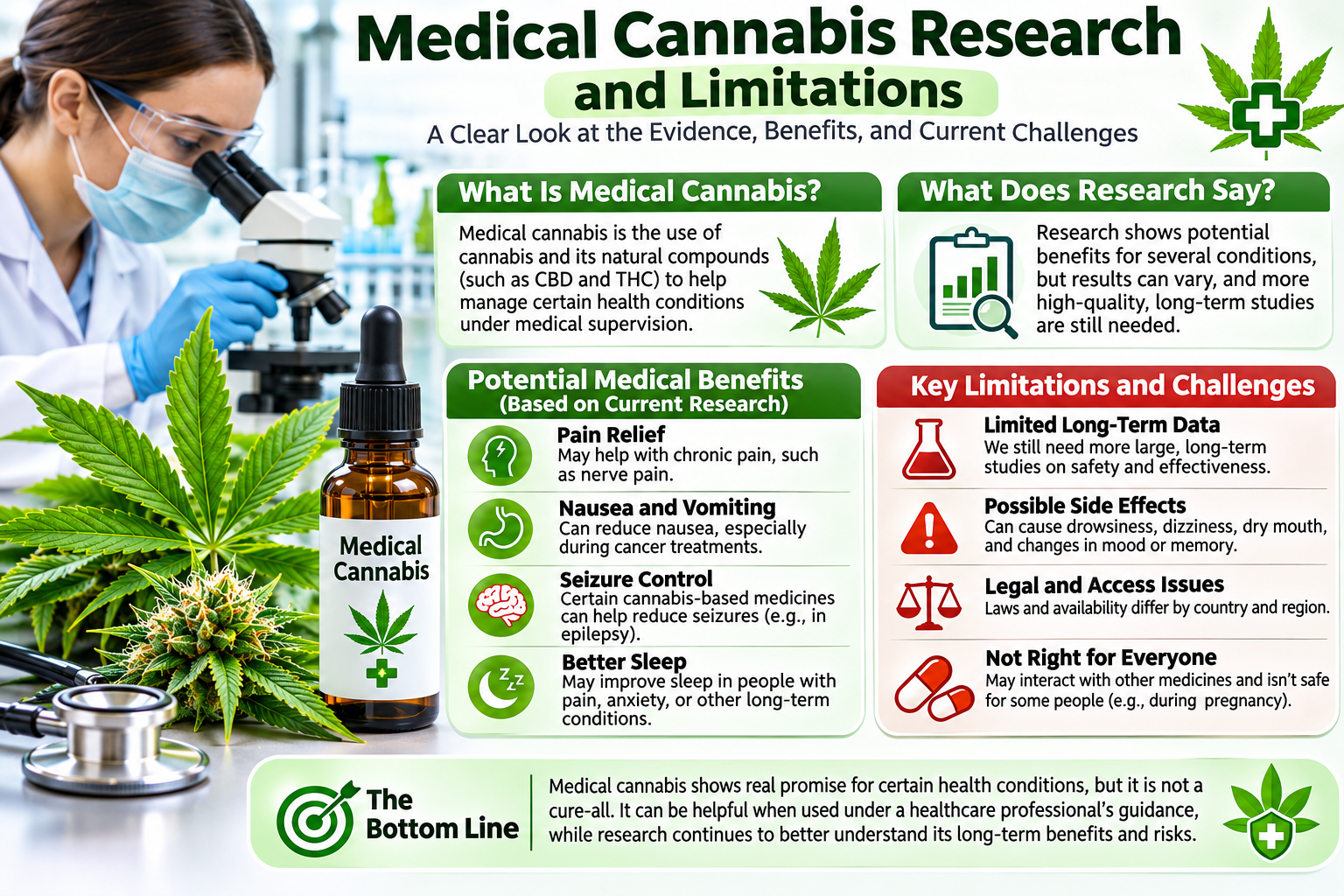
Medical cannabis research and limitations is an important topic for understanding how cannabis-derived compounds are being studied in modern medicine. Cannabis contains several biologically active chemicals, including cannabidiol (CBD) and tetrahydrocannabinol (THC). Researchers have investigated these compounds for conditions involving seizures, chronic pain, nausea, muscle spasticity, and other symptoms. Although certain cannabis-derived medicines have established medical applications, many popular claims about medical cannabis remain unsupported by strong scientific evidence. Understanding both the findings and the limitations of research helps patients and readers distinguish proven treatments from experimental possibilities.
Quick Overview of Medical Cannabis Research
| Category | Details |
|---|---|
| Main topic | Medical Cannabis Research and Limitations |
| Plant source | Cannabis |
| Main compounds studied | CBD and THC |
| Other compounds | CBG, CBC, CBN, terpenes |
| Research areas | Epilepsy, chronic pain, nausea, spasticity, sleep |
| Established applications | Specific prescription cannabinoid medicines |
| Strong CBD evidence | Certain rare seizure disorders |
| THC-related medical uses | Certain forms of chemotherapy-related nausea and appetite problems |
| Main research challenge | Limited high-quality, long-term clinical evidence |
| Common side effects | Drowsiness, dizziness, digestive symptoms |
| Additional THC risks | Intoxication, impairment, dependence |
| Drug interactions | Possible with several medications |
| Legal status | Varies by jurisdiction |
| Long-term safety | Not fully understood for many products |
| Research outlook | Continuing clinical investigation |
Medical cannabis has attracted increasing attention from researchers, healthcare professionals, and the public.
Some people believe cannabis can treat a wide range of illnesses.
Others question whether its medical benefits have been exaggerated.
The scientific picture is more complicated.
Certain cannabinoid medicines have demonstrated benefits for specific conditions.
However, evidence for many other uses remains limited, inconsistent, or uncertain.
Different cannabis products also contain different amounts of active compounds.
This makes it difficult to compare study results.
The following guide explores what researchers currently understand, where evidence is strongest, and why important questions remain unanswered.
What Is Medical Cannabis?
Medical cannabis refers to cannabis or cannabis-derived compounds used with the intention of treating symptoms or medical conditions.
The term covers several different products.
These include purified cannabinoid medicines, standardized pharmaceutical preparations, and other cannabis products used under medical programs.
However, these products are not interchangeable.
A prescription medicine containing purified CBD is different from an unregulated CBD oil.
Likewise, a pharmaceutical THC preparation is different from an ordinary cannabis edible.
The strength of medical evidence depends on the specific product, condition, and clinical study.
What Compounds Are Found in Medical Cannabis?
Cannabis produces numerous chemical compounds.
Some are called cannabinoids.
Others include terpenes and flavonoids.
Researchers are especially interested in CBD and THC.
Cannabidiol (CBD)
CBD is a cannabinoid that does not typically produce an intoxicating high.
It influences several biological signaling pathways.
Purified prescription CBD has established medical uses for certain rare seizure disorders.
However, many other proposed benefits remain experimental.
Tetrahydrocannabinol (THC)
THC is the principal intoxicating cannabinoid in cannabis.
It activates cannabinoid receptors, especially CB1 receptors.
THC can influence appetite, nausea, perception, and pain signaling.
However, it can also impair coordination, judgment, and memory.
Minor Cannabinoids
Other cannabinoids include CBG, CBC, and CBN.
Scientists are studying their biological properties.
However, human clinical evidence remains limited for many proposed applications.
Terpenes
Terpenes contribute to the aroma of cannabis.
Some have been studied in laboratory experiments.
However, claims that specific terpenes provide established medical benefits are often stronger than the available clinical evidence.
How Does Medical Cannabis Work?
Cannabinoids interact with several biological systems.
One important system is the endocannabinoid system.
This system includes signaling molecules, receptors, and enzymes.
It is involved in processes such as appetite regulation, pain signaling, and stress responses.
THC activates cannabinoid receptors, particularly CB1 receptors.
CBD has more complex interactions with several molecular targets.
However, identifying a biological mechanism does not automatically prove that a substance is an effective treatment.
Clinical studies are needed to establish whether a proposed effect produces meaningful benefits in patients.
Why Is Medical Cannabis Being Studied?
Researchers investigate medical cannabis because cannabinoids can affect biological processes relevant to disease symptoms.
For example, some compounds influence nerve signaling.
Others affect appetite or nausea-related pathways.
Laboratory findings have encouraged research into additional medical applications.
However, laboratory results are only an early stage of scientific investigation.
A compound that produces an interesting effect in cells or animals may not provide the same benefit in humans.
This is why carefully designed clinical trials are essential.
Medical Cannabis Research for Epilepsy
Epilepsy is one of the clearest examples of an established medical application for a cannabis-derived compound.
A purified prescription cannabidiol medicine has demonstrated effectiveness in clinical trials involving certain rare seizure disorders.
In the United States, Epidiolex is approved for seizures associated with Lennox-Gastaut syndrome, Dravet syndrome, and tuberous sclerosis complex.
However, this evidence applies to a specific pharmaceutical formulation.
It does not mean every commercial CBD product is effective for epilepsy.
Prescription treatment also involves monitoring for side effects and medication interactions.
Medical Cannabis Research for Chronic Pain
Chronic pain is one of the most frequently studied reasons for medical cannabis use.
Researchers have examined cannabis-based medicines for neuropathic pain and other pain conditions.
Some studies suggest that certain THC-containing or mixed-cannabinoid products may provide modest short-term benefits.
However, findings vary considerably.
Many trials are relatively small or short.
Some products also cause dizziness, sedation, or cognitive side effects.
Evidence for CBD alone as a treatment for chronic pain remains insufficient.
Therefore, cannabis should not automatically be considered a safer or more effective alternative to established pain management.
Medical Cannabis Research for Cancer-Related Symptoms
Cannabinoid medicines have been investigated for symptoms associated with cancer treatment.
One important area is chemotherapy-related nausea and vomiting.
Certain prescription cannabinoid medicines have approved uses for chemotherapy-related nausea when other treatments have not worked adequately.
However, these medicines are not the same as unregulated cannabis products.
Research into appetite and other cancer-related symptoms is also ongoing.
Importantly, there is no reliable clinical evidence that cannabis cures cancer.
Laboratory findings involving cancer cells do not establish effective cancer treatment in humans.
Medical Cannabis Research for Multiple Sclerosis
Multiple sclerosis is a neurological condition that can cause muscle stiffness and spasms.
Some studies have examined cannabinoid-based medicines for spasticity-related symptoms.
Certain standardized cannabis-derived products are authorized for specific uses in some countries.
However, results differ depending on the product and outcome measured.
Some patients report symptom improvements.
Objective measurements do not always show the same degree of benefit.
Side effects and treatment tolerability are also important considerations.
Medical Cannabis Research for Anxiety
CBD has attracted attention as a possible treatment for anxiety.
Some small human studies suggest potential effects in specific situations.
However, the evidence remains preliminary.
Many studies involve limited numbers of participants.
Others use different formulations or study designs.
THC can also cause anxiety, panic, or paranoia.
Therefore, results involving one cannabinoid should not be applied to every cannabis product.
CBD is not an established general treatment for anxiety disorders.
Medical Cannabis Research for Sleep Disorders
Cannabis is often marketed for sleep.
However, research findings remain mixed.
Some cannabinoid products may cause sedation.
Yet sedation is not necessarily the same as improving sleep quality.
Regular THC use may also affect sleep patterns.
Stopping frequent use can cause sleep disturbances.
Larger clinical trials are needed to determine whether specific cannabinoid medicines provide meaningful benefits for particular sleep disorders.
Medical Cannabis Research for Inflammation
Cannabinoids have been studied for effects on inflammatory signaling.
Laboratory and animal studies suggest several possible mechanisms.
However, evidence in humans remains limited for many inflammatory conditions.
It is important to distinguish between reducing an inflammatory marker in an experiment and treating an inflammatory disease in patients.
Reliable clinical outcomes are necessary before medical claims can be established.
Medical Cannabis Research for Neurological Conditions
Researchers are investigating cannabinoids in relation to several neurological conditions.
These include Parkinson’s disease, Alzheimer’s disease, and other disorders.
However, most proposed applications remain experimental.
Some early findings are promising.
Others are inconsistent or show little benefit.
There is insufficient evidence to conclude that cannabis prevents or reverses neurodegenerative diseases.
Medical Cannabis Research for PTSD
Post-traumatic stress disorder, or PTSD, is another area of cannabinoid research.
Some observational studies report changes in symptoms among cannabis users.
However, observational findings cannot establish that cannabis caused improvement.
THC can also affect sleep, anxiety, and emotional processing.
Current evidence is insufficient to recommend cannabis as a proven general treatment for PTSD.
Medical Cannabis Evidence by Condition
| Medical condition | Current evidence |
|---|---|
| Certain rare seizure disorders | Strong evidence for specific prescription CBD medicine |
| Chemotherapy-related nausea | Established uses for certain prescription cannabinoid medicines |
| Multiple sclerosis spasticity | Some evidence for specific standardized products |
| Chronic pain | Modest possible benefits for selected products; important limitations |
| Anxiety disorders | Preliminary and insufficient |
| Sleep disorders | Mixed and limited |
| PTSD | Insufficient |
| Inflammatory diseases | Mostly early-stage research |
| Parkinson’s disease | Insufficient for routine treatment |
| Alzheimer’s disease | Insufficient |
| Cancer cure | No reliable clinical evidence |
This comparison shows why medical cannabis cannot be described as one treatment with equal effectiveness for every condition.
What Are Clinical Trials?
Clinical trials are studies designed to evaluate medical interventions in humans.
They help researchers determine whether a treatment is effective and safe.
A well-designed clinical trial may compare a treatment with a placebo or an established therapy.
Researchers also monitor side effects.
Randomization and blinding can help reduce bias.
However, not every clinical trial provides equally reliable evidence.
Study quality, sample size, duration, and outcome measurements all matter.
Why Are Medical Cannabis Studies Difficult?
Medical cannabis research faces several challenges.
Different products contain different cannabinoids.
Concentrations may vary.
Routes of administration also differ.
Some studies examine purified compounds.
Others investigate whole-plant products.
These differences make results difficult to compare.
Legal and regulatory requirements can create additional research challenges.
However, methodological limitations remain important even where research is legally permitted.
Limitation 1: Small Study Sizes
Many medical cannabis studies involve relatively few participants.
Small studies can provide useful early information.
However, they may not reliably detect modest benefits or uncommon adverse effects.
Results can also be influenced by chance.
Larger trials are often necessary to confirm preliminary findings.
Limitation 2: Short Research Duration
Some clinical trials last only a few weeks or months.
This can make it difficult to understand long-term effectiveness.
It also limits information about dependence, tolerance, and chronic side effects.
Longer studies are especially important for conditions requiring ongoing treatment.
Limitation 3: Different Cannabis Formulations
Cannabis products vary in chemical composition.
One product may contain purified CBD.
Another may contain THC and CBD.
A third may include additional cannabinoids and terpenes.
Therefore, results from one formulation cannot automatically be applied to another.
Limitation 4: Problems With Blinding
Blinding means participants and researchers do not know which treatment a person receives.
This helps reduce bias.
However, THC can produce noticeable intoxicating effects.
Participants may correctly guess whether they received THC or a placebo.
This can influence reported outcomes.
It is an important challenge in cannabis clinical trials.
Limitation 5: Limited Long-Term Safety Data
Long-term safety remains uncertain for many cannabinoid products.
Researchers need better information about repeated exposure, cognitive effects, dependence, and medication interactions.
Different age groups may also face different risks.
Findings from short trials cannot answer every long-term safety question.
Limitation 6: Inconsistent Product Quality
Commercial cannabis products may contain inaccurate cannabinoid concentrations.
Some may also contain contaminants.
This makes it difficult to generalize research findings to ordinary consumer products.
Pharmaceutical preparations typically have more controlled manufacturing standards.
Limitation 7: Limited Evidence for Specific Patient Groups
Some medical cannabis studies exclude people with complex medical conditions.
Others include few older adults or patients taking multiple medications.
This limits how confidently results can be applied to different populations.
Children, pregnant individuals, and people with liver conditions may face additional safety concerns.
Limitation 8: Confusing Association With Causation
Observational research can identify associations.
For example, a study may find that cannabis users report different symptom levels.
However, this does not necessarily mean cannabis caused the difference.
Other factors may influence the results.
Randomized clinical trials are often needed to establish treatment effects.
Limitation 9: Marketing Claims Exceeding Evidence
Commercial cannabis marketing sometimes presents preliminary findings as established facts.
A laboratory study may be described as proof of a medical benefit.
However, laboratory findings do not automatically translate into effective human treatments.
Consumers should be cautious about products claiming to cure serious diseases.
Limitation 10: Difficulty Comparing Studies
Researchers may measure outcomes differently.
One study may examine pain scores.
Another may measure sleep quality or daily functioning.
Different doses, formulations, and patient populations create additional complications.
These differences make systematic reviews and meta-analyses challenging.
Medical Cannabis Side Effects
Cannabis-derived products can cause adverse effects.
The specific risks depend on the compounds present.
Commonly reported effects may include:
-
Drowsiness
-
Dizziness
-
Fatigue
-
Digestive symptoms
-
Changes in appetite
-
Impaired coordination
-
Anxiety or confusion
-
Medication interactions
THC-containing products can also cause intoxication.
CBD has distinct risks, including liver enzyme abnormalities.
Medical Cannabis and Liver Health
CBD can affect liver enzymes.
At certain exposures, clinically significant liver-related problems may occur.
The risk can increase with particular medications or existing health conditions.
Prescription CBD treatment may require liver function monitoring.
Consumers should not assume that over-the-counter CBD products are free from these concerns.
Medical Cannabis and Drug Interactions
Cannabinoids can interact with medications.
CBD can influence enzymes involved in drug metabolism.
THC can also interact with other substances and medications.
Potential concerns include increased sedation or altered drug exposure.
People taking prescription medications should discuss cannabinoid products with qualified healthcare professionals.
Medical Cannabis and Mental Health Risks
THC can affect mood, perception, and cognition.
Some individuals experience anxiety, panic, or paranoia.
Frequent use of high-potency cannabis is associated with increased mental health concerns in certain populations.
However, risk varies between individuals.
People with certain psychiatric vulnerabilities may face greater concerns.
Medical cannabis should not be considered a substitute for established mental health treatment.
Medical Cannabis and Addiction
THC-containing cannabis products can lead to cannabis use disorder.
Risk may increase with frequent use and high-potency products.
Symptoms can include difficulty controlling use and continuing despite negative consequences.
Withdrawal symptoms may occur after stopping frequent use.
Purified CBD appears to have low abuse potential, but this does not eliminate its other medical risks.
Medical Cannabis During Pregnancy
Cannabis use is generally discouraged during pregnancy and breastfeeding.
THC can cross the placenta.
CBD safety during pregnancy is not established.
Potential developmental risks are an important concern.
Pregnant or breastfeeding individuals should seek professional medical advice.
Medical Cannabis in Older Adults
Older adults may have additional considerations.
These include medication interactions, dizziness, sedation, and fall risk.
Some may also have liver or kidney conditions that affect treatment decisions.
Clinical evidence in older populations remains limited for many cannabinoid products.
Medical supervision is especially important when multiple medications are involved.
Medical Cannabis and Driving
THC can impair reaction time, attention, coordination, and judgment.
Driving while impaired increases accident risk.
CBD does not typically cause the same intoxication.
However, it may cause drowsiness or interact with medications.
No one should drive while impaired by cannabis or cannabinoid products.
Prescription Cannabinoids vs Commercial Cannabis Products
Prescription cannabinoid medicines are developed and evaluated for specific medical purposes.
They have defined formulations and manufacturing standards.
Commercial cannabis products may vary in quality and composition.
| Feature | Prescription cannabinoid medicine | Commercial cannabis product |
|---|---|---|
| Manufacturing standards | Pharmaceutical controls | Varies by jurisdiction and manufacturer |
| Clinical evidence | Evaluated for specific approved uses | Often limited or absent |
| Ingredient consistency | Standardized | May vary |
| Medical supervision | Required for prescription use | Not always present |
| Safety information | Product-specific prescribing information | May be incomplete |
| Regulatory status | Medicine approval for defined indications | Varies |
Evidence supporting a prescription medicine should not automatically be applied to an unrelated commercial product.
Why Standardization Matters
Standardization means controlling important product characteristics.
These may include cannabinoid concentration, purity, and formulation.
Standardized products make research results easier to interpret.
They also help clinicians understand what patients are receiving.
Without consistent formulations, it becomes difficult to compare safety and effectiveness.
The Importance of Placebo-Controlled Trials
Placebo-controlled trials help researchers distinguish treatment effects from expectations and other influences.
Participants may experience changes in symptoms for several reasons.
These include natural symptom variation and placebo effects.
A controlled trial can help determine whether the treatment produces additional benefits.
However, placebo-controlled cannabis studies can be challenging when participants recognize THC’s intoxicating effects.
What Is a Systematic Review?
A systematic review examines evidence from multiple studies using a defined method.
Researchers identify relevant studies and assess their quality.
Some systematic reviews include meta-analyses.
A meta-analysis statistically combines results when appropriate.
However, combining weak or highly different studies does not automatically produce strong evidence.
The quality of the underlying research remains essential.
How to Evaluate Medical Cannabis Research
Readers can ask several useful questions.
Was the study conducted in humans?
Was it randomized and controlled?
How many participants were included?
How long did the study last?
What product was tested?
Were benefits clinically meaningful?
What side effects occurred?
Were the findings repeated in other studies?
These questions help distinguish reliable clinical evidence from preliminary claims.
Common Myths About Medical Cannabis Research
Myth 1: Cannabis Has Been Proven to Cure Cancer
There is no reliable clinical evidence that cannabis cures cancer.
Myth 2: All CBD Products Have Proven Medical Benefits
Evidence supporting specific prescription CBD medicines does not apply to every commercial CBD product.
Myth 3: Natural Cannabis Has No Side Effects
Cannabis can cause adverse effects and drug interactions.
Myth 4: THC and CBD Are Medically Identical
They are different compounds with different effects and risks.
Myth 5: Laboratory Results Prove Human Benefits
Laboratory findings require clinical investigation before medical claims can be established.
Myth 6: Medical Cannabis Cannot Cause Dependence
THC-containing products can lead to cannabis use disorder.
Myth 7: Every Cannabis Study Is High Quality
Study quality varies significantly.
Myth 8: More Research Always Means a Treatment Works
Research may identify benefits, risks, or a lack of effectiveness.
Future of Medical Cannabis Research in 2026 and Beyond
Medical cannabis research continues to develop.
Scientists are studying purified cannabinoids and standardized combinations.
Researchers are also investigating long-term safety and drug interactions.
Larger randomized trials may help clarify which conditions benefit from specific products.
Improved manufacturing standards could make research findings easier to compare.
Scientists also need better evidence involving older adults and people with complex medical conditions.
However, future discoveries cannot be predicted with certainty.
The goal of research is to determine what works, what does not work, and what risks are involved.
Frequently Asked Questions About Medical Cannabis Research
1. What is medical cannabis research?
It is scientific investigation into the medical effects, safety, and potential uses of cannabis-derived compounds and products.
2. Is medical cannabis scientifically proven?
Certain prescription cannabinoid medicines have established uses, but evidence remains limited for many other applications.
3. What is the strongest evidence for CBD?
Purified prescription CBD has strong evidence for treating seizures associated with certain rare disorders.
4. Can medical cannabis relieve chronic pain?
Some cannabinoid products may provide modest benefits for selected pain conditions, but important limitations remain.
5. Can cannabis treat cancer?
There is no reliable clinical evidence that cannabis cures cancer.
6. Can cannabis help chemotherapy-related nausea?
Certain prescription cannabinoid medicines have established uses for chemotherapy-related nausea and vomiting.
7. Can CBD treat anxiety?
Research is preliminary, and CBD is not an established general treatment for anxiety disorders.
8. Does medical cannabis improve sleep?
Evidence remains mixed and insufficient for many sleep-related claims.
9. Can cannabis help multiple sclerosis?
Certain standardized cannabinoid products may help specific spasticity-related symptoms, but benefits and risks vary.
10. What are the main limitations of cannabis research?
Common limitations include small studies, short follow-up periods, inconsistent formulations, and limited long-term safety data.
11. Why are randomized trials important?
They help researchers evaluate whether a treatment causes meaningful benefits.
12. What is a placebo?
A placebo is an inactive comparison treatment used in certain clinical studies.
13. What is blinding in research?
Blinding means participants or researchers do not know which treatment is being given.
14. Why is cannabis research difficult to compare?
Studies use different products, concentrations, patient groups, and outcome measurements.
15. Is CBD safer than THC?
CBD does not typically cause THC-like intoxication, but it still has important medical risks.
16. Can medical cannabis cause addiction?
THC-containing cannabis products can lead to cannabis use disorder.
17. Can CBD damage the liver?
CBD can cause liver enzyme abnormalities and, in some circumstances, liver injury.
18. Can cannabis interact with medications?
Yes. Cannabinoids may interact with prescription medications.
19. Is medical cannabis safe during pregnancy?
Cannabis use is generally discouraged during pregnancy and breastfeeding.
20. Can cannabis affect mental health?
Yes. THC can cause anxiety, paranoia, and other psychological effects.
21. Are prescription cannabinoid medicines different from CBD supplements?
Yes. Prescription medicines have specific formulations, regulatory standards, and approved medical uses.
22. Are all medical cannabis products FDA-approved?
No. Most commercial cannabis products are not FDA-approved medicines.
23. What is a systematic review?
It is a structured evaluation of evidence from multiple studies.
24. What is the biggest unanswered question in cannabis medicine?
Important questions include long-term safety, product-specific effectiveness, and which patients may benefit from particular treatments.
25. What is the future of medical cannabis research?
Future studies may clarify medical applications, improve safety information, and identify treatments that do or do not provide meaningful benefits.
Final Thoughts
Medical cannabis research and limitations show that cannabis-derived compounds have genuine scientific importance, but their medical applications must be evaluated carefully.
Certain prescription cannabinoid medicines have established benefits for specific conditions.
Purified CBD has strong evidence for certain rare seizure disorders.
Other cannabinoid medicines have specific uses involving nausea and related symptoms.
However, many broader claims about cannabis remain unsupported by reliable clinical evidence.
Research is often limited by small sample sizes, short study durations, inconsistent formulations, and incomplete long-term safety information.
Cannabis products can also cause adverse effects, drug interactions, impairment, and dependence.
The distinction between approved medicines and commercial cannabis products is especially important.
Reliable medical decisions should be based on high-quality clinical evidence rather than advertising or personal testimonials alone.
As research continues, scientists may better understand which cannabinoid treatments offer meaningful benefits and which risks outweigh their potential usefulness.
For more health education, cannabis science, CBD guides, hemp information, and beginner-friendly wellness articles, visit Picanto Magazine.
Medical Disclaimer: This article is for general educational purposes only and is not a substitute for professional medical advice, diagnosis, or treatment. Cannabis and cannabinoid products may cause side effects, impairment, dependence, and medication interactions. Consult a qualified healthcare professional before considering cannabinoid products for a medical condition.