
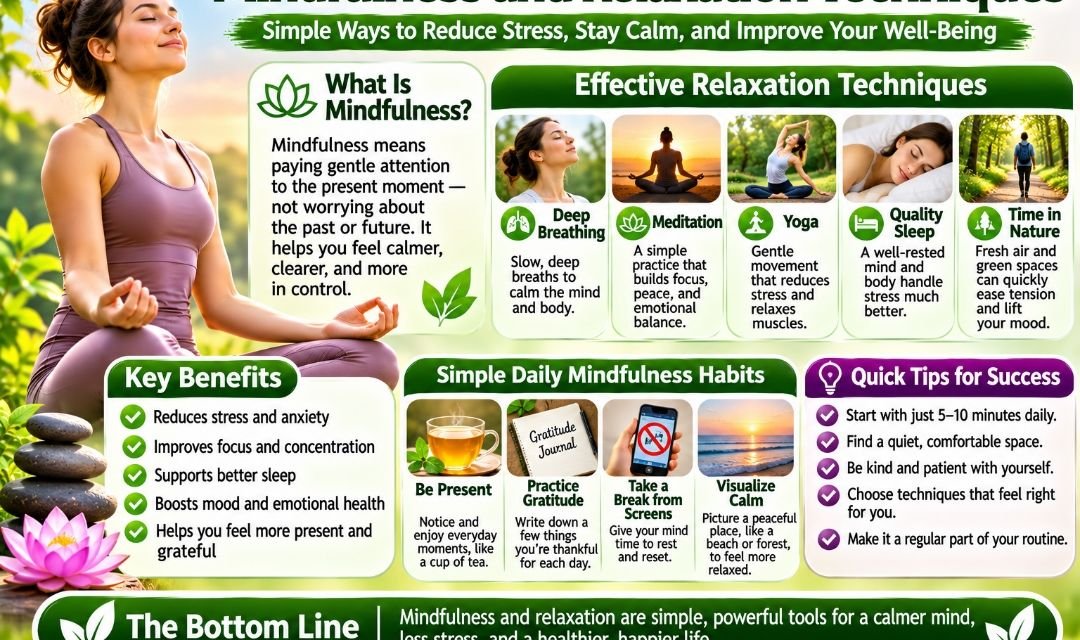
Quick Overview of Mindfulness and Relaxation Techniques
| Category | Details |
|---|---|
| Main topic | Mindfulness and Relaxation Techniques |
| Primary purpose | Stress management and emotional well-being |
| Common methods | Meditation, breathing, body scans, muscle relaxation |
| Beginner-friendly practices | Mindful walking, gentle breathing, sensory awareness |
| Typical practice time | 5–20 minutes, depending on preference |
| Potential benefits | Improved stress management, attention, relaxation |
| Sleep support | May help some people prepare for rest |
| Physical wellness | May reduce perceived muscle tension |
| Mental wellness | Supports emotional awareness |
| Scientific evidence | Varies by technique and condition |
| Main precautions | Avoid uncomfortable breathing or emotionally distressing practices |
| Long-term approach | Regular, comfortable practice |
Modern life can involve demanding schedules, constant notifications, work responsibilities, and personal challenges.
These experiences may contribute to stress and difficulty relaxing.
Mindfulness offers a way to notice what is happening in the present moment.
Relaxation techniques provide structured methods for calming the body or reducing tension.
The two approaches often overlap.
However, they are not identical.
This guide explores their differences, practical exercises, potential benefits, scientific limitations, and ways to incorporate them into everyday life.
What Is Mindfulness?
Mindfulness is the practice of paying attention to present experiences with openness and awareness.
It may involve noticing thoughts, emotions, breathing, or physical sensations.
The goal is not necessarily to eliminate thoughts.
Instead, mindfulness encourages people to recognize experiences without immediately judging or reacting to them.
For example, someone practicing mindfulness may notice that they feel stressed.
Rather than trying to force the feeling away, they may observe it and respond more deliberately.
Mindfulness can be practiced through meditation or during ordinary activities.
What Are Relaxation Techniques?
Relaxation techniques are methods intended to reduce physical or psychological tension.
They may involve slow breathing, muscle relaxation, guided imagery, or gentle movement.
Some techniques focus primarily on the body.
Others involve attention and mental imagery.
For example, progressive muscle relaxation involves tightening and releasing different muscle groups.
Guided imagery involves imagining a peaceful environment.
These methods may help some people manage everyday stress.
However, results vary between individuals.
Mindfulness vs Relaxation: What’s the Difference?
Mindfulness and relaxation are closely related, but their goals are slightly different.
| Feature | Mindfulness | Relaxation |
|---|---|---|
| Main focus | Awareness of present experiences | Reducing tension and promoting calm |
| Primary goal | Attentive, nonjudgmental observation | Physical or mental relaxation |
| Common practices | Meditation, mindful walking, body awareness | Breathing exercises, muscle relaxation, imagery |
| Requires a calm feeling? | No | Often aims to encourage calm |
| Can be practiced daily? | Yes | Yes |
| Potential challenges | Difficult emotions may arise | Some methods may feel uncomfortable |
| Scientific evidence | Some support for selected outcomes | Some support for selected outcomes |
A person can practice mindfulness without feeling relaxed.
Similarly, someone can feel relaxed without deliberately practicing mindfulness.
Both approaches may contribute to a balanced wellness routine.
1. Mindful Breathing
Mindful breathing is one of the simplest mindfulness exercises.
It involves paying attention to the natural rhythm of breathing.
The goal is awareness rather than forcing a particular breathing pattern.
How to Practice Mindful Breathing
-
Sit or stand in a comfortable position.
-
Allow your breathing to remain natural.
-
Notice the sensation of air moving in and out.
-
When your attention wanders, gently return it to breathing.
-
Continue for a few minutes.
It is normal for thoughts to appear during the exercise.
Mindfulness does not require an empty mind.
If focusing on breathing feels uncomfortable, attention can be directed toward sounds or other neutral sensations instead.
2. Deep Breathing for Relaxation
Slow, comfortable breathing is commonly used to support relaxation.
Some people find it helpful during stressful situations.
However, breathing exercises should not involve forcing large breaths or prolonged breath-holding.
Overbreathing can cause dizziness or tingling.
A Gentle Breathing Exercise
GENTLE BREATHING PRACTICE
InhaleExhale
Follow a natural, comfortable rhythm. Switch between inhaling and exhaling at your own pace.
This exercise can be practiced briefly while seated.
Stop if you feel dizzy, uncomfortable, or short of breath.
3. Body Scan Meditation
Body scan meditation involves directing attention toward different areas of the body.
It may help people notice physical sensations and areas of tension.
How to Practice a Body Scan
Begin in a comfortable seated or lying position.
Notice sensations in your feet.
Gradually move your attention toward your legs, abdomen, shoulders, arms, and face.
You do not need to change every sensation.
Simply observe what you notice.
If focusing on bodily sensations feels distressing, stop or choose another relaxation method.
4. Progressive Muscle Relaxation
Progressive muscle relaxation is a structured technique involving muscle tension and release.
It can help people recognize the difference between tension and relaxation.
How It Works
A person gently tightens a muscle group for a short period.
They then release the tension and notice how the muscles feel.
The process continues through different muscle groups.
However, people with injuries, chronic pain, or certain medical conditions should avoid movements that cause discomfort.
Muscle relaxation should never involve painful contractions.
5. Guided Imagery
Guided imagery involves imagining a peaceful or comforting environment.
For example, someone may imagine sitting near a quiet lake or walking through a garden.
The exercise may involve visualizing sounds, colors, and other sensory details.
Some people find guided imagery relaxing.
However, it does not work equally well for everyone.
People who find visualization difficult can focus on real environmental sounds or sensations instead.
6. Mindful Walking
Mindful walking combines gentle movement with present-moment awareness.
It can be practiced indoors or outdoors.
The goal is to notice the experience of walking.
This may include sensations in the feet, body movement, and surrounding sounds.
How to Practice Mindful Walking
Choose a safe walking area.
Walk at a comfortable pace.
Notice the movement of your feet and legs.
Pay attention to your surroundings.
If your mind wanders, gently return your attention to walking.
Safety should remain the priority, particularly near traffic or uneven surfaces.
7. Mindful Eating
Mindful eating involves paying attention to food and the experience of eating.
It may include noticing flavors, textures, hunger, and fullness.
This approach can encourage greater awareness of eating habits.
However, mindful eating is not a guaranteed weight-loss treatment.
People with eating disorders or significant food-related anxiety may need individualized professional guidance.
8. Meditation for Beginners
Meditation is a broad category of practices involving attention, awareness, or mental training.
Some methods focus on breathing.
Others involve repeated phrases, sounds, or open awareness.
Beginners can start with short sessions.
There is no requirement to meditate for long periods.
A Simple Five-Minute Meditation
Sit comfortably.
Notice your surroundings.
Direct attention toward breathing or another neutral sensation.
When thoughts arise, acknowledge them without criticism.
Return attention gently.
Continue for a few minutes.
The goal is practice, not perfection.
9. Loving-Kindness Meditation
Loving-kindness meditation involves intentionally directing feelings of goodwill toward oneself and others.
Some people use phrases expressing wishes for safety, peace, or well-being.
Research has explored its possible effects on positive emotions and social connection.
However, evidence varies.
It should not be considered a replacement for psychological treatment.
10. Mindfulness During Daily Activities
Mindfulness does not always require sitting quietly.
It can be practiced during ordinary activities.
Examples include washing dishes, preparing food, or walking.
The goal is to pay attention to the activity rather than operating entirely on autopilot.
However, mindfulness should not distract from tasks requiring full attention, such as driving.
11. Relaxation Through Gentle Stretching
Gentle stretching can help some people feel physically comfortable.
It may be particularly useful after long periods of sitting.
However, stretching should remain within a comfortable range of motion.
Painful stretching is not necessary.
People with injuries or mobility limitations may need modified exercises.
12. Yoga for Mindfulness and Relaxation
Yoga often combines movement, breathing, and attention.
Different yoga styles vary in intensity.
Some are physically demanding.
Others emphasize gentle movement and relaxation.
Research suggests yoga may provide benefits for selected physical and mental health outcomes.
However, it should not replace necessary medical treatment.
13. Journaling for Emotional Awareness
Journaling involves writing about thoughts, experiences, or feelings.
Some people find it useful for organizing their thoughts.
It may also encourage emotional reflection.
However, writing about difficult experiences can sometimes increase distress.
People should choose topics and approaches that feel manageable.
14. Spending Time in Nature
Natural environments may provide opportunities for relaxation and physical activity.
Walking in a park or sitting in a garden can offer a break from demanding routines.
Some research associates access to green spaces with better well-being.
However, environmental and social factors can influence these findings.
Nature exposure is best viewed as one supportive lifestyle practice.
15. Digital Mindfulness
Digital mindfulness involves becoming more aware of technology habits.
For example, someone may notice how often they check notifications.
They may choose to reduce unnecessary interruptions.
Taking regular breaks from screens can support more balanced routines.
However, technology can also provide useful tools for education, communication, and health support.
The goal is intentional use rather than complete avoidance.
16. Mindfulness for Workplace Stress
Workplace demands can contribute to stress.
Short mindfulness exercises may help some employees pause and refocus.
Examples include noticing breathing, relaxing tense shoulders, or taking a short walking break.
However, mindfulness cannot solve every workplace problem.
Excessive workloads, unsafe conditions, and organizational issues require practical solutions.
Stress management should not place all responsibility on individual employees.
17. Mindfulness Before Sleep
Some people use relaxation exercises before bedtime.
Gentle breathing, progressive muscle relaxation, or guided imagery may help create a calmer evening routine.
However, mindfulness does not guarantee better sleep.
Persistent insomnia may require medical evaluation or evidence-based treatment.
Healthy sleep habits remain important.
18. Mindfulness and Emotional Regulation
Emotional regulation involves recognizing and responding to feelings.
Mindfulness may help some people notice emotions before reacting.
For example, someone may recognize frustration during a difficult conversation.
They can then choose a more deliberate response.
However, emotional regulation skills develop differently across individuals.
Professional support may be useful when emotional difficulties interfere with daily life.
19. Mindfulness for Concentration
Attention is an important part of mindfulness practice.
Some research suggests mindfulness training may influence certain aspects of attention.
However, findings vary across studies.
Mindfulness should not be marketed as a guaranteed way to improve memory or productivity.
Adequate sleep, manageable workloads, and healthy routines also influence concentration.
20. Relaxation Through Creative Activities
Creative activities can provide opportunities for enjoyment and relaxation.
Examples include drawing, painting, gardening, music appreciation, and crafts.
These activities may help people take breaks from demanding tasks.
However, benefits vary.
The most useful activity is often one that feels enjoyable rather than stressful.
Benefits of Mindfulness and Relaxation Techniques
Mindfulness and relaxation practices may provide several benefits.
Potential outcomes include reduced perceived stress, improved emotional awareness, and greater relaxation.
Some structured programs have shown benefits for selected anxiety-related symptoms.
However, research quality varies.
The effects are not always large or long-lasting.
Mindfulness and relaxation should be viewed as supportive tools rather than universal treatments.
What Does Scientific Research Say?
Different techniques have different levels of evidence.
| Technique | Evidence overview |
|---|---|
| Mindfulness-based programs | Some evidence for stress and selected mental health outcomes |
| Progressive muscle relaxation | Some evidence for reducing perceived tension |
| Slow breathing | May support relaxation for some people |
| Yoga | Some evidence for selected physical and psychological outcomes |
| Guided imagery | Evidence varies by condition |
| Mindful walking | Limited but growing research |
| Loving-kindness meditation | Preliminary evidence for selected emotional outcomes |
| Aromatherapy | Limited and variable evidence |
| Commercial meditation apps | Evidence varies by program |
Research findings should not be generalized to every person or medical condition.
Are Mindfulness Techniques Safe?
Mindfulness and relaxation are generally low-risk for many people.
However, they are not completely risk-free.
Some individuals experience increased anxiety, distressing memories, or uncomfortable bodily sensations during meditation.
Intense breathing exercises may cause dizziness or tingling.
People with trauma histories or certain mental health conditions may benefit from modified practices or professional guidance.
If an exercise feels distressing, stopping is appropriate.
Common Mistakes When Practicing Mindfulness
Expecting an Empty Mind
Mindfulness does not require eliminating every thought.
Trying Too Hard to Relax
Forcing relaxation can sometimes create additional frustration.
Practicing Uncomfortable Breathing
Breathing should remain comfortable and natural.
Ignoring Emotional Distress
Mindfulness is not a reason to avoid professional help.
Expecting Immediate Results
Benefits may vary and can take time to develop.
Comparing Progress With Others
Different people respond differently to mindfulness practices.
A Seven-Day Mindfulness and Relaxation Plan
This beginner-friendly plan introduces short, manageable exercises.
Your seven-day practice tracker
0 of 7 completed
Monday: Mindful breathing
Spend five minutes noticing natural breathing.
Tuesday: Body awareness
Notice physical sensations while sitting comfortably.
Wednesday: Mindful walking
Take a short walk while paying attention to movement and surroundings.
Thursday: Muscle relaxation
Gently relax tense muscles without causing discomfort.
Friday: Guided imagery
Imagine a peaceful setting for a few minutes.
Saturday: Digital mindfulness
Take a planned break from unnecessary notifications.
Sunday: Reflection
Review which exercises felt useful and choose one to continue.
This plan is a general example.
It can be adjusted according to individual needs.
Mindfulness and Relaxation for Different Age Groups
Mindfulness practices can be adapted for different ages.
Young adults may use short exercises during study or work breaks.
Middle-aged adults may incorporate relaxation into busy schedules.
Older adults may prefer seated mindfulness or gentle movement.
However, age alone does not determine which method is appropriate.
Comfort, mobility, medical history, and personal preference matter.
Mindfulness vs Medication for Anxiety
Mindfulness may help some people manage stress or selected anxiety symptoms.
However, it is not equivalent to every evidence-based medical treatment.
Anxiety disorders may require psychotherapy, medication, or a combination of approaches.
Treatment decisions should be made with qualified healthcare professionals.
People should not stop prescribed medications because they begin meditation.
How to Build a Daily Mindfulness Routine
A daily routine can begin with a few minutes of practice.
For example, someone may spend five minutes noticing breathing after waking up.
A short walking break during the day can provide another opportunity for awareness.
Evening relaxation may involve gentle stretching or guided imagery.
However, the routine should remain flexible.
The goal is to create a supportive habit rather than another obligation.
Frequently Asked Questions About Mindfulness and Relaxation Techniques
1. What are mindfulness and relaxation techniques?
They are practices that encourage present-moment awareness or reduce physical and mental tension.
2. What is the difference between mindfulness and relaxation?
Mindfulness focuses on awareness, while relaxation primarily aims to reduce tension.
3. Can mindfulness reduce stress?
Some research suggests mindfulness-based practices can help certain people manage stress.
4. How long should beginners meditate?
Beginners can start with a few minutes and adjust according to comfort.
5. Is mindfulness the same as meditation?
Mindfulness can be practiced through meditation, but it can also be used during everyday activities.
6. What is mindful breathing?
It involves paying attention to the natural rhythm of breathing.
7. What is progressive muscle relaxation?
It is a technique involving gentle muscle tension and release.
8. Can relaxation techniques improve sleep?
They may help some people prepare for sleep, but they are not guaranteed treatments for insomnia.
9. Is meditation safe for everyone?
Not always. Some people experience distress or uncomfortable sensations.
10. Can mindfulness help anxiety?
Certain mindfulness-based programs may help selected anxiety symptoms, but professional care may still be necessary.
11. Can mindfulness cure depression?
No. Mindfulness should not be described as a guaranteed cure for depression.
12. What is body scan meditation?
It involves directing attention toward sensations in different parts of the body.
13. What is guided imagery?
It is a relaxation technique involving imagined scenes or experiences.
14. Can walking be a mindfulness practice?
Yes. Mindful walking involves paying attention to movement and surroundings.
15. Is yoga a mindfulness technique?
Some yoga practices incorporate mindfulness and breathing awareness.
16. Can mindfulness improve concentration?
Some studies suggest possible attention-related benefits, but findings vary.
17. Do relaxation exercises require equipment?
Most basic exercises require little or no equipment.
18. What is digital mindfulness?
It involves developing greater awareness of technology habits.
19. Can children practice mindfulness?
Some mindfulness activities can be adapted for children, but they should be age-appropriate.
20. Can older adults practice meditation?
Yes. Practices can be adapted to individual comfort and mobility.
21. What should I do if meditation makes me anxious?
Stop the exercise and consider a different method. Seek professional guidance if distress persists.
22. Are breathing exercises always safe?
Gentle breathing is usually low-risk, but forced or intense techniques can cause discomfort.
23. Can mindfulness replace medication?
No. Prescribed treatments should not be stopped without medical guidance.
24. How can I practice mindfulness at work?
Short awareness breaks, gentle breathing, or mindful walking may be useful.
25. What is the easiest mindfulness technique for beginners?
Noticing natural breathing or paying attention to ordinary activities can be simple starting points.
Final Thoughts
Mindfulness and relaxation techniques can be useful additions to a balanced lifestyle.
Mindful breathing, meditation, body scans, gentle movement, and progressive muscle relaxation offer different ways to manage everyday tension.
Some practices may support emotional awareness, stress management, and sleep routines.
However, scientific evidence varies between techniques and conditions.
Mindfulness does not require an empty mind or perfect concentration.
Relaxation should never involve forcing the body into uncomfortable positions or breathing patterns.
The most useful practice is one that feels safe, manageable, and appropriate for individual needs.
Regular physical activity, balanced nutrition, adequate sleep, supportive relationships, and professional healthcare remain important foundations of well-being.
For more mindfulness guides, stress-management tips, natural wellness education, and beginner-friendly health articles, visit Picanto Magazine.
Medical Disclaimer: This article is for educational purposes only and does not replace professional medical or mental health advice. Stop any practice that causes significant discomfort or distress. Consult a qualified healthcare professional if you experience persistent anxiety, depression, sleep problems, or other health concerns.