
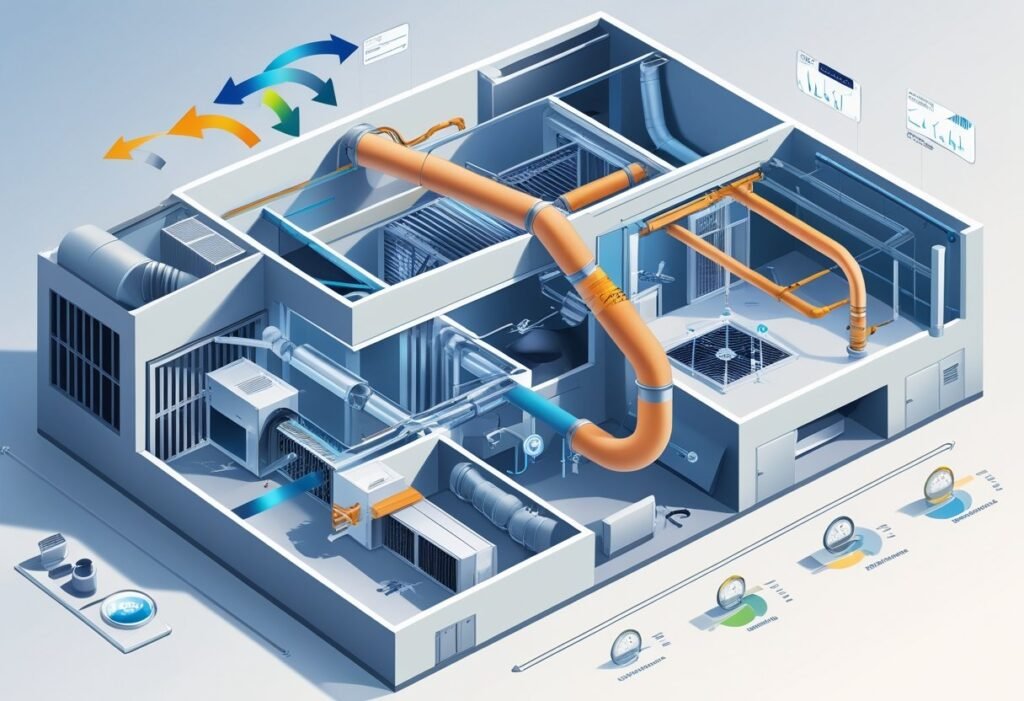
Valencia’s long, dry summers, occasional heat spikes, and periods of wildfire smoke create a unique set of demands for home cooling. Many homeowners are tempted to solve hot rooms or rising energy bills by installing a larger air conditioner. In practice, comfort and efficiency depend as much on proper equipment sizing, filtration suited to local air quality, and ducts and fans that move air quietly and evenly. This article presents a simple decision framework to help you consider capacity, filtration, and airflow together so your system can cool effectively on triple-digit afternoons while supporting cleaner indoor air when outdoor conditions decline.
-
Right-Size Cooling With a Load Calculation, Not Rules of Thumb
The most reliable way to select equipment capacity is through a residential load calculation, often called Manual J. Choosing tonnage based only on floor area can lead to oversized equipment, which may cause frequent cycling, noisy operation, and uneven room temperatures. Equipment capacity must also match the appropriate airflow through the evaporator coil. Residential systems often operate at about 350 to 450 cubic feet per minute per ton, although the correct airflow depends on equipment design and operating conditions. For a general look at local HVAC services, homeowners can review resources such as the HVAC Company in Valencia, CA page while preparing questions for an on-site assessment.
Two common Valencia situations show why careful sizing matters. In a two-story home where upstairs bedrooms remain warmer, installing an oversized single-stage system may cool the thermostat location quickly while upper rooms continue to lag. Homeowners may respond by lowering the thermostat even further without solving the underlying airflow problem. In a single-story home with large west-facing windows, a larger unit may temporarily compensate for strong afternoon solar heat gain while increasing cycling and electricity use during milder periods. In both situations, a balanced solution may involve properly sized equipment combined with duct improvements, shading, or zoning rather than simply increasing cooling capacity.
-
Use MERV 11 to 13 Filtration Without Restricting Airflow
Wildfire smoke and airborne dust make filtration an important consideration in Valencia. Filters rated MERV 11 to 13 can capture smaller particles more effectively than many basic MERV 8 filters, but higher filtration can also create additional airflow resistance. Installing a restrictive one-inch filter in a return grille designed for a lower resistance filter may reduce airflow, limit cooling performance, and increase the risk of evaporator coil icing during long cooling cycles. A deeper media cabinet with a three- to five-inch filter often provides more surface area, allowing higher filtration efficiency with less resistance than a narrow filter of the same rating.
Modern electronically commutated blower motors can adjust their speed within a certain range, but they cannot fully compensate for an undersized return duct or heavily restricted airflow path. Ask for static pressure measurements before and after changing filtration. Total external static pressure should remain within the equipment manufacturer’s recommended range. If pressure is excessive, possible improvements may include adding another return air pathway, enlarging restrictive return grilles, correcting duct restrictions, or installing a deeper media filter rather than sacrificing indoor air quality.
-
Duct Sealing, Returns, and Register Placement Shape Room Temperatures
Conditioned air that does not reach the rooms cannot provide effective cooling. In attic duct systems common in Valencia homes, leaking joints and poorly sealed takeoffs can release cooled air into hot attic spaces before it reaches supply registers. Sealing joints with mastic, properly supporting flexible ducts, and maintaining intact duct insulation can help preserve delivered airflow and reduce unnecessary heat gain. Bedrooms with closed doors also need adequate return air pathways. Door undercuts, jumper ducts, or dedicated returns can help prevent pressure imbalances that restrict supply airflow and leave rooms uncomfortable at night.
Supply register and return grille placement also affects comfort. Registers designed to project air across the ceiling can promote better mixing in larger rooms. In contrast, a poorly directed register may blow conditioned air directly toward the thermostat, causing the system to stop before other rooms reach the desired temperature. Balancing dampers in branch ducts can help fine-tune airflow, but they cannot correct an undersized main duct or missing return. If one room regularly stays 3 to 5 degrees warmer than nearby spaces, measuring airflow at the register can help determine whether inadequate airflow, excessive heat gain, or insufficient equipment capacity is the cause.
-
Ventilation on Clear Days Versus Wildfire Smoke Days
Indoor air quality needs can change with outdoor conditions. On clear days, introducing a controlled amount of outdoor air through a properly designed fresh air system can help reduce carbon dioxide buildup, odors, and indoor pollutants. During wildfire smoke events, however, bringing outdoor air inside may worsen indoor air quality. Under those conditions, homeowners may need to reduce outdoor air intake, keep windows and doors closed, and rely more heavily on recirculation and effective filtration.
Running the HVAC fan in On or Circulate mode can increase how often indoor air passes through the filter. Still, this strategy works properly only when the filter, return system, and blower can support the extra airflow without excessive resistance. During periods of clean outdoor air, a properly designed ventilation system may introduce a modest amount of fresh air while the home is occupied. When smoke moves into the area, outdoor air intake may need to be reduced or disabled, depending on the system design. At the same time,e a MERV 13 filter can provide additional particle capture if the HVAC system has been confirmed to support it.
After a smoke event, inspect the return grilles and filter. A filter that has become visibly loaded with dust, ash, or other particles may need to be replaced sooner than its normal schedule to restore airflow and filtration performance.
Zoning, Thermostats, and Maintenance That Make Changes Last
Zoning can improve comfort in two-story homes or large floor plans by dividing the duct system into separately controlled areas with dedicated dampers and temperature sensors. However, zoning requires careful design. Improper damper operation, inadequate return capacity, or poorly sized ductwork can increase static pressure and reduce system performance. Smart thermostats with remote room sensors may provide a simpler alternative in some homes by considering temperatures in several rooms rather than relying only on the thermostat location.
Routine maintenance also helps protect HVAC upgrades. Replace filters according to their condition, depth, household dust levels, and manufacturer recommendations rather than relying only on a fixed calendar. Maintain adequate clearance around the outdoor condenser and gently remove ash, leaves, and debris from the coil when necessary after shutting off power. Keep the condensate drainage system clear during the cooling season to reduce the risk of water backups.
During professional service visits, ask for measurements instead of relying only on a visual inspection. Useful information may include supply and return static pressure, airflow measurements, coil condition, and refrigerant performance readings such as superheat or subcooling when appropriate for the system. These measurements help show whether airflow, filtration, refrigerant performance, and equipment capacity remain properly balanced.
Treating capacity, filtration, and airflow as one system can help a home stay more comfortable during Valencia’s hottest weeks while supporting cleaner indoor air when outdoor conditions worsen. Start with a proper load calculation, confirm the ducts and returns can move the required airflow, and select a high-surface-area MERV 11 to 13 filter the blower can handle without excessive pressure. Plan how ventilation will operate during clean air conditions and how the system will shift toward recirculation and stronger filtration during smoke events. Once these elements are properly coordinated, equipment selection becomes the final part of the process rather than the first.