
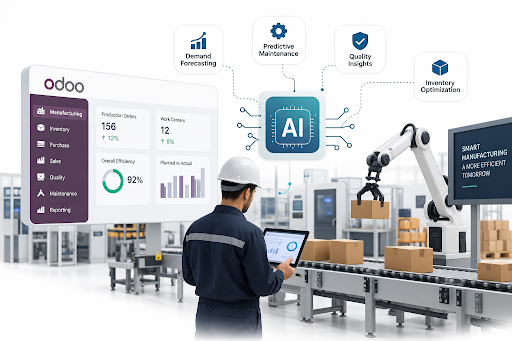
Manufacturing is no longer driven only by machines, materials, and production schedules. Today, manufacturers also depend on connected data to understand demand, manage inventory, plan production, and respond quickly to operational changes. Yet many businesses still rely on disconnected systems and manual processes, making it difficult to turn that data into timely decisions.
This is where modern ERP and artificial intelligence can work together. Odoo ERP brings core manufacturing processes into a connected environment, while AI can help identify patterns, generate forecasts, and support smarter operational decisions. With the right implementation, an Odoo development company can also adapt ERP workflows and integrations to fit the way a manufacturer actually operates, creating a stronger foundation for automation and intelligent decision-making.
Why Manufacturers Need Smarter Digital Systems
Manufacturers often deal with a chain of connected decisions every day, but the information behind those decisions is not always connected. Sales forecasts may sit in one system, inventory records in another, while production schedules and purchasing data are managed through spreadsheets or manual updates. This makes it harder to see what is happening across the business in real time.
As production volumes and product variations increase, these gaps can lead to excess inventory, material shortages, inefficient production schedules, and slower responses to changing demand. Manual data entry can add another layer of risk, especially when teams need accurate information to coordinate purchasing, production, warehousing, and delivery.
A smarter digital setup brings these processes together, giving manufacturers a clearer operational picture and creating the data foundation needed for automation and AI-driven decision-making.
How Odoo ERP Creates a Connected Manufacturing Environment
A connected manufacturing operation starts with having the right information available across departments. Odoo ERP brings key business functions into one environment, allowing manufacturers to manage production, inventory, purchasing, sales, quality, maintenance, and finance without relying on isolated systems.
For production teams, Odoo can organize bills of materials, manufacturing orders, work centers, and production schedules in a single workflow. Inventory teams can track raw materials and finished goods while maintaining visibility into stock movements and replenishment needs. Purchasing can work from actual inventory and production requirements rather than relying solely on manual estimates.
This connected structure becomes particularly valuable when manufacturers need to respond quickly to changes. A new sales order, for example, can affect material requirements, purchasing activities, inventory levels, and production planning. Keeping these processes connected reduces the need to repeatedly transfer information between teams and gives decision-makers a more consistent view of operations.
The value of an ERP system therefore goes beyond replacing spreadsheets. It creates a structured source of operational data that can later support advanced analytics, automation, and AI applications. For manufacturers moving toward smarter production environments, this connected foundation is an important starting point.
Where AI Adds Intelligence to Manufacturing Operations
Odoo can bring manufacturing data into one connected environment, but AI can take that information a step further by identifying patterns and supporting decisions that would otherwise require significant manual analysis. This is where AI & ML development solutions can complement an ERP system and address specific manufacturing challenges.
For example, AI can analyze historical sales, inventory levels, and seasonal patterns to improve demand forecasting. Manufacturers can use these insights to plan material purchases and production volumes with greater confidence. Similarly, production data can help identify recurring bottlenecks, unusual process variations, or capacity constraints that may affect delivery schedules.
AI can also support predictive maintenance by analyzing equipment performance and maintenance records to identify warning signs before a failure disrupts production. In quality management, models can help detect patterns associated with recurring defects and highlight areas that require attention.
The goal is not to replace the ERP system or human decision-makers. Instead, AI works alongside operational data to provide predictions, recommendations, and actionable insights. When these capabilities are connected to reliable ERP data, manufacturers can move from simply recording what happened to gaining better visibility into what may happen next.
Odoo + AI: Key Manufacturing Use Cases
The combination of Odoo ERP and AI becomes most valuable when it is applied to specific manufacturing challenges. Instead of treating AI as a standalone technology, manufacturers can use ERP data as the operational context for more informed predictions, recommendations, and automated workflows.
1) Demand and Inventory Planning
Manufacturers can use historical sales, current stock levels, purchasing activity, and order patterns to improve demand forecasting. AI can identify trends that may be difficult to spot through manual analysis, helping teams plan raw material purchases and maintain appropriate inventory levels.
2) Production Optimization
Production data can provide insight into work center utilization, order volumes, production times, and recurring bottlenecks. AI can analyze these patterns to support production scheduling, identify capacity constraints, and help planners make better use of available resources.
3) Predictive Maintenance
Unexpected equipment failures can interrupt production and create costly delays. By combining maintenance records with machine or operational data, AI can identify unusual patterns and potential warning signs. Maintenance teams can then prioritize inspections or servicing before minor issues become major disruptions.
4) Quality Management
Quality data collected across manufacturing processes can also become useful for AI-driven analysis. Models can identify recurring defect patterns, connect quality issues with production conditions, and help teams focus on processes that may require adjustment.
Applying Odoo and AI Across Different Manufacturing Industries
Manufacturing processes vary significantly from one industry to another, so the value of Odoo and AI depends on how well the technology fits the specific workflow. A food and beverage manufacturer has different requirements from a furniture producer, yet both can use connected ERP data and AI to improve planning and operational control.
Food & Beverage Manufacturing
Food and beverage businesses need close control over ingredients, batches, expiry dates, quality checks, and inventory movement. Odoo can connect these processes, while AI can help analyze demand patterns and inventory data to support better purchasing and production planning.
For businesses managing multiple products, locations, or distribution activities, Odoo for food and beverage distribution can also provide greater visibility across orders, stock, procurement, and fulfillment.
Furniture Manufacturing
Furniture production often involves customized orders, multiple product configurations, bills of materials, and varying material requirements. Odoo can help coordinate these processes from sales through production and inventory, while AI can support demand analysis, material planning, and production insights.
For manufacturers handling customized or made-to-order furniture, Odoo for furniture industry can provide workflows that are better aligned with these specific production requirements.
What Manufacturers Gain From Combining Odoo and AI
Combining Odoo ERP with AI can give manufacturers a more responsive way to manage day-to-day operations. Instead of relying entirely on historical reports or manual analysis, teams can use connected operational data to identify patterns and respond to changes sooner.
The benefits can extend across multiple areas of the business:
- Better production visibility: Teams can see orders, inventory, production activity, and operational issues from a connected system.
- More informed planning: AI-supported forecasting can help align production and purchasing with expected demand.
- Improved inventory control: Data-driven recommendations can help reduce both excess stock and material shortages.
- Less manual work: Repetitive data analysis and selected workflows can be automated.
- Faster decision-making: Managers can access relevant insights without waiting for information to be consolidated manually.
- Earlier problem detection: AI can highlight unusual patterns that may indicate quality, maintenance, or production issues.
Conclusion
Manufacturing modernization is no longer just about adding more technology to the production floor. It is about connecting operational data, improving visibility, and using that information to make better decisions. Odoo ERP can provide the connected foundation across production, inventory, purchasing, quality, and other business processes, while AI can add forecasting, analysis, and intelligent decision support.
The right approach will vary by industry, production model, and existing systems. Working with an experienced Odoo development company can help manufacturers adapt ERP workflows, integrate AI capabilities, and build a technology environment that supports their specific operational goals. When implemented around real business needs, Odoo and AI can become practical tools for building more connected, responsive, and data-driven manufacturing operations.