
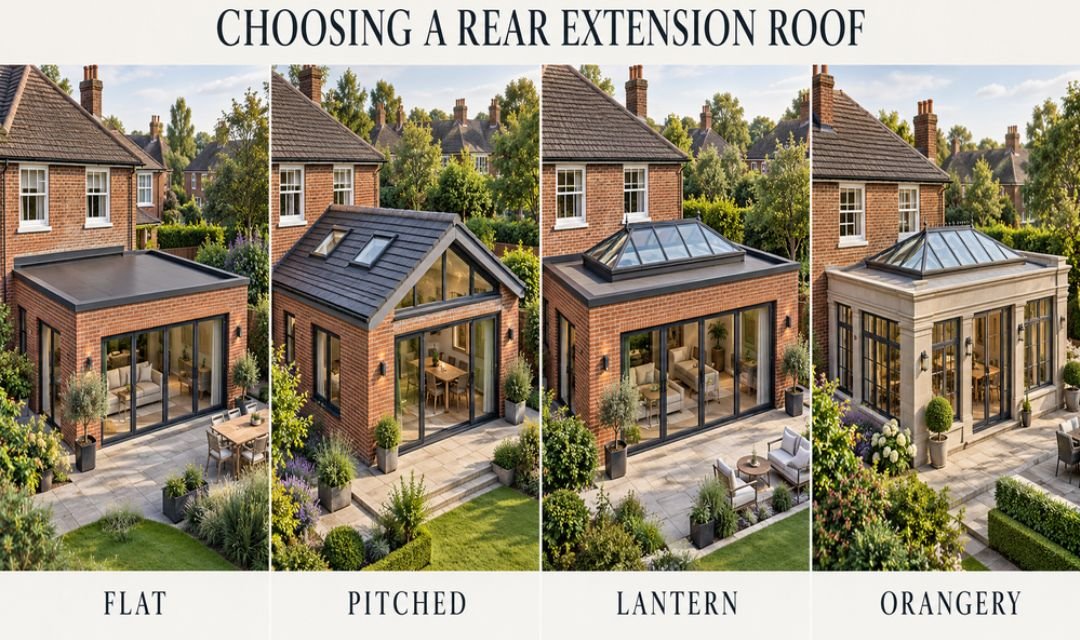
The roof is a small part of an extension’s budget and the single biggest influence on how the finished room feels. Get it right and the light, the height and the character all follow. That is why the roof deserves more thought than most people give it when planning a rear extension.
Here are the four main options, what each costs in 2026, and which suits which home.
Flat Roof: Cheapest, Brightest, Most Modern
The flat roof is the default for contemporary rear extensions, and for good reasons.
It is the cheapest to build, at roughly £1,800 to £2,600 per square metre for a good quality shell, typically £3,000 to £8,000 less than an equivalent pitched roof of the same footprint. It builds faster, with less structure and covering.
- Best for: modern kitchen diners, open plan spaces, tight budgets
- Big advantage: it takes a roof lantern or large rooflights that a pitched roof cannot
- Planning benefit: it keeps the ridge line low, which helps stay within permitted development at 3 metres height near a boundary
- Watch out for: it needs the right warm roof build up, insulation and drainage fall to perform
The flat roof’s real strength is overhead glazing, which is where the next two options come in.
Flat Roof With a Lantern: The Most Popular Choice
Strictly this is a flat roof with a feature added, but it has become the single most popular rear extension roof in 2026, so it deserves its own entry.
A roof lantern is a raised glazed structure that sits on the flat roof, usually over the island or dining area. It floods the centre of the plan with daylight in a way rear doors alone never manage.
- Lantern cost: £1,500 to £3,000 for a standard 2m by 1.5m unit, up to £5,500 for large or premium
- Best for: deep extensions where the middle would otherwise go dark
- Cheaper alternative: flush rooflights, often £300 to £800 less than a lantern of similar size for similar light
- Building regs: a lantern on an existing permitted development flat roof is usually permitted development itself, subject to structural loading
For any extension deeper than about four metres, overhead glazing is not a luxury. It is what makes the back of the room usable.
Pitched Roof: Traditional, Taller, Better for Period Homes
A pitched roof slopes like the main house roof, and it suits certain homes far better than a flat one.
It costs more, typically £4,000 to £7,000 above a flat roof on a single storey extension, or 20 to 40 per cent more for the roof element. But it buys height and character.
- Best for: period homes, and conservation areas where officers often expect a pitched roof to match the house
- Height bonus: it allows a vaulted ceiling inside, adding drama a flat roof cannot
- Planning note: it can reach up to 4 metres height where a flat roof is effectively limited to 3, though the ridge must stay below the existing house
- Watch out for: it can let in less light at the rear than a flat roof with a lantern, unless you add rooflights into the slope
In a conservation area, the pitched roof is frequently the path of least resistance with planning.
Orangery Style Roof: Solid Perimeter, Glazed Centre
The orangery roof is the hybrid, and it is worth understanding as its own option.
It combines a solid flat perimeter roof, often with a parapet, and a central glazed lantern. That solid border gives thermal mass and a room like feel, while the lantern drops light into the middle.
- Best for: homeowners who want the light of glazing with the comfort and permanence of a solid roof
- Thermal advantage: the solid perimeter holds heat far better than a fully glazed conservatory roof
- Character: it reads as a more substantial, year round room than a conservatory
- Cost: sits above a plain flat roof because of the perimeter structure plus the lantern
Understanding the different types of orangery roof is worth doing if you want that balance of daylight and warmth, because the perimeter detailing is what separates a good orangery roof from a cold one.
The Four Compared
| Roof type | Typical cost position | Light | Best for |
| Flat | Lowest | Good with rooflights | Modern, budget, open plan |
| Flat with lantern | Low plus £1,500 to £5,500 | Excellent | Deep plans, kitchen diners |
| Pitched | £4,000 to £7,000 more than flat | Moderate, better with rooflights | Period homes, conservation areas |
| Orangery style | Above flat | Excellent centre, warm edges | Year round rooms, character |
How to Choose
Work from three questions, in order.
First, your house. A Victorian or period home in a conservation area often points to a pitched or orangery roof, both for planning and for how it looks against the original building. A modern or unconstrained home opens up the flat roof and lantern.
Second, your depth. The deeper the extension, the more you need overhead light, which pushes you toward a flat roof with a lantern or an orangery roof. A shallow extension can light itself from the rear glazing alone.
Third, your budget and your priority. A flat roof is cheapest and brightest. A pitched roof costs more but adds height and character. An orangery roof costs more again but gives warmth and light together.
Extension Architecture’s project on Tadorne Road returned around 30 per cent in value, and the gain came from how well the new ground floor worked, light, flow and proportion, rather than from its size. The roof is central to that. On a rear extension, the single decision that most changes how the finished room feels is not how far you build out, but what you put on top.