
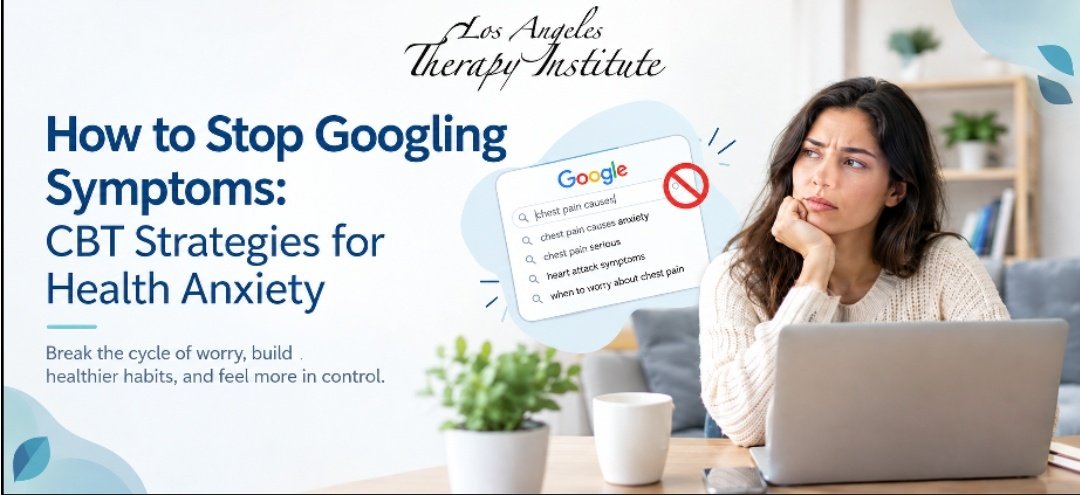
A headache, a sudden heartbeat, or an unfamiliar sensation can quickly lead to an online search for possible medical explanations. At first, Googling symptoms may seem like a sensible way to find answers. However, when every search leads to more questions, frightening possibilities, and repeated reassurance-seeking, it can become a difficult habit to break.
For people experiencing health anxiety, searching for symptoms can create a cycle of worry rather than lasting peace of mind. A minor physical sensation may trigger thoughts about a serious illness, prompting an online search. Although finding a reassuring answer may bring temporary relief, the next unfamiliar sensation can restart the same process.
Cognitive behavioral therapy for health anxiety offers practical strategies for recognising this cycle and responding differently to health-related fears. By learning to challenge catastrophic thinking, tolerate uncertainty, and reduce compulsive checking, individuals can begin developing a more balanced relationship with their health concerns.
Why Googling Symptoms Can Make Health Anxiety Worse
Online health information is widely available, but search results rarely provide the context needed to interpret an individual’s symptoms accurately. Many common physical sensations can have several possible explanations, and reading about serious conditions may make frightening possibilities feel more likely than they actually are.
The cycle of symptom checking
Health anxiety often follows a repeating pattern:
- A physical sensation appears: You notice a headache, muscle twitch, or change in your heartbeat.
- A worrying thought develops: You wonder whether the sensation indicates a serious illness.
- You search online: You read symptom lists, medical articles, and personal experiences.
- Anxiety increases: You encounter alarming information or become uncertain about what applies to you.
- You seek reassurance: You search again, ask someone for confirmation, or repeatedly check your body.
Even when a search provides temporary relief, it may reinforce the belief that anxiety can only be managed by finding another answer. Over time, this pattern can interfere with concentration, sleep, work, and everyday activities.
Why reassurance does not always last
Reassurance can feel comforting in the moment, but it does not necessarily resolve the underlying fear of uncertainty. Someone may receive a reassuring answer and still wonder whether something important has been missed.
This is where cognitive behavioral therapy for health anxiety can be useful. Rather than trying to eliminate every doubt, CBT helps people examine their interpretations, recognise unhelpful behaviours, and practise responding to uncertainty more constructively.
Cognitive Behavioral Therapy for Health Anxiety: Strategies to Try
Cognitive behavioral therapy (CBT) focuses on the relationship between thoughts, feelings, physical sensations, and behaviours. It can help individuals recognise how their responses to health concerns may maintain anxiety.
The following strategies introduce practical CBT principles that can be explored independently or with guidance from a qualified mental health professional.
1. Identify catastrophic thinking
Catastrophic thinking occurs when an uncertain situation is interpreted as evidence of the worst possible outcome.
For example, noticing chest discomfort might lead to the thought, “This must mean something is seriously wrong.” The thought can feel convincing, particularly when anxiety is high, but a feeling of certainty is not the same as medical evidence.
Instead of immediately accepting the thought, pause and ask:
- What facts do I actually know?
- Am I treating a possibility as a certainty?
- Are there other reasonable explanations?
- What would I say to a friend experiencing the same worry?
The goal is not to dismiss symptoms or assume everything is harmless. It is to recognise when fear is influencing your interpretation and respond proportionately.
2. Set boundaries around symptom Googling
Trying to stop searching completely through willpower alone may feel difficult, especially when online checking has become an automatic response to anxiety.
Begin by noticing when and why you search. Do you reach for your phone whenever you feel a physical sensation? Do you revisit the same websites because the previous answers no longer feel reassuring?
If the search is driven by repeated reassurance-seeking rather than a clear healthcare need, practise delaying the urge. Start with five or ten minutes and gradually extend the delay as you become more comfortable with the discomfort.
During that time, return to an ordinary activity, such as preparing a meal, completing a work task, or taking a gentle walk.
Importantly, these boundaries should not replace appropriate medical advice. New, severe, or concerning symptoms deserve suitable professional assessment, and urgent symptoms should be handled through the appropriate emergency service.
3. Challenge the urge to seek reassurance
Repeatedly asking family members whether you look ill, checking your pulse, or searching multiple websites for the same answer can become part of the anxiety cycle.
Before seeking reassurance, ask yourself what you hope the action will achieve. Are you looking for genuinely new information, or are you trying to make uncertainty disappear?
When there is no new medical concern requiring attention, try allowing the question to remain unanswered for a while. You might remind yourself, “I feel worried, but I do not need to solve every uncertainty immediately.”
With practice, this approach can help you respond to anxious thoughts without automatically performing the same checking behaviour.
4. Practise tolerating uncertainty
A central part of health anxiety is the desire for complete certainty about bodily sensations and future health. Unfortunately, no amount of searching can provide absolute certainty.
CBT can help individuals gradually become more comfortable with uncertainty without repeatedly seeking reassurance.
Try using balanced statements such as:
- “I can acknowledge this concern without reaching a conclusion immediately.”
- “Not knowing everything right now does not mean I should assume the worst.”
- “I can follow appropriate medical guidance while allowing some uncertainty to remain.”
These statements are not intended to deny genuine health concerns. They encourage a more measured response when the available information does not justify further checking.
5. Reduce body checking gradually
Repeatedly examining your skin, monitoring your heartbeat, or scanning your body for changes can make physical sensations more noticeable. Increased attention may then trigger additional worry.
Notice which checking behaviours occur most frequently and consider reducing them gradually, where doing so is medically appropriate.
For instance, if you repeatedly inspect a particular area despite having no new concern or medical instruction to do so, practise postponing that check and redirecting your attention.
If a healthcare professional has recommended monitoring a symptom or following a treatment plan, continue doing so as advised. The aim is to reduce anxiety-driven checking, not necessary health monitoring.
6. Redirect attention towards everyday life
Health anxiety can gradually narrow a person’s routine. Time spent researching illnesses may replace hobbies, social activities, exercise, or work.
Behavioural strategies can help restore balance by encouraging meaningful activities even when some anxiety remains.
Create a short list of activities you value, such as meeting a friend, reading, cooking, or spending time outdoors. Schedule one manageable activity each day and practise completing it without repeatedly checking symptoms.
The objective is not to force yourself to feel calm before living normally. Instead, it is to build confidence in your ability to participate in everyday life while managing uncomfortable thoughts.
Creating a Practical Plan to Break the Googling Habit
Changing an established pattern takes practice. A simple plan can make the process more manageable.
Step 1: Track your triggers. Record when you feel the urge to search, what you were thinking, and what happened immediately beforehand.
Step 2: Recognise the pattern. Identify whether the trigger is a physical sensation, a health-related story, a stressful day, or an uncomfortable feeling of uncertainty.
Step 3: Pause before responding. When appropriate, delay anxiety-driven searches and notice how the urge changes over time.
Step 4: Choose a different response. Try balanced thinking, a grounding exercise, or returning to a meaningful activity instead of checking repeatedly.
Step 5: Review your progress. Focus on whether you are responding differently to anxious thoughts, rather than expecting every worry to disappear.
Setbacks are normal. One difficult day does not erase progress, and the goal is to develop more flexible responses rather than achieve perfect control over every thought.
When to Seek Professional Support in Los Angeles
Self-help strategies can be a useful starting point, but persistent health anxiety may require additional support, particularly when it affects relationships, work, sleep, or daily functioning.
A therapist experienced in cognitive behavioral therapy for health anxiety can help identify unhelpful thought patterns, develop an individualised treatment approach, and practise reducing reassurance-seeking and compulsive checking.
Depending on individual needs, treatment may include cognitive restructuring, behavioural experiments, and gradual exposure to uncertainty. A therapist can also help distinguish anxiety-driven checking from appropriate healthcare decisions.
People in Los Angeles can explore in-person or telehealth therapy options based on their preferences and circumstances. If physical symptoms are new, persistent, severe, or otherwise concerning, consult an appropriate healthcare professional rather than assuming anxiety is the cause.
Frequently Asked Questions
1. Why do I keep Googling symptoms even when it makes me anxious?
Searching can provide temporary reassurance, which may encourage you to repeat the behaviour whenever another worry appears. However, alarming information and unanswered questions can increase anxiety. Recognising this cycle is an important first step towards changing it.
2. Can CBT help me stop searching for illnesses online?
CBT can help people recognise catastrophic thoughts, understand reassurance-seeking behaviours, and develop alternative responses to uncertainty. Progress varies between individuals, and some people benefit from working with a qualified therapist.
3. Should I completely stop looking up medical symptoms?
Not necessarily. Reliable health information can be useful when seeking general guidance. The concern arises when searching becomes repetitive, distressing, or a substitute for appropriate medical care. Follow professional medical advice and use reputable sources when necessary.
4. How long does it take to reduce health anxiety?
There is no fixed timeline. Progress depends on factors such as the intensity of anxiety, how long the checking pattern has been present, and the support available. Consistent practice and professional guidance may help people develop healthier responses over time.
5. When should I consider therapy for health anxiety?
Consider seeking support when health worries occupy a substantial part of your day, repeated searches interfere with normal activities, or reassurance provides only short-lived relief. A mental health professional can help you explore suitable treatment options.
Conclusion
Stopping the habit of Googling symptoms is not simply about putting your phone away. It involves understanding the thoughts and behaviours that keep health anxiety going and learning to respond to uncertainty in a different way.
Cognitive behavioral therapy for health anxiety provides practical tools for challenging catastrophic interpretations, reducing unnecessary checking, and reconnecting with everyday activities. With consistent practice, individuals can work towards making health concerns a more manageable part of life without allowing repeated searches to dominate their attention.
If health-related worries are affecting your daily routine, Los Angeles Therapy Institute can be a starting point for exploring mental health support and therapy options in Los Angeles. Consider speaking with a qualified professional to discuss your concerns and identify an approach suited to your needs.