
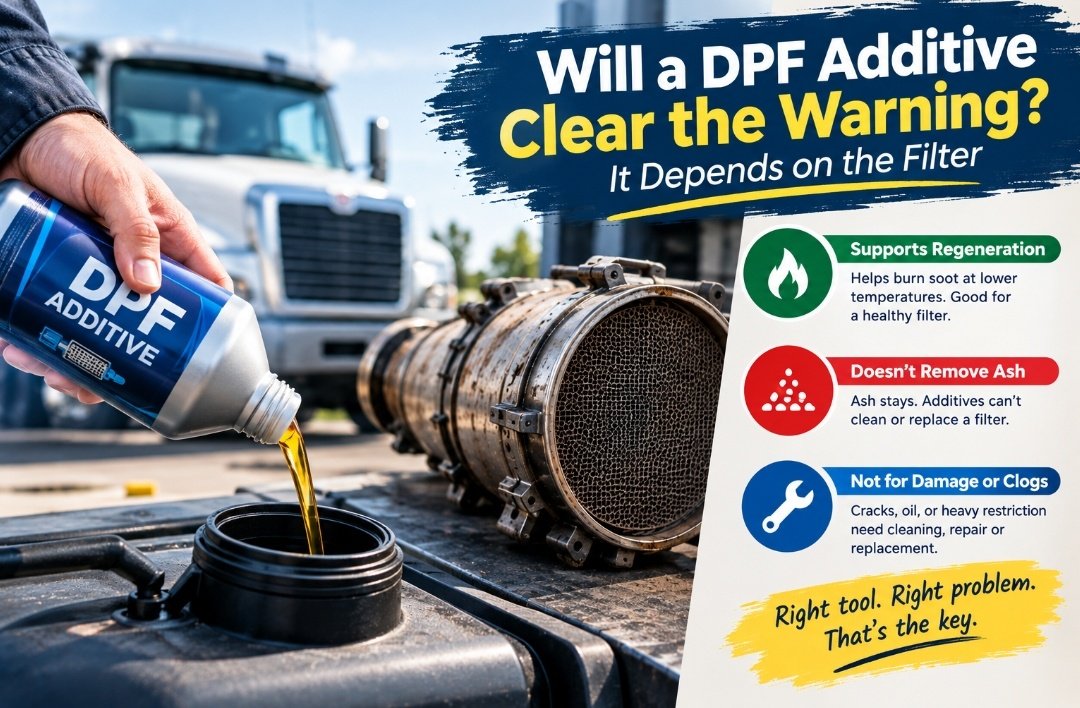
The lamp comes on at a fuel stop in Ohio. Somebody at the next pump swears by a bottle he pours in every other tank, and the parts counter inside has a whole shelf of them. Pouring one in is cheap and takes ten seconds. Whether it’s the right response depends on what’s wrong, and a dpf cleaner additive is built for only a narrow slice of the possibilities.
What these products are designed to do
Going by manufacturers’ own descriptions, most products sold as DPF regeneration additives are fuel-borne catalysts. They contain organometallic compounds meant to lower the temperature at which trapped soot ignites. The idea is that a regeneration that might stall on a cold, short trip has a better chance of finishing.
Notice what that doesn’t say. Nothing in those descriptions involves washing a filter. The word “cleaner” on the bottle is shorthand for supporting regeneration, and regeneration only deals with soot. Whether a particular product delivers what its label promises is a separate question. It depends on the product, the engine, and the condition of the system it’s going into.
Soot is the additive’s territory. Ash isn’t
Soot is carbon, and it burns. Ash is what’s left of oil additives and the trace of lube oil burned in the cylinders. No regeneration burns it away, with or without a catalyst in the fuel. It stays until the filter is physically cleaned or replaced. A filter that keeps requesting regens after successful ones may simply have less room left because of ash. Another bottle feeds a process that was never the problem.
It helps to keep the tools straight. Additives are meant to support regeneration. A parked regen, run with a scan tool, burns soot at high temperature, but it doesn’t remove ash. Professional cleaning takes ash and hardened soot out of a filter that’s been pulled off the truck. Replacement is for a filter that’s damaged or fails testing.
Three conditions, three different answers
A healthy filter on a truck that rarely gets hot enough. Think of a delivery van or a pickup that mostly makes short hops. Regens start but don’t always finish. This is the situation additives are aimed at, alongside a longer drive each week and the oil grade your engine maker specifies. For routine support like this, preventive additive use on a filter in good shape is a reasonable part of the routine. It isn’t a rescue.
A filter loaded with soot but still intact. The lamp has been on for a while and regens aren’t completing. Here the additive arrives late. A parked regen with a scan tool, where your truck supports it and the manual allows, is the more direct tool. Then comes the question of why soot built up in the first place. An additive afterward may help keep it from happening again, but it isn’t the fix.
A filter that’s ash-loaded, hardened, soaked with oil, or physically damaged. No bottle addresses any of that. This is territory for inspection and testing, followed by professional cleaning or replacement, depending on what the testing finds.
Run a fair trial
If you do try an additive, treat it as a test with an end date instead of an open-ended habit. Note how often the truck has been regenerating and when the lamp last came on. Follow the label’s dose, since more doesn’t make a product work harder, and run it for a few tanks with a long highway drive mixed in. Then compare.
If regens are less frequent and the lamp stays off, the product is doing something useful on a healthy system. If the lamp is back within days, or nothing changed, stop buying bottles. That isn’t a failed experiment. It’s information that the problem lies elsewhere.
When it’s diagnosis, not another bottle
A lamp that returns soon after a completed regen. A truck that mostly runs highway miles yet regenerates constantly. A derate. Regens that won’t finish. Fault codes pointing at sensors. Any of these says the issue isn’t a cold-trip problem.
The usual suspects are familiar. A failing differential pressure sensor or a plugged line. An exhaust leak near the filter. A fouled EGR system, injector or air-system trouble, or an engine burning oil. Each one either feeds the filter more than it can handle or imitates a loaded one, and an additive can’t tell the difference.
That’s also when a filter should come off for a look. Shops that clean filters, 30 Minute DPF Clean among them, describe checking soot load, ash, and differential pressure before any cleaning starts. Whoever does it, ask what they found and compare it with what triggered the warning.
Before you buy a bottle
Read the label for the dose and the engine types it’s intended for. Check your owner’s manual and warranty paperwork for anything the engine maker says about aftermarket additives. Be wary of wording that promises to dissolve ash or restore a blocked filter, because that isn’t what catalysts are described as doing. And don’t let a bottle stand in for the basics: the right oil, clean fuel, and letting regens finish.
The short version
An additive is a support tool for a system that’s basically healthy. It’s the wrong tool for ash, for damage, and for a filter that’s already restricted. If a couple of tanks and a long drive don’t change anything, the better move is to look at the filter and the system behind it.