
Buying a treadmill gets confusing surprisingly fast. One model looks perfectly capable, while another costs considerably more and promises a stronger motor, better cushioning, a larger running deck, and enough training features to fill a control panel.
So, do you actually need a more capable machine?
That depends less on how serious you consider yourself as a runner and more on what you’re asking the treadmill to do. A person walking three times a week has very different equipment needs from someone doing hard intervals every morning. Before paying for extra performance, it helps to know which upgrades you’ll actually notice.
Start With How You’ll Really Use It
It’s tempting to shop for the person you plan to become. You picture long runs, steep hill sessions, and intense workouts five days a week.
Then real life happens.
Before comparing machines, think about your likely routine six months from now. Will you mostly walk? Jog for 30 minutes? Train for longer races? Will several people in the household use the same machine?
Frequency matters too. A treadmill used for occasional walking isn’t under the same stress as one handling daily running sessions. The harder and more frequently you train, the more useful heavier construction and stronger components become.
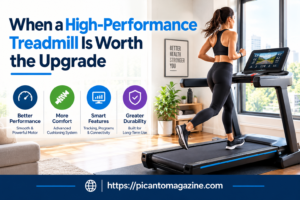
If you’re expecting demanding or frequent workouts, looking specifically at high-performance treadmills can make more sense than choosing a basic machine and discovering its limitations later.
Motor Power Matters, but Don’t Shop by One Number
Motor specifications get a lot of attention because they’re easy to compare. Bigger number, better treadmill, right?
Not necessarily.
Motor performance matters most when you’re running at higher speeds, exercising for extended periods, or sharing the treadmill with other regular users. Under those conditions, you want a machine designed to maintain its workload consistently rather than one built primarily for short walking sessions.
But motor power shouldn’t make the decision by itself.
A powerful motor attached to a cramped deck or unstable frame doesn’t suddenly create a great running experience. Consider the machine as a complete system rather than comparing one impressive specification.
The Running Deck Can Change the Whole Experience
You might barely notice deck dimensions when casually walking. Start running faster and they become much harder to ignore.
Running naturally requires room. Taller runners and people with longer strides can feel restricted on shorter decks, particularly as speed increases. Width matters as well because nobody wants to spend an interval session worrying about drifting toward the edge of the belt.
There’s also cushioning.
Treadmill decks generally provide some degree of impact management compared with repeatedly landing on a hard outdoor surface. How the deck feels can vary significantly between machines, though. If you’re going to spend several hours a week on it, comfort deserves serious consideration.
This is one feature that’s difficult to judge from a specification sheet. When possible, actually run on a treadmill before buying it. Five minutes can tell you things that an hour of online research won’t.
Stability Becomes More Important as Speed Increases
Walking gently on a treadmill doesn’t put enormous forces through the frame. Sprinting is another story.
As pace increases, you’ll quickly notice whether a machine feels planted. Excessive movement, vibration, or shaking can become distracting, particularly during intervals when you’re repeatedly changing speed.
Heavier-duty construction can also matter when several people use the machine.
Imagine a household where one person walks in the morning, another runs after work, and someone else uses it for evening incline sessions. That’s considerably more wear than a treadmill seeing three short workouts each week.
In that situation, paying for stronger construction isn’t simply about getting something that feels premium. You’re buying equipment suited to a heavier workload.
Incline Is More Useful Than It First Appears
Top speed gets attention, but incline capability may affect your everyday workouts more.
You don’t have to sprint to make a treadmill session challenging. Increasing the incline lets you change workout intensity while keeping speed manageable. That makes it useful for walking workouts, hill sessions, and training variety.
For runners, incline settings can also add another dimension to indoor training. Instead of repeating the same flat run, you can alternate between easier sections and climbing efforts.
Ask yourself how much variation you want. If your routine consists mainly of steady walking, extensive incline options may not justify spending more. If you enjoy structured workouts, they become considerably more valuable.
Don’t Pay Extra for a Screen You Won’t Use
Premium treadmills can include touchscreens, connected workouts, speakers, apps, heart-rate features, preset programs, and various entertainment options.
Some people love them.
Others use the screen twice and then put a tablet over it.
Separate performance features from entertainment features when comparing machines. A stable frame, suitable running area, useful speed range, and comfortable deck directly affect how the treadmill performs. A large touchscreen doesn’t make an unstable treadmill better.
Think about your existing habits. If you already watch television while exercising, an elaborate entertainment system might be unnecessary. If guided workouts keep you consistent, connected training could genuinely be worth paying for.
There’s no universally correct answer here. The valuable feature is the one you’ll keep using.
Consider Who Else Will Be Training
A treadmill bought for one person is relatively easy to choose. Shared machines require more thought.
Different users can mean different body weights, stride lengths, workout styles, and preferred speeds. Someone might want slow incline walks while another wants fast intervals.
In this situation, buying only for the least demanding workout can create problems. The machine needs to comfortably handle the hardest regular use it’ll receive.
User weight capacity is worth checking too, but don’t treat it simply as a pass-or-fail number. Look at the overall construction, running surface, intended usage, and warranty alongside it.
Space Can Override Every Other Specification
You can find a treadmill with exactly the performance you want and still make the wrong purchase if it overwhelms your room.
Measure first.
And don’t measure only the treadmill itself. You need comfortable space to get on and off the machine, plus appropriate clearance around it. Check the manufacturer’s placement recommendations before deciding where it’ll live.
Folding designs can help in smaller rooms, although folding doesn’t make a treadmill disappear. You’ll still need somewhere for the machine when the deck is raised.
It’s also worth thinking about ceiling height, particularly if you’re tall or considering a machine with substantial incline capability. Your feet will already be elevated by the running deck, and incline can raise your position further.
Think in Years, Not Just Purchase Price
A cheaper treadmill can be perfectly sensible for light use. Spending more makes more sense when your training places greater demands on the equipment.
That’s why price comparisons should start with your expected workload.
If you’re mainly walking a few times per week, you may get little benefit from paying for commercial-style performance. If you’re running frequently, doing hard intervals, sharing the machine, or expecting long sessions, durability becomes much more important.
Maintenance matters regardless of price. Keeping the machine clean, checking belt alignment and tension, and following the manufacturer’s lubrication and servicing instructions can help prevent unnecessary wear.
Buy for the Workout You’ll Actually Do
A high-performance treadmill isn’t automatically the right treadmill.
The upgrade starts making sense when the extra capability solves a real problem: you need more running space, greater stability, sustained performance, harder incline workouts, or a machine capable of handling frequent use.
Ignore features that sound impressive but don’t match your routine. Pay closer attention to the parts you’ll experience every time you step onto the belt.
The goal isn’t to own the most advanced treadmill in the room. It’s to have one that still feels right after the excitement of buying it has worn off.