
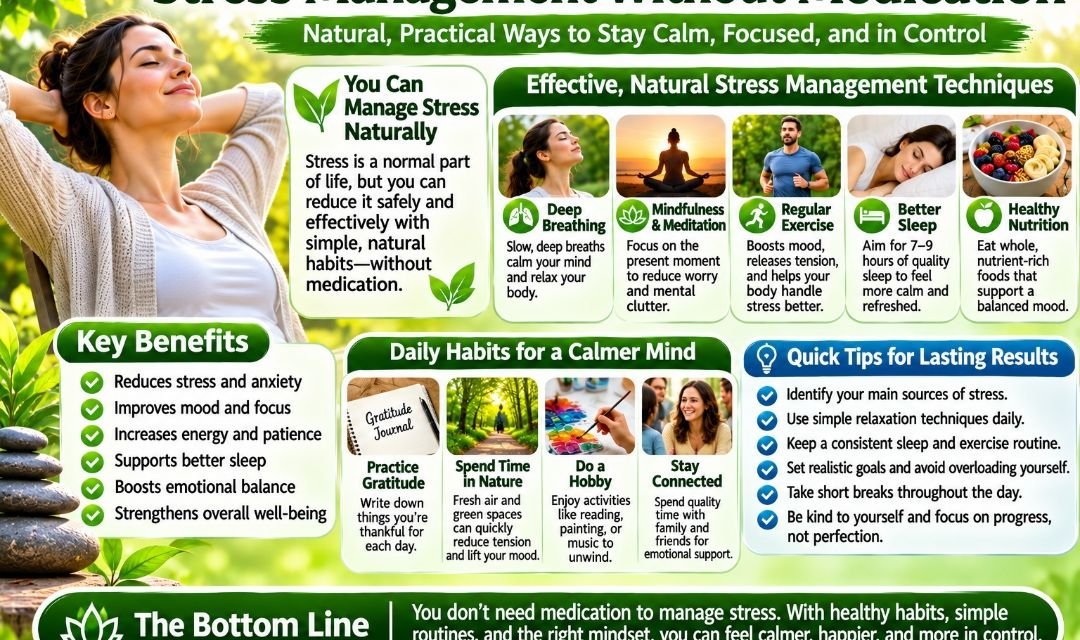
Quick Overview of Stress Management Without Medication
| Category | Details |
|---|---|
| Main topic | Stress Management Without Medication |
| Primary goal | Reducing everyday stress and improving coping skills |
| Common methods | Exercise, mindfulness, relaxation, sleep |
| Breathing techniques | Slow, comfortable breathing |
| Physical activities | Walking, yoga, cycling, swimming |
| Mental wellness | Emotional awareness and stress management |
| Sleep | Consistent sleep routines |
| Nutrition | Balanced meals and appropriate hydration |
| Social support | Friends, family, and community |
| Professional support | Counseling and psychotherapy |
| Natural products | Herbal products require safety evaluation |
| Main limitation | Not every condition can be managed without medication |
| Long-term approach | Sustainable lifestyle habits |
Stress can develop from work responsibilities, financial concerns, family challenges, health problems, or major life changes.
Sometimes, several sources of stress occur together.
A person may experience difficulty sleeping, muscle tension, irritability, or trouble concentrating.
However, these symptoms can also have other causes.
Managing stress involves understanding its triggers and choosing appropriate coping strategies.
Some people benefit from simple daily changes.
Others need structured psychological treatment or medical care.
This guide explains practical ways to manage stress without relying exclusively on medication.
What Is Stress?
Stress is the body’s physical and psychological response to demands or perceived challenges.
When a person encounters a stressful situation, the nervous system and hormonal systems respond.
These changes may increase alertness and prepare the body for action.
This response is sometimes called the fight-or-flight response.
Short-term stress is not always harmful.
For example, it may help someone respond quickly to an urgent situation.
However, persistent stress can interfere with everyday functioning.
Common Signs of Stress
Stress can affect people differently.
Some experience physical symptoms.
Others notice changes in mood or behavior.
| Physical symptoms | Emotional or behavioral symptoms |
|---|---|
| Muscle tension | Irritability |
| Headaches | Feeling overwhelmed |
| Sleep difficulties | Difficulty concentrating |
| Digestive discomfort | Restlessness |
| Fatigue | Changes in motivation |
| Increased heart rate | Social withdrawal |
These symptoms are not specific to stress.
Persistent, severe, or unexplained symptoms should be assessed by a qualified healthcare professional.
1. Practice Slow Breathing
Slow breathing is one of the simplest relaxation techniques.
It may help some people feel calmer during stressful situations.
The goal is to breathe comfortably rather than force large breaths.
How to Practice
Sit in a comfortable position.
Allow your shoulders to relax.
Breathe in gently through your nose if comfortable.
Exhale slowly without straining.
Continue for a few minutes.
If you experience dizziness, tingling, or discomfort, stop the exercise.
2. Try Mindfulness Meditation
Mindfulness involves paying attention to present experiences.
It encourages awareness of thoughts, emotions, and physical sensations.
Some research suggests mindfulness-based programs can help reduce perceived stress.
However, the effects vary.
Meditation should not be considered a guaranteed treatment for anxiety or depression.
A Simple Mindfulness Exercise
Sit comfortably.
Notice your natural breathing.
When thoughts arise, acknowledge them.
Gently return attention to the present moment.
Continue for a few minutes.
There is no requirement to eliminate every thought.
3. Exercise Regularly
Physical activity can support both physical and mental well-being.
Walking, cycling, swimming, and other activities may help people manage stress.
Exercise can also support sleep and cardiovascular health.
However, the appropriate activity level depends on individual health and ability.
Adults can gradually work toward recommended physical activity levels.
Even short periods of movement can be useful.
4. Improve Sleep Habits
Poor sleep can make stressful situations more difficult to manage.
Stress can also interfere with sleep.
This can create a difficult cycle.
Healthy sleep habits may help improve rest.
Practical Sleep Tips
-
Maintain a consistent bedtime.
-
Wake at approximately the same time each day.
-
Keep the bedroom comfortable.
-
Limit caffeine late in the day.
-
Reduce stimulating activities before sleep.
-
Seek medical advice for persistent insomnia.
Most adults generally need around seven to nine hours of sleep.
However, individual needs vary.
5. Spend Time Outdoors
Outdoor activities may provide opportunities for relaxation and movement.
Walking in a park, gardening, or spending time in a safe natural environment can offer a break from demanding routines.
Some research associates green-space exposure with improved well-being.
However, results vary.
Nature exposure is best viewed as one supportive lifestyle practice.
6. Use Progressive Muscle Relaxation
Progressive muscle relaxation involves gently tightening and releasing muscle groups.
The technique can help people notice physical tension.
For example, someone may gently tense their hands and then release them.
The process can continue through other muscle groups.
However, people with injuries or chronic pain should avoid uncomfortable movements.
Muscle relaxation should never cause pain.
7. Maintain a Balanced Diet
Nutrition supports normal body function.
A balanced diet generally includes vegetables, fruits, whole grains, legumes, and appropriate protein sources.
Regular meals may help maintain energy levels.
However, no single food has been proven to eliminate stress.
Dietary supplements should not replace balanced nutrition or appropriate medical care.
8. Reduce Excessive Caffeine
Caffeine can increase alertness.
However, excessive intake may contribute to nervousness, sleep disruption, or a racing heartbeat in some people.
Sensitivity varies.
People who notice these effects may benefit from reducing caffeine intake.
Abruptly stopping high caffeine consumption can cause withdrawal symptoms.
Gradual reduction may be more comfortable.
9. Build Supportive Relationships
Social support can help people cope with difficult experiences.
Talking with a trusted friend or family member may provide emotional relief.
Supportive relationships can also reduce feelings of isolation.
However, not everyone has access to a strong social network.
Community organizations, peer support, or professional counseling may provide additional options.
10. Practice Time Management
Poorly organized schedules can contribute to stress.
Time management involves setting priorities and creating realistic plans.
For example, breaking a large task into smaller steps may make it feel more manageable.
However, time management cannot solve every stressful situation.
Some problems require changes in workload, responsibilities, or external circumstances.
11. Set Healthy Boundaries
Healthy boundaries involve recognizing personal limits.
For example, someone may need to reduce unnecessary commitments.
Others may benefit from establishing clearer work hours.
Boundaries can support emotional well-being.
However, setting boundaries may be difficult in certain family, employment, or financial situations.
Practical support may be needed.
12. Try Journaling
Journaling involves writing about thoughts, feelings, or experiences.
Some people find it useful for organizing concerns.
It may also help identify recurring stress triggers.
However, journaling is not equally helpful for everyone.
Writing about difficult experiences can sometimes increase distress.
People should choose an approach that feels manageable.
13. Practice Gratitude
Gratitude practices involve noticing positive experiences or meaningful aspects of life.
Some people write down a few things they appreciate.
Others reflect quietly.
Research has explored possible benefits for emotional well-being.
However, gratitude does not eliminate serious problems.
It should not be used to dismiss difficult emotions or discourage people from seeking help.
14. Reduce Unnecessary Screen Time
Technology can contribute to stress when it creates constant interruptions.
Notifications, demanding messages, and excessive information may make it difficult to relax.
Reducing unnecessary alerts may improve concentration.
Taking breaks from screens can also support healthier routines.
However, technology can provide important social connection and access to support.
The goal is balanced use.
15. Practice Gentle Yoga
Yoga combines movement, breathing, and attention.
Some yoga programs may help with selected stress-related outcomes.
However, different styles have different physical demands.
Gentle yoga may be suitable for some beginners.
People with injuries or medical conditions may require modifications.
Yoga should not replace necessary healthcare.
16. Engage in Enjoyable Hobbies
Hobbies can provide opportunities for relaxation and enjoyment.
Examples include reading, gardening, drawing, cooking, and crafts.
These activities may help people take breaks from stressful responsibilities.
However, a hobby should not become another demanding obligation.
The most useful activity is one that feels enjoyable and manageable.
17. Use Guided Imagery
Guided imagery involves imagining a peaceful or comforting setting.
For example, someone may picture a quiet beach or garden.
They may focus on imagined sounds, colors, and sensations.
Some people find this technique relaxing.
However, visualization does not work equally well for everyone.
People who find imagery uncomfortable can choose another relaxation method.
18. Practice Self-Compassion
Self-compassion involves responding to personal difficulties with understanding rather than excessive self-criticism.
For example, someone who makes a mistake may acknowledge it without treating it as proof of personal failure.
This approach can support emotional coping.
However, self-compassion does not mean avoiding responsibility.
It involves combining realistic self-evaluation with a constructive response.
19. Consider Counseling or Psychotherapy
Stress management without medication can still include professional treatment.
Counseling and psychotherapy are non-medication approaches.
Cognitive behavioral therapy, or CBT, is one evidence-based psychological treatment used for several mental health conditions.
Therapy may help people identify unhelpful thought patterns and develop coping strategies.
However, treatment needs vary.
Some people benefit from psychotherapy alone.
Others may need medication or combined treatment.
20. Create a Sustainable Daily Routine
A consistent routine can make healthy habits easier to maintain.
For example, someone may schedule a short walk during the day.
They may also set aside time for relaxation before bed.
However, routines should remain flexible.
Overly strict schedules can create additional stress.
The goal is to support well-being rather than achieve perfection.
A Simple Five-Minute Stress Relief Exercise
This short exercise combines comfortable breathing and present-moment awareness.
GUIDED FIVE-MINUTE RESET
Minute 1
1 / 5
Notice your surroundings
Sit comfortably and notice a few things you can see or hear.
Move through the steps at your own pace. This guide does not automatically time each minute.
The exercise is optional.
If focusing on breathing or bodily sensations feels uncomfortable, choose another calming activity.
Stress Management Techniques Compared
| Technique | Main purpose | Evidence overview |
|---|---|---|
| Physical activity | Supports overall health and stress coping | Strong evidence for broad health benefits |
| Mindfulness | Develops present-moment awareness | Some evidence for stress-related outcomes |
| Slow breathing | Encourages relaxation | Some supportive evidence |
| Progressive muscle relaxation | Reduces perceived muscle tension | Some supportive evidence |
| Yoga | Combines movement and relaxation | Evidence varies |
| Journaling | Encourages emotional reflection | Mixed evidence |
| Guided imagery | Supports relaxation | Limited to moderate evidence depending on use |
| Counseling and CBT | Develops coping and psychological skills | Strong evidence for certain conditions |
| Herbal supplements | Marketed for relaxation | Highly variable evidence |
Different techniques may work better for different people.
Natural Stress Management vs Medication
Non-medication approaches can be helpful for everyday stress.
However, medication may be appropriate for certain mental health conditions.
| Feature | Non-Medication Approaches | Medication |
|---|---|---|
| Examples | Exercise, therapy, relaxation | Prescribed medicines |
| Main purpose | Coping skills and symptom management | Treatment of specific conditions |
| Professional guidance | Helpful; sometimes essential | Required for prescription treatment |
| Possible limitations | May be insufficient alone | May cause side effects |
| Long-term role | Often useful as ongoing habits | Depends on diagnosis and response |
| Best choice | Depends on individual needs | Depends on individual needs |
Medication should not be stopped abruptly without medical guidance.
Can Herbal Products Help With Stress?
Some herbal products are marketed for relaxation.
Examples include chamomile, lavender preparations, and ashwagandha.
However, evidence varies by product and condition.
Some supplements may cause side effects or interact with medications.
Ashwagandha, for example, has been associated with rare liver injury and may affect thyroid-related conditions.
Herbal supplements should not be assumed safe simply because they are natural.
What About CBD for Stress?
CBD products are sometimes marketed for stress relief and relaxation.
CBD is a cannabinoid found in cannabis.
Although researchers are studying its potential effects, evidence supporting many commercial CBD stress claims remains limited.
CBD can cause drowsiness, digestive symptoms, liver-related concerns, and medication interactions.
Some products may contain THC.
CBD should not be considered a proven replacement for established stress-management treatments.
How Stress Affects Physical Health
Persistent stress may influence several body systems.
It can affect sleep, appetite, concentration, and muscle tension.
Stress can also influence health behaviors.
For example, someone experiencing ongoing stress may become less physically active or sleep poorly.
However, stress is not the sole cause of most medical conditions.
Persistent physical symptoms require appropriate evaluation.
Stress Management at Work
Work-related stress may involve deadlines, workload, unclear expectations, or difficult relationships.
Short breaks and practical planning can help some people.
However, individual coping techniques cannot resolve every workplace problem.
Organizational changes may also be necessary.
Examples include realistic workloads, adequate staffing, and safe working conditions.
Stress Management for Students and Young Adults
Students and young adults may experience stress related to education, employment, finances, and relationships.
Helpful habits may include realistic study schedules, adequate sleep, and physical activity.
Supportive conversations can also be useful.
However, severe anxiety or persistent emotional difficulties may require professional care.
Stress Management for Older Adults
Older adults may experience stress related to health changes, caregiving, finances, or social isolation.
Appropriate physical activity and supportive relationships may help.
Relaxation practices can be adapted to individual mobility and comfort.
However, medical conditions and medication effects should also be considered.
Seven-Day Stress Management Plan
The following plan introduces manageable daily practices.
Weekly stress-management checklist
0 of 7 completed
Monday: Breathing
Spend a few minutes practicing comfortable, natural breathing.
Tuesday: Movement
Take a short walk or enjoy another suitable activity.
Wednesday: Sleep
Maintain a consistent bedtime routine.
Thursday: Mindfulness
Practice a short present-moment awareness exercise.
Friday: Social support
Connect with someone supportive.
Saturday: Enjoyable activity
Make time for a hobby or relaxing activity.
Sunday: Reflection
Identify one stress-management habit to continue.
This plan is a general example.
People can adjust it according to their needs and circumstances.
Common Stress Management Mistakes
Some approaches may be less helpful when expectations are unrealistic.
Common mistakes include:
-
Expecting stress to disappear completely
-
Ignoring serious emotional symptoms
-
Using alcohol or other substances to cope
-
Following extreme relaxation techniques
-
Relying on unsupported supplements
-
Avoiding necessary medical care
-
Trying to change every habit immediately
-
Blaming oneself for stressful circumstances
Stress management should focus on realistic coping and appropriate support.
When Should You Seek Professional Help?
Professional support may be appropriate when stress becomes persistent or overwhelming.
Warning signs may include severe sleep problems, difficulty functioning, frequent panic symptoms, or significant changes in mood.
Stress can sometimes overlap with anxiety disorders, depression, or medical conditions.
A qualified professional can help determine the cause and appropriate treatment.
Non-medication treatment may be an option, but it is not always sufficient.
If someone is at immediate risk of harming themselves or others, emergency assistance is necessary.
Frequently Asked Questions About Stress Management Without Medication
1. What is stress management without medication?
It involves using lifestyle habits, psychological techniques, and other non-medication approaches to manage stress.
2. Can stress be managed naturally?
Everyday stress can sometimes be improved through healthy habits and coping strategies.
3. What is the fastest way to reduce stress?
A short break, comfortable breathing, or changing a stressful environment may help some people.
4. Does walking reduce stress?
Walking can support general well-being and may help with stress management.
5. Can meditation help stress?
Some mindfulness-based programs have evidence for reducing perceived stress.
6. How does sleep affect stress?
Poor sleep can make coping with stress more difficult.
7. Can food reduce stress?
Balanced nutrition supports overall health, but no single food eliminates stress.
8. Does caffeine increase stress?
Excessive caffeine can contribute to nervousness or sleep problems in some people.
9. What is progressive muscle relaxation?
It is a technique involving gentle muscle tension and release.
10. Can yoga help manage stress?
Some yoga practices may support relaxation and well-being.
11. Is journaling useful for stress?
Some people find journaling helpful for organizing thoughts and feelings.
12. Can spending time outdoors help?
Outdoor activities may support relaxation and physical activity.
13. Are herbal supplements effective for stress?
Evidence varies, and some products can cause adverse effects.
14. Is CBD proven to treat stress?
Evidence remains limited for many commercial CBD stress claims.
15. Can therapy help without medication?
Yes. Psychotherapy can be an effective non-medication treatment for certain conditions.
16. What is cognitive behavioral therapy?
CBT is a structured psychological treatment that helps people develop coping and thinking skills.
17. Can stress cause headaches?
Stress may contribute to certain headaches, but persistent symptoms need appropriate evaluation.
18. Can stress affect digestion?
Stress can influence digestive symptoms in some people.
19. How can I reduce work stress?
Practical planning, breaks, supportive communication, and workplace improvements may help.
20. Is stress always harmful?
No. Short-term stress is a normal response and can sometimes be useful.
21. How much exercise helps with stress?
Needs vary, but regular physical activity supports general health and stress coping.
22. Can relaxation techniques replace anxiety medication?
Not necessarily. Treatment depends on the condition and individual needs.
23. How long does stress management take to work?
Results vary depending on the technique, person, and stressors.
24. What if relaxation exercises make me anxious?
Stop the exercise and try another approach. Seek professional guidance if distress continues.
25. What is the best long-term stress-management strategy?
A combination of healthy routines, practical problem-solving, social support, and appropriate professional care is often useful.
Final Thoughts
Stress management without medication can involve many practical approaches.
Regular physical activity, adequate sleep, mindfulness, comfortable breathing, and supportive relationships may help people cope with everyday challenges.
Time management, healthy boundaries, and enjoyable activities can also support emotional well-being.
However, stress management is not simply about learning to relax.
Some stressors require practical changes in work, finances, relationships, or living conditions.
Professional counseling and psychotherapy can provide additional support.
Natural supplements and CBD products should not be treated as guaranteed stress treatments.
Most importantly, managing stress without medication does not mean avoiding medical care when it is needed.
The best approach is safe, realistic, and appropriate for the individual.
For more stress-management guides, mindfulness techniques, natural wellness education, healthy lifestyle advice, and beginner-friendly health articles, visit Picanto Magazine.
Medical Disclaimer: This article is for educational purposes only and does not replace professional medical or mental health advice. Do not stop prescribed medication without consulting your healthcare professional. Seek qualified help for persistent, severe, or worsening symptoms.