
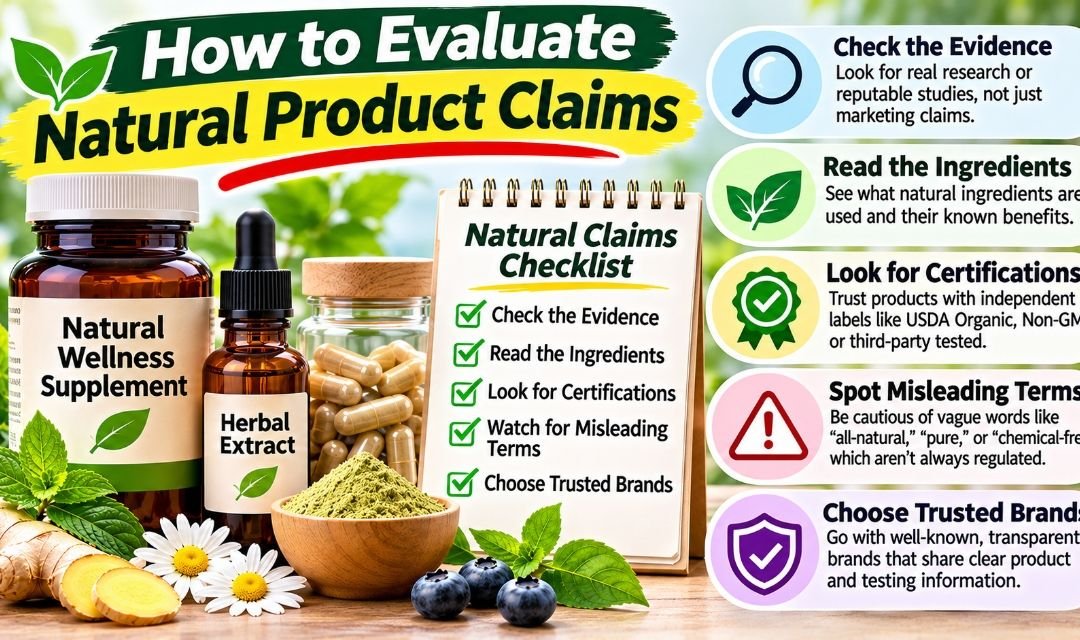
Natural products have become increasingly popular in everyday wellness routines.
People use them for skincare, personal care, relaxation, nutrition, and general wellbeing.
However, product packaging often makes bold promises.
A cream might claim to restore youthful skin overnight. An herbal supplement may promise better sleep, stronger immunity, or immediate energy.
But how much evidence supports these statements?
The answer depends on the product, its ingredients, the research available, and the exact claim being made.
This guide explains how to separate useful product information from exaggerated marketing.
Quick Overview
| Category | Details |
|---|---|
| Main topic | How to Evaluate Natural Product Claims |
| Main goal | Identify reliable and misleading product claims |
| Common products | Herbal supplements, skincare, botanical extracts |
| Popular marketing terms | Natural, organic, pure, clean, plant-based |
| Important evidence | Reliable human studies and appropriate testing |
| Ingredient checks | Identity, concentration, dosage, warnings |
| Quality indicators | Relevant testing and verifiable certifications |
| Common risks | Allergies, contamination, interactions |
| Main warning sign | Guaranteed results or miracle cures |
| Consumer responsibility | Compare claims with credible evidence |
| Best approach | Evaluate the entire product, not just its packaging |
| Key takeaway | Natural does not automatically mean safe or effective |
What Are Natural Product Claims?
Natural product claims are statements used to describe or promote products containing ingredients derived from nature.
These claims may appear on packaging, websites, advertisements, or social media.
Some describe the source of ingredients.
Others suggest that a product provides particular health benefits.
For example, a label may state that a lotion contains aloe vera.
That is an ingredient claim.
Another product may claim that aloe vera can cure a serious skin disease.
That is a medical claim requiring much stronger evidence and appropriate regulatory authorization.
Understanding this difference is essential.
Why Are Natural Product Claims So Popular?
Many consumers associate natural ingredients with simplicity, purity, and healthy living.
Companies often use green packaging, plant images, and botanical names to strengthen these impressions.
However, appearance is not scientific evidence.
A product with leaves on its packaging is not automatically environmentally friendly.
Similarly, a supplement made from plants is not necessarily safer than a manufactured alternative.
Consumers should examine what the product actually contains and what evidence supports its advertised benefits.
1. Understand What Natural Really Means
The word natural can have different meanings depending on the product and country.
In some contexts, it may describe the origin of an ingredient.
In others, it may be used as a broad marketing term.
However, natural does not automatically mean free from processing, chemicals, or possible side effects.
Plants naturally contain chemical compounds.
Some are useful, while others can be harmful.
The important question is whether the specific product is appropriate for its intended use.
2. Do Not Assume Natural Means Safe
One of the most common wellness myths is that natural substances cannot cause harm.
However, many naturally occurring substances have powerful biological effects.
Certain herbs can interact with medications.
Some botanical extracts can irritate sensitive skin.
Others may cause allergic reactions.
Safety depends on the ingredient, amount, route of exposure, and individual circumstances.
3. Understand the Difference Between Claims and Evidence
A product claim is a statement made by a manufacturer or seller.
Evidence is the information used to support that statement.
For example, a company may claim that a supplement improves sleep.
However, that claim should be evaluated using relevant research.
Personal testimonials and attractive advertisements are not enough to establish effectiveness.
Reliable evidence is especially important when a product claims to affect health.
4. Look for Reliable Scientific Research
Scientific studies can help determine whether an ingredient or product provides a particular benefit.
However, not all studies offer the same level of confidence.
Research involving humans is generally more directly relevant to human health claims than laboratory or animal experiments.
Study quality also matters.
Well-designed trials, systematic reviews, and consistent findings across multiple studies can provide stronger support.
5. Understand Laboratory Research Limitations
Laboratory studies may reveal interesting properties of plant compounds.
For example, an extract might demonstrate antioxidant activity in a test tube.
However, this does not automatically mean that applying or consuming the extract improves human health.
The body absorbs, processes, and eliminates substances in complex ways.
Clinical benefits require appropriate human evidence.
6. Be Careful With Animal Studies
Animal research can provide useful early information.
However, animals and humans may respond differently to the same substance.
A product that shows promising results in animals may not produce similar effects in humans.
Consumers should avoid treating animal findings as proof of human benefits.
7. Examine Human Clinical Studies
Human clinical studies can help evaluate product effects.
However, their reliability depends on several factors.
These include the number of participants, study duration, comparison groups, and methods used.
A small study may provide preliminary information without establishing a firm conclusion.
Consumers should be cautious when companies describe limited research as definitive proof.
8. Understand the Meaning of Clinically Tested
The phrase clinically tested sounds impressive.
However, it does not necessarily mean that a product has demonstrated meaningful benefits.
A study may have involved only a small number of participants.
It may also have examined a different formulation or ingredient amount.
Consumers should ask what was tested, how the study was conducted, and what the results actually showed.
9. Understand the Meaning of Scientifically Proven
Scientifically proven is a strong claim.
However, scientific evidence often involves uncertainty and ongoing research.
One study rarely settles every question about a product.
Consumers should look for consistent, high-quality evidence rather than relying on dramatic language.
10. Read the Complete Ingredient List
Product packaging often highlights one appealing ingredient.
However, the full formula may contain many other substances.
For example, a skincare product advertised as botanical may also contain preservatives, fragrances, and other ingredients.
These are not automatically harmful.
However, they may affect suitability for people with allergies or sensitivities.
Reading the complete label provides a clearer understanding of the product.
11. Check Ingredient Concentrations
The amount of an ingredient can influence its effects and risks.
A product containing a small amount of botanical extract may differ from a highly concentrated preparation.
However, higher concentrations are not automatically better.
They may increase the possibility of irritation or other adverse effects.
Consumers should consider both concentration and intended use.
12. Understand Botanical Extract Claims
Botanical extracts are produced from plant materials such as leaves, roots, flowers, and seeds.
Their composition depends on the plant species, extraction method, and manufacturing process.
Two extracts from the same plant may not be identical.
A claim supported by research on one extract may not apply to another.
This distinction is especially important for concentrated herbal supplements.
13. Understand Organic Claims
Organic labeling generally refers to specific production standards.
However, the meaning and requirements vary by certification system and country.
Organic does not automatically mean safer, more nutritious, or medically effective.
Consumers should verify whether a product has a legitimate certification.
14. Understand Clean Beauty Claims
Clean beauty is a popular term in skincare marketing.
However, there is no single universal regulatory definition.
Different brands may use different standards.
A clean beauty label does not guarantee that a product is free from allergens or irritation risks.
Consumers should evaluate the actual ingredients and formulation.
15. Understand Chemical-Free Claims
Everything made of matter contains chemicals, including water and plants.
Therefore, chemical-free is generally not a scientifically meaningful description of a physical product.
A company may intend to say that a product does not contain certain synthetic ingredients.
However, consumers should look for specific information rather than vague statements.
16. Understand Non-Toxic Claims
Non-toxic is another phrase that requires context.
Toxicity depends on the substance, dose, exposure, and individual circumstances.
Even substances considered safe under normal conditions can become harmful at excessive doses.
Consumers should avoid interpreting non-toxic as a guarantee of complete safety.
17. Understand Hypoallergenic Claims
Hypoallergenic products are marketed as less likely to cause allergic reactions.
However, this does not mean that reactions are impossible.
The definition and regulation of the term vary.
People with known allergies should still review ingredient lists.
18. Understand Dermatologist-Tested Claims
Dermatologist-tested suggests that a dermatologist was involved in some form of product testing.
However, the phrase does not explain the testing method or results.
It also does not guarantee that a product will suit every skin type.
Consumers should consider the complete formulation and any available supporting evidence.
19. Understand Cruelty-Free Claims
Cruelty-free usually relates to animal testing practices.
However, standards and verification systems vary.
A cruelty-free claim does not automatically establish that a product is safe, effective, vegan, or environmentally sustainable.
Consumers should verify the specific certification or policy.
20. Understand Vegan Claims
Vegan products generally exclude animal-derived ingredients.
However, vegan does not automatically mean natural or safe.
A vegan skincare product can still contain ingredients that irritate sensitive skin.
A vegan supplement can also contain excessive amounts of certain nutrients.
Ingredient evaluation remains important.
21. Understand Sustainable Claims
Some natural products are marketed as sustainable or environmentally friendly.
However, these terms can be vague.
A meaningful sustainability claim should explain what environmental benefit is being measured.
For example, it might refer to packaging, sourcing, emissions, or a specific production practice.
Broad claims without supporting information deserve caution.
22. Recognize Greenwashing
Greenwashing occurs when marketing creates a misleading impression about environmental responsibility.
A company may use green packaging or nature imagery without providing meaningful evidence of environmental benefits.
Consumers should look for specific, verifiable claims.
For example, a measurable packaging reduction is more informative than simply calling a product eco-friendly.
23. Evaluate Third-Party Testing Claims
Third-party testing means an independent organization examines certain product characteristics.
Testing may assess ingredient identity, potency, or contaminants.
However, testing programs differ.
A product tested for heavy metals has not necessarily been tested for every possible contaminant.
Independent testing also does not automatically prove health benefits.
24. Understand Certificates of Analysis
A Certificate of Analysis, or COA, summarizes specified laboratory results.
It may include product identity, batch number, test methods, and measured values.
However, not every COA is issued by an independent laboratory.
Consumers should check who performed the testing and whether the report applies to the relevant product.
25. Verify Certification Logos
Certification logos can provide useful information when they are legitimate.
However, fake or misleading badges may appear on packaging.
Consumers should check whether the product is listed by the certification organization.
They should also understand what the certification actually covers.
26. Be Careful With Influencer Recommendations
Social media influencers often promote natural wellness products.
Some recommendations are sponsored.
However, personal experiences do not establish that a product works for everyone.
A testimonial may reflect individual circumstances or other factors.
Consumers should look for reliable evidence beyond promotional content.
27. Recognize Before-and-After Marketing
Before-and-after photographs can be persuasive.
However, lighting, camera angles, editing, and other changes may affect appearance.
A photograph does not establish why a result occurred.
Consumers should not treat images alone as proof of product effectiveness.
28. Avoid Miracle Cure Claims
Products promising to cure serious diseases deserve particular caution.
Claims that a supplement can replace medical treatment or cure multiple unrelated conditions are major warning signs.
Medical treatment claims require appropriate evidence and regulatory authorization.
Consumers should not stop prescribed treatment because of wellness advertising.
29. Check for Medication Interactions
Natural supplements may interact with prescription or over-the-counter medications.
Some herbal ingredients can affect how drugs are processed by the body.
Others may increase the risk of adverse effects.
People taking medication should consult a qualified healthcare professional or pharmacist before using relevant herbal supplements.
30. Consider Individual Health Needs
A product suitable for one person may not be appropriate for another.
Age, pregnancy, allergies, medical conditions, and medication use can affect safety.
Children and older adults may have different needs.
Consumers should avoid assuming that one product is suitable for everyone.
Common Natural Product Claims vs What They Actually Mean
| Marketing claim | What consumers should understand |
|---|---|
| 100% natural | Does not automatically establish safety |
| Organic | Refers to particular production standards |
| Chemical-free | Scientifically misleading as a literal claim |
| Non-toxic | Requires context about exposure and dose |
| Clinically tested | Testing quality and results must be evaluated |
| Scientifically proven | Requires strong and relevant evidence |
| Dermatologist-tested | Does not guarantee suitability |
| Hypoallergenic | Allergic reactions may still occur |
| Third-party tested | Scope and independence should be verified |
| Vegan | Generally excludes animal-derived ingredients |
| Cruelty-free | Usually relates to animal testing practices |
| Eco-friendly | Should be supported by specific environmental evidence |
| Pure botanical extract | Composition and concentration still matter |
| Supports immunity | Does not automatically mean disease prevention |
| Detoxifying | Requires clear evidence and a defined mechanism |
Natural Product Claims in Skincare
Skincare advertisements frequently use botanical ingredients to attract consumers.
For example, a moisturizer may highlight aloe vera, chamomile, or green tea.
However, the presence of these ingredients does not automatically establish a particular benefit.
The complete formulation matters.
Other ingredients may contribute to hydration, texture, or preservation.
People with sensitive skin should also consider fragrance and allergy risks.
Natural Product Claims in Dietary Supplements
Dietary supplements often make claims about energy, immunity, digestion, or general wellness.
However, the evidence varies by ingredient and product.
A supplement may contain a nutrient that supports normal body functions.
That does not mean taking extra amounts will improve health in someone who already obtains enough.
Excessive intake of certain vitamins or minerals can also be harmful.
Natural Product Claims in Herbal Products
Herbal products may contain concentrated plant extracts.
However, traditional use does not automatically prove effectiveness.
Some herbal preparations have been studied in humans.
Others have limited evidence.
Product quality, dosage, and possible medication interactions should be considered.
Natural Product Claims in Essential Oils
Essential oils are concentrated aromatic plant substances.
They are commonly promoted for relaxation and personal care.
However, evidence for specific health benefits varies.
Some essential oils can irritate the skin or cause allergic reactions.
Certain oils are toxic if swallowed.
Consumers should follow appropriate safety instructions and avoid unsupported medical claims.
How to Compare Two Natural Wellness Products
| Feature | Product A | Product B |
|---|---|---|
| Complete ingredient list | Available | Missing |
| Ingredient concentrations | Clearly stated where relevant | Unclear |
| Scientific evidence | Relevant studies identified | Only testimonials |
| Manufacturer details | Transparent | Limited |
| Testing information | Verifiable | Unverified |
| Safety warnings | Provided | Missing |
| Marketing claims | Specific and cautious | Exaggerated |
| Overall assessment | More transparent | Requires further investigation |
This is a fictional comparison intended to demonstrate product evaluation.
Transparency is useful, but it does not independently prove that a product is safe or effective.
Seven Steps to Evaluate Natural Product Claims
Natural product evaluation checklist
0 of 7 completed
Copy checklist
Warning Signs of Misleading Natural Product Advertising
Consumers should investigate products that make unusually strong claims.
Common warning signs include:
-
Guaranteed results for everyone
-
Promises to cure serious diseases
-
Claims that natural products have no side effects
-
Missing ingredient information
-
Unclear dosage instructions
-
Unverifiable certifications
-
Pressure to purchase immediately
-
Reliance only on testimonials
-
Claims that doctors are hiding a simple cure
-
Statements that the product replaces prescribed treatment
-
Vague claims without measurable evidence
-
Refusal to provide relevant safety information
These signs do not automatically prove that a product is fraudulent.
However, they justify greater caution.
Why Product Quality Matters
A product may contain a useful ingredient but still have quality problems.
For example, botanical ingredients can vary because of growing conditions, harvesting, and processing.
Contamination may also occur.
Relevant quality testing can help identify certain problems.
However, quality testing does not automatically establish clinical effectiveness.
Why More Natural Ingredients Are Not Always Better
Some products contain long lists of botanical extracts.
However, a larger number of ingredients does not necessarily mean greater benefits.
Complex formulas may increase the possibility of allergies or interactions.
Consumers should focus on ingredients that serve a clear purpose.
A simpler formulation may sometimes be more appropriate.
Can Natural Products Replace Medical Treatment?
Natural wellness products should not automatically be considered substitutes for medical treatment.
Some may support general wellbeing or address specific needs.
However, treating a medical condition requires appropriate evidence and professional guidance.
People should not stop prescribed medication or delay necessary medical care because of commercial wellness claims.
How to Find Trustworthy Product Information
Reliable information should come from credible sources.
Examples include qualified healthcare professionals, established public health organizations, regulatory authorities, and well-designed scientific research.
Consumers should consider whether the source has a financial interest in selling the product.
Information should explain both possible benefits and limitations.
Claims that sound too good to be true deserve closer examination.
Frequently Asked Questions About Natural Product Claims
1. What are natural product claims?
They are statements describing the ingredients, properties, or advertised benefits of products marketed as natural.
2. Does natural mean safe?
No. Natural substances can cause adverse effects.
3. Are organic products always healthier?
Not necessarily. Organic production standards do not guarantee greater nutritional value or effectiveness.
4. What does chemical-free mean?
It is generally not scientifically meaningful as a literal claim because all physical substances consist of chemicals.
5. What does clinically tested mean?
It suggests that some form of clinical testing occurred, but the study quality and results must be examined.
6. Does scientifically proven guarantee effectiveness?
No. The strength and relevance of the evidence matter.
7. Are herbal products safe?
Some are suitable for particular uses, but others may cause side effects or interactions.
8. Can botanical extracts cause allergies?
Yes. Certain plant-derived ingredients can trigger allergic reactions.
9. Are natural skincare products better?
Not automatically. Suitability depends on the complete formulation and individual skin needs.
10. What is greenwashing?
It is marketing that creates a misleading impression about environmental responsibility.
11. Are vegan products always natural?
No. Vegan products may contain synthetic ingredients.
12. Does cruelty-free mean safe?
No. It generally relates to animal testing practices rather than product safety.
13. What does hypoallergenic mean?
It suggests a product is intended to reduce allergy risk, but reactions can still occur.
14. Is third-party testing important?
It can provide useful information about certain quality characteristics.
15. Does third-party testing prove a product works?
No. Clinical effectiveness requires appropriate evidence.
16. What is a Certificate of Analysis?
It is a document summarizing specified laboratory test results.
17. Are influencer recommendations reliable?
They may provide personal experiences but are not substitutes for scientific evidence.
18. Can natural supplements interact with medication?
Yes. Some interactions can be serious.
19. Are essential oils always safe?
No. Concentrated essential oils can cause irritation or toxicity.
20. Should pregnant people use herbal supplements?
They should seek qualified medical advice because some products may be unsafe during pregnancy.
21. Can children use adult wellness products?
Not automatically. Children’s needs and safety considerations differ.
22. Are expensive natural products better?
Not necessarily. Price does not guarantee quality or effectiveness.
23. How can I identify misleading claims?
Look for exaggerated promises, missing evidence, unclear ingredients, and unverifiable certifications.
24. What is the best way to compare natural products?
Compare ingredients, concentrations, relevant evidence, safety warnings, and quality information.
25. Should natural products replace prescribed medicine?
No. Do not replace prescribed treatment without professional medical guidance.
Final Thoughts
Learning how to evaluate natural product claims can help consumers make more informed decisions about wellness products.
Words such as natural, organic, clean, and pure may describe certain product characteristics, but they do not automatically establish safety or effectiveness.
Reliable evaluation involves examining ingredients, understanding concentrations, reviewing scientific evidence, and checking relevant quality information.
Consumers should also consider allergies, medication interactions, and individual health needs.
Third-party testing and certification can provide useful assurance about particular quality characteristics.
However, they do not guarantee that a product will work or be safe for everyone.
The best approach is to question exaggerated promises and choose products based on transparent information and credible evidence.
Healthy living should focus on sustainable habits and informed choices rather than relying on marketing claims.
For more natural wellness product guides, ingredient safety information, balanced nutrition advice, and practical healthy lifestyle tips, visit Picanto Magazine.
Medical Disclaimer: This article is for general educational purposes only and does not replace professional medical advice, diagnosis, or treatment. Natural products, herbal supplements, and botanical extracts may cause adverse effects or interact with medications. Consult a qualified healthcare professional before using products to manage medical conditions, especially during pregnancy, while breastfeeding, or when taking prescription medication.