
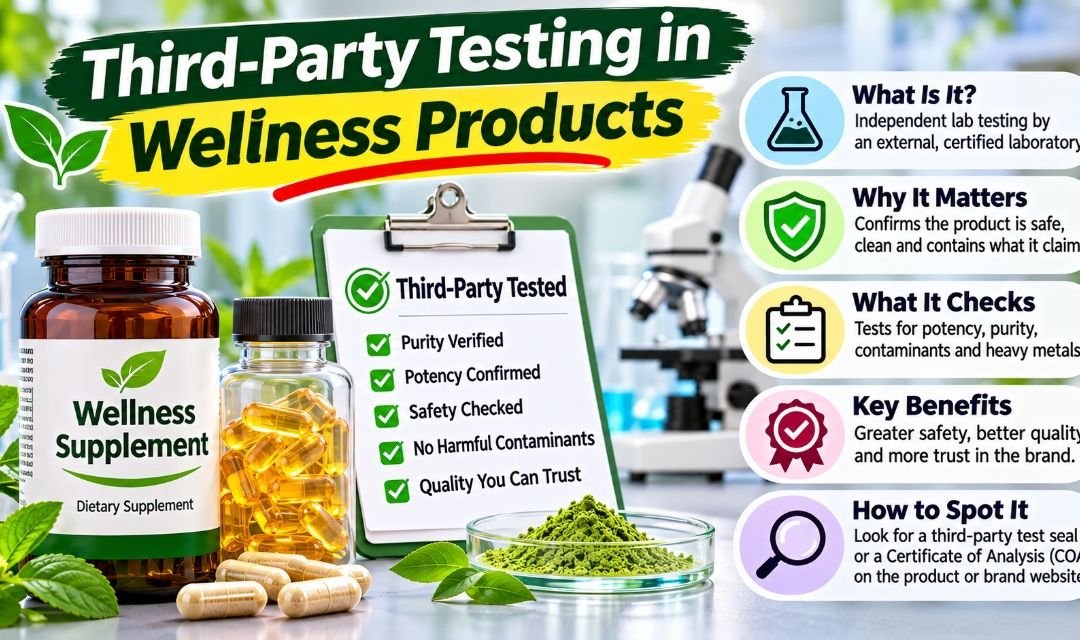
Third-party testing in wellness products is an important quality-checking process that helps consumers understand whether certain products meet specific standards for identity, purity, ingredient amounts, and contamination. As dietary supplements, herbal extracts, protein powders, skincare products, and other wellness items become more popular, independent testing has gained attention. Many manufacturers advertise their products as laboratory-tested, but not all testing claims mean the same thing. Understanding quality assurance can help consumers recognize meaningful testing information, evaluate certifications, and make more informed purchasing decisions.
Quick Overview
| Category | Details |
|---|---|
| Main topic | Third-Party Testing in Wellness Products |
| Main purpose | Independent evaluation of product quality |
| Testing performed by | Laboratories or organizations independent of the manufacturer |
| Common products | Supplements, herbal extracts, protein powders, skincare |
| Important tests | Identity, potency, purity, contaminants |
| Common contaminants | Heavy metals, microorganisms, unwanted chemicals |
| Key document | Certificate of Analysis (COA) |
| Certification examples | USP Verified, NSF certification programs |
| Important limitation | Testing does not automatically prove health benefits |
| Consumer benefit | Greater transparency about tested characteristics |
| Main concern | Fake, outdated, or incomplete testing claims |
| Best practice | Verify the laboratory, results, and product batch |
The wellness market contains thousands of products promising better energy, relaxation, sleep, skin health, and general wellbeing.
Some products contain familiar ingredients such as vitamins and minerals.
Others contain concentrated plant extracts, herbal mixtures, or complex formulations.
But how can consumers know whether a product actually contains the ingredients listed on its label?
And how can they check whether a manufacturer has examined potential contaminants?
Third-party testing can help answer some of these questions.
However, understanding what testing can and cannot prove is essential.
What Is Third-Party Testing?
Third-party testing is the examination of a product by an organization that is independent of the manufacturer.
The laboratory may evaluate specific ingredients, chemical properties, contamination risks, or manufacturing-related quality characteristics.
For example, a supplement company may send a sample of its product to an independent laboratory.
The laboratory might check whether the product contains the stated amount of a vitamin.
It may also test for certain heavy metals or microorganisms.
The results can provide information about the tested sample.
However, they do not automatically establish that every unit of the product has identical quality.
Why Is Third-Party Testing Important?
Wellness products can vary in composition and quality.
Some ingredients are naturally variable.
Others may be affected by manufacturing, storage, or contamination.
Independent testing can provide an additional layer of quality assessment.
It may help identify problems that are not visible on packaging.
However, the usefulness of testing depends on what was tested, how the sample was collected, and whether the laboratory used appropriate methods.
1. Understand the Difference Between First-Party and Third-Party Testing
First-party testing is performed by the manufacturer or its internal quality team.
Third-party testing is performed by an independent organization.
Both can contribute to quality control.
However, independence can reduce certain conflicts of interest.
This does not mean every independent test is automatically reliable.
Laboratory competence, testing methods, and transparency still matter.
2. Understand Product Identity Testing
Identity testing helps determine whether an ingredient is what the manufacturer claims.
For example, a botanical supplement may contain a particular plant extract.
Identity testing can help verify the botanical material or selected chemical markers.
However, the reliability of identification depends on the methods used.
Some complex products require multiple analytical techniques.
3. Understand Potency Testing
Potency testing measures the amount or concentration of selected ingredients.
For example, a vitamin supplement may claim to contain a particular amount of vitamin D.
Testing may help determine whether the measured amount matches the label claim within applicable specifications.
However, potency testing does not automatically prove that the ingredient provides the advertised health benefit.
4. Understand Purity Testing
Purity testing examines whether a product meets specified requirements for unwanted substances.
The meaning of purity depends on the product.
For example, a laboratory may test for particular chemical impurities.
However, no single test can identify every possible contaminant.
Consumers should check which substances were actually examined.
5. Heavy Metal Testing
Some wellness ingredients may contain heavy metals.
Potential concerns include lead, cadmium, arsenic, and mercury.
Exposure risks depend on the substance, chemical form, amount, frequency of use, and individual circumstances.
Testing can help assess whether measured levels meet relevant limits.
However, a report stating that a product passed heavy metal testing should identify the applicable standards.
6. Microbial Testing
Microbial testing examines contamination by microorganisms.
Depending on the product, laboratories may test for bacteria, yeast, mold, or particular pathogens.
Microbial contamination can create health risks.
However, the appropriate tests vary by product category.
A dry capsule and a water-based skincare product may require different testing approaches.
7. Pesticide Residue Testing
Botanical ingredients may contain pesticide residues.
Testing can identify selected residues when suitable analytical methods are used.
However, a pesticide-free marketing claim should be interpreted carefully.
Laboratories test for defined substances at particular detection limits.
A result showing no detectable residue does not necessarily mean that absolutely no residue exists.
8. Residual Solvent Testing
Some botanical extracts are produced using solvents.
Manufacturers may use alcohol or other substances during processing.
Residual solvent testing can help determine whether certain solvents remain in the final product.
However, not all solvents have the same risk profile.
The amount present and applicable safety limits matter.
9. Allergen Testing
Some wellness products may contain ingredients that trigger allergic reactions.
Testing can sometimes help identify specific allergen contamination.
However, testing cannot guarantee that a product will be safe for every person with allergies.
Ingredient labeling and manufacturing controls remain important.
10. Testing for Undeclared Ingredients
Certain wellness product categories have been associated with undeclared substances.
Examples include some products marketed for weight loss, muscle building, or sexual performance.
Undeclared pharmaceutical ingredients can create serious risks.
Targeted laboratory testing may help identify some of these substances.
However, testing for one group of compounds does not rule out every possible hidden ingredient.
11. Stability Testing
Stability testing examines how product characteristics change over time.
Manufacturers may study how heat, humidity, light, or storage conditions affect a formulation.
These tests can help support shelf-life decisions.
However, a product tested shortly after manufacturing may behave differently after extended storage.
12. Packaging Compatibility Testing
Packaging can affect product quality.
Certain ingredients may react with packaging materials or degrade when exposed to air and light.
Testing may examine whether the packaging protects the product under expected conditions.
However, not every third-party testing program includes packaging evaluation.
13. Understanding a Certificate of Analysis
A Certificate of Analysis, commonly called a COA, summarizes specified test results for a material or product.
It may include the product name, batch number, test methods, measured results, specifications, and laboratory details.
However, COAs vary considerably.
Some are issued by manufacturers.
Others are issued by independent laboratories.
A COA is not automatically evidence of third-party testing unless its source is verified.
Example Certificate of Analysis
| Test | Example result | Example specification | Status |
|---|---|---|---|
| Ingredient identity | Matches reference | Identity confirmed | Pass |
| Active ingredient | 98 mg | 95–105 mg | Pass |
| Lead | 0.2 ppm | Maximum 0.5 ppm | Pass |
| Microbial count | 100 CFU/g | Maximum 1,000 CFU/g | Pass |
| Residual solvent | Below reporting limit | Within specified limit | Pass |
This table is fictional and intended only to explain how test reports may be presented. The example limits are not universal regulatory standards.
14. Check the Batch Number
A batch number identifies a particular manufacturing lot.
This information is important because products can vary between batches.
A test report should ideally correspond to the batch being evaluated.
However, manufacturers may use different sampling and release procedures.
Consumers should avoid assuming that an old report applies to newly manufactured products.
15. Check the Laboratory Name
A reliable report should identify the laboratory responsible for testing.
Consumers may be able to verify whether the laboratory exists and offers the relevant services.
However, a professional-looking laboratory name is not enough.
The laboratory should have suitable technical competence.
16. Understand Laboratory Accreditation
Laboratory accreditation can provide evidence that a laboratory meets specified competence requirements.
For example, ISO/IEC 17025 is an internationally recognized standard for testing and calibration laboratories.
However, accreditation applies to a defined scope.
A laboratory may be accredited for certain tests but not others.
Consumers should verify that the relevant test falls within the laboratory’s accredited scope when that assurance is important.
17. Understand Third-Party Certification
Certification is different from a single laboratory test.
A certification program may include product testing, manufacturing assessments, ongoing monitoring, or other requirements.
However, programs differ.
Consumers should understand what a particular certification covers.
A certification logo does not automatically mean that a product has proven medical benefits.
18. Understand USP Verified
The USP Verified Mark is associated with a voluntary verification program for eligible dietary supplements.
The program evaluates specific quality characteristics, including relevant ingredient and manufacturing requirements.
However, verification does not mean that a supplement is effective for every advertised purpose.
Consumers should verify whether a particular product is actually covered by the program.
19. Understand NSF Certification
NSF operates several certification programs.
Requirements vary according to the product and program.
Some programs focus on dietary supplement quality.
NSF Certified for Sport also addresses certain substances prohibited in sport.
However, no certification eliminates every possible risk.
Consumers should check the exact certification rather than relying only on a logo.
20. Understand Informed Sport
Informed Sport is a certification program focused on testing supplements for selected substances prohibited in sport.
This may be relevant for competitive athletes.
However, certification does not guarantee that a supplement improves athletic performance.
Nor does it establish that a product is suitable for every individual.
21. Understand GMP Claims
Good Manufacturing Practices, often abbreviated as GMP, refer to systems intended to support consistent manufacturing quality.
However, GMP compliance and third-party product testing are not identical.
A product may be manufactured under a quality management system without having every finished batch independently tested.
Consumers should distinguish manufacturing claims from product-specific laboratory results.
22. Understand the Meaning of Lab Tested
The phrase lab tested can sound reassuring.
However, it does not necessarily mean independent testing.
The manufacturer may have performed the testing internally.
The label may also omit which characteristics were examined.
Consumers should ask what was tested, who performed the testing, and whether the results can be verified.
23. Understand the Meaning of Purity Tested
Purity tested is another common marketing phrase.
However, it may refer to a limited group of contaminants.
A product could pass one purity test while still having other quality problems.
Consumers should look for specific information rather than broad claims.
24. Understand the Meaning of Clinically Tested
Clinical testing usually involves research in humans.
However, the phrase clinically tested does not reveal whether the study was well designed or whether meaningful benefits were demonstrated.
Clinical testing and laboratory quality testing serve different purposes.
A product may be independently tested for purity without having clinical evidence of effectiveness.
25. Understand Testing Limitations
Third-party testing provides information about selected characteristics.
It does not guarantee that a product is completely safe.
Potential limitations include incomplete testing panels, sampling errors, changing product quality, and undisclosed contaminants.
Individual reactions and medication interactions may also occur even when a product meets quality specifications.
26. Third-Party Testing for Protein Powders
Protein powders may be tested for protein content, heavy metals, microorganisms, or other characteristics.
However, testing requirements vary.
Consumers should check whether the testing covers the specific product.
Athletes may also consider certification programs addressing substances prohibited in sport.
27. Third-Party Testing for Herbal Supplements
Herbal supplements can present particular quality challenges.
Plant identity, growing conditions, harvesting, and extraction methods may affect composition.
Testing may examine botanical identity, chemical markers, contaminants, or adulteration.
However, herbal products can still cause adverse effects or medication interactions even when their quality is verified.
28. Third-Party Testing for Skincare Products
Skincare products may undergo microbial, stability, compatibility, or other relevant testing.
However, not every cosmetic product is independently tested.
The appropriate testing depends on the formulation and intended use.
A tested moisturizer is not automatically suitable for every skin type.
29. Third-Party Testing for Essential Oils
Essential oils may be examined using analytical methods that assess chemical composition.
For example, gas chromatography may help identify selected volatile compounds.
However, chemical analysis alone does not establish that an essential oil is safe for ingestion or direct skin application.
Concentrated essential oils can cause irritation or toxicity.
30. Third-Party Testing for Wellness Beverages
Wellness beverages may contain vitamins, botanical extracts, caffeine, or other ingredients.
Testing may examine ingredient amounts, microbial quality, or contaminants.
However, a beverage that passes laboratory testing is not automatically nutritionally balanced.
Consumers should also read nutrition labels and consider caffeine or added sugar content.
Third-Party Testing vs Certification
| Feature | Third-party laboratory testing | Third-party certification |
|---|---|---|
| Main purpose | Examine specified product characteristics | Assess compliance with program requirements |
| Scope | Defined tests | Depends on certification program |
| Typical output | Laboratory report or COA | Certificate or authorized mark |
| Ongoing monitoring | Not necessarily | May be included |
| Manufacturing review | Not always | May be included |
| Proves health benefits | No | Generally no |
| Guarantees complete safety | No | No |
Both approaches can provide useful information.
However, consumers should understand the exact scope of each.
Why Testing Matters for Botanical Extracts
Botanical extracts can vary depending on plant species, growing conditions, harvesting, and processing.
For example, two extracts from the same plant may contain different concentrations of selected compounds.
Independent testing may help verify botanical identity and particular quality characteristics.
However, it does not eliminate the need to consider potential side effects.
How to Verify a Testing Claim
A product may display a laboratory-tested badge.
Before relying on it, check whether the claim can be independently verified.
Look for the laboratory name, testing date, product identification, batch number, and tested characteristics.
If a certification is claimed, check whether the product appears in the certification organization’s official records.
However, even genuine certification should be interpreted according to its scope.
Product Testing Checklist
Check before trusting a testing claim
0 of 10 completed
Copy checklist
Common Third-Party Testing Red Flags
Consumers should be cautious when testing claims are unclear.
Warning signs include:
-
No laboratory name
-
Missing product identification
-
No testing date
-
No batch information
-
Unverifiable certification logos
-
Reports unrelated to the product
-
Claims that testing proves a cure
-
Missing test methods
-
Results without specifications
-
Refusal to explain what was tested
These signs do not automatically prove fraud.
However, they indicate that more information is needed.
Is Third-Party Testing Required for Every Wellness Product?
Testing requirements depend on the product category and jurisdiction.
Some products must meet specific quality or safety requirements.
However, independent third-party certification is not universally required for every supplement, cosmetic, or wellness item.
Manufacturers may use internal testing, external laboratories, or combinations of quality-control methods.
Consumers should not assume that a product is unlawful simply because it lacks a voluntary certification.
Can Third-Party Testing Prevent Counterfeit Products?
Testing can help identify certain product quality problems.
However, it cannot eliminate counterfeiting.
A counterfeit product may display a copied certification logo or falsified report.
Consumers should purchase from reliable sellers and verify certification claims directly.
Does Third-Party Testing Make Products More Expensive?
Independent testing creates additional costs for manufacturers.
However, product price depends on many factors, including branding, packaging, ingredients, and distribution.
An expensive product is not automatically better tested.
A lower-cost product may also meet appropriate quality standards.
Consumers should evaluate evidence rather than price alone.
How to Choose Better-Tested Wellness Products
The most useful approach is to compare products based on transparent information.
Look for relevant testing, clear ingredient quantities, reliable manufacturer details, and appropriate warnings.
However, the best product is not necessarily the one with the greatest number of badges.
A simple product with clear quality information may be more appropriate than a complicated formula with vague claims.
Frequently Asked Questions About Third-Party Testing
1. What is third-party testing?
It is product testing performed by an organization independent of the manufacturer.
2. Why is third-party testing important?
It can provide additional information about product quality and certain contamination risks.
3. Does third-party testing guarantee safety?
No. It cannot eliminate every possible risk.
4. What is a Certificate of Analysis?
A COA is a document summarizing specified laboratory test results.
5. Is every COA issued by an independent laboratory?
No. Some COAs are issued by manufacturers.
6. What is potency testing?
It measures the amount or concentration of selected ingredients.
7. What is purity testing?
It examines whether a product meets defined requirements for unwanted substances.
8. What is heavy metal testing?
It measures selected metals that may present health concerns.
9. What is microbial testing?
It checks for specified microorganisms or microbial contamination.
10. What is pesticide residue testing?
It examines a product for selected pesticide residues.
11. What is residual solvent testing?
It measures certain solvents that may remain after manufacturing.
12. Does lab tested mean independently tested?
Not necessarily.
13. What does USP Verified mean?
It indicates that an eligible supplement has met requirements of a particular voluntary verification program.
14. What does NSF certification mean?
It indicates compliance with the requirements of a specific NSF certification program.
15. What is Informed Sport?
It is a program focused on testing supplements for selected substances prohibited in sport.
16. Is GMP the same as third-party testing?
No. GMP concerns manufacturing practices, while third-party testing examines specified characteristics.
17. Can a product pass testing and still cause side effects?
Yes. Individual reactions and medication interactions can still occur.
18. Does third-party testing prove a supplement works?
No. Quality testing and clinical effectiveness are different questions.
19. Are all supplements third-party tested?
No. Testing and certification practices vary.
20. Should protein powders be tested?
Relevant quality testing can provide useful assurance about ingredients and contaminants.
21. Can herbal products contain contaminants?
Yes. Contamination can occur during sourcing, processing, or manufacturing.
22. How can I verify a certification logo?
Check the certification organization’s official product records.
23. Does a testing report apply to every batch?
Not necessarily. Batch-specific information matters.
24. Are expensive wellness products better tested?
Not automatically.
25. What is the most important testing question?
Ask exactly what was tested, who performed the testing, and whether the results can be verified.
Final Thoughts
Third-party testing in wellness products can provide valuable information about ingredient identity, potency, purity, and selected contamination risks.
Independent laboratories may help manufacturers and consumers understand whether products meet specified quality requirements.
However, not all testing claims are equal.
A label stating lab tested does not automatically mean that testing was independent, comprehensive, or relevant to the product’s advertised benefits.
Consumers should examine laboratory reports, verify certification claims, and understand the limitations of testing.
Certificates of Analysis can be useful, but they must be interpreted carefully.
Testing also does not guarantee that a product is effective or completely safe.
Individual health conditions, medication interactions, dosage, and intended use remain important.
The best approach is to combine transparent quality information with reliable evidence and responsible product use.
For more wellness product safety guides, botanical ingredient information, balanced nutrition advice, and everyday healthy lifestyle tips, visit Picanto Magazine.
Medical Disclaimer: This article is for general educational purposes only and does not replace professional medical advice, diagnosis, or treatment. Third-party testing and certification do not guarantee that a wellness product is safe or effective for every individual. Consult a qualified healthcare professional before using dietary supplements or herbal products, especially if you take medication, are pregnant or breastfeeding, or have an existing medical condition.