
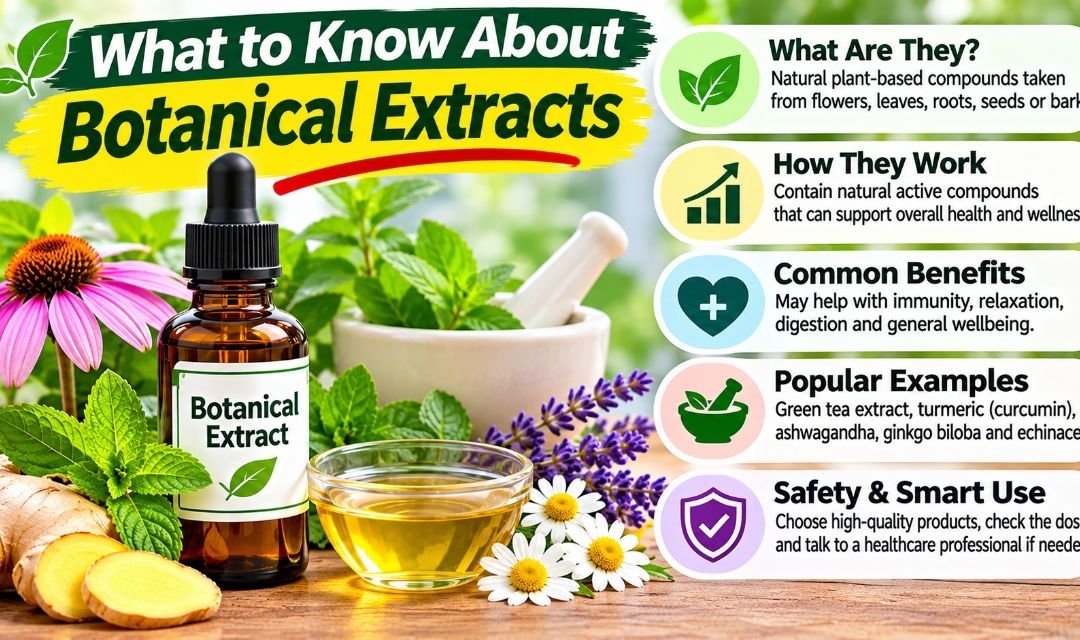
What to know about botanical extracts begins with understanding how plants are used to create concentrated ingredients for skincare, personal care, dietary supplements, and other wellness products. Botanical extracts are made from plant materials such as leaves, flowers, roots, seeds, and bark. Manufacturers use different methods to separate selected substances from these materials. Some extracts are used for fragrance, while others are studied for their possible effects on health or skin. Learning about botanical extracts can help consumers understand ingredient labels, recognize misleading claims, and make informed decisions about wellness products.
Quick Overview of Botanical Extracts
| Category | Details |
|---|---|
| Main topic | What to Know About Botanical Extracts |
| Definition | Ingredients extracted from plant materials |
| Common sources | Leaves, flowers, roots, seeds, bark |
| Extraction methods | Water, alcohol, oil, and other solvents |
| Common examples | Aloe vera, chamomile, green tea, turmeric |
| Product categories | Skincare, cosmetics, supplements, personal care |
| Potential uses | Fragrance, formulation, skin care, research |
| Main concerns | Allergies, contamination, interactions |
| Natural origin | Does not guarantee safety |
| Product quality | Depends on sourcing, processing, and testing |
| Important label details | Plant name, plant part, concentration, warnings |
| Best approach | Evaluate evidence and use products appropriately |
Botanical extracts have become popular in the wellness industry.
They appear in moisturizers, shampoos, facial serums, herbal teas, dietary supplements, and many other products.
Their plant-based origins often make them attractive to consumers looking for natural ingredients.
However, natural does not always mean harmless.
Some botanical extracts contain substances that may irritate the skin or interact with medications.
Others have been studied for possible benefits, but the strength of scientific evidence varies considerably.
Understanding these differences is important before purchasing or using botanical products.
What Are Botanical Extracts?
Botanical extracts are preparations made by separating certain substances from plants.
The starting material may include flowers, roots, leaves, seeds, fruits, or bark.
Extraction can involve water, alcohol, oils, or other solvents.
The resulting preparation may contain a mixture of plant compounds.
However, different extraction methods can produce different chemical compositions.
Two products made from the same plant may therefore contain different amounts of particular substances.
Why Are Botanical Extracts Used?
Botanical extracts are used for several reasons.
Some provide fragrance or color.
Others contribute to cosmetic formulations.
Certain extracts are also studied for possible biological effects.
However, traditional use does not automatically establish clinical effectiveness.
The intended use, concentration, and available evidence must be considered.
1. Understand How Botanical Extracts Are Made
Botanical extraction begins with plant material.
The material may be cleaned, dried, crushed, or otherwise prepared.
A solvent is then used to dissolve selected compounds.
After extraction, the liquid may be filtered or concentrated.
However, manufacturing methods vary.
The final composition depends on the plant, solvent, temperature, processing time, and other factors.
2. Water-Based Botanical Extracts
Water is commonly used to extract certain plant compounds.
Herbal teas are a familiar example of water extraction.
However, not every plant substance dissolves well in water.
Water-based extracts may therefore differ from alcohol-based or oil-based preparations.
3. Alcohol-Based Botanical Extracts
Alcohol can dissolve certain plant compounds that may not extract as easily with water.
Some herbal tinctures are produced using alcohol.
However, the alcohol content and ingredient concentration vary.
Alcohol-containing products may be unsuitable for some individuals or uses.
4. Oil-Based Botanical Extracts
Oil-based extraction involves using oils to collect certain plant substances.
These preparations may appear in skincare or personal care products.
However, oil infusions are not identical to essential oils.
Their composition and concentration can differ significantly.
5. Standardized Botanical Extracts
Some extracts are standardized to contain a specified amount of a selected compound.
For example, a manufacturer may identify a particular marker substance.
However, standardization does not automatically prove effectiveness or safety.
It may help improve consistency between batches.
The relevance of the standardized compound still requires evaluation.
6. Aloe Vera Extract
Aloe vera is commonly used in skincare products.
It may appear in moisturizers, gels, and other formulations.
However, different aloe preparations have different compositions.
Topical aloe products may cause reactions in some individuals.
Oral aloe preparations, especially certain latex-containing products, can present significant safety concerns.
7. Chamomile Extract
Chamomile is used in herbal teas and personal care products.
It is often marketed for relaxation or skin comfort.
However, clinical evidence for particular benefits varies.
People allergic to plants in the daisy family may experience reactions.
8. Green Tea Extract
Green tea contains plant compounds known as catechins.
Green tea extracts are used in some skincare products and supplements.
However, concentrated green tea extract supplements have been associated with liver injury in some cases.
Drinking ordinary green tea is not equivalent to taking a concentrated supplement.
9. Turmeric Extract
Turmeric contains compounds called curcuminoids.
These substances have been studied for various biological effects.
However, laboratory findings do not automatically establish clinical benefits.
Some concentrated turmeric or curcumin supplements have been linked to liver injury.
Certain formulations may also interact with medications.
10. Lavender Extract
Lavender is commonly used in fragrances, cosmetics, and aromatherapy products.
However, lavender preparations vary.
Essential oils, water extracts, and other formulations are not interchangeable.
Some individuals may experience skin irritation or allergic reactions.
11. Rosemary Extract
Rosemary is used in food, cosmetics, and personal care products.
Certain rosemary-derived ingredients may serve antioxidant or fragrance-related functions in formulations.
However, concentrated extracts can differ greatly from culinary rosemary.
Safety depends on the product and intended use.
12. Peppermint Extract
Peppermint is used in flavorings, personal care products, and certain preparations.
Its characteristic aroma comes from compounds such as menthol.
However, concentrated peppermint oil may cause irritation.
Some peppermint products are unsuitable for young children or particular medical conditions.
13. Ginger Extract
Ginger is commonly used as a culinary ingredient.
Concentrated ginger extracts also appear in supplements.
Some preparations have been studied for nausea.
However, the evidence depends on the condition and formulation.
High-dose supplements may cause side effects or interact with medications.
14. Licorice Root Extract
Licorice root appears in certain herbal and skincare products.
However, some licorice preparations contain glycyrrhizin.
Excessive glycyrrhizin intake can cause serious problems, including high blood pressure and low potassium levels.
The safety of a licorice product depends on its composition and use.
15. Calendula Extract
Calendula is used in some creams, ointments, and personal care products.
It is often marketed for skin comfort.
However, evidence for specific clinical benefits is limited or variable.
Allergic reactions are possible, especially among people sensitive to related plants.
16. Botanical Extracts in Skincare
Skincare products may include botanical extracts for fragrance, appearance, or other formulation purposes.
However, the presence of a plant extract does not automatically make a product effective.
A moisturizer’s performance depends on the complete formula.
Other ingredients, such as humectants and emollients, may contribute substantially.
17. Botanical Extracts in Hair Care
Shampoos and conditioners may contain botanical extracts.
These ingredients may provide fragrance or other cosmetic properties.
However, claims about preventing hair loss or stimulating growth require reliable evidence.
Hair loss can have many medical causes.
Persistent or unusual hair loss should be evaluated by a healthcare professional.
18. Botanical Extracts in Dietary Supplements
Botanical supplements may contain concentrated plant substances.
Some are sold as capsules, tablets, powders, or liquids.
However, concentrated extracts can produce effects different from eating the original plant.
The dosage, preparation method, and possible interactions matter.
19. Botanical Extracts in Herbal Teas
Herbal teas are made by steeping plant materials in water.
However, not all herbal teas are safe for every person.
Some plants contain compounds that may affect medications or medical conditions.
Pregnant people and individuals taking medication should be particularly careful with unfamiliar herbal preparations.
20. Botanical Extracts and Antioxidants
Many plants contain compounds that can act as antioxidants in laboratory experiments.
However, antioxidant activity in a test tube does not guarantee health benefits when a product is consumed or applied to skin.
The body processes compounds in complex ways.
Clinical evidence is necessary to support specific health claims.
21. Botanical Extracts and Skin Sensitivity
Plant-derived ingredients can cause irritation or allergic contact dermatitis.
Fragrances and essential oils may be particularly relevant for sensitive individuals.
However, reactions depend on the specific ingredient and formulation.
People with known allergies should review ingredient labels carefully.
22. Botanical Extracts and Medication Interactions
Some botanical preparations can interact with medications.
For example, certain herbal products can alter how drugs are metabolized or affect bleeding risk.
However, interaction risks vary widely.
People taking prescription medication should consult a qualified healthcare professional or pharmacist before using concentrated botanical supplements.
23. Botanical Extracts During Pregnancy
Pregnancy requires additional caution.
Some botanical products have not been adequately studied during pregnancy.
Others may have known risks.
Traditional use is not enough to establish safety.
Pregnant or breastfeeding individuals should seek professional guidance before using herbal supplements.
24. Botanical Extracts for Children
Children may be more vulnerable to certain concentrated plant substances.
Products intended for adults may be unsuitable.
Essential oils and some herbal preparations can present particular risks.
Parents should avoid giving children concentrated botanical supplements without appropriate professional advice.
25. Botanical Extracts and Product Quality
Product quality depends on several factors.
These include plant identification, harvesting, processing, storage, and testing.
Contamination with heavy metals, pesticides, microorganisms, or other substances may occur.
However, the risks vary by product and supply chain.
Relevant quality testing can help identify certain problems.
26. Understanding Botanical Names
Labels may use scientific plant names.
These names can help identify the botanical source more precisely.
However, different plant species may have similar common names.
The plant part used can also matter.
For example, a root extract may have a different composition from a leaf extract.
27. Understanding Extract Ratios
Some labels display ratios such as 4:1 or 10:1.
These may describe the relationship between starting plant material and resulting extract under a particular manufacturing process.
However, ratios do not reliably indicate potency or effectiveness on their own.
Extraction methods and chemical composition also matter.
28. Understanding Botanical Concentrations
Concentration is important because some plant compounds can have biological effects.
However, a higher concentration is not automatically better.
A concentrated product may increase the risk of side effects.
Consumers should follow appropriate instructions and avoid unnecessary high doses.
29. Understanding Third-Party Testing
Independent testing may examine product identity, ingredient amounts, or contaminants.
However, testing programs vary.
A testing certificate should be relevant to the specific product and batch.
Third-party testing does not automatically prove clinical effectiveness.
30. Avoiding Misleading Botanical Claims
Botanical products are sometimes marketed with exaggerated promises.
Claims that a plant extract cures serious diseases or works for everyone should be questioned.
Reliable information acknowledges uncertainty.
Consumers should look for appropriate human evidence rather than relying only on testimonials or laboratory findings.
Common Botanical Extracts and Their Uses
| Botanical extract | Common product use | Important consideration |
|---|---|---|
| Aloe vera | Skincare gels and moisturizers | Some preparations may cause reactions |
| Chamomile | Teas and personal care | Allergy risk in susceptible individuals |
| Green tea | Skincare and supplements | Concentrated supplements may affect the liver |
| Turmeric | Supplements and cosmetics | High-dose preparations may cause adverse effects |
| Lavender | Fragrance and aromatherapy | May cause skin sensitivity |
| Rosemary | Cosmetics and food formulations | Concentration and intended use matter |
| Peppermint | Flavoring and personal care | Concentrated oils can irritate |
| Ginger | Food and supplements | May interact with certain medications |
| Licorice | Herbal and skincare products | Some oral preparations can affect blood pressure |
| Calendula | Creams and personal care | Allergic reactions are possible |
Botanical Extracts vs Essential Oils
Botanical extracts and essential oils are sometimes confused.
However, they are not identical.
| Feature | Botanical extracts | Essential oils |
|---|---|---|
| Source | Plant materials | Aromatic plant materials |
| Production | Various extraction methods | Often steam distillation or expression |
| Composition | Depends on extraction method | Concentrated volatile compounds |
| Common uses | Skincare, supplements, cosmetics | Fragrance, aromatherapy |
| Concentration | Varies widely | Often highly concentrated |
| Safety | Depends on ingredient and use | Irritation and toxicity risks possible |
Essential oils are one category of plant-derived preparation, but not every botanical extract is an essential oil.
Botanical Extracts vs Whole Plants
Whole plants contain many substances, including fiber and other components.
Extracts may concentrate selected compounds.
For example, drinking ordinary green tea is different from taking a concentrated green tea extract supplement.
The concentration, absorption, and potential risks may differ.
Consumers should not assume that a concentrated extract has the same safety profile as the original food or beverage.
How to Read Botanical Extract Labels
A botanical product label may include several important details.
Scientific Plant Name
This helps identify the species used.
Plant Part
The label may identify leaves, roots, flowers, seeds, or bark.
Extraction Method
Some products describe whether water, alcohol, or another solvent was used.
Concentration
The label may provide an extract ratio or standardized compound amount.
Serving Instructions
For supplements, this may identify the recommended quantity.
Warnings
Warnings may identify allergies, medication interactions, or other precautions.
However, labeling requirements vary by product category and country.
Botanical Product Safety Checklist
Before choosing a botanical product
0 of 10 completed
Copy checklist
Are Botanical Extracts Safe?
Botanical extracts are not automatically safe or unsafe as a group.
Their safety depends on the plant, preparation, concentration, route of exposure, and individual circumstances.
Some are widely used in foods and cosmetics.
Others contain biologically active substances that can cause serious adverse effects.
People should avoid assuming that plant-based products are risk-free.
Are Botanical Extracts Effective?
Effectiveness depends on the specific extract and intended purpose.
Some botanical ingredients have been studied in human clinical trials.
Others have limited evidence.
Laboratory research may identify interesting biological properties, but these findings do not always translate into meaningful health benefits.
Consumers should evaluate claims individually.
How to Store Botanical Products
Storage instructions vary.
Some products should be kept away from heat, moisture, or direct sunlight.
Others may require refrigeration.
Improper storage can affect stability or increase contamination risks.
Follow manufacturer instructions and avoid products showing signs of deterioration.
Common Mistakes When Choosing Botanical Extracts
Consumers may make several mistakes when purchasing plant-based products.
Common examples include:
-
Assuming natural means completely safe
-
Ignoring concentration differences
-
Confusing essential oils with other extracts
-
Believing all plant extracts have proven benefits
-
Using multiple herbal supplements together
-
Ignoring medication interactions
-
Trusting exaggerated advertising
-
Overlooking allergies
-
Assuming expensive products are better
-
Using concentrated extracts without appropriate guidance
Avoiding these mistakes can support more informed decisions.
Frequently Asked Questions About Botanical Extracts
1. What are botanical extracts?
They are preparations made by extracting substances from plant materials.
2. How are botanical extracts produced?
Manufacturers use methods involving water, alcohol, oils, or other solvents.
3. Are botanical extracts natural?
They are derived from plants, although processing methods vary.
4. Are botanical extracts always safe?
No. Safety depends on the substance, concentration, and intended use.
5. What are common botanical extracts?
Examples include aloe vera, chamomile, green tea, turmeric, and rosemary.
6. Are botanical extracts used in skincare?
Yes. They appear in moisturizers, serums, shampoos, and other products.
7. Can botanical extracts cause allergies?
Yes. Certain plant ingredients may trigger allergic reactions.
8. Are botanical extracts the same as essential oils?
No. Essential oils are a particular type of concentrated aromatic plant preparation.
9. Can botanical extracts be taken orally?
Some products are intended for oral use, but suitability and safety vary.
10. Are concentrated extracts stronger?
They may contain higher concentrations of certain compounds, but this does not guarantee greater effectiveness.
11. What does a 10:1 extract ratio mean?
It generally describes a manufacturing relationship between starting plant material and resulting extract, but does not independently establish potency.
12. Are herbal teas botanical extracts?
Herbal teas are examples of water-based plant preparations.
13. Can botanical extracts interact with medication?
Yes. Some interactions can be serious.
14. Are botanical products safe during pregnancy?
Not necessarily. Professional guidance is important.
15. Can children use botanical supplements?
Adult botanical supplements may be unsuitable for children.
16. Are botanical extracts used in hair care?
Yes. They appear in shampoos, conditioners, and other products.
17. Do botanical extracts contain antioxidants?
Some contain compounds with antioxidant activity, but clinical benefits are not guaranteed.
18. Are botanical extracts better than synthetic ingredients?
Not automatically. Safety and effectiveness depend on the specific substances and uses.
19. Does organic mean safer?
No. Organic production standards do not guarantee safety.
20. What is a standardized botanical extract?
It is an extract manufactured to contain a specified amount of a selected compound or marker.
21. Does third-party testing prove effectiveness?
No. It may verify certain quality characteristics.
22. Can botanical extracts cause liver problems?
Some concentrated herbal supplements have been associated with liver injury.
23. Are expensive botanical extracts better?
Not necessarily. Price does not guarantee quality or effectiveness.
24. How can I choose a botanical product?
Check the plant identity, ingredients, concentration, warnings, manufacturer, and relevant evidence.
25. Should I consult a doctor before using botanical supplements?
Yes, particularly if you take medication, have a medical condition, or are pregnant or breastfeeding.
Final Thoughts
Understanding what to know about botanical extracts can help consumers make better decisions about plant-based wellness products.
Botanical extracts are used in skincare, personal care, herbal preparations, and dietary supplements.
However, their effects depend on the plant, extraction method, concentration, and intended use.
Some extracts have useful applications, while others have limited scientific evidence or important safety concerns.
Natural origin does not guarantee safety.
Consumers should read ingredient labels, consider allergies, evaluate quality information, and avoid exaggerated health claims.
Concentrated botanical supplements deserve particular caution because they may interact with medications or cause adverse effects.
The best approach is to choose products for a clear purpose and rely on credible evidence rather than marketing promises.
For more botanical ingredient guides, wellness product safety information, balanced nutrition advice, and everyday healthy lifestyle tips, visit Picanto Magazine.
Medical Disclaimer: This article is for general educational purposes only and does not replace professional medical advice, diagnosis, or treatment. Botanical extracts and herbal supplements may cause allergic reactions, side effects, or medication interactions. Consult a qualified healthcare professional before using concentrated botanical products for health purposes, particularly during pregnancy, while breastfeeding, or when managing a medical condition.