
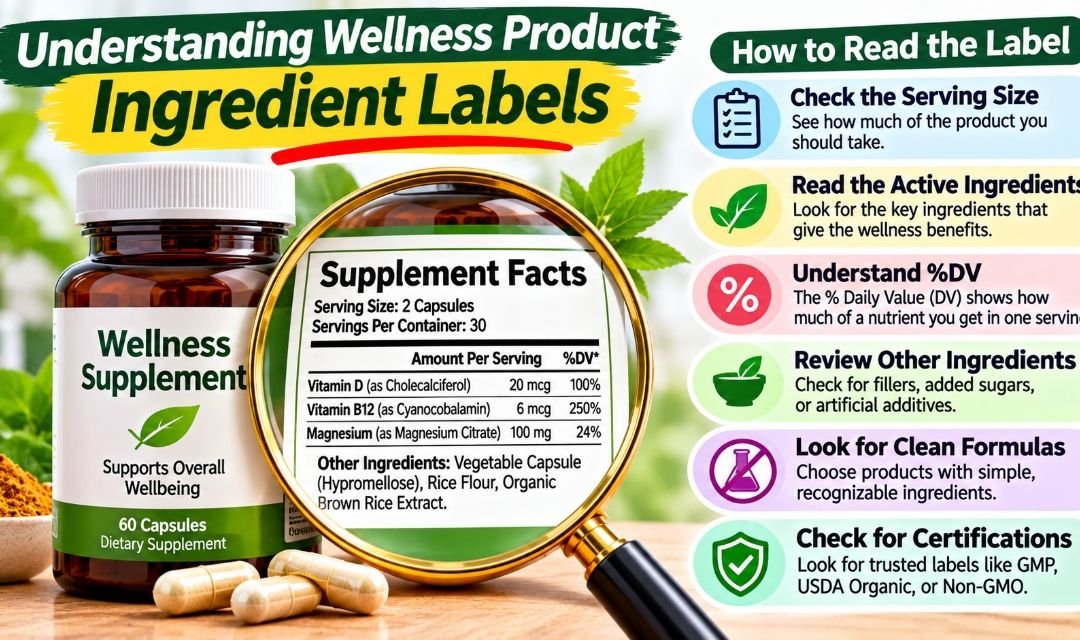
Understanding wellness product ingredient labels is an important skill for anyone who wants to make safer and more informed purchasing decisions. Wellness products such as dietary supplements, herbal preparations, skincare products, essential oils, and personal care items often contain ingredients that are difficult to recognize. Some labels include scientific names, unfamiliar abbreviations, or complicated claims that can confuse consumers. Learning the basics of ingredient labeling can help people understand what a product contains, compare different options, and recognize possible safety concerns before using it.
Quick Overview of Wellness Product Ingredient Labels
| Category | Details |
|---|---|
| Main topic | Understanding Wellness Product Ingredient Labels |
| Primary purpose | Helping consumers interpret product information |
| Common product categories | Supplements, skincare, herbal products, personal care |
| Important label sections | Ingredients, amounts, instructions, warnings |
| Active ingredients | Substances intended to produce specific effects |
| Inactive ingredients | Substances used for formulation or stability |
| Common concerns | Allergens, interactions, excessive doses |
| Scientific names | Often used to identify ingredients |
| Supplement information | Nutrient quantities and serving sizes |
| Certifications | May indicate particular quality standards |
| Marketing claims | Require careful evaluation |
| Best approach | Read the complete label before use |
Many people choose wellness products based on attractive packaging.
Words such as natural, organic, clean, pure, and scientifically formulated can make a product sound trustworthy.
However, these words do not always explain what the product contains.
Two products may look similar but have very different ingredients.
One may contain a simple moisturizer.
Another may include fragrances, botanical extracts, and active ingredients that could irritate sensitive skin.
The same problem occurs with dietary supplements.
A product may advertise one vitamin on the front while containing several additional ingredients.
Understanding the complete label can help people make better choices.
What Is an Ingredient Label?
An ingredient label identifies substances used to make a product.
Depending on the product category and country, labels may also provide quantities, serving sizes, warnings, and instructions.
However, labeling requirements differ.
Food supplements, cosmetics, medicines, and medical devices are not regulated in exactly the same way.
Consumers should understand which type of product they are purchasing.
Why Are Ingredient Labels Important?
Ingredient labels provide information that may affect safety and suitability.
They can help consumers identify allergens, compare formulations, and understand intended use.
For example, someone with a fragrance allergy may need to avoid certain skincare ingredients.
A person taking medication may need to check whether a supplement contains interacting substances.
However, a complete ingredient list does not automatically prove that a product is safe or effective.
The amount, quality, intended use, and individual circumstances also matter.
1. Identify the Product Category
The first step is understanding what kind of product you are examining.
Common categories include dietary supplements, cosmetics, herbal preparations, medicines, and fitness products.
Different categories may have different labeling requirements.
For example, a supplement label may provide nutrient amounts per serving.
A cosmetic label may list ingredients without giving the exact concentration of every substance.
Understanding the category helps you interpret the information correctly.
2. Read the Entire Ingredient List
Do not rely only on the front of the package.
Marketing claims may highlight one attractive ingredient while leaving other substances less noticeable.
Read the complete list.
Look for ingredients you recognize and identify unfamiliar substances when necessary.
However, unfamiliar names do not automatically indicate danger.
Many ordinary ingredients have scientific names.
3. Understand Ingredient Order
In many food and cosmetic labeling systems, ingredients are listed according to their weight or concentration, usually from highest to lowest, subject to specific regulatory exceptions.
However, the exact rules vary by country and product category.
An ingredient appearing near the beginning may be present in a larger amount.
An ingredient appearing near the end may be present in a smaller amount.
This does not automatically establish safety or effectiveness.
4. Learn About Active Ingredients
Active ingredients are substances intended to produce a particular effect.
For example, some skincare products contain salicylic acid for acne-related purposes.
Certain supplements contain vitamins or minerals intended to address nutritional needs.
However, active ingredient terminology differs across regulatory categories.
Consumers should not assume that every highlighted ingredient has proven medical benefits.
5. Understand Inactive Ingredients
Inactive ingredients help create the final product.
They may improve texture, stability, appearance, or shelf life.
Examples include certain fillers, binders, preservatives, and emulsifiers.
However, inactive does not mean incapable of causing a reaction.
Some individuals may be sensitive or allergic to particular formulation ingredients.
6. Check Ingredient Quantities
The amount of an ingredient can be important.
A vitamin supplement may contain a modest amount or a very high dose.
Two products with the same ingredient may therefore have different risks.
However, not every product category requires exact quantities for all ingredients.
When amounts are unclear, consumers should avoid making assumptions.
7. Understand Serving Size
Serving size is especially important for supplements.
A label may list nutrient amounts per capsule, tablet, scoop, or multiple-unit serving.
For example, a product might list the amount of an ingredient for two capsules rather than one.
Consumers should read this information carefully.
Taking more than the recommended amount may increase the risk of adverse effects.
8. Understand Daily Value Percentages
Some supplement labels display a percentage of Daily Value.
This indicates how a serving contributes to a reference daily intake.
However, Daily Values are general labeling standards.
They are not personalized recommendations.
A product containing 100% of a Daily Value is not necessarily appropriate for every individual.
9. Recognize Common Allergens
Allergens are substances that can trigger allergic reactions in susceptible individuals.
Common food allergens include milk, eggs, peanuts, tree nuts, soy, wheat, fish, shellfish, and sesame.
However, allergen labeling rules vary by country and product category.
Cosmetics and herbal products may also contain ingredients capable of causing reactions.
People with allergies should review labels carefully.
10. Understand Fragrance Ingredients
Fragrances are common in skincare and personal care products.
They may be listed under terms such as fragrance or parfum.
However, fragrance mixtures can contain multiple substances.
Some people develop irritation or allergic reactions.
Fragrance-free products may be preferable for certain sensitive individuals.
However, fragrance-free does not guarantee that a product will never cause a reaction.
11. Understand Preservatives
Preservatives help prevent microbial growth or product deterioration.
They are particularly important in products containing water.
However, some preservatives can cause sensitivity in certain individuals.
The presence of a preservative does not automatically make a product harmful.
Products without adequate preservation may also present contamination risks.
12. Learn About Botanical Extracts
Botanical extracts are ingredients derived from plants.
They may appear under common or scientific names.
Examples include aloe vera, chamomile, and green tea extracts.
However, plant origin does not guarantee safety.
Some botanical ingredients can cause allergies or interact with medications.
The concentration and method of preparation also matter.
13. Understand Essential Oil Labels
Essential oils are concentrated plant-derived substances.
Their labels may identify the botanical source.
However, essential oils can cause skin irritation and other adverse effects.
Some are toxic if swallowed.
Consumers should follow appropriate safety instructions and avoid casual ingestion.
14. Understand Vitamin Labels
Vitamin supplements may contain vitamin A, vitamin C, vitamin D, vitamin E, or B vitamins.
These nutrients have important roles in normal body functions.
However, excessive intake of certain vitamins can be harmful.
Fat-soluble vitamins, including vitamins A and D, deserve particular attention when high doses are involved.
Supplementation should reflect individual needs.
15. Understand Mineral Labels
Mineral supplements may contain iron, zinc, magnesium, calcium, or other nutrients.
These minerals support normal physiological functions.
However, taking excessive amounts can cause adverse effects.
Iron supplements, for example, can be harmful when used unnecessarily or taken in excessive quantities.
People should avoid assuming that more minerals always mean better health.
16. Identify Proprietary Blends
Some supplements list ingredients as part of a proprietary blend.
The label may provide the total weight of the blend without identifying the amount of each component.
However, requirements vary by jurisdiction.
This can make it difficult to evaluate individual ingredient doses.
Consumers should be cautious when important quantities are not disclosed.
17. Understand Herbal Supplement Labels
Herbal supplements may contain plant extracts, powders, or concentrated preparations.
Labels may provide botanical names and extract ratios.
However, these details do not automatically establish effectiveness.
Some herbs can interact with medications.
People should seek professional advice when necessary.
18. Check Caffeine Content
Some wellness products contain caffeine.
Examples include energy supplements, certain fitness products, and stimulant-containing beverages.
Caffeine can temporarily increase alertness.
However, excessive intake may cause anxiety, palpitations, or sleep problems.
Consumers should consider caffeine from all sources.
19. Recognize Added Sugars
Some wellness drinks, gummies, and nutritional products contain added sugar.
These ingredients may appear under different names.
Examples include sucrose, glucose syrup, and other sweeteners.
However, not every sweetener has the same nutritional characteristics.
Reading the nutrition information can help consumers understand the product.
20. Understand Artificial Sweeteners
Some products contain low-calorie or non-sugar sweeteners.
These may be used to provide sweetness with fewer calories.
However, different sweeteners have different properties.
Safety and suitability depend on the specific ingredient, amount, and individual circumstances.
21. Understand Coloring Ingredients
Coloring ingredients are used to change product appearance.
They may be natural or synthetic.
However, natural origin does not automatically indicate greater safety.
Some individuals may experience sensitivity to particular color additives.
Regulatory approval and permitted uses vary by country.
22. Understand Emulsifiers and Stabilizers
Emulsifiers help ingredients mix.
Stabilizers help maintain texture or consistency.
They are common in foods, cosmetics, and other products.
However, their safety depends on the specific substance and intended use.
A complicated ingredient name does not automatically mean a product is unsafe.
23. Understand Product Claims
Packaging may contain statements such as supports immunity, promotes relaxation, or improves energy.
However, these claims can have different meanings depending on the product category and regulatory system.
Some may be supported by evidence.
Others may be exaggerated.
Consumers should distinguish general marketing statements from established medical benefits.
24. Understand the Meaning of Natural
The word natural does not always have a consistent legal meaning across product categories and countries.
It may refer to ingredient origin or manufacturing practices.
However, natural does not guarantee safety, purity, or effectiveness.
Consumers should examine the actual ingredients.
25. Understand Organic Labels
Organic labels may indicate compliance with particular production standards.
However, the standards depend on the certification system.
Organic does not automatically mean more nutritious or safer.
Consumers should verify the certification and understand what it covers.
26. Understand Clean Beauty Claims
Clean beauty is a popular marketing phrase.
However, it does not have one universal regulatory definition.
Different companies may use different criteria.
A product described as clean can still cause irritation or allergic reactions.
Ingredient evaluation remains important.
27. Check Product Warnings
Warnings may identify important risks.
Examples include avoiding contact with eyes, keeping products away from children, or consulting a healthcare professional before use.
These instructions should not be ignored.
However, the absence of a warning does not guarantee complete safety.
28. Check Storage Instructions
Some products require protection from heat, sunlight, or moisture.
Others may require refrigeration.
Improper storage can affect product quality.
Follow the manufacturer’s instructions.
Avoid using products showing signs of contamination or deterioration.
29. Understand Expiration Dates
Expiration dates may indicate the period during which a manufacturer expects a product to meet certain quality specifications.
However, labeling requirements vary.
Some cosmetics use a period-after-opening symbol instead.
Consumers should follow applicable instructions and avoid using visibly deteriorated products.
30. Compare Products Carefully
Two products may advertise the same main ingredient.
However, their formulations can differ.
Compare ingredient lists, quantities, warnings, and relevant testing information.
Price alone does not establish quality.
A more expensive product is not automatically safer or more effective.
Common Wellness Product Label Terms
| Label term | General meaning | Important consideration |
|---|---|---|
| Active ingredient | Intended to produce a particular effect | Evidence and concentration matter |
| Inactive ingredient | Supports formulation | May still cause reactions |
| Natural | Often refers to ingredient origin | Not automatically safe |
| Organic | May follow specific production standards | Does not guarantee effectiveness |
| Fragrance-free | Intended to contain no added fragrance | Does not eliminate all allergy risks |
| Hypoallergenic | Marketed as less likely to cause reactions | Not a guarantee |
| Proprietary blend | Combination of ingredients | Individual amounts may be unclear |
| Third-party tested | Evaluated by an independent organization | Testing scope varies |
| Dermatologist tested | Indicates some form of dermatologist involvement | Does not guarantee suitability |
| Clinically tested | Refers to testing involving a product or ingredient | Study quality must be assessed |
| Vegan | Generally excludes animal-derived ingredients | Not automatically safer |
| Cruelty-free | Usually relates to animal testing practices | Standards vary |
How to Read a Supplement Facts Label
Supplement labels may include several important sections.
Serving Size
This indicates the quantity used to calculate the listed nutrient amounts.
Nutrient Amount
This shows how much of a particular ingredient is present per serving.
Daily Value
This provides a general reference for certain nutrients.
Other Ingredients
These may include capsule materials, binders, fillers, or flavorings.
Warnings
Warnings may identify important precautions or restrictions.
However, supplement labeling rules vary by country.
How to Read a Skincare Ingredient Label
Skincare labels commonly include ingredient lists and instructions.
For example, a moisturizer may contain water, humectants, oils, emulsifiers, and preservatives.
Each ingredient may have a particular formulation role.
However, the exact concentration of every ingredient is not always disclosed.
People with sensitive skin should pay attention to fragrances and known allergens.
How to Read Herbal Product Labels
Herbal product labels may include common plant names, scientific names, extract ratios, and serving instructions.
However, plant extracts vary in strength and composition.
Two products containing the same herb may not be equivalent.
Consumers should also consider medication interactions and possible adverse effects.
Example of Comparing Two Wellness Products
| Feature | Product A | Product B |
|---|---|---|
| Ingredient list | Complete | Incomplete |
| Ingredient quantities | Clearly stated where relevant | Unclear |
| Manufacturer | Identifiable | Limited information |
| Usage instructions | Detailed | Basic |
| Safety warnings | Provided | Missing |
| Testing claims | Verifiable | Unverified |
| Overall transparency | Higher | Lower |
This is an illustrative comparison.
Transparency helps consumers evaluate products, but it does not independently prove safety or effectiveness.
Simple Wellness Product Label Checklist
Before using a wellness product
0 of 10 completed
Copy checklist
Common Mistakes When Reading Ingredient Labels
Consumers sometimes focus on one attractive ingredient while ignoring the rest of the formula.
Other mistakes include:
-
Assuming natural means safe
-
Ignoring ingredient quantities
-
Overlooking allergens
-
Trusting certification logos without verification
-
Believing expensive products are automatically better
-
Taking more than the recommended amount
-
Combining supplements with overlapping ingredients
-
Ignoring medication interactions
-
Assuming all herbal products are harmless
-
Treating marketing claims as scientific proof
Reading labels carefully can reduce some of these risks.
Ingredient Labels and Product Safety
Ingredient labels are useful, but they have limitations.
They may not reveal contamination, manufacturing defects, or inaccurate ingredient amounts.
For this reason, product safety also depends on manufacturing practices, appropriate testing, regulatory oversight, and responsible use.
Consumers should avoid relying on ingredient lists alone.
Frequently Asked Questions About Wellness Ingredient Labels
1. What is a wellness product ingredient label?
It is information identifying substances used in a wellness product.
2. Why should I read ingredient labels?
They help identify ingredients, warnings, and potential allergens.
3. Are ingredients always listed by quantity?
Not always. Rules vary by product category and jurisdiction.
4. What are active ingredients?
They are substances intended to produce particular effects.
5. What are inactive ingredients?
They are substances used for formulation, stability, or other supporting purposes.
6. Are inactive ingredients always harmless?
No. Some can cause allergic reactions or sensitivities.
7. What does natural mean?
It often refers to ingredient origin, but definitions vary.
8. Does organic mean safer?
Not automatically.
9. What is a proprietary blend?
It is a combination of ingredients that may not disclose every individual quantity.
10. Why are scientific ingredient names used?
They help identify substances consistently.
11. Are unfamiliar ingredients dangerous?
Not necessarily. Safety depends on the substance and its use.
12. What does fragrance-free mean?
It generally indicates that no fragrance has been intentionally added, although labeling practices vary.
13. Can skincare ingredients cause allergies?
Yes. Certain ingredients may trigger reactions.
14. Are herbal extracts safe?
Not always. Some can cause side effects or medication interactions.
15. Why does dosage matter?
Excessive amounts of some substances can be harmful.
16. What is Daily Value?
It is a general reference amount used in nutrition labeling.
17. Are supplements regulated like medicines?
Not necessarily. Regulatory requirements vary by country and product category.
18. Does third-party testing guarantee safety?
No. It may verify certain quality characteristics.
19. What does clinically tested mean?
It indicates that some form of clinical testing occurred, but the quality and relevance of the evidence must be assessed.
20. Are expensive products better?
Not automatically.
21. Can supplements interact with medications?
Yes. Some interactions can be serious.
22. Should pregnant people check ingredient labels?
Yes. Certain ingredients may be unsuitable during pregnancy.
23. Can children use adult wellness products?
Not automatically. Age-specific safety considerations apply.
24. What should I do if a product causes a reaction?
Stop using the suspected product and seek appropriate medical advice. Severe reactions require urgent care.
25. What is the best way to understand wellness ingredient labels?
Read the full label, verify important claims, and seek professional advice when necessary.
Final Thoughts
Understanding wellness product ingredient labels can help consumers make informed decisions about supplements, skincare products, herbal preparations, and other personal care items.
A product should not be considered safe simply because it contains natural ingredients or has attractive packaging.
Ingredient quantities, usage instructions, warnings, and individual health needs all matter.
Learning common label terms can make product comparisons easier.
However, ingredient labels do not provide every detail about manufacturing quality or scientific effectiveness.
Consumers should also consider appropriate testing, regulatory information, and possible interactions.
The best approach is to choose products for a clear purpose, examine their ingredients carefully, and avoid exaggerated marketing claims.
For more wellness product safety guides, healthy lifestyle information, balanced nutrition advice, and practical everyday wellbeing tips, visit Picanto Magazine.
Medical Disclaimer: This article is for general educational purposes only and does not replace professional medical advice, diagnosis, or treatment. Wellness products and dietary supplements may cause side effects or interact with medications. Consult a qualified healthcare professional before using supplements or products to manage medical conditions, particularly during pregnancy, while breastfeeding, or when taking prescription medication.