
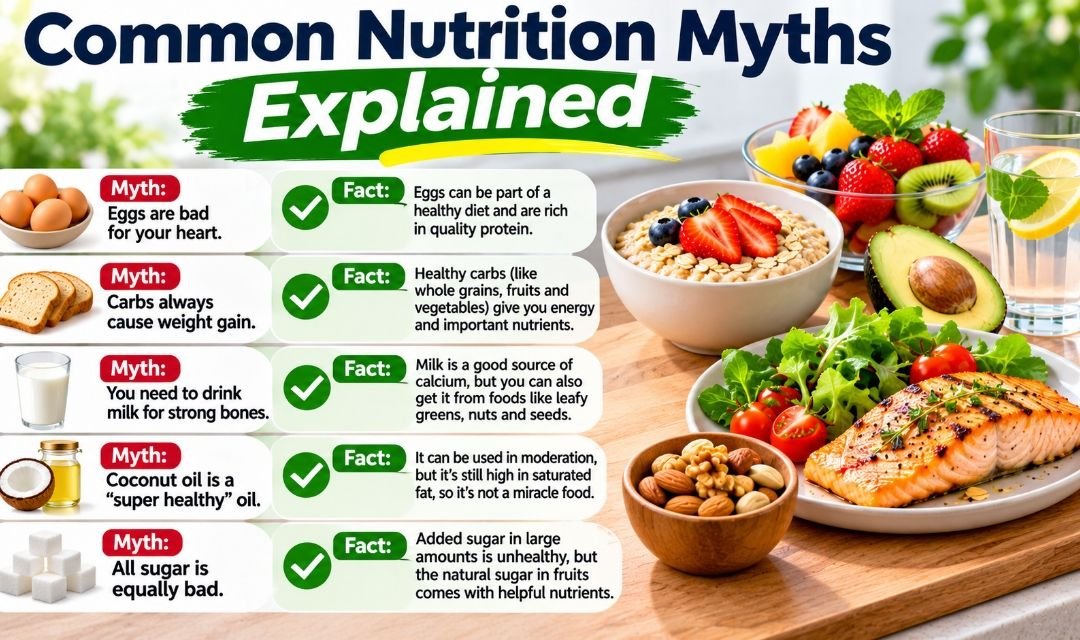
Common nutrition myths explained can help people understand the difference between reliable nutrition advice and misleading food claims. Every day, social media, advertisements, and popular diets introduce new rules about what people should eat. Some claim that carbohydrates cause weight gain, while others suggest that expensive supplements are necessary for good health. However, scientific understanding of nutrition shows that healthy eating is more complicated than following simple food rules. A balanced diet depends on nutritional variety, appropriate portions, individual needs, and sustainable eating habits.
Quick Overview of Common Nutrition Myths
| Category | Details |
|---|---|
| Main topic | Common Nutrition Myths Explained |
| Primary goal | Separating nutrition facts from misinformation |
| Common myths | Carbs are bad, fat causes weight gain, detox diets are necessary |
| Important nutrients | Protein, carbohydrates, fats, vitamins, minerals |
| Healthy eating approach | Balanced and varied diet |
| Weight management | Influenced by multiple factors |
| Sugar | Added sugar and naturally occurring sugar differ |
| Supplements | Useful in specific situations, not always necessary |
| Hydration | Individual fluid needs vary |
| Plant-based eating | Can be nutritious when properly planned |
| Food labels | Helpful for comparing products |
| Main takeaway | Avoid extreme claims and focus on evidence |
Nutrition advice can be confusing.
One day, a particular food is described as healthy. The next day, someone claims that the same food should be avoided.
Many popular nutrition myths spread because they offer simple answers to complicated questions.
But does eating after 8 PM automatically cause weight gain? Is brown sugar healthier than white sugar? Do people really need expensive detox drinks?
Understanding the facts can make everyday food choices easier.
This guide explores 30 common nutrition myths, explains what the evidence suggests, and offers practical advice for building healthier eating habits.
Why Do Nutrition Myths Spread?
Nutrition myths often spread through social media, advertising, personal stories, and misunderstood research.
A dramatic headline can attract attention even when it leaves out important details.
For example, a study involving a small group of people may be presented as proof that a certain food is harmful to everyone.
However, nutritional research is complex.
Results can depend on the study design, population, duration, and many other factors.
Personal experiences can also be misleading.
A diet that works well for one person may not be appropriate for another.
Learning to question exaggerated claims is an important part of nutrition education.
1. Myth: Carbohydrates Are Bad for Your Health
Fact: Carbohydrates are an important source of energy.
The body uses carbohydrates to support normal physical and mental activities.
Foods such as oats, fruits, beans, lentils, and whole grains contain carbohydrates along with other nutrients.
However, carbohydrate quality matters.
Whole grains and fiber-rich foods generally offer more nutritional benefits than foods containing large amounts of refined starches and added sugar.
There is no need for most people to eliminate carbohydrates completely.
2. Myth: Eating Fat Automatically Makes You Fat
Fact: Dietary fat is essential for normal body functions.
Fat helps the body absorb certain vitamins and contributes to cell structure.
Healthy fat sources include nuts, seeds, olive oil, and certain fish.
However, fats are energy-dense, and different types have different health effects.
Replacing some saturated fat with unsaturated fat can support cardiovascular health.
Weight changes depend on many factors rather than one nutrient alone.
3. Myth: Skipping Breakfast Always Causes Weight Gain
Fact: Breakfast is not essential for every adult.
Some people prefer eating early in the morning.
Others feel comfortable eating later.
Research does not establish that skipping breakfast automatically causes weight gain.
Overall food intake, nutritional quality, physical activity, sleep, and other factors matter.
However, children and people with certain medical conditions may have different meal-timing needs.
4. Myth: Eating After 8 PM Automatically Causes Weight Gain
Fact: There is no universal time after which food automatically causes weight gain.
Meal timing can influence appetite, sleep, and metabolic health.
However, total dietary intake and individual circumstances remain important.
Eating a large meal immediately before bed may cause discomfort or worsen reflux in some people.
A consistent eating routine can be useful, but strict evening food bans are not necessary for everyone.
5. Myth: All Calories Are Nutritionally Equal
Fact: Calories measure energy, but foods differ in nutritional quality.
For example, an apple and a sugary drink may provide similar amounts of energy.
However, the apple contains fiber and other nutrients.
Foods also differ in how they influence fullness, digestion, and overall dietary quality.
Energy balance matters, but nutrition involves more than calorie numbers.
6. Myth: Detox Diets Remove Harmful Toxins
Fact: The body already has systems that process and eliminate many waste products.
The liver, kidneys, lungs, and digestive system perform important functions.
There is little reliable evidence that commercial detox diets improve these processes in otherwise healthy people.
Some detox products can even be harmful.
A balanced diet, adequate hydration, and appropriate medical care are more useful than extreme cleansing routines.
7. Myth: Drinking More Water Always Improves Health
Fact: Proper hydration is important, but excessive water intake can be dangerous.
Water supports circulation, temperature regulation, and normal kidney function.
However, daily fluid requirements vary.
Drinking excessive amounts can contribute to dangerously low blood sodium in certain circumstances.
The goal is appropriate hydration rather than drinking as much water as possible.
8. Myth: Brown Sugar Is Much Healthier Than White Sugar
Fact: Brown and white sugar have similar nutritional effects when consumed in comparable amounts.
Brown sugar contains small amounts of certain minerals because of its molasses content.
However, these amounts are generally too small to provide meaningful nutritional benefits.
Both contribute added sugar.
Moderating overall added sugar intake is more important than choosing one type over another.
9. Myth: Honey Is Always Healthier Than Sugar
Fact: Honey contains sugars and provides calories.
It also contains small amounts of other compounds.
However, honey is not a nutritional replacement for vegetables, fruits, or other nutrient-rich foods.
It can still contribute to excessive sugar intake.
Honey must never be given to infants younger than 12 months because of the risk of infant botulism.
10. Myth: Fresh Vegetables Are Always Better Than Frozen
Fact: Frozen vegetables can be nutritious.
Many are frozen soon after harvesting.
They can provide vitamins, minerals, and fiber.
Nutrient levels vary depending on the vegetable, storage, and preparation.
Fresh, frozen, and appropriately prepared canned vegetables can all contribute to a balanced diet.
11. Myth: Protein Supplements Are Necessary for Everyone
Fact: Many people can meet their protein needs through ordinary foods.
Eggs, dairy products, fish, poultry, beans, lentils, and tofu provide protein.
Protein supplements may be convenient for certain individuals.
However, they are not necessary for everyone.
Excessive protein intake does not automatically improve muscle growth or health.
12. Myth: More Vitamins Always Mean Better Health
Fact: Vitamins are essential, but excessive intake can be harmful.
Some vitamins can accumulate in the body.
High doses of certain supplements may cause toxicity or interact with medications.
Supplements can be important for diagnosed deficiencies or specific dietary needs.
However, they should not replace a varied diet.
13. Myth: Gluten-Free Foods Are Healthier for Everyone
Fact: Gluten-free diets are medically important for people with celiac disease and certain other gluten-related conditions.
However, avoiding gluten does not automatically improve health for everyone.
Some gluten-free packaged products contain refined starches and limited fiber.
People without a medical reason to avoid gluten do not generally need to eliminate it.
14. Myth: Dairy Products Are Necessary for Everyone
Fact: Dairy products can provide protein, calcium, and other nutrients.
However, people can obtain these nutrients from other suitable foods.
Fortified plant-based alternatives, certain vegetables, tofu, and other foods may contribute.
Nutritional adequacy depends on the complete diet.
People who avoid dairy should pay attention to calcium, vitamin D, and other relevant nutrients.
15. Myth: Plant-Based Diets Cannot Provide Enough Protein
Fact: Well-planned plant-based diets can provide adequate protein.
Beans, lentils, tofu, soy products, nuts, seeds, and whole grains contribute protein.
However, nutritional planning remains important.
Fully vegan diets require reliable vitamin B12 intake through fortified foods or supplements.
Iron, calcium, iodine, vitamin D, and omega-3 fatty acids may also need attention.
16. Myth: All Processed Foods Are Unhealthy
Fact: Food processing covers many different methods.
Freezing vegetables, pasteurizing milk, and canning beans are forms of processing.
These methods can improve convenience, preservation, or safety.
However, some highly processed products contain substantial added sugar, sodium, or saturated fat.
The nutritional composition matters more than the word processed alone.
17. Myth: Organic Food Is Always More Nutritious
Fact: Organic labeling refers to particular production standards.
It does not guarantee that a food contains more vitamins or minerals.
Nutritional differences between organic and conventional foods vary.
Both can contribute to a balanced diet.
People should consider affordability, availability, and overall dietary quality.
18. Myth: Natural Ingredients Are Always Safe
Fact: Natural origin does not guarantee safety.
Some naturally occurring substances can be harmful.
Likewise, some manufactured ingredients have established safe uses.
Safety depends on the substance, dose, exposure, and individual circumstances.
A product labeled natural should still be evaluated carefully.
19. Myth: Fruit Contains Too Much Sugar to Be Healthy
Fact: Whole fruit provides naturally occurring sugars along with fiber, water, vitamins, and minerals.
Eating fruit is generally consistent with healthy dietary patterns.
However, fruit juice does not provide the same fiber benefits as whole fruit.
People with specific medical conditions may need individualized dietary guidance.
20. Myth: Eggs Are Unhealthy for Everyone
Fact: Eggs provide protein and several essential nutrients.
They also contain dietary cholesterol.
However, the relationship between dietary cholesterol and cardiovascular health is more complex than once believed.
For many people, eggs can fit into a balanced diet.
Individual health conditions and the overall dietary pattern matter.
21. Myth: Eating Small Meals Every Two Hours Boosts Metabolism
Fact: Eating more frequently does not automatically increase total daily energy expenditure.
Meal frequency may influence hunger and convenience.
However, the body does not require constant eating to maintain metabolism.
Some people prefer three meals.
Others benefit from smaller, more frequent meals.
The best schedule depends on individual needs.
22. Myth: You Must Avoid All Sugar
Fact: Naturally occurring sugars are present in nutritious foods such as fruit and milk.
Added sugars should generally be limited.
However, eliminating every food containing sugar is unnecessary.
A balanced diet can include occasional desserts.
Overall dietary quality matters more than strict food rules.
23. Myth: Supplements Can Replace Healthy Meals
Fact: Supplements cannot fully replace the benefits of varied foods.
Whole foods provide combinations of nutrients, fiber, and other compounds.
Supplements may help address particular nutritional needs.
However, they are not complete substitutes for balanced eating.
24. Myth: Eating Healthy Food Is Always Expensive
Fact: Nutritious meals can be prepared using affordable ingredients.
Examples include lentils, beans, oats, eggs, rice, and seasonal vegetables.
Frozen and canned foods may also be economical.
Food prices vary by location.
Planning meals and reducing waste can help manage costs.
25. Myth: Drinking Lemon Water Burns Body Fat
Fact: Lemon water does not directly burn body fat.
It can be a refreshing beverage.
Replacing sugary drinks with water may reduce calorie intake.
However, lemon itself does not create a special fat-burning effect.
Weight management depends on multiple factors.
26. Myth: Coconut Oil Is Always Healthier Than Other Oils
Fact: Coconut oil contains substantial saturated fat.
Although it is plant-derived, that does not automatically make it the healthiest choice.
Oils rich in unsaturated fats, such as olive oil, are generally preferred for cardiovascular health.
However, overall dietary patterns and quantities matter.
27. Myth: You Need Expensive Superfoods
Fact: No single food is necessary for good health.
Foods marketed as superfoods may provide useful nutrients.
However, ordinary foods such as beans, oats, vegetables, fruits, and nuts can also be highly nutritious.
Dietary variety is more important than purchasing expensive products.
28. Myth: Healthy Eating Means Never Eating Your Favorite Foods
Fact: Balanced nutrition does not require perfection.
Occasional desserts, snacks, and favorite meals can fit into a healthy dietary pattern.
Rigid restrictions may make eating more stressful.
A sustainable approach focuses on variety, appropriate portions, and consistency.
29. Myth: Exercise Means You Can Ignore Nutrition
Fact: Physical activity and nutrition support health in different ways.
Exercise contributes to fitness, muscle function, and cardiovascular health.
Nutrition provides energy and essential nutrients.
Neither completely replaces the other.
A healthy lifestyle includes both appropriate activity and balanced eating.
30. Myth: One Diet Works for Everyone
Fact: Nutritional needs differ between individuals.
Age, activity level, genetics, health conditions, food preferences, and cultural practices all influence dietary choices.
A diet that works well for one person may not suit another.
Personalized advice may be important for people with medical conditions or specific nutritional goals.
Nutrition Myths vs Facts: Quick Comparison
| Common myth | What the evidence suggests |
|---|---|
| Carbs are always unhealthy | Carbohydrate quality and overall diet matter |
| Fat automatically causes weight gain | Weight is influenced by multiple factors |
| Breakfast is mandatory | Meal timing preferences and needs vary |
| Detox drinks remove toxins | The body has natural waste-processing systems |
| More water is always better | Excessive water intake can be harmful |
| Brown sugar is much healthier | Brown and white sugar are nutritionally similar |
| Frozen vegetables are inferior | Frozen vegetables can be nutritious |
| Everyone needs protein powder | Many people meet protein needs through food |
| Organic means more nutritious | Organic standards do not guarantee higher nutrients |
| Fruit is unhealthy because of sugar | Whole fruit provides fiber and nutrients |
| Lemon water burns fat | No special fat-burning effect is established |
| Superfoods are essential | A varied diet matters more |
| Supplements replace food | Supplements cannot fully replace balanced meals |
| One diet fits everyone | Individual nutritional needs vary |
How to Recognize Misleading Nutrition Advice
Nutrition misinformation often uses exaggerated language.
Statements such as “this food cures every disease” or “never eat this ingredient again” should raise questions.
Reliable nutrition advice usually acknowledges uncertainty and individual differences.
Here are some useful warning signs:
-
Promises of rapid or guaranteed results
-
Claims that one food cures serious diseases
-
Recommendations to eliminate entire food groups without medical reasons
-
Pressure to purchase expensive supplements
-
Reliance only on personal testimonials
-
Claims that scientists or doctors are hiding a simple cure
-
Advice that ignores age, medical conditions, or nutritional needs
A trustworthy claim should be supported by appropriate scientific evidence.
How to Find Reliable Nutrition Information
Nutrition advice should come from credible sources.
Registered dietitians, qualified healthcare professionals, and established public health organizations can provide useful guidance.
Scientific research is also important.
However, one study does not always settle a complicated nutrition question.
Large reviews and consistent findings across multiple studies generally provide stronger evidence.
When reading nutrition information, consider who published it, what evidence supports it, and whether the author is selling a product.
Understanding Food Labels and Nutrition Claims
Food packaging can sometimes create confusion.
Terms such as natural, low-fat, high-protein, and sugar-free may sound healthy.
However, these labels do not describe the entire nutritional profile.
For example, a low-fat snack may contain substantial added sugar.
A high-protein product may also contain significant sodium.
Reading the nutrition facts and ingredient list provides a clearer picture.
Pay attention to serving sizes, fiber, added sugars, sodium, and saturated fat.
How to Build a Balanced Diet Without Following Myths
Healthy eating does not need to be complicated.
A practical approach is to include several food groups throughout the day.
Vegetables and Fruits
These provide fiber, vitamins, minerals, and other beneficial compounds.
Choose different varieties when possible.
Whole Grains
Oats, whole wheat, and brown rice provide carbohydrates and fiber.
They can form part of balanced meals.
Protein-Rich Foods
Eggs, fish, poultry, beans, lentils, tofu, and dairy products can provide protein.
Choose according to dietary preferences and nutritional needs.
Healthy Fats
Nuts, seeds, olive oil, and certain fish provide unsaturated fats.
These can be included in appropriate amounts.
Water and Other Suitable Fluids
Adequate hydration supports normal body functions.
Fluid needs vary according to activity, climate, and medical conditions.
Seven-Day Balanced Eating Plan
This example shows how nutritious meals can be prepared without following extreme food rules.
| Day | Breakfast | Lunch | Dinner |
|---|---|---|---|
| Monday | Oatmeal with banana | Lentils, rice, vegetables | Chicken or tofu with vegetables |
| Tuesday | Eggs and whole-grain toast | Chickpea salad | Fish or beans with potatoes |
| Wednesday | Yogurt with fruit | Vegetable wrap with protein | Lentil soup and whole-grain bread |
| Thursday | Oats with nuts | Rice and vegetable bowl | Tofu stir-fry |
| Friday | Whole-grain toast with nut butter | Bean sandwich | Vegetable pasta with protein |
| Saturday | Eggs with vegetables | Chickpea and rice bowl | Homemade vegetable curry |
| Sunday | Yogurt with oats | Lentil salad | Balanced family dinner |
Portions should reflect individual nutritional needs.
Snacks can be added when appropriate.
This plan is an educational example rather than a personalized diet.
Common Mistakes People Make When Following Nutrition Trends
Nutrition trends can encourage unnecessary dietary changes.
Some people stop eating carbohydrates because they hear that carbs are unhealthy.
Others purchase supplements without knowing whether they need them.
Another common mistake is believing that expensive foods are always more nutritious.
These habits can increase costs and make healthy eating unnecessarily difficult.
A better approach is to focus on dietary variety, appropriate portions, and reliable information.
Nutrition Myths About Weight Management
Weight management is one of the most common areas of nutrition misinformation.
Popular diets often promise rapid changes through strict rules.
However, body weight is influenced by genetics, energy intake, physical activity, medications, sleep, medical conditions, and environmental factors.
No single food automatically causes weight gain or guarantees weight loss.
Extreme diets can create nutritional deficiencies or unhealthy eating patterns.
People seeking weight-management treatment may benefit from individualized professional guidance.
Nutrition Myths About Plant-Based Eating
Plant-based eating is sometimes misunderstood.
Some people believe that plant-based diets cannot provide enough protein.
Others assume every vegan product is automatically healthy.
Neither claim is correct.
Well-planned plant-based diets can provide adequate nutrition.
However, fully vegan diets require reliable vitamin B12 intake.
Iron, calcium, iodine, vitamin D, zinc, and omega-3 fatty acids may also require attention.
Packaged vegan foods should still be evaluated using nutrition labels.
Nutrition Myths About Natural Wellness Products
Natural wellness products are often promoted with broad health claims.
However, natural does not automatically mean safe or effective.
Herbal products and dietary supplements can cause side effects or interact with medications.
Some products contain ingredients that have not been adequately studied for particular health claims.
Consumers should avoid assuming that a product is beneficial simply because it comes from a plant.
Nutrition Myths About Hydration
Hydration is essential for normal body functions.
However, there is no universal water intake target suitable for everyone.
Fluid requirements vary with age, activity, climate, food intake, and health conditions.
Another common myth is that every caffeinated beverage causes dehydration.
In reality, coffee and tea can contribute to daily fluid intake.
However, excessive caffeine may cause unwanted effects.
The goal is to maintain appropriate fluid balance.
Nutrition Myths About Daily Energy
Many products claim to provide instant or lasting energy.
However, vitamins do not directly provide calories.
Carbohydrates, fats, and proteins supply energy.
Vitamins and minerals support the body’s ability to use these nutrients.
Caffeine may temporarily increase alertness, but it cannot replace adequate sleep.
Persistent fatigue may have medical causes and should not automatically be treated with supplements.
Frequently Asked Questions About Common Nutrition Myths
1. What are nutrition myths?
Nutrition myths are misleading or unsupported beliefs about food, nutrients, diets, and health.
2. Why do nutrition myths spread?
They often spread through advertising, social media, personal stories, and misunderstood research.
3. Are carbohydrates unhealthy?
No. Many carbohydrate-rich foods provide important nutrients.
4. Does eating fat cause weight gain?
Not automatically. Weight is influenced by many factors.
5. Is breakfast necessary?
Not for every adult. Overall nutritional intake matters.
6. Does eating late at night cause weight gain?
Not automatically. Meal timing is only one part of a larger dietary pattern.
7. Do detox diets work?
There is limited reliable evidence supporting commercial detox diets for general health.
8. Is brown sugar healthier than white sugar?
They are nutritionally similar.
9. Is honey better than sugar?
Honey contains sugar and calories and should not be treated as a health food simply because it is natural.
10. Are frozen vegetables nutritious?
Yes. They can provide important vitamins, minerals, and fiber.
11. Does everyone need protein supplements?
No. Many people can meet protein requirements through food.
12. Can too many vitamins be harmful?
Yes. Excessive doses of certain vitamins can cause adverse effects.
13. Is gluten-free food healthier?
Not necessarily. Gluten-free diets are important for specific medical conditions.
14. Are vegan diets low in protein?
Not necessarily. Well-planned vegan diets can provide adequate protein.
15. Are all processed foods unhealthy?
No. Nutritional quality varies considerably.
16. Is organic food always more nutritious?
No. Organic production does not guarantee higher nutrient content.
17. Is fruit unhealthy because it contains sugar?
No. Whole fruit provides fiber, vitamins, and other nutrients.
18. Are eggs unhealthy?
Eggs can fit into a balanced diet for many people.
19. Does eating frequently boost metabolism?
More frequent meals do not automatically increase total daily energy expenditure.
20. Is all sugar bad?
Naturally occurring sugars in nutritious foods differ from added sugars.
21. Can supplements replace meals?
No. Supplements cannot fully replace a varied diet.
22. Is healthy eating expensive?
Not necessarily. Affordable nutritious foods are widely available, although prices vary.
23. Does lemon water burn fat?
No special fat-burning effect has been established.
24. Are superfoods necessary?
No. A varied diet is more important than individual superfoods.
25. Is coconut oil always healthy?
No. It contains substantial saturated fat.
26. Can exercise replace healthy eating?
No. Nutrition and physical activity support health in different ways.
27. Do energy drinks improve health?
They are not necessary for good health and may contain substantial caffeine or sugar.
28. Is natural food always safe?
No. Natural substances can also cause harm.
29. Should everyone follow the same diet?
No. Nutritional needs vary between individuals.
30. What is the best way to avoid nutrition myths?
Use reliable evidence, question exaggerated claims, and seek qualified professional guidance when necessary.
Final Thoughts
Common nutrition myths explained in simple language can help people make better food choices without unnecessary confusion.
Healthy eating does not require eliminating all carbohydrates, avoiding every processed food, purchasing expensive supplements, or following extreme diet rules.
Instead, balanced nutrition focuses on variety, appropriate energy intake, essential nutrients, and sustainable habits.
Whole grains, vegetables, fruits, protein-rich foods, healthy fats, and suitable fluids can all contribute to a nutritious diet.
However, individual needs vary.
Medical conditions, age, physical activity, and personal preferences can influence dietary recommendations.
The most useful habit is learning to question dramatic nutrition claims and look for reliable evidence.
Good nutrition is not about following every new trend. It is about making informed choices that support long-term health.
For more healthy eating guides, balanced nutrition advice, wellness education, and practical lifestyle tips, visit Picanto Magazine.
Medical Disclaimer: This article is for general educational purposes only and does not replace professional medical or nutritional advice, diagnosis, or treatment. Consult a qualified healthcare professional or registered dietitian before making major dietary changes, using supplements, or managing medical conditions through nutrition.