
Every serious collection, however personal, is shaped by the icons. These are the watches that defined their categories, influenced generations of designers and remain as relevant today as on the day they were introduced. You do not need to own them all, but understanding them is part of understanding watchmaking itself. And among them, one watch arguably changed the course of modern luxury more than any other.
The Audemars Piguet Royal Oak
Audemars Piguet was founded in 1875 in Le Brassus, in the Vallée de Joux, by Jules Louis Audemars and Edward Auguste Piguet, and it remains in the hands of its founding families today. For much of the twentieth century, the house was celebrated for complicated and ultra-thin watches. Then, in 1972, it introduced something no one expected.
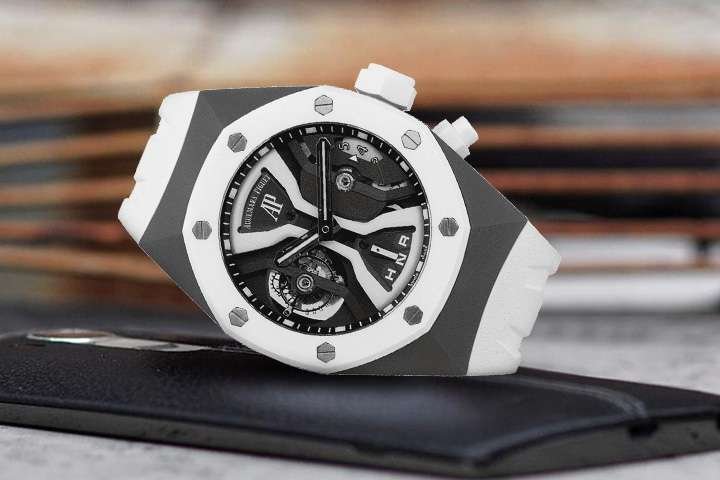
Designed by Gérald Genta, the Royal Oak was a luxury watch made in stainless steel, at a time when steel was considered a material for tool watches. Its octagonal bezel, secured by eight visible hexagonal screws, its integrated bracelet and its finely textured Tapisserie dial created an entirely new category: the luxury sports watch. The combination of satin-brushed and polished surfaces demanded exceptional finishing, and it still does.
Over five decades, the Royal Oak has evolved without losing its identity. The Royal Oak Offshore, introduced in 1993, offered a bolder, more muscular interpretation, while thinner, complicated and gem-set versions have shown how versatile the original design can be. Today the collection spans compact 34mm and 37mm models through to larger chronographs and perpetual calendars, in steel, gold, titanium and ceramic. Its influence can be seen across the industry.
A note on Audemars Piguet price
Collectors frequently ask about Audemars Piguet price. The honest answer is that it varies considerably by reference, case material, size and complication, and demand for certain Royal Oak models means availability can be limited. An authorised retailer is the most reliable source for accurate, current pricing and for guidance on which reference suits you.
Other Swiss icons to know
The Rolex Submariner. Introduced in 1953, it set the template for the modern dive watch, with a robust case, a rotating bezel and a highly legible dial. Few watches move as easily from the ocean to the boardroom.
The Patek Philippe Calatrava. Since 1932, the archetype of the round dress watch: a clean dial, a refined case and nothing superfluous.
The Omega Speedmaster. Launched in 1957 as a racing chronograph, it earned its place in history by accompanying astronauts to the Moon in 1969.
The Jaeger-LeCoultre Reverso. Created in 1931 for polo players, its swivelling Art Deco case remains a masterclass in form following function.
Why the icons endure
Icons combine a clear purpose with distinctive design. They solved a problem, whether diving, timing or simply telling the time with elegance, and they did so in a way that was instantly recognisable. For collectors, they also provide a reference point: understanding why the Royal Oak or the Submariner matters makes it easier to evaluate new releases and make confident decisions about your own collection.
Seeing them in person
Photographs rarely do justice to the finishing and presence of these watches. The interplay of brushed and polished surfaces on a Royal Oak, in particular, has to be seen on the wrist to be appreciated. Ahmed Seddiqi has been bringing the world’s great watch houses to collectors since 1950, and for collectors seeking Audemars Piguet in Dubai, its boutiques are home to the Audemars Piguet Royal Oak collection, alongside other modern classics worth knowing.