
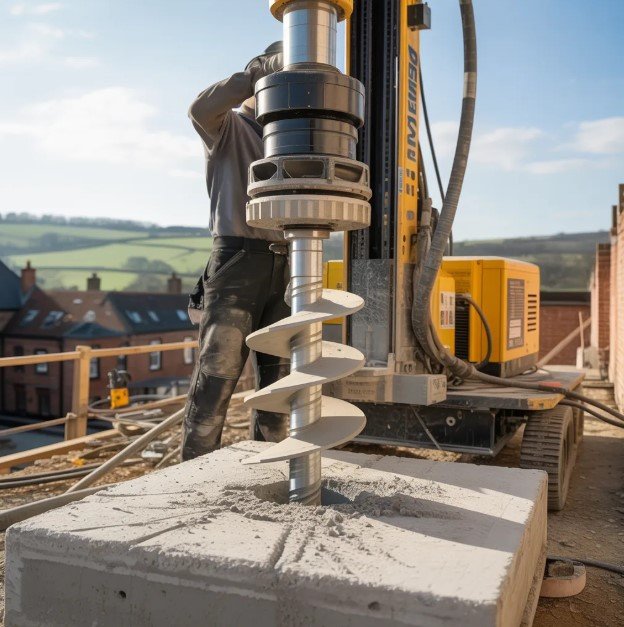
Nothing may appear more simple than the drilling of a small hole and the insertion of a bar. But, in situations where new concrete must connect to old, and a high degree of engineering and structural control is required, these seemingly simple connections convey a major part of the structural load. Drilling thousands of these to the exact size, position and depth is a real test of engineering and construction discipline.
It is equally important for subsequent concreting work. A poorly positioned hole or a bar that is not cut to the specified length is cheap to correct before other work starts.
Where is dowel drilling required?
Dowels are required whenever new concrete is to be integrated with old. The design engineer will make the final decision on what type of connection is to be used, which could also be in the form of dowels. Common examples are:
- Alteration to foundations
- Tying new concrete pads to existing pads
- Alteration and redevelopment of structures
- Reinforcement, repair and upgrade of concrete structures and facilities
- Extending and widening concrete structures and facilities
The dimension, spacing and embedment of dowel holes are defined in the drawings and specifications and should not be left to guesswork.
Why is accuracy important?
Every hole has a function to serve. If it is placed incorrectly, the connection will not be lined up and the structure will be out of alignment. If it is too shallow, the connection will not reach its required embedment. If it is too deep, the existing structure may be compromised needlessly.
It is always a good idea to check a few things before commencing drilling works to save unnecessary time and cost down the track.
These include the diameter and depth of the holes to be drilled, the centre-to-centre spacing and edge distances, alignment and drilling angle, the existing concrete condition and thickness, the position and type of any reinforcement and embedded services, etc.
A few minutes checking the above items saves a lot of time and corrections later, and keeps drilling aligned with the project schedule.
Know what is in the concrete
Bare in mind that you can’t see what is embedded in a concrete slab. Reinforcement, services and other obstructions can be embedded in the concrete, and drilling blind into them causes structural and other problems.
Prior to the drilling works, the available structural plans and site conditions should be assessed to determine the location of reinforcement, and whether further assessment like X-raying is required. If there is a need to change the location of drilling for any reason, this should be confirmed with the engineer or design team.
Access should be taken into consideration as different drilling equipment is required for various working conditions (e.g. basement, limited space, etc.).
Choosing a drilling method
There is no best method. Both rotary-impact drilling and diamond drilling methods are used to drill holes for the post-installed reinforcing bars, and each have their own advantages and disadvantages. Neither method should be used as a default option.
Hilti’s Post-Installed Reinforcing Bar Guide provides information about the drilling methods, locating the reinforcing bars and other aspects of the system. It is important to consider the installation procedure of the system as drilling is only one element of the entire process.
Ultimately, the method should align with the engineer’s specification and the anchoring or reinforcing system used.
A real example: 7,914 dowel holes
Planning is tested at the limit. While working with Erith Contractors Ltd at the Former Biscuit Factory redevelopment in Bermondsey, CA Drillers carried out a package of works that included the drilling of 7,914 dowel holes at the foundation level in concrete pads. Other parts of the package included track and wire sawing of reinforced concrete slabs, and drilling of builders’ openings.
This project only works well when the drilling is organised and consistent. This is what our drilling contractor excels at, as you can read in the Bermondsey Project case study.
A pre-start checklist
Prior to any drilling, the following should be checked:
- Approved Drawings: Layout, diameter, spacing and embedment requirements should be checked.
- Condition of the Structure: The condition of the concrete should be checked, as well as the position of the reinforcement. Structural constraints should be considered.
- Site Investigations: Check the location of embedded services.
- Equipment and Access: Ensure the available equipment is suitable for the job.
- Installation requirements: Confirm the procedure for cleaning the holes and the anchoring or reinforcing system requirements.
- Quality: Agree the procedure for inspection of the finished holes.
Continuous communication between the drilling contractor, site management and the structural engineer will help minimize the occurrence of rework on site.
Final thoughts
Drilling dowel holes is a specialized trade that is often the limiting factor in many structural and refurbishment projects. The successful completion of the work depends on many factors, of which the number of holes drilled is far from the most important. The position of the holes is critical as is the depth. The drilling method can be equally important. The successful completion of the work is dependent on a good understanding of the tasks required of all the other trades on site.
The bigger the project, with the greater the number of holes, the more important the preparation becomes. Drilling gives the next phase of construction an assured start.