
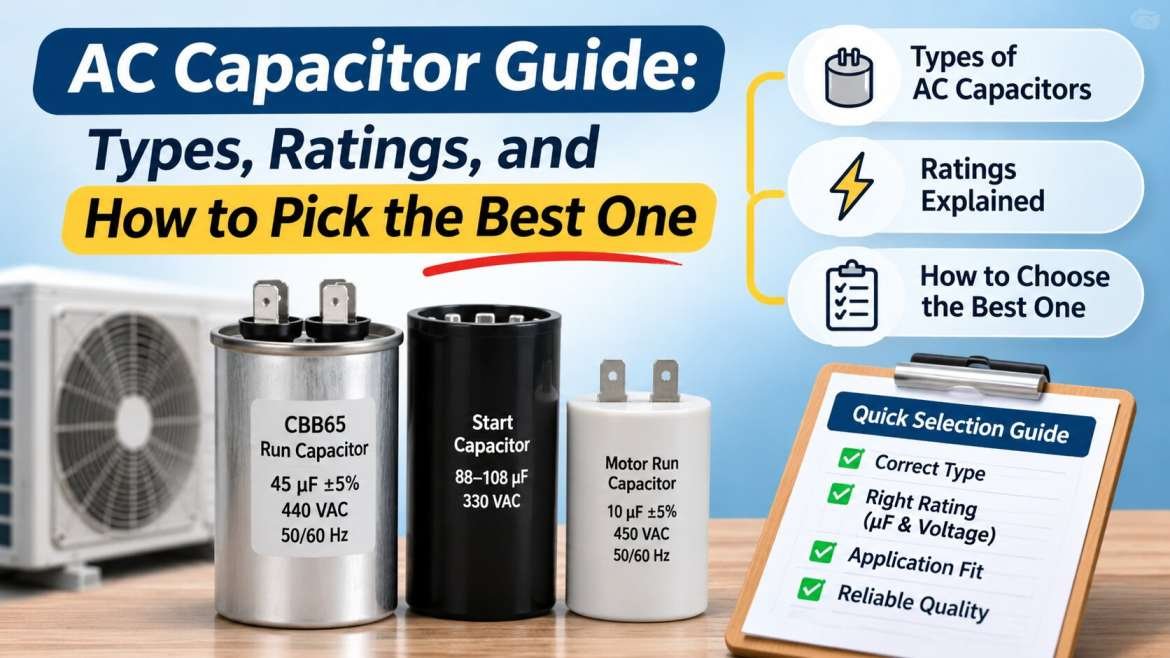
All air conditioners have a small part that most people don’t think about until there is a problem: the capacitor. If your AC is humming but the fan isn’t spinning, the compressor is not starting up during a hot day or the unit is blowing the breaker often, you likely have a blown capacitor. If you know what it is and how to pick the right one, you can prevent repeat repairs, increased power bills and a breakdown in the heat of summer.
Not all capacitors are created equal, and there are great variances in the quality of capacitors available on the market. From technicians and HVAC contractors to bulk part buyers, collaborating with a reliable Leading AC Capacitor Manufacturer in India can significantly impact performance, durability, and warranty support. The reliable manufacturers adhere to uniform test parameters, apply high quality metallized polypropylene film and develop the products to withstand the temperature, dust and voltage variations prevalent in India.
Functions of AC Capacitor
The function of an AC capacitor is to hold the electricity and give it a sudden burst. Single-phase motors, like compressor and fan motors in an air conditioner, require this additional boost to get started and to maintain a constant speed. The capacitor produces a phase shift in the current which flows through the windings of the motor that gives the torque to start the rotation of the rotor.
The motor could not start, overheat, vibrate or draw excessive current if the capacitor is not healthy. This strain over time can cause damage to the compressor, the most costly part of the system. That is the reason it is important to pay attention to a small and inexpensive part.
Main Types of AC Capacitors
1. Start Capacitors
Start capacitors provide a burst of energy for a fleeting moment to start the compressor motor. Once the motor has attained the operating speed, they are no longer in circuit. Although they have large capacitance values, they are meant for occasional use only, and not for continuous duty.
2. Run Capacitors
Run capacitors are present in the circuit all the time the motor is running. They increase efficiency, maintain the level torque, and minimize losses of energy. They have less capacitance than start capacitors but they are designed to be used continuously, usually made of metallized polypropylene film and self-healing.
3. Dual Run Capacitors
A dual run capacitor is a combination of 2 capacitors in one case – one for the compressor and one for the condenser fan motor. It comes with three terminals, typically labelled as C (common), HERM (hermetic compressor), and FAN. This type is the most common in split and window ACs as it takes up less space and requires less wiring.
4. Fan Capacitors
Fan capacitors typically have smaller capacitance values and are smaller in size, and are used in indoor blower motors and other applications. They assist the fan to start up smoothly and to hold their speed.
Understanding Capacitor Ratings
It’s important to read the label correctly to choose a good replacement. These are the primary ratings you’ll need to consider.
- The most important value is the capacitance (µF). Always match the rating and always use it within the tolerance of the label (typically ±5%). An incorrect value may lead to overheating or cooling inefficiency of the motor.
- The voltage rating is the voltage at which the fan will operate, such as 370V and 440V. A 370V unit can be replaced by a 440V unit, but not the other way around.
- Frequency: The frequency of electricity in India is 50 cycles per second. Most capacitors will be rated for 50/60 Hz – always check for this.
- Outdoor units are always subjected to harsh weather conditions, this is why it is important to check the temperature range, e.g., -25°C to +85°C.
- Tolerance: The lower the tolerance the more precise will the motor perform and the longer its life will be.
- Features for safety: A self-healing dielectric, and a pressure-sensitive overpressure disconnect, are both features that give valuable protection against failure and bursting.
Picking the best AC Capacitor
- Compile to the original specifications. Look at the label on the old capacitor to see the value and voltage of the capacitor. Don’t guess or approximate, or it will put strain on the motor.
- Select the appropriate type. Apply dual run capacitors for compressor/fan duty, single run capacitors for one motor and start capacitors only when circuit design requires it.
- Prioritize build quality. The metallized polypropylene film between the plates and a robust aluminium can, with secure terminals and sealing, will last longer when under continuous load. Early signs of bad units is in the material that is used and it is not good quality at an affordable price.
- Check certifications. Seek compliance to IS and IEC. When purchasing in bulk, request test reports and batch traceability.
- Take into account the context of the operation. If the capacitor is used in hot, dusty, or humid areas, select a capacitor that has a broader temperature operating range and good moisture resistance and sealing.
- Check the warranties and support. A good warranty means that the manufacturer is confident in its product and will provide you with a means to recover if a product does not last.
Trim the Causes of AC Capacitor Failure.Trim the Signs Your AC Capacitor Is Failing.
If a weak capacitor can be caught early, it is prevented from causing greater damage. Look out for the following warning signs:
- The compressor or fan fails to turn on, although the AC is humming.
- Fan runs slowly or does not run until manually pushed
- The circuit breaker is breaking often
- Unnecessary increase in Electricity Bill.
- The body of the capacitor is swollen, bulging or leaking.
- The unit automatically turns off during the hottest times of the day.
- Cooling performance becomes significantly reduced
Most frequently encountered errors:
Many failures are repeated due to avoidable errors. Rated for a lower voltage than necessary is one of the most frequently used and causes early breakdown. One is the use of another µF value, because the actual value is “out of stock. Loose terminal connections can also lead to heat and can ruin a new capacitor in weeks. Lastly, purchasing a non-branded and untested part will eventually cost more in calls to repair the compressor and callbacks.
Safety Tips Before Replacing
Capacitors can hold a dangerous charge even after the power is switched off. Always turn off the supply at the main breaker, discharge the capacitor with an insulated resistor, and wear insulated gloves. Take a photo of the wiring before disconnecting anything so you can reconnect it correctly. If you are not trained to handle electrical components, leave the replacement to a qualified technician.
Final Thoughts
A capacitor may be small and affordable, but it protects the most expensive part of your air conditioner. For consistent quality, dependable ratings, and long service life, brands like Concap are worth considering when you source AC capacitors for repair shops, installations, or OEM requirements. Choosing the right specification from a reliable source reduces failures, callbacks, and downtime.