
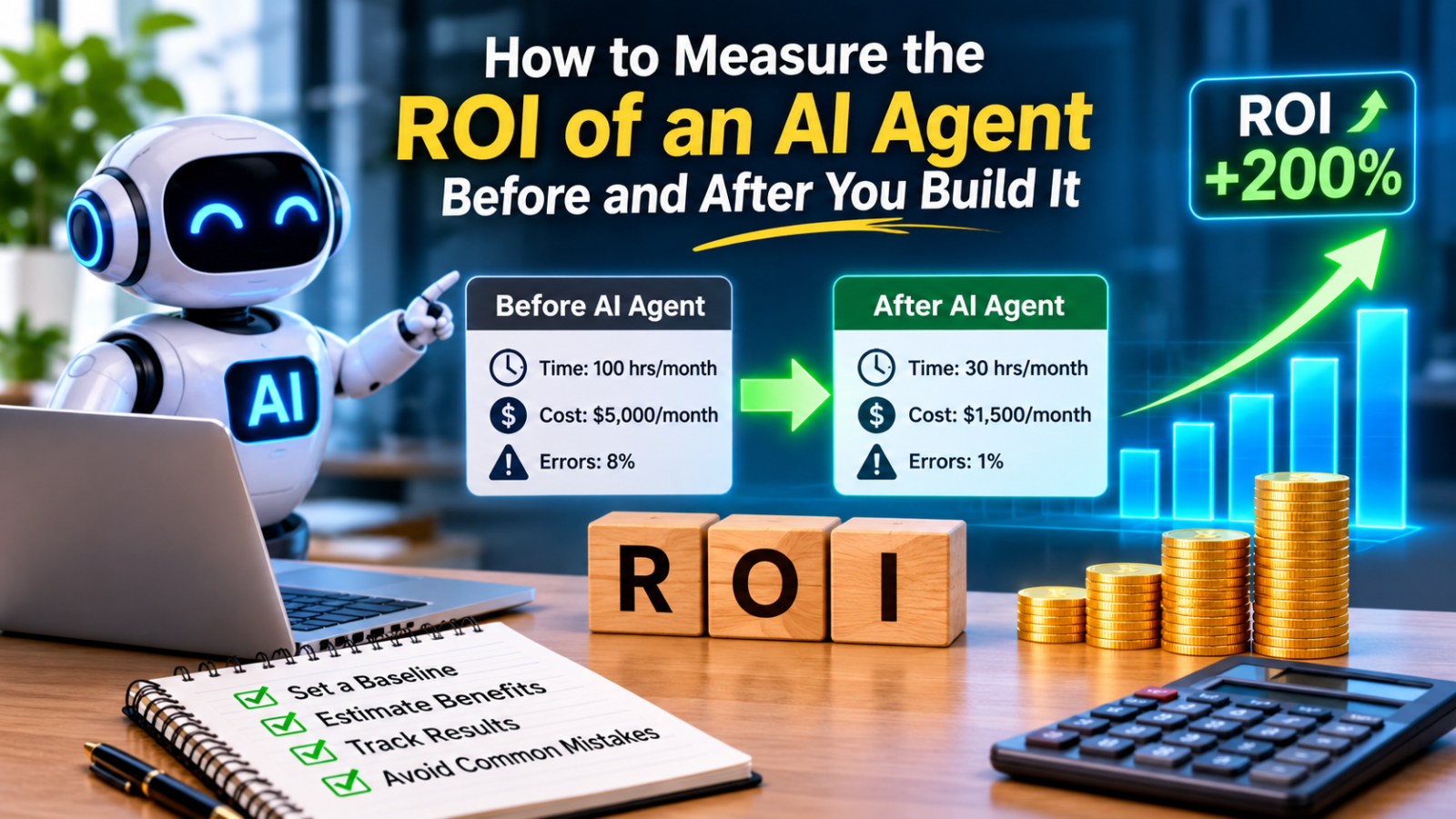
AI agents are easy to approve in a meeting and hard to justify a year later. The demo looked impressive, the team liked it, and then finance asks a simple question: what did we actually get for the money?
The answer is much easier to give if you decide how to measure return before the agent is built, ideally while you are still comparing AI agent development services. Here is a practical way to estimate ROI up front, track it after launch and avoid the common mistakes that make agent projects look better or worse than they really are.
Start with the cost of the work today
Every ROI calculation starts with a baseline. Before anyone builds anything, measure the workflow the agent will take over.
Volume
How many times does the task happen per week or month? Count real cases, such as invoices processed, tickets triaged or orders entered, not estimates from memory.
Time per case
How long does each case take a person, from opening the input to finishing the record? Time a sample of real cases. People usually underestimate the time spent on exceptions.
Cost per hour
Use the fully loaded cost of the people doing the work, including benefits and overhead, not just salary.
Error cost
What do mistakes cost today? A wrong price on an order, a late payment penalty or a missed follow-up all have a number attached.
Multiply volume by time per case by hourly cost, add the cost of errors, and you have the monthly cost of the workflow as it runs now.
Estimate what the agent can realistically take on
No agent handles every case. A realistic plan assumes the agent processes the routine cases and hands the rest to people.
Share of cases handled
Look at your sample and sort cases into routine and exception. If most follow a few clear patterns, the agent can take a large share. If every case is different, it will take less.
Time still needed from people
Even routine cases often need a quick review, especially early on. Budget a few minutes of human review per case for the first months, then reduce it as the agent earns trust.
Running cost
Agents cost money every time they run: model usage, hosting and monitoring. Estimate the cost per case and multiply by volume. For most business workflows this is small compared with staff time, but it should be in the model.
Put the numbers together
A simple monthly ROI view looks like this:
- Cost of the workflow today
- Minus the cost of the people still involved after the agent is live
- Minus the agent’s running cost
- Equals monthly savings
Compare monthly savings with the build cost to get a payback period. Many well-chosen agent projects pay back within the first year, but the only number that matters is the one from your own baseline.
Count the benefits that aren’t hours
Hours saved are the easiest benefit to measure, but often not the largest.
Speed
Orders entered in minutes instead of hours can mean earlier shipments. Faster quotes can mean higher win rates.
Consistency
An agent applies the same rules every time. That can reduce errors, audit findings and customer complaints.
Capacity
The same team can handle more volume without hiring, which matters most for growing companies.
Track at least one of these alongside hours saved, so the business case doesn’t rest on time alone.
Track ROI after launch
Once the agent is live, measure the same numbers you used for the baseline.
Weekly
Cases handled by the agent, cases escalated to people, review time and errors caught.
Monthly
Running cost, hours saved, and the business measure you chose, such as quote turnaround or days sales outstanding.
Quarterly
Compare actual savings with the original estimate and decide whether to widen the agent’s role, adjust it or stop.
Common mistakes that distort ROI
Skipping the baseline
Without a measured “before”, every “after” is a guess.
Counting all cases as automated
If the agent drafts and a person still checks everything, the savings are smaller than they look. Count review time honestly.
Ignoring running costs
Model usage grows with volume. A cost that looks trivial in a pilot can matter at full scale.
Measuring too early
The first weeks include setup, tuning and cautious review. Judge ROI after the agent has run steadily for a couple of months.
Building it with ROI in mind
The best time to think about return is before the first line of code. When you evaluate vendors, ask each one to help you build the baseline, estimate running cost per case and agree on how success will be measured. A partner who can’t talk about ROI before the build will struggle to show it after.
As an AI Development Company building agents for operations teams, we ask clients for one number before anything else: how many hours the workflow costs today. It keeps every later decision grounded.
The bottom line
AI agent ROI is not mysterious. Measure the workflow today, estimate realistically what the agent will take on, include running costs and review time, and track the same numbers after launch. Do that, and the conversation with finance becomes simple.
About the Contributor
Nishkam Batta, Editor-in-Chief, HonestAI Magazine | AI Consultant, GrayCyan AI Solutions
Nish leads an applied AI company helping manufacturing and related companies automate operations with human-in-the-loop AI that integrates into ERPs, WMS, CRMs, and other enterprise tools, with an emphasis on explainable AI, clear audit trails, and measurable outcomes. His team builds agentic ERP systems that execute multi-step tasks inside approved guardrails so humans keep accountability, approvals, and override control.