
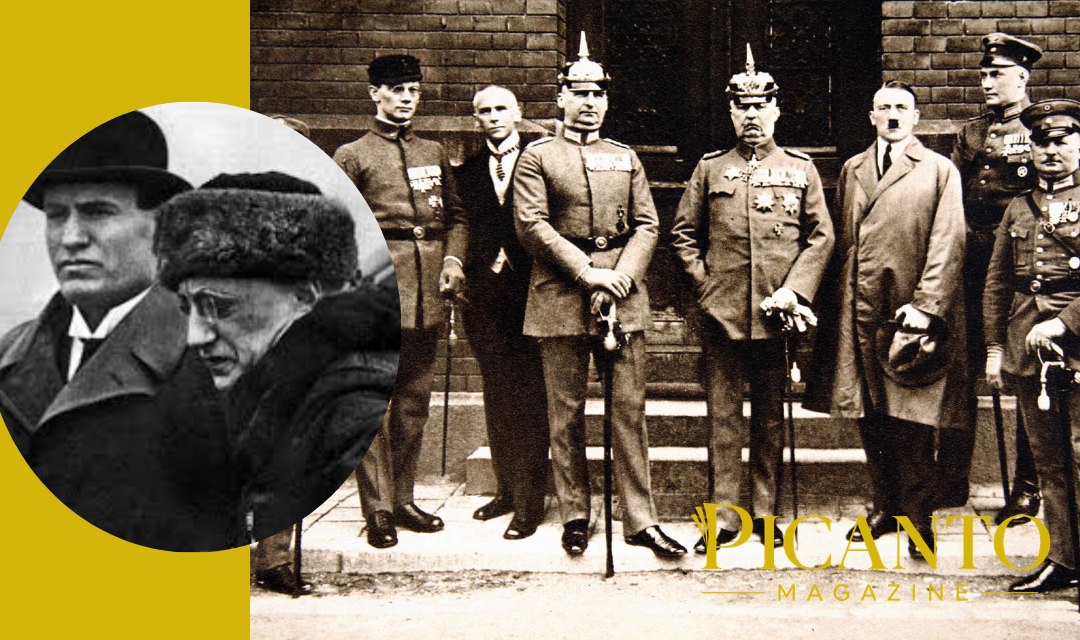
Fascisterne may look like a strange or complicated word, especially if you do not speak Danish. But its basic meaning is actually very simple. Fascisterne means “the fascists” in Danish—the people who support or follow fascism. The Danish dictionary lists fascist as a supporter of fascism and shows -erne as its definite plural ending.
But understanding the word is only the beginning.
Behind Fascisterne is a much bigger story involving political power, strong leaders, nationalism, propaganda, war, and the struggle between dictatorship and democracy. The word takes us back to Europe in the early 1900s, especially Italy under Benito Mussolini, and it also connects with an important part of Danish history.
So, what exactly were the fascisterne? Why did fascism become popular? And why do people still use this word today?
Here is the story in simple English.
Fascisterne Quick Overview
| Detail | Simple Explanation |
|---|---|
| Word | Fascisterne |
| Language | Danish |
| English meaning | The fascists |
| Singular | Fascist |
| Plural | Fascister |
| Definite plural | Fascisterne |
| Related idea | Fascism |
| Famous historical leader | Benito Mussolini |
| Fascist rise in Italy | Mainly after World War I |
| Mussolini became prime minister | 1922 |
| Danish Nazi party | DNSAP |
| DNSAP founded | 1930 |
| German occupation of Denmark | 1940–1945 |
| Modern use | History and political discussion |
What Does Fascisterne Mean?
Let us make this very easy.
A fascist is one person connected with fascism.
Fascister means fascists.
Fascisterne means the fascists.
Think of it like the difference between “cars” and “the cars.” The small change at the end of the Danish word changes it from a general group to a specific group.
Den Danske Ordbog describes a fascist as a supporter of fascism. It also notes that the word can sometimes be used more broadly for someone associated with strongly authoritarian and nationalist ideas.
That is why context matters.
If you see fascisterne in an old history book, it may be talking about actual members of fascist movements.
If you see the word during a modern political argument, someone may be using it much more loosely.
Those are not always the same thing.
What Is Fascism in Simple Words?
Imagine a country where one powerful leader says:
“The nation must come first. Everyone should follow one direction. People who disagree should not be allowed to stand in the way.”
That gives you a simple starting point for understanding fascism.
Historically, fascist movements promoted very strong nationalism and authoritarian government. They usually opposed liberal democracy and gave far more power to the state and its leader.
The United States Holocaust Memorial Museum describes fascism as an authoritarian and ultranationalist political philosophy that places the nation above the individual. Fascist governments typically reject representative democracy and suppress people or groups viewed as threats to national unity.
In simple terms, fascism often involves:
- A very powerful leader
- Extreme nationalism
- Weak or removed democratic checks
- Strong control over political opposition
- Propaganda
- Militarism
- Pressure on people to follow the state
- Limited political freedom
Not every dictatorship is exactly the same, though. Historians study the differences between different authoritarian movements rather than treating all of them as identical.
Where Did Fascism Begin?
The story of modern fascism is closely connected with Italy after World War I.
Europe had just been through a terrible war.
Millions of people had died. Economies were struggling. Families had lost loved ones. Workers were angry. Governments appeared weak to many people.
In that atmosphere, political movements promising strength and order could attract attention.
One man became especially important.
His name was Benito Mussolini.
Mussolini helped build the Italian Fascist movement after World War I. His movement grew during a period of social and political unrest.
In 1922, Fascist supporters carried out the famous March on Rome.
King Victor Emmanuel III then invited Mussolini to form a government.
Mussolini became Italy’s prime minister in 1922. Over the following years, the Fascists destroyed much of the country’s democratic political system and created a one-party dictatorship.
That changed European history.
Why Did People Support the Fascisterne?
This can be difficult to understand today.
Why would ordinary people support a movement that could reduce their political freedom?
There was no single reason.
Some people were frightened by economic problems.
Others feared political revolution.
Some wanted a stronger country.
Others believed promises that a powerful leader could bring stability, jobs, pride, or order.
Propaganda also played an important role.
A political movement does not usually become powerful by simply telling people, “We want to take away your freedom.”
The message may sound much more attractive.
It may promise a better future.
It may tell people that their country was once great and can become great again.
It may blame certain groups for national problems.
And it may present one leader as the person who can solve everything.
That combination can become very powerful when people are scared or angry.
Mussolini and the Growth of Fascist Power
Mussolini did not become a complete dictator in a single day.
That is one of the important parts of the story.
He first became prime minister.
Then his political power increased.
Opposition was weakened.
Fascist influence spread through public life.
Italy gradually became a dictatorship dominated by Mussolini and the Fascist Party.
This is important because political freedom can disappear little by little.
People may notice one change.
Then another.
Then another.
Eventually, the political system can look very different from the one that existed before.
What Did Fascisterne Believe?
Different fascist groups were not identical, but historians identify several ideas that appeared again and again.
The Nation Came First
Fascists believed that the nation was more important than individual people.
A person’s own rights could therefore become less important than what leaders claimed was good for the nation.
Strong Leadership
Fascist movements often celebrated one powerful leader.
The leader was presented as strong, confident, and able to guide the whole country.
Opposition to Liberal Democracy
Free elections, independent political parties, and open disagreement can limit a government’s power.
Fascist movements often saw these limits as weaknesses rather than protections.
Nationalism
Patriotism means loving your country.
Extreme nationalism can go much further.
It may claim that one nation or national group is superior or that outsiders are responsible for the country’s problems.
Militarism
Military strength, uniforms, marches, discipline, and ideas about struggle often became important parts of fascist political culture.
These things helped create an image of unity and strength.
Propaganda Was a Powerful Tool
Imagine hearing the same political message everywhere.
On posters.
In newspapers.
At rallies.
On the radio.
At public events.
Maybe even at school.
After hearing one message again and again, some people may begin to accept it without asking many questions.
That is why propaganda was so useful to authoritarian movements.
Fascist governments tried to shape the way citizens saw their country, their leader, and their enemies.
Large rallies were especially effective.
Thousands of people standing together could make a political movement appear unstoppable.
Symbols, uniforms, flags, speeches, music, and carefully planned public events created a feeling of power and belonging.
What Is the Difference Between Fascism and Nazism?
This is an important question because the two words are often mixed together.
They are closely connected, but they are not simply two different names for exactly the same movement.
Italian Fascism developed under Mussolini.
Nazism developed in Germany under Adolf Hitler.
Both were authoritarian, fiercely nationalist, anti-democratic movements.
However, Nazi ideology placed an especially central focus on racist ideas, antisemitism, supposed racial hierarchy, and the belief in an “Aryan” racial community.
Under Hitler, Nazi Germany carried out systematic persecution and mass murder, including the Holocaust.
Historians therefore often discuss Nazism as a particular and especially radical form of fascism, while still paying attention to its distinctive racial ideology.
What Does Fascisterne Have to Do With Denmark?
This is where the Danish word becomes especially interesting.
Denmark had its own far-right and Nazi movements during the 1930s and 1940s.
The most important was Danmarks Nationalsocialistiske Arbejderparti, usually known as DNSAP.
DNSAP was founded on November 16, 1930.
It was strongly influenced by Hitler’s Nazi Party in Germany. According to Denmark’s historical encyclopedia, the party copied much of the German Nazi Party’s program, imagery, and political language. Its ideas included antisemitism, nationalism, and opposition to parliamentary democracy.
Cay Lembcke was its first leader.
Frits Clausen later became the party’s best-known leader.
Did Fascism Become Very Powerful in Denmark?
No.
That difference matters.
While fascist and Nazi movements existed in Denmark, they never won anything close to the political power that Mussolini achieved in Italy or Hitler achieved in Germany.
Danish Nazi groups remained relatively weak in electoral politics.
Even during the German occupation, DNSAP failed to become the dominant political force it hoped to be.
Denmark’s political history therefore followed a very different path from Italy and Germany.
Still, Danish fascists and Nazis remain an important subject for historians because they help us understand collaboration, political extremism, and life during occupation.
Denmark Under German Occupation
Germany invaded Denmark on April 9, 1940.
Denmark was then occupied by Nazi Germany until 1945.
This created difficult choices for Danish society.
Some people tried to continue normal life.
Some cooperated with the occupation authorities in different ways.
Others joined resistance movements.
And a smaller number actively supported Nazi Germany.
DNSAP was involved in recruiting men for military service connected with Germany. Denmark’s historical encyclopedia records that the party helped recruit volunteers for Frikorps Danmark, a Danish Waffen-SS formation created after Germany attacked the Soviet Union in 1941.
This remains one of the darkest and most debated parts of Denmark’s wartime history.
What Happened to the Danish Fascisterne After the War?
Nazi Germany collapsed in 1945.
Denmark was liberated in May.
DNSAP also fell apart.
After the occupation ended, Denmark began dealing with people accused of collaboration with the German occupiers.
The resistance movement seized DNSAP’s records, including its membership archive.
Part of that information later became connected with what was known as the Bovrup archive.
The history of these records became controversial because it raised difficult questions.
Who should be punished?
Was simply joining a political party enough?
Should former members’ names be made public?
How should a country deal with people who supported an enemy occupation?
Those questions show that the end of a war does not instantly end every problem created by it.
Why Did Fascism Lose Power?
World War II changed everything.
Italy suffered military defeats.
Support for Mussolini weakened.
In July 1943, the Fascist Grand Council turned against him, and King Victor Emmanuel III had Mussolini arrested.
Germany later rescued Mussolini and placed him at the head of a German-backed regime in northern Italy.
But the war was already moving toward its final stages.
Mussolini was captured and killed by Italian partisans in April 1945. Nazi Germany surrendered soon afterward.
The fascist governments that had once appeared extremely powerful had fallen.
Yet the ideas did not completely disappear.
Is Fascisterne Still Used Today?
Yes.
You may still see fascisterne in Danish books, newspapers, documentaries, school materials, and political discussions.
But there is an important difference between historical use and political name-calling.
When discussing Mussolini’s followers, fascist organizations, or actual historical movements, the word has a clear meaning.
Modern political arguments can be messier.
People sometimes call someone a “fascist” simply because they strongly dislike that person’s politics.
That can make the word less precise.
Calling every strict leader or political opponent a fascist can hide the specific historical features that made fascism what it was.
It is better to ask:
Does this person or movement actually show the main characteristics historians associate with fascism?
That gives us a more useful discussion than simply throwing labels at people.
Why Is Learning About Fascisterne Important?
History is not only about memorizing old dates.
It helps us understand how societies change.
The story of fascism shows that democratic institutions cannot always protect themselves automatically.
Fear matters.
Economic problems matter.
Propaganda matters.
Political violence matters.
The way leaders talk about minorities and opponents matters.
And the willingness of ordinary people to question political claims matters too.
Learning about fascisterne is therefore not about becoming trapped in the past.
It is about understanding how power can work.
A Simple Way to Remember the Meaning
If the word still feels confusing, remember this:
Fascism = the political ideology.
Fascist = one supporter.
Fascister = fascists.
Fascisterne = the fascists.
That is all you need to understand the basic Danish meaning.
Everything else is the history behind the word.
Interesting Facts About Fascisterne and Fascism
The word fascism has roots connected with the Latin fascis, meaning a bundle. The ancient Roman fasces—a bundle of rods, often shown with an axe—represented authority. The symbol was later adopted by Italian Fascists.
Mussolini came to power in 1922, but the building of his dictatorship happened over time rather than in one instant.
Danish Nazi movements existed before and during World War II, but they never gained the level of popular political support achieved by fascist movements in Italy or Nazi Germany.
The word fascist is now sometimes used far beyond its original historical meaning, which is why careful context is important.
Final Thoughts
Fascisterne simply means “the fascists” in Danish, but the history behind those two words is anything but simple.
The term connects us with the rise of fascism in Italy, Mussolini’s dictatorship, authoritarian movements across Europe, World War II, and Denmark’s own experience with Nazi-inspired political groups.
Perhaps the biggest lesson is that powerful political movements do not grow in empty spaces. They often grow during periods of fear, anger, uncertainty, and social division.
That is why understanding history matters.
When we know what words such as fascisterne really mean, we can understand political discussions more clearly—and we are less likely to use important historical labels without knowing the story behind them.
Frequently Asked Questions
What does Fascisterne mean in English?
Fascisterne means “the fascists.” It is a Danish definite plural form of fascist.
Is Fascisterne the name of a political party?
No. Fascisterne is a general Danish word for “the fascists.” It is not the official name of one particular party.
Where did fascism begin?
Modern fascism is most strongly connected with Italy after World War I and the political movement led by Benito Mussolini.
Who was Benito Mussolini?
Benito Mussolini was the founder of Italian Fascism. He became Italy’s prime minister in 1922 and later established a fascist dictatorship.
Was Denmark a fascist country?
No. Denmark had fascist and Nazi political organizations, including DNSAP, but they never gained control of Denmark in the way Fascists controlled Italy.
What was DNSAP?
DNSAP was the Danish National Socialist Workers’ Party. It was founded in 1930 and was strongly influenced by Hitler’s Nazi Party in Germany.
Are fascism and Nazism exactly the same?
No. They share major authoritarian and ultranationalist features, but Nazism developed its own especially extreme racial and antisemitic ideology.
Why is the word Fascisterne still important?
It appears in historical writing and modern political discussion. Understanding its real meaning helps people separate serious historical analysis from casual political insults.