
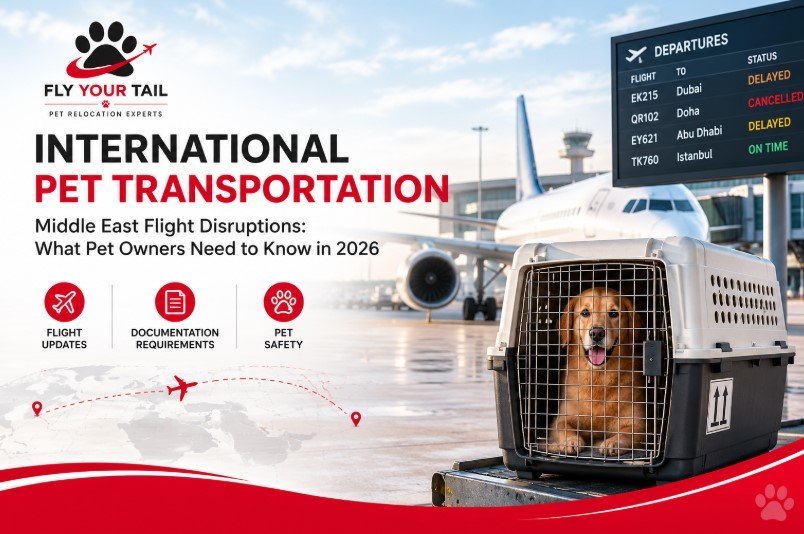
Dubai, Doha and Abu Dhabi are among the busiest connection points between Europe, Africa and Asia. When the regional conflict escalated on 28 February 2026, airspace closures and airport shutdowns hit exactly those corridors, and Cirium estimated that the three big Gulf airlines normally carry around 90,000 transit passengers a day. A passenger can rebook onto the next flight. A pet cannot be moved so easily.
That is why these disruptions matter for international pet transportation. Pets travel under airline-specific acceptance rules, kennel requirements, journey-time limits and vet paperwork that is tied to dates. Change one leg of the route and several of those things can change with it.
This guide explains what has changed, why pets are affected differently from passengers, and how to plan a safer route.
Quick answer: Pets can still travel on routes that use Gulf hubs, but the details have changed. As of late October 2026, reporting shows Dubai, Doha and Abu Dhabi airports operating and UAE airspace open. Even so, some foreign airlines have kept Dubai off their schedules, many flights take longer routes, and pet acceptance rules apply leg by leg. Confirm every leg directly with the airline before you book.
What has actually changed for pet travel through the Gulf
Airports are open, but airspace is still constrained. Late-October reporting describes Dubai, Doha and Abu Dhabi as operating, with the UAE open to commercial flights. It also notes that European aviation regulators continue to advise airlines to avoid large parts of the region’s airspace, so many flights take longer routes.
Airline schedules are patchy and keep moving. After the escalation, a number of non-Gulf airlines suspended services, and return dates have been pushed back repeatedly.
Detours add hours. Early in the crisis, airlines diverted around closed airspace, adding hours to some journeys. For a pet, a longer journey is not just inconvenient. It can push a trip past an airline’s limits (more on that below).
Why pets feel the disruption more than passengers do
- Pets are accepted airline by airline, and often through a different department. Emirates, for example, asks for at least one week’s notice before departure to prepare the paperwork, and only carries animals older than four months. Pets travelling as manifest cargo are handled by its cargo division, and PetRelocation’s guide to Emirates pet travel cites at least four business days for processing. If your flight changes, a new booking may need all of that again.
- The way a pet travels can depend on the direction. Emirates states that pets are not allowed in the cabin (with narrow exceptions such as certain guide dogs and falcons on specific routes). Per PetRelocation’s summary of Emirates rules, itineraries ending in Dubai must travel as cargo, while pets leaving Dubai can travel as checked baggage where the destination allows it and the carrier’s total dimensions are 300 cm or less.
- Journey-time limits can matter more after a detour. Several published summaries of Emirates’ policy mention a 17-hour limit on total journey time for pets travelling as excess baggage. Treat that as something to confirm with the airline for your exact itinerary, because rerouting can lengthen total travel time.
- Vet paperwork is tied to dates. Health certificates often have a short validity window, and some treatments and tests must happen within set timeframes. If your travel date moves, certificates or treatments may need to be repeated.
- Breed and temperature rules apply on every leg. Published summaries report that Qatar Airways Cargo does not accept short-nosed (brachycephalic) breeds, and Gulf carriers also apply seasonal heat restrictions. These rules differ by airline, so you cannot simply swap one carrier for another.
Routes most likely to be affected
Any journey that traditionally connects Europe, Africa, South Asia, Southeast Asia or Australia through a Gulf hub deserves a second look. Two cases come up often.
Pets moving to or from the UAE. The UAE’s Ministry of Climate Change and Environment (MOCCAE) requires an import permit for pets before travel. Permit validity and fees are reported differently across sources, so check the MOCCAE portal rather than relying on a blog post (including this one). A good starting point for pet relocation to the UAE is to settle the import side first, then choose a route that fits the permit’s timing.
Pets moving to India. At the start of the crisis, India’s civil aviation authority classified much of the Middle East’s airspace as high risk, and several airlines cancelled flights. If you are moving a pet to India and would normally have connected through a Gulf hub, ask early about alternatives, and sequence India’s own import paperwork around whichever flight you end up on.
Smarter backup routes to ask about
There is no universal answer, and anyone promising one is guessing. These are the questions that lead to a good plan.
Is the shortest route the best route? Not always. A strong international pet transport planning process weighs airline live-animal policies, aircraft type, transit facilities, temperature restrictions, breed restrictions, kennel size, import rules, transit-country requirements, total journey time and destination handling.
Could another hub work? For some pets, European, Turkish or Asian hubs may offer a workable alternative. One Fly Your Tail client moved three pugs from Los Angeles to Hanoi via Istanbul as live cargo, with a carefully planned long layover and larger crates. Each airline has its own live-animal rules, so this is a question to put to the airline, not an assumption.
Can the pet and the owner travel separately? Pets travelling as manifest cargo can often travel on a different flight from their owner, which gives more routing options. Government rules may still require the owner’s movement to fall within a set window, so check the destination’s rules.
Would waiting be better? Sometimes the safest recommendation is to travel later, when routes, temperatures or documents line up better.
Frequently asked questions
Is it safe to send a pet through Dubai or Doha right now? No one can answer that for every pet and route. The airports are reported as operating, but the answer depends on the airline, aircraft, season, breed, journey time and what the airline will accept on the day. Plan around those details rather than a headline.
Can my pet travel in the cabin through a Gulf hub? Emirates does not allow pets in the cabin, apart from narrow exceptions. Qatar Airways generally carries pets in the hold or as cargo. Check the airline you plan to use.
What happens if a flight is cancelled while my pet is travelling? A specialist will coordinate the next available option, which may mean rebooking, an extra hotel stay or a change of ground transport. Additional costs depend on the circumstances and the airline’s rules.
Should I postpone my pet’s move? It depends on your timeline, route and pet. If your documents are time-sensitive or your pet is a short-nosed breed, get advice early so you have time to choose a different route or date.
Final thoughts
Middle East flight disruptions have not made pet travel impossible, but they have made it less forgiving. The pets that travel best are the ones whose owners ask the right questions early: how the pet travels on each leg, how long the whole journey takes, and what happens to the paperwork if the plan changes.
Fly Your Tail plans each relocation case by case, reviewing the whole journey rather than just the flight.