
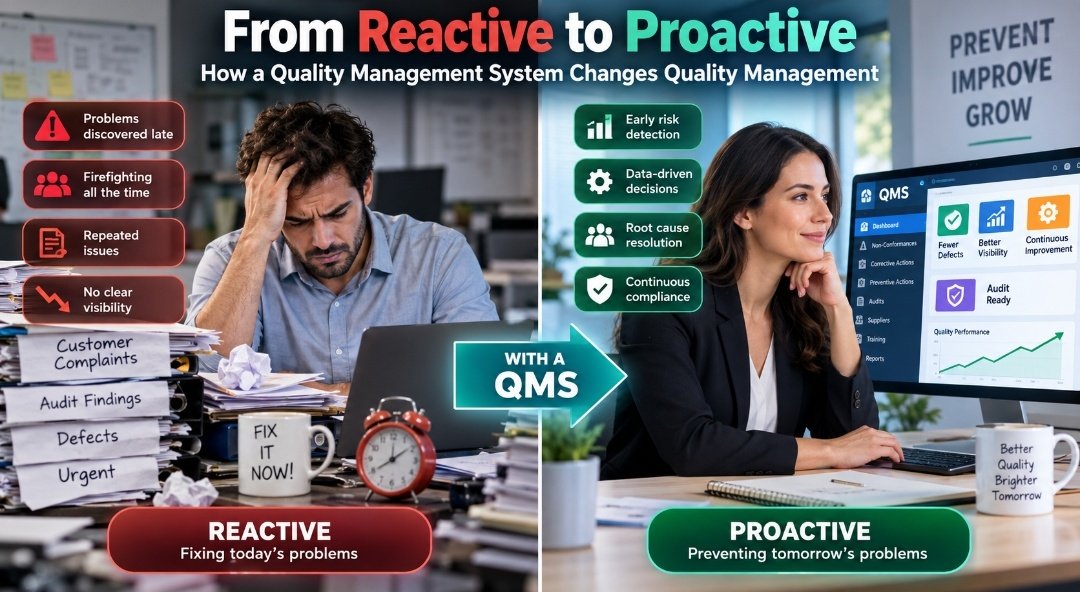
Most quality teams don’t set out to be reactive. It sort of just comes in over time. A complaint shows up , someone fixes it. An audit finding appears, someone addresses it. A defect gets caught on the line, someone reworks it. None of these responses are wrong in their own way, but if you string enough of them together you end up with a quality function that spends all its hours putting out fires instead of preventing them. This is usually the moment where organizations start seriously looking at a Quality management system , not because they want “yet another tool”, but because they’re tired of being one step behind every time.
The shift from reactive to proactive isn’t only a mindset thing. It needs structure, visibility , and a practical method to catch patterns before they turn into repeated failures. That is exactly the gap a properly implemented QMS is meant to close, and it’s worth seeing what that change actually feels like day to day , not just reading about it in theory.
What Reactive Quality Management Actually Looks Like
Reactive quality management has a very recognizable rhythm. Problems get discovered late, most often by a customer or an auditor instead of internally. Fixes handle the immediate symptom, but they don’t dig into the underlying cause in the first place. And because there’s usually no consistent way of tracking things, the same root cause can pop back up months later wearing a slightly different disguise.
This pattern isn’t necessarily proof of a weak team. More often, it’s the sign of a system with no real mechanism for catching issues early. Spreadsheets, and email threads , they simply weren’t built to surface patterns across departments, locations, or time periods. They capture what happened, but they rarely help anyone anticipate what’s coming next.
Why Proactive Quality Management Is Genuinely Different
Proactive quality management basically flips the order, like you don’t wait for something to break and then react. Instead it watches for early signals that usually come just before a failure, you know, drifting process metrics, repeating minor non-conformances, or supplier performance that is slowly trending the wrong way, even if it still looks “fine”.
To do that it takes two things that reactive systems often don’t really have: steady data collection and a way to connect that information across the whole organization. One missed deadline on a corrective action might not mean much by itself. But three missed deadlines from the same team over a two month period… yeah that starts to feel like a pattern, and it’s worth checking, seriously.
Centralized Data Turns Noise Into Signal
One of the most obvious ways a QMS supports this shift is by putting information where it can actually be used, rather than keeping it in scattered places that never meet. Non-conformances, audit findings, supplier scorecards, and training records all end up in one system, not in five separate ones that never talk, or just pretend they do.
Once that data is centralized, patterns that were invisible before become obvious. A defect type that seemed like a one-off in one location might turn out to be happening at three other sites too, just reported slightly differently each time. This is where a platform like Effivity’s quality management system becomes genuinely useful, since it’s built specifically to surface these connections rather than leaving teams to spot them manually.
Root Cause Analysis Becomes Routine, Not Rare
In reactive environments root cause analysis tends to show up only after major incidents, the kind that are serious enough to require a formal investigation. The smaller issues get patched, dismissed, and kind of forgotten, even though they often are early warning signs of a larger problem starting to form.
A proactive approach treats root cause analysis like it should be part of routine handling for any non-conformance, not only the dramatic ones. A QMS makes that practical by structuring the workflow, prompting teams to record findings in a consistent way, and linking related incidents so recurring root causes become more visible over time.
Instead of getting buried in individual case files, you can see how the same problem keeps echoing. Over months, this builds a kind of institutional memory that manual systems simply can’t replicate, because nobody has to try to remember, “oh this happened before” , the system already knows.
Preventive Actions Get Tracked, Not Just Planned
There’s some real difference between saying you’re going to take a preventive action and, ya know, actually following through with it. In manual systems, preventive actions usually get talked about in a meeting, jotted down somewhere, and then quietly forgotten. Not even malicious, just because the next urgent thing demands attention, and everything else kind of… slides.
A structured QMS gives preventive actions ownership and deadlines the same way it does for corrective ones, plus it does automatic follow-up if anything stalls. It’s a minor operational detail, but it lands with a big impact, because it’s often the line between an organization that merely claims it’s proactive and one that truly is.
Compliance Becomes a Constant State, Not a Deadline
Then there’s compliance. Reactive organizations tend to treat compliance like an “event,” like it ramps up right before a scheduled audit, then it calms down again once the noise is over. Proactive organizations handle compliance continuously, so there isn’t any ramp up time since the records were already current to begin with, not “finished” on the eve of review.
This distinction matters beyond just reducing audit stress. Continuous compliance means issues surface and get resolved throughout the year, rather than accumulating quietly until an external auditor happens to notice them. Teams exploring how to make this shift often start by researching quality management system software that supports continuous audit readiness rather than periodic scrambling.
Leadership Gets Ahead of Problems, Not Just Behind Reports
And, honestly, proactive quality management reshapes leadership conversations too. Instead of going over what went wrong last quarter, teams start talking about which metrics are moving in a worrying direction right now, while there’s still time to do something about it. That kind of shift needs dashboards and reports that update continuously, not those manually compiled reports once every quarter.
With a QMS, that near real-time visibility becomes possible, which turns quality reviews into forward-looking conversations rather than after-the-fact recaps of issues that already cost time and money. Over time, it also changes how leadership assigns resources, because it’s easier to spot which processes or suppliers really need attention, instead of relying on whatever problem happened to be the loudest that month.
Grounding This in Established Practice
This shift from reactive to proactive isn’t a new idea within quality management, it’s foundational to how modern quality frameworks are built. The ISO 9001 quality management principles published by ISO explicitly emphasize risk-based thinking and continual improvement as core requirements, not optional extras, which reflects exactly this shift away from purely reactive quality control.
Final Thoughts
Becoming proactive isn’t about eliminating problems entirely. Even the best-run organizations still have non-conformances and the occasional audit finding. The real difference is timing: proactive organizations catch issues while they’re still small, cheap, and easy to fix, rather than after they’ve grown into something that costs far more to address.
A quality management system doesn’t make an organization proactive on its own, but it removes the structural barriers that keep most teams stuck in reactive mode. Once the data is centralized, the tracking is consistent, and the patterns are visible, proactive quality management stops being an aspiration and starts being the default way work gets done.