
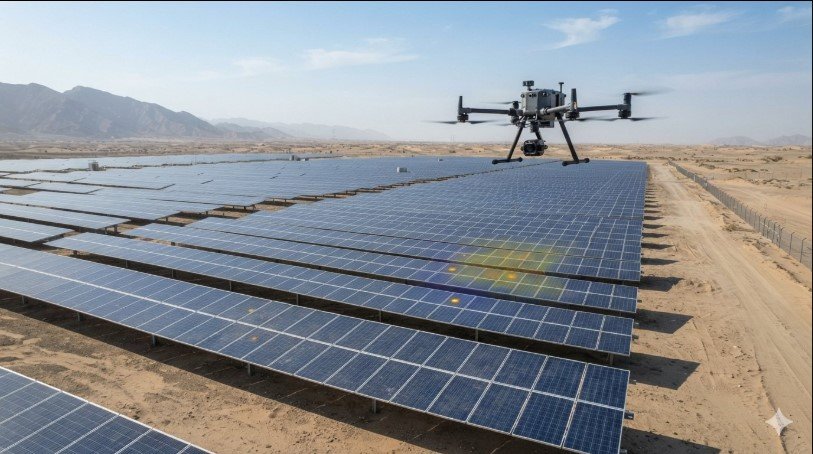
Utility-scale solar is now a familiar part of the UAE’s energy landscape, and plants built over the past decade are settling into long-term operation. Keeping them productive is a different task from building them. Walking rows of panels with a handheld camera is slow, and one underperforming string can hide among thousands of healthy ones. That is why solar farm drone inspection has become a routine tool for owners and asset managers. This guide explains what a drone thermal survey can and cannot tell you, how the work is run, and what to ask before you book. It is based on the approach used for Baseera 360’s thermal drone inspections across the UAE, which are run from Dubai and Abu Dhabi with engineer sign-off on reports.
Why solar inspection matters in the UAE
Solar plants in the Gulf work in demanding conditions. Irradiance is excellent, which is why the region builds so much solar, but fine dust, sand, coastal humidity and very high module temperatures all take a toll. Soiling reduces output, heat accelerates the ageing of cells and connectors, and a small defect can grow into a larger one if nobody sees it early. For an owner or asset manager the practical question is simple: which modules, strings or connections are losing energy, and what should be fixed first?
Thermal imaging helps answer that. A faulty cell, a failed bypass diode or a loose connection often runs hotter than its neighbours, and a radiometric thermal camera shows the difference even when the panel looks perfect to the eye. On a drone, the same camera covers large arrays far faster than a team on foot, and nobody has to walk energised rows in the midday heat. Solar panel thermal inspection is one part of the wider field of infrastructure inspection services, which also covers transmission lines, towers and industrial assets.
How a drone thermal survey works
A good survey follows a repeatable sequence. In practice it looks like this:
- Define the scope. Share layout drawings, string maps, inverter locations, module type and the date of the last cleaning. Without this, anomalies cannot be tied to a specific module or string.
- Confirm permissions and site rules. Flights near airports, grid assets and sensitive sites need approval. The operator should hold the right permissions and agree access with the plant operator. Check current requirements with the General Civil Aviation Authority and any local authority.
- Choose the right conditions. Thermal surveys need clear skies, strong and steady sunlight, light wind and a plant that is generating. Readings from an idle plant or under cloud are hard to trust. The IEC’s technical specification for outdoor infrared thermography of PV modules, IEC TS 62446-3, covers these conditions.
- Plan the flight. Altitude, speed, overlap and camera angle are set so each module is captured clearly and the sun’s reflection off the glass does not create false hot spots.
- Capture thermal and visual images together. Paired images let the analyst separate a genuine heat fault from dirt, shading or a reflection.
- Analyse and classify. Each anomaly is located to a module or string and given a type and a severity.
- Report and retest. A useful report gives a georeferenced anomaly register, photographs, recommended actions and an engineer’s review, and it sets a baseline for the next survey.
Typical findings include a single hot cell, a hot substring pointing to a bypass diode problem, a whole module running warm, an offline string, overheated connectors and uneven soiling. Thermal imaging flags where to look. It does not always explain why. Many faults need a follow-up electrical test on site, so treat the report as a prioritised work list rather than a final diagnosis.
When to schedule surveys
Timing is worth planning. Common trigger points are:
- Before handover or commissioning, to catch installation faults while contractors are still on site
- Before a warranty period ends, so defects are documented in time
- On a regular schedule, often yearly, to track change against a baseline
- After extreme weather, a dust event, a grid fault or an unexplained drop in yield
Summer heat and winter haze each affect thermal readings in different ways, so a competent operator will help you pick the survey window rather than simply offering the first free day.
How to choose a provider
Not every drone operator can deliver a survey you can act on. Before you book a solar farm drone inspection, ask:
- Which thermal camera will be used, is it radiometric, and what resolution will each module get on the ground?
- Does the operator hold the relevant drone permissions for your site, and who handles airspace and site access?
- How are reflections, shading and soiling separated from true defects?
- Will an engineer review and sign off the report?
- Can anomalies be exported by module or string ID so your maintenance team can act on them?
- Will the same flight plan be repeated next time, so results can be compared fairly?
- Who owns the raw images and data after delivery?
Ask for a sample report before you commit. A good one is clear to a non-specialist, shows locations on a plan and ranks faults by urgency. If your plant sits within a larger estate, ask whether the same team can inspect other assets, such as roofs, substations or towers. Baseera’s inspection specialists can scope a survey around your site layout and reporting needs.
Drone thermal surveys will not replace electrical testing or good maintenance, but they make it much easier to find problems early and spend maintenance budgets where they matter. A clear brief, the right conditions and an engineer-reviewed report are what turn a folder of thermal images into decisions.
FAQ’s
Can a drone detect faulty solar panels?
Often, yes. A radiometric thermal camera shows hot spots caused by cell defects, bypass diode faults and loose connections that are invisible in ordinary photos. It tells you where to look, so faults usually still need confirming with electrical testing on site.
What conditions does a solar panel thermal inspection need?
Clear skies, strong and steady sunlight, light wind and a plant that is generating. Cloud, an idle plant or glare off the glass can give misleading readings, so agree the survey window with your operator.
How often should a solar farm be inspected by drone?
There is no single rule. Many owners survey at commissioning, then yearly, and again after extreme weather, grid faults or an unexplained drop in output. Check your operations contract and module warranty terms for any requirements.
Do drone flights over solar plants need approval in the UAE?
Generally yes. Drone operations are regulated, and plant sites can sit near restricted areas. Your operator should manage permissions, but check current requirements with the relevant authority and the site owner.