
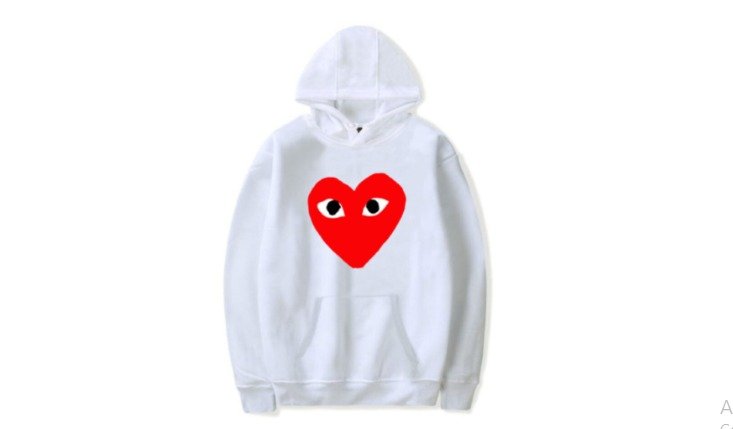
Two eyes. No mouth. A flat red heart that, honestly, stares straight back at whoever is standing in front of somebody’s chest across the subway car. That one small drawing has carried the brand’s name further than any runway show ever did, and it’s the thing people point at first when they’re scrolling the hoodie pages at Comme Des Garcons trying to work out which print is which.
A graphic designer drew it, not the house’s founder
The heart with eyes came from Filip Pagowski, a graphic designer, and it was made for the PLAY line rather than for the main collections. People assume the founder sketched it herself. She didn’t. That matters more than it sounds, because PLAY was never meant to be a shrunken version of the runway work — it’s a separate idea with its own logic, built around one repeated graphic instead of around tailoring.
And that’s why a PLAY piece reads so differently from the rest of the house. No seams doing strange things, no asymmetry, no puzzle. Just cotton, a clean shape, and a heart sitting where a chest pocket would normally go.
Tokyo, 1969
Rei Kawakubo started Comme des Garçons in Tokyo in 1969, and over the decades it stopped being a single label and turned into a group of them. PLAY is the one most people meet first. Alongside it sit Homme and Homme Plus, CDG Shirt, CDG CDG, Noir Kei Ninomiya, and the Parfums side of the business, with designers including Junya Watanabe, Tao Kurihara, Kei Ninomiya and Fumito Ganryu having worked under the same umbrella.
So when somebody says they bought a CDG hoodie, that could mean half a dozen different things. A heart print and a Homme Plus jacket are cousins, basically — same family, very different households.
The eyes are the whole point
Take the eyes away and you’ve got a greeting-card heart. Nothing more. Put them back and the shape turns into a face, which is a slightly unsettling thing to wear on your sternum, and that discomfort is exactly what keeps it from looking sentimental. It’s a heart that watches.
You notice this most when the print runs large. On the Big Red Heart hoodies the mark takes up most of the chest panel, and at that scale the eyes stop being cute and start being a graphic — closer to a band logo than to anything romantic. Shrink it to the small-heart size, though, and the whole thing flips back the other way and sits on you about as loudly as a lapel pin.
Reading the print before you buy
This is where listings trip people up, because several prints share almost the same name. The CDG Hoodie pages run through the lot of them: a big red heart across the front, a small heart up near the collarbone, a zip-up with a large heart split by the zipper teeth, a double-side print with marks front and back, a black heart on a zip hoodie, and a camo version where the heart sits on printed fabric instead of flat cotton fleece.
- A large front heart dominates the chest, so it fights with anything worn open over it
- A small heart near the shoulder reads quiet and sits fine under a jacket
- A split heart on a zip-up only lines up properly when the zipper is pulled all the way
- A double-side print means the back is doing as much work as the front
Prices on those sit in two bands. The plain logo hoodies are listed at $170 and sell around $99, while the heart prints — big, small and the zip-up — list at $175 and land nearer $124. The Play Black Heart Zip is listed higher at $210 and discounted to about $120. Worth knowing before you decide the big print is the cheap one, because it isn’t.
| Pro Tip: Look at the back view in the product photos, not just the front. Some of these hoodies are printed on both sides, and a heart between the shoulder blades changes how the piece layers under an open coat. |
Where else the mark turns up
It isn’t only on fleece. The PLAY heart has been stamped onto Converse for years, and the shop carries the Chuck Taylor All Star ’70 in low and high versions plus Jack Purcell, One Star, Multi Heart and Big Heart makeups, all sitting around $138 after discount. On the Chuck 70s the eyes land on the medial side of the shoe, which means they only show up when you’re mid-step.
The fragrance side skips the heart entirely. Those bottles lean on the pebble shape and the number-and-word naming instead, so if you’re hunting for the logo on a box of eau de toilette, you won’t find it there.
Does the logo tell you anything about quality?
Honestly, no — not on its own. A print is a print. What the mark does tell you is which line you’re looking at, and that’s genuinely useful, because PLAY pieces are cut and priced differently from the main-line garments, and they follow Japanese sizing, which runs smaller than a lot of people expect from a US label.
Judge the garment by the fabric weight and the fit, then. The hoodies here are described as cotton fleece and run from XS all the way to 5XL, and the shop’s own size guide is published in centimeters, so a tape measure beats guessing.
Frequently Asked Questions
Who drew the heart with eyes?
Filip Pagowski, a graphic designer, created it for the PLAY line. It wasn’t drawn by the house’s founder, which is the assumption most people start with.
Is PLAY a separate brand?
It’s a line inside Comme des Garçons, not a different company. The house runs several lines at once — Homme, Homme Plus, CDG Shirt, CDG CDG and others — and PLAY is the graphic-led one.
Do all the heart hoodies have a print on the back?
No. Only the double-side versions do. Everything else carries the mark on the front, either large across the chest or small up near the collarbone.
Why do the eyes sometimes sit on the inside of a sneaker?
On the Chuck 70 lows and highs the heart is placed on the inner side panel rather than the outer one, so it’s half hidden when you’re standing still and visible when you walk.
Once you know the heart belongs to one line and not to the whole house, the catalog gets a lot less confusing — you stop comparing a $99 fleece hoodie with a $299 logo pullover as though they’re the same thing. Measure your chest, decide whether you want the mark loud or quiet, and pick from there.