
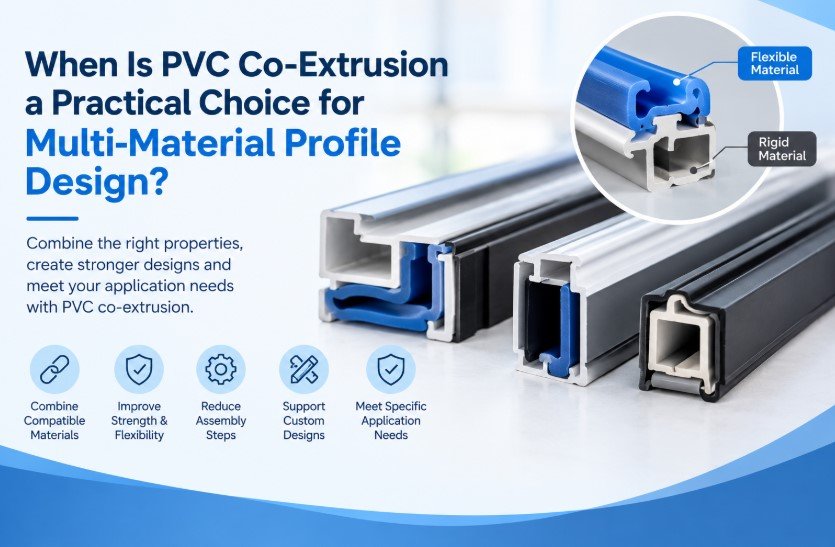
PVC co-extrusion is a practical choice when a product needs two or more compatible materials or material properties in a single profile. It allows manufacturers to combine features such as rigidity and flexibility in one component, provided the materials, design, and production process are suitable. For businesses developing custom industrial parts, PVC co-extrusion solutions for industrial components can be worth considering when a single-material profile does not meet the design requirements.
Understanding when to use co-extrusion helps product designers and purchasing teams make better decisions about profile structure, material selection, production needs, and long-term use.
When Does PVC Co-Extrusion Make Sense?
PVC co-extrusion is useful when a profile needs different material properties in separate sections of the same component. Instead of manufacturing two parts and joining them later, co-extrusion can form multiple materials into one profile during the extrusion process.
For example, an industrial component may need a rigid section to maintain its shape and a flexible section to provide contact or sealing. A suitable co-extrusion design may combine these features in one profile.
PVC co-extrusion may be worth considering when:
- A product needs both rigid and flexible sections.
- The design calls for different material properties in one profile.
- Separate parts would make assembly more complex.
- A custom profile must follow specific drawings and dimensions.
- The production volume supports the required tooling and manufacturing process.
However, co-extrusion is not always the best option. If a profile can meet its requirements using one material, standard extrusion may be simpler. The decision should depend on the product’s function, design, production needs, and cost considerations.
How Does PVC Co-Extrusion Work?
PVC co-extrusion uses two or more extrusion streams to form a single profile. Each material is processed through its own extrusion system before being brought together through a specially designed die.
The materials meet in the die and leave the extrusion line as one combined shape. The profile is then cooled, sized, and cut according to the product requirements.
The exact process depends on the materials, profile design, dimensions, and production equipment.
For successful PVC co-extrusion manufacturing, several factors need careful attention:
Material compatibility
The materials must be suitable for use together. Their processing temperatures, flow behaviour, and bonding characteristics need to be assessed before production. Two materials that look suitable on paper may not form a reliable combined profile under actual manufacturing conditions.
Profile design
The shape of each material section affects how the profile performs. Designers should define where each material is needed, how thick each section should be, and how the different sections will work together.
Tooling and production control
The extrusion die must support the intended cross-section and material flow. Process settings also need to be controlled to maintain the required dimensions and consistency.
Testing and sample approval
Samples help buyers and manufacturers review the profile before bulk production. Checks may include dimensions, appearance, material bonding where relevant, flexibility, and performance under the intended conditions.
What Are the Main Reasons to Choose Multi-Material Extrusion Profiles?
Multi-material extrusion profiles can help solve design problems that are difficult to address with a single material. Their suitability depends on the application and the materials selected.
Combining rigidity and flexibility
Some components need a firm section for support and a softer section for contact or sealing. A suitable co-extruded design can bring these properties together in one profile.
The materials must be compatible with the process, and the finished profile should be tested for its intended use.
Reducing the need for separate components
When two material sections can be formed into one profile, the design may reduce the need to handle and assemble separate parts. Whether this improves manufacturing efficiency depends on the component design and production volume.
Supporting custom product designs
Custom PVC co-extrusion can be useful when a standard profile does not meet a product’s requirements. Manufacturers can develop a profile around customer drawings, dimensions, material specifications, and application needs.
Creating integrated sealing features
Some sealing applications require different material properties in different areas of a profile. Co-extrusion may be suitable when the design calls for a supporting section and a more flexible sealing section.
For a related discussion, read about PVC co-extrusion for durable and reliable seals.
Which Applications May Benefit from PVC Co-Extrusion?
PVC co-extrusion can be considered for a range of industrial and commercial components where the design requires more than one material property.
Possible applications include:
- Sealing profiles: Components that need a supporting section and a flexible contact area.
- Window and door profiles: Designs that may require different properties across separate sections.
- Industrial equipment components: Custom profiles developed around particular fitting, contact, or support requirements.
- Enclosures and protective profiles: Designs where different sections serve separate structural or functional purposes.
- Custom OEM components: Parts made to a customer’s drawings and specifications for use in a larger product.
These are potential applications, not a guarantee that co-extrusion is suitable for every product in these categories. Material compatibility, environmental conditions, dimensional needs, and testing requirements should be reviewed for each design.
PVC Co-Extrusion vs Single-Material Extrusion
The main difference is whether the profile needs one material or several materials with different properties.
| Consideration | Single-material extrusion | PVC co-extrusion |
| Material structure | Uses one material in the profile | Combines two or more materials |
| Design requirements | Suitable when one material meets the requirements | Useful when different sections need different properties |
| Production setup | May be simpler, depending on the profile | Usually requires more complex tooling and process control |
| Assembly | Separate components may be needed for different functions | May combine sections into one profile |
| Material compatibility | One material is selected for the application | Materials must be compatible with the process and intended use |
| Cost considerations | Depends on material, tooling, and production volume | Depends on tooling, materials, complexity, testing, and production volume |
Neither method is automatically better. Single-material extrusion may be the practical choice for a straightforward profile, while co-extrusion may suit a design that needs multiple material properties in one component.
What Should You Check Before Ordering PVC Co-Extrusion Profiles?
Before choosing a manufacturer, prepare clear product requirements. This helps determine whether co-extrusion is technically suitable and what needs to be confirmed before production.
1. Define the profile’s function
Explain what the component needs to do. Identify whether it must provide support, flexibility, sealing, protection, or another function.
2. Provide drawings and dimensions
Share the profile cross-section, dimensions, tolerances, and any important details about the different material sections. If a drawing is not available, discuss whether a design specification can be prepared.
3. Confirm material requirements
Specify the required PVC grades or other materials, where known. Ask the manufacturer to assess material compatibility and processing requirements rather than assuming that all materials can be combined.
4. Discuss the operating environment
Explain how the profile will be used, including relevant temperature ranges, exposure conditions, contact surfaces, and expected mechanical demands. These details help guide material selection and testing.
5. Review samples before bulk production
A sample can help confirm whether the profile matches the intended shape, dimensions, appearance, and functional requirements. Agree on the checks needed before approving a bulk order.
6. Consider production volume and lead time
Tooling, setup, material availability, and order quantity can affect the overall production plan. Discuss expected volumes and delivery requirements early in the process.
When Is PVC Co-Extrusion Not the Right Choice?
Co-extrusion may not be necessary when a single material can meet all the product requirements. Adding another material can increase tooling complexity, process control needs, and testing requirements.
It may also be unsuitable if the selected materials cannot be processed together reliably or if the required profile design cannot be produced consistently.
Before proceeding, compare co-extrusion with alternatives such as single-material extrusion or assembling separate components. The right choice is the method that meets the product requirements with an appropriate balance of function, manufacturability, quality, and cost.
How M3 Extrusion Supports Custom Profile Manufacturing
M3 Extrusion is an Indian manufacturer of customised plastic extrusion profiles for industrial and commercial applications, supplying products to customers worldwide. With more than 13 years of manufacturing experience, the company works with business customers on profiles developed to their drawings, specifications, dimensions, and bulk production requirements.
For projects involving co-extruded profiles, buyers should share the intended application, profile drawing, material requirements, and expected order quantity so the manufacturing requirements can be reviewed. Material compatibility, tooling needs, sample approval, and production feasibility should be confirmed for each project.
M3 Extrusion supports sample production before bulk orders, helping customers review the profile against their requirements before proceeding with larger quantities.
Frequently Asked Questions
1. What is PVC co-extrusion?
PVC co-extrusion is a manufacturing process that combines two or more material streams into one profile through a specially designed extrusion die. It can be used when a component needs different material properties in separate sections.
2. Can rigid and flexible PVC be combined in one profile?
It may be possible, depending on the specific PVC formulations, processing conditions, profile design, and bonding requirements. Compatibility should be assessed and confirmed through suitable testing before bulk production.
3. What is the difference between co-extrusion and overmoulding?
Co-extrusion forms multiple materials into a profile during an extrusion process. Overmoulding generally involves moulding one material over or around another component. The suitable process depends on the part design, materials, and production requirements.
4. Is PVC co-extrusion suitable for sealing profiles?
It can be suitable when a sealing profile needs different properties in separate sections, such as a supporting section and a flexible contact area. The material combination and finished profile must be checked for the intended sealing application.
5. Does PVC co-extrusion reduce manufacturing costs?
Not always. It may reduce the need for separate components or assembly steps, but tooling, material selection, production complexity, and testing can add costs. A comparison based on the design and expected order volume is needed.
6. What information should I provide when requesting a custom co-extruded profile?
Provide a profile drawing or cross-section, dimensions and tolerances, material requirements, intended application, operating conditions, expected order quantity, and any testing requirements. This information helps the manufacturer assess feasibility and prepare for sample development.
Summary
PVC co-extrusion is a practical choice when a custom profile needs two or more compatible materials to provide different properties in one component. It can support integrated sealing features, reduce the need for separate parts in some designs, and meet specialised industrial requirements.
Before selecting PVC co-extrusion, review the material compatibility, profile design, production process, sample requirements, and expected order volume. If one material can meet the requirements, single-material extrusion may be the simpler option.
For businesses developing custom industrial or commercial profiles, M3 Extrusion can review project requirements and discuss the manufacturing needs. Contact M3 Extrusion to discuss your profile drawing, material requirements, and bulk production plans.