
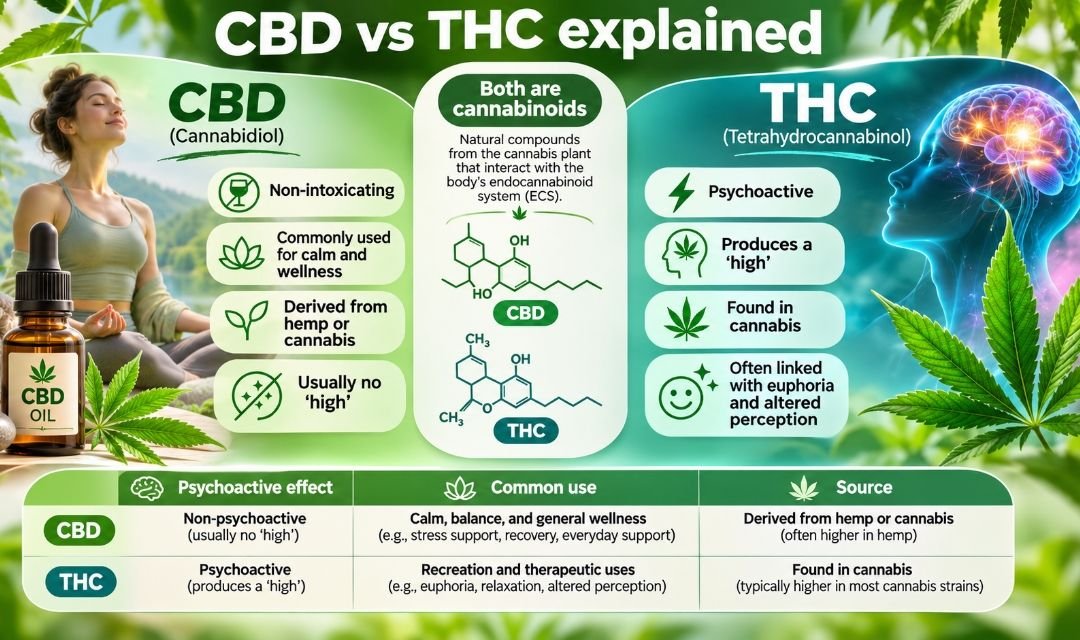
CBD vs THC explained is an important topic for anyone who wants to understand cannabis, hemp products, and the differences between two of the plant’s best-known compounds. CBD, or cannabidiol, and THC, or tetrahydrocannabinol, are both naturally occurring cannabinoids found in cannabis plants. However, they affect the human body differently. CBD does not typically produce an intoxicating high, while THC can alter perception, mood, coordination, and judgment. Both compounds interact with biological signaling systems, including the endocannabinoid system, but their effects, medical evidence, safety concerns, and legal treatment are not the same.
Quick Overview: CBD vs THC
| Category | CBD | THC |
|---|---|---|
| Full name | Cannabidiol | Tetrahydrocannabinol |
| Chemical category | Cannabinoid | Cannabinoid |
| Natural source | Cannabis plant | Cannabis plant |
| Intoxicating effects | Not typically intoxicating | Intoxicating |
| Main receptor activity | Complex and largely indirect | Activates CB1 receptors |
| Medical research | Epilepsy, anxiety, pain, and other conditions | Pain, nausea, appetite, and other conditions |
| Established medical uses | Certain rare seizure disorders | Certain approved cannabinoid medicines have specific uses |
| Potential side effects | Drowsiness, diarrhea, liver-related effects | Anxiety, dizziness, impaired coordination |
| Addiction potential | Low based on current evidence | Cannabis use disorder is possible |
| Drug interactions | Yes | Yes |
| Drug testing | THC contamination can be an issue | Can result in positive tests |
| Legal status | Varies by jurisdiction | Varies by jurisdiction |
| Main safety concern | Interactions and product quality | Intoxication and impairment |
CBD and THC are often discussed together because they come from the same plant.
However, sharing a natural source does not mean they have identical effects.
Some people are interested in CBD because it is generally non-intoxicating.
Others encounter THC through recreational or medical cannabis products.
Understanding the differences matters because products may contain one or both compounds.
Their concentrations can also vary significantly.
This guide explains how CBD and THC work, what scientific research suggests about their possible medical uses, and what consumers should know about safety.
What Are CBD and THC?
CBD and THC are chemical compounds known as cannabinoids.
Cannabis plants produce many cannabinoids, including cannabidiol and tetrahydrocannabinol.
These compounds can interact with the human body’s biological signaling systems.
However, their pharmacological effects are different.
CBD has a complex pattern of activity involving several molecular targets.
THC is especially known for activating cannabinoid receptors associated with intoxication.
This difference helps explain why THC can produce a high while CBD usually does not.
What Is CBD?
CBD stands for cannabidiol.
It is found naturally in cannabis plants, including hemp varieties.
CBD is commonly sold in products such as oils, capsules, creams, and gummies.
However, product quality and composition vary.
CBD does not typically cause the intoxicating effects associated with THC.
Researchers have investigated CBD for several medical conditions.
The strongest established evidence supports a purified prescription cannabidiol medicine for seizures associated with certain rare disorders.
Many other proposed health benefits remain under investigation.
CBD can also cause side effects and interact with medications.
What Is THC?
THC stands for tetrahydrocannabinol.
The term commonly refers to delta-9-tetrahydrocannabinol, the principal intoxicating cannabinoid in cannabis.
THC affects brain signaling through cannabinoid receptors, particularly CB1 receptors.
It can produce changes in mood, sensory perception, memory, and coordination.
Some people experience relaxation or euphoria.
Others experience anxiety, confusion, or unpleasant psychological effects.
THC can also impair driving and other activities requiring attention.
Its effects depend on several factors, including the amount consumed, product formulation, individual sensitivity, and route of exposure.
How Do CBD and THC Work in the Body?
Both CBD and THC interact with biological signaling systems.
The endocannabinoid system is especially important.
This system includes naturally occurring signaling molecules, cannabinoid receptors, and enzymes.
It helps regulate several physiological processes.
However, CBD and THC interact with this system differently.
How THC Works
THC activates cannabinoid receptors, especially CB1 receptors.
These receptors are abundant in parts of the nervous system.
Activation can affect neurotransmitter release and brain activity.
This helps explain THC’s effects on perception, memory, appetite, and coordination.
How CBD Works
CBD does not strongly activate the main cannabinoid receptor binding sites in the same way as THC.
Instead, it influences several biological pathways.
Researchers have studied its interactions with receptor systems, ion channels, and enzymes.
However, the mechanisms responsible for many proposed health effects are not fully understood.
CBD vs THC: Chemical Differences
CBD and delta-9-THC share the same molecular formula:
However, their atoms are arranged differently.
This difference in molecular structure affects how they interact with receptors.
THC’s structure allows it to activate CB1 receptors in a way that produces intoxication.
CBD has different receptor interactions.
Therefore, two compounds with the same molecular formula can produce very different effects.
Does CBD Get You High?
Purified CBD does not typically produce a THC-like high.
It is generally considered non-intoxicating.
However, non-intoxicating does not mean biologically inactive.
CBD can cause drowsiness and other side effects.
Some commercial CBD products may also contain THC.
Inaccurate labeling can lead to unexpected exposure.
Therefore, consumers should not assume every product marketed as CBD is completely THC-free.
Does THC Get You High?
Yes.
THC can produce intoxicating effects.
These may include altered perception, changes in mood, impaired coordination, and slower reaction times.
Some people experience euphoria.
Others may feel anxious, frightened, or confused.
The intensity and duration of effects vary.
Products with high THC concentrations can increase the risk of unpleasant reactions.
THC impairment is especially important when driving or operating machinery.
CBD vs THC Effects on the Brain
CBD and THC influence the nervous system differently.
THC activates CB1 receptors and can affect memory, attention, judgment, and coordination.
CBD does not typically produce the same pattern of intoxication.
However, CBD can still affect alertness.
It may cause sleepiness, particularly at certain exposures or when combined with other medications.
Neither compound should be assumed completely free from neurological effects.
CBD vs THC for Anxiety
Anxiety is one of the most commonly discussed topics in cannabis research.
CBD and Anxiety
Some preliminary human studies suggest CBD may influence anxiety in certain situations.
However, research remains limited.
CBD is not an established general treatment for anxiety disorders.
Larger clinical trials are needed.
THC and Anxiety
THC can produce different psychological effects.
Some people report temporary relaxation.
However, THC can also increase anxiety, panic, and paranoia.
Higher exposure may increase the risk of unpleasant reactions.
Therefore, THC should not be assumed to be a reliable anxiety treatment.
CBD vs THC for Pain
Researchers have investigated cannabinoids for different types of pain.
However, the evidence varies by condition and product.
CBD for Pain
CBD is widely marketed for pain relief.
Nevertheless, evidence supporting CBD alone as an effective treatment for many pain conditions remains insufficient.
Laboratory studies do not automatically establish clinical benefits.
THC for Pain
Some studies of THC-containing cannabis products suggest modest benefits for certain chronic pain conditions.
However, results vary, and adverse effects can limit usefulness.
Products containing multiple cannabinoids cannot establish the effectiveness of THC alone.
Neither CBD nor THC should replace established pain treatment without appropriate medical guidance.
CBD vs THC for Sleep
CBD and THC are both discussed in relation to sleep.
However, they have different effects.
CBD may cause drowsiness, but this does not prove that it improves sleep disorders.
Research findings remain mixed.
THC may produce short-term sedation in some individuals.
However, regular THC use may affect sleep patterns, and stopping frequent use can cause sleep disturbances.
Neither compound is an established universal solution for insomnia.
CBD vs THC for Inflammation
Researchers are studying the effects of cannabinoids on inflammatory pathways.
Laboratory and animal studies have identified possible biological mechanisms.
However, findings from these studies cannot automatically be applied to human diseases.
Clinical evidence remains limited for many inflammatory conditions.
Therefore, claims that CBD or THC can cure inflammation-related diseases are not supported by reliable evidence.
CBD vs THC for Epilepsy
CBD has an established role in treating certain rare seizure disorders.
In the United States, the FDA has approved Epidiolex, a purified cannabidiol medicine, for seizures associated with specific conditions.
These include Lennox-Gastaut syndrome, Dravet syndrome, and tuberous sclerosis complex.
Prescription treatment requires medical supervision.
THC is not an equivalent substitute for prescription cannabidiol.
THC may also carry neurological and psychological risks.
CBD vs THC for Appetite
THC is known to influence appetite.
Some prescription medicines containing synthetic or pharmaceutical forms of THC-related compounds have been used for specific conditions involving appetite or nausea.
However, these medicines are different from unregulated cannabis products.
CBD does not have the same established appetite-stimulating effects.
CBD may also cause changes in appetite as a side effect.
CBD vs THC Side Effects
Both compounds can cause adverse effects.
However, their side-effect profiles differ.
| Possible effect | CBD | THC |
|---|---|---|
| Drowsiness | Possible | Possible |
| Diarrhea | Possible | Less characteristic |
| Appetite changes | Possible | Common |
| Anxiety | Not a typical intoxicating effect | Possible |
| Impaired coordination | Not typical of purified CBD | Possible |
| Memory impairment | Not typical of purified CBD | Possible |
| Liver-related effects | Important concern | Possible concerns depending on product and exposure |
| Drug interactions | Yes | Yes |
| Intoxication | Not typical | Yes |
Side effects depend on the individual, product, and exposure.
Can CBD and THC Be Used Together?
Some cannabis products contain both CBD and THC.
Researchers have investigated combinations of cannabinoids for certain medical conditions.
However, combining CBD and THC does not automatically improve safety or effectiveness.
CBD does not reliably cancel THC intoxication.
The interaction between the compounds depends on several factors.
Products containing THC can still impair judgment and coordination.
Medical use should be guided by evidence and appropriate clinical supervision.
Full-Spectrum, Broad-Spectrum, and CBD Isolate
CBD products are often divided into three categories.
Full-Spectrum CBD
Full-spectrum products contain CBD along with other cannabis compounds.
They may contain THC.
The exact amount depends on the product.
Broad-Spectrum CBD
Broad-spectrum products generally contain CBD and other cannabis compounds.
Manufacturers usually attempt to reduce or remove THC.
However, trace amounts may remain.
CBD Isolate
CBD isolate is a purified form of cannabidiol.
However, manufacturing quality still matters.
Products should not be assumed free from contaminants simply because they are labeled isolate.
CBD vs THC in Drug Testing
Drug tests commonly screen for THC-related metabolites rather than CBD itself.
However, CBD products may contain THC.
Repeated use of THC-containing CBD products can potentially lead to a positive test.
Some products may contain more THC than their labels suggest.
Therefore, people subject to workplace or other drug testing should be cautious about commercial cannabinoid products.
CBD vs THC: How Long Do They Stay in the Body?
The time CBD or THC remains detectable depends on several factors.
These include:
-
Frequency of exposure
-
Amount consumed
-
Product formulation
-
Individual metabolism
-
Body composition
-
Type of biological test
THC metabolites may remain detectable after noticeable intoxication has ended.
CBD also has variable elimination times.
There is no universal detection timeline that applies to everyone.
CBD vs THC and Addiction Risk
CBD and THC differ in their abuse potential.
Purified CBD appears to have low abuse potential based on current evidence.
THC-containing cannabis products can lead to cannabis use disorder.
Risk varies according to factors such as frequency of use, product potency, and individual vulnerability.
Regular cannabis use may also lead to tolerance and withdrawal symptoms.
These can include irritability, sleep problems, and changes in appetite.
CBD vs THC During Pregnancy
Cannabis and cannabinoid use during pregnancy raises safety concerns.
Health authorities generally advise avoiding CBD and THC during pregnancy and breastfeeding.
THC can cross the placenta.
CBD safety during pregnancy is not established.
Both substances may present risks to fetal or infant development.
Pregnant or breastfeeding individuals should seek professional medical guidance rather than assuming non-intoxicating products are safe.
CBD vs THC and Mental Health
THC can affect mood, perception, and cognition.
Some people experience anxiety, paranoia, or other psychological symptoms.
Frequent use of high-potency cannabis is associated with increased mental health concerns in certain populations.
However, associations do not mean every individual will experience the same outcome.
CBD is being studied for possible psychiatric applications.
Nevertheless, evidence remains insufficient for many proposed uses.
Neither compound should be treated as a replacement for established mental healthcare.
CBD vs THC and Driving Safety
THC can impair reaction time, attention, and coordination.
Driving while impaired by THC increases safety risks.
CBD does not typically cause the same intoxication.
However, CBD may cause drowsiness or interact with medications.
Some CBD products may also contain THC.
Therefore, individuals should not drive or operate dangerous machinery if they experience impairment or sedation.
CBD vs THC: Legal Differences
CBD and THC laws vary widely.
Some countries permit certain hemp-derived products.
Others regulate cannabinoids as medicines or controlled substances.
In the United States, federal hemp rules use a THC concentration threshold.
However, this does not automatically make every CBD product lawful.
THC-containing products are subject to additional restrictions.
State laws and federal laws may differ.
Consumers should verify the rules that apply in their jurisdiction.
CBD vs THC: Which Is Safer?
It is not possible to describe either compound as completely safe.
CBD is generally non-intoxicating and appears to have low abuse potential.
However, it can cause liver-related problems, medication interactions, and other adverse effects.
THC produces intoxication and can impair memory, coordination, and judgment.
It also carries risks related to dependence and psychological effects.
The safety of any cannabinoid product depends on its ingredients, exposure, quality, and the individual’s health.
What Are the Main Risks of CBD Products?
Commercial CBD products can present several problems.
Some contain inaccurate cannabinoid concentrations.
Others may contain unexpected THC.
Contamination is another concern.
CBD can also interact with prescription medications.
Marketing claims may exaggerate benefits.
A product being natural does not guarantee that it is safe or effective.
What Are the Main Risks of THC Products?
THC-containing products may cause intoxication and impairment.
Other risks include anxiety, panic, dependence, and accidental overconsumption.
High-potency products may produce stronger effects.
Edible products can also create problems because their effects may be delayed.
Children are particularly vulnerable to accidental exposure.
THC products should be stored securely and kept away from children and pets.
CBD vs THC for Beginners: Important Things to Know
Beginners should understand that CBD and THC are not interchangeable.
CBD does not typically cause intoxication.
THC does.
However, both substances can affect the body.
Scientific evidence differs depending on the condition being studied.
Prescription cannabinoid medicines should also be distinguished from ordinary commercial products.
Consumers should be cautious about exaggerated claims.
Medical questions should be discussed with qualified healthcare professionals.
Common Myths About CBD and THC
Myth 1: CBD and THC Are the Same
They are different compounds with different effects.
Myth 2: CBD Has No Side Effects
CBD can cause side effects and medication interactions.
Myth 3: THC Always Makes People Relaxed
THC can also cause anxiety, paranoia, and confusion.
Myth 4: All CBD Products Are THC-Free
Some CBD products contain THC.
Myth 5: Natural Cannabis Products Are Always Safe
Natural products can still cause harmful effects.
Myth 6: CBD Cancels THC Intoxication
CBD does not reliably reverse THC impairment.
Myth 7: CBD and THC Cure Cancer
There is no reliable evidence that either compound cures cancer.
Myth 8: Every Cannabinoid Product Is Legally Approved
Legal status and medical approval vary by product and jurisdiction.
Future of CBD and THC Research in 2026 and Beyond
Scientists continue studying cannabinoids and their effects on human health.
CBD research includes neurological conditions, drug interactions, and other possible medical applications.
THC research includes pain, nausea, appetite, and neurological effects.
Researchers are also studying how different cannabinoids interact.
However, many questions remain unanswered.
Future clinical trials may clarify which products are effective for specific conditions.
They may also provide better information about long-term safety.
Regulation and product quality will remain important issues.
Final Thoughts
CBD vs THC explained in simple terms means understanding two cannabinoids that come from the same plant but affect the human body differently.
CBD is generally non-intoxicating.
THC can produce a high and impair judgment, coordination, and memory.
Both compounds interact with biological signaling systems.
However, their medical evidence and safety concerns are different.
CBD has an established prescription use for certain rare seizure disorders.
THC-related medicines also have specific approved medical applications.
Many other popular claims about CBD and THC remain under investigation.
Neither compound should be viewed as a cure for every health problem.
Product quality, legal status, side effects, and medication interactions are important considerations.
Understanding these differences helps readers evaluate cannabis-related information more critically.
Frequently Asked Questions About CBD vs THC
1. What is the main difference between CBD and THC?
CBD does not typically produce an intoxicating high, while THC does.
2. Are CBD and THC from the same plant?
Yes. Both occur naturally in cannabis plants.
3. Does CBD make you high?
Purified CBD does not typically cause a THC-like high.
4. Does THC make you high?
Yes. THC can produce intoxication and changes in perception.
5. Is CBD safer than THC?
CBD avoids typical THC intoxication but still has important medical risks. Safety depends on the product and individual.
6. Can CBD help anxiety?
Research is preliminary, and CBD is not an established general treatment for anxiety disorders.
7. Can THC cause anxiety?
Yes. THC can cause anxiety, panic, or paranoia.
8. Does CBD help with sleep?
Evidence remains mixed and insufficient for many sleep-related claims.
9. Does THC help with sleep?
THC may cause sedation, but it can also affect sleep quality and cause problems with regular use.
10. Can CBD relieve pain?
Evidence for CBD alone remains insufficient for many pain conditions.
11. Can THC relieve pain?
Some THC-containing products show modest benefits for certain pain conditions, but risks and evidence limitations remain.
12. Is CBD addictive?
Purified CBD appears to have low abuse potential.
13. Is THC addictive?
THC-containing cannabis products can lead to cannabis use disorder.
14. Can CBD cause side effects?
Yes. Side effects include drowsiness, diarrhea, and liver-related concerns.
15. Can THC cause side effects?
Yes. Side effects can include dizziness, anxiety, impaired coordination, and memory problems.
16. Is CBD legal everywhere?
No. CBD laws vary by jurisdiction.
17. Is THC legal everywhere?
No. THC laws vary significantly.
18. Can CBD show up on a drug test?
CBD itself is not usually the target, but THC contamination may lead to a positive result.
19. Can CBD and THC be combined?
Some products contain both, but combining them does not guarantee safety or effectiveness.
20. What is full-spectrum CBD?
It generally contains CBD and other cannabis compounds, potentially including THC.
21. What is CBD isolate?
It is a purified form of cannabidiol.
22. What is the endocannabinoid system?
It is a biological signaling system involving cannabinoids, receptors, and enzymes.
23. Is CBD approved for medical treatment?
A specific prescription CBD medicine is approved in the United States for certain seizure disorders.
24. Can THC affect driving?
Yes. THC can impair driving-related abilities.
25. Which is better, CBD or THC?
Neither is universally better. Their effects, risks, and evidence-supported uses differ.
For more health education, cannabis science, CBD information, wellness guides, and beginner-friendly articles, visit Picanto Magazine