
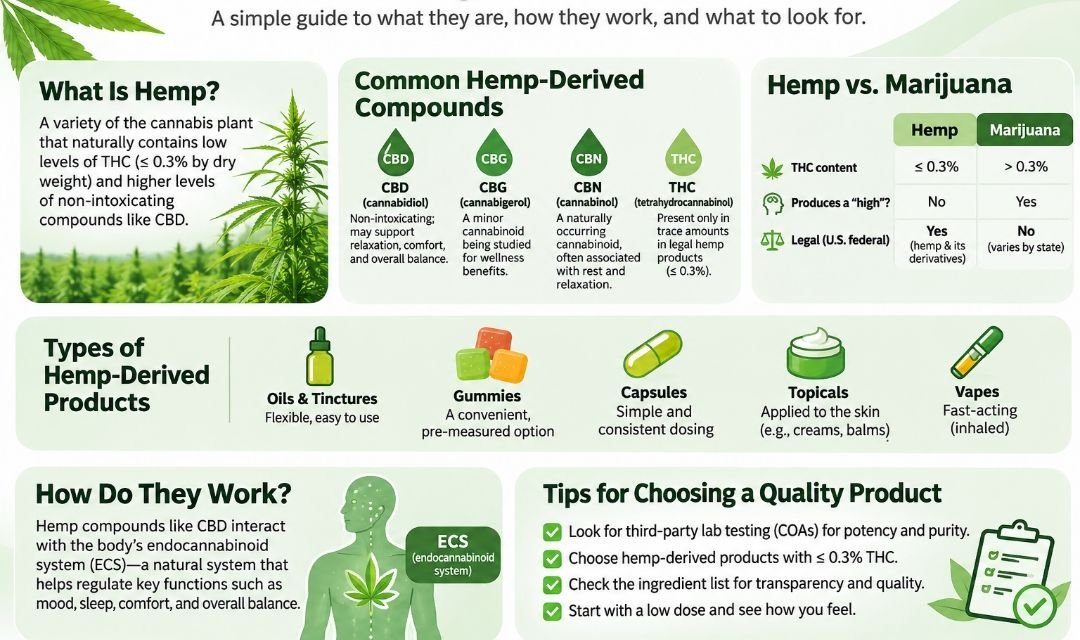
Understanding hemp-derived products is becoming increasingly important as hemp-based foods, skincare products, textiles, and wellness items become more familiar to consumers. Hemp is a variety of the cannabis plant grown for purposes such as producing fiber, seeds, oils, and cannabinoids. Unlike the common assumption that every cannabis-related product causes intoxication, many hemp products contain little or no THC, the compound associated with marijuana’s intoxicating effects. According to information about hemp, the plant has a long history of agricultural and industrial use. However, different hemp-derived products have very different ingredients, potential benefits, safety concerns, and legal requirements.
Quick Overview of Hemp-Derived Products
| Category | Details |
|---|---|
| Main topic | Understanding Hemp-Derived Products |
| Plant source | Cannabis sativa |
| Common agricultural type | Industrial hemp |
| Main product categories | Food, fiber, cosmetics, cannabinoids |
| Popular food products | Hemp seeds, hemp protein, hemp seed oil |
| Popular wellness products | CBD oils, capsules, creams |
| Industrial uses | Clothing, rope, paper, insulation |
| Main cannabinoid of interest | CBD |
| Intoxicating compound | THC |
| Nutritional benefits | Protein, fiber, essential fatty acids |
| Important safety concerns | Contamination, drug interactions, inaccurate labeling |
| Legal status | Varies by country and product |
| Environmental considerations | Farming methods, processing, transportation |
| Research status | Varies significantly by product |
Hemp has been used by humans for thousands of years.
Historically, people cultivated hemp for rope, fabric, paper, and seeds.
Today, manufacturers use different parts of the plant to produce a wide range of consumer goods.
Some hemp products are ordinary foods.
Others are cosmetics or industrial materials.
A separate category includes cannabinoid products such as CBD oils.
These categories should not be confused.
Hemp seed oil, for example, is different from CBD oil.
Likewise, hemp clothing does not have the same safety considerations as ingestible cannabinoid products.
This guide explains the main types of hemp-derived products, their uses, possible benefits, and important consumer considerations.
What Are Hemp-Derived Products?
Hemp-derived products are goods made using materials obtained from hemp plants.
These materials may come from the seeds, stalks, fibers, leaves, or flowers.
Different plant parts provide different ingredients.
For example, hemp seeds are used to produce food and nutritional ingredients.
Hemp stalks provide fibers for textiles and construction materials.
CBD can be extracted from cannabinoid-containing plant material.
However, the phrase hemp-derived does not automatically mean a product is safe, legal, non-intoxicating, or medically effective.
The specific ingredients and manufacturing process matter.
What Is Industrial Hemp?
Industrial hemp refers to cannabis cultivated for agricultural and commercial purposes.
It is commonly grown for fiber, grain, and other materials.
In the United States, federal law generally defines hemp using a delta-9 THC concentration threshold of no more than 0.3% on a dry-weight basis.
However, laws differ internationally and may change.
This definition also does not mean that every product manufactured from hemp is automatically lawful.
Products containing concentrated cannabinoids can raise additional legal and safety questions.
Hemp vs Marijuana: What Is the Difference?
Hemp and marijuana are terms commonly used to describe different cannabis categories.
Both come from the cannabis plant.
The distinction often relates to legal definitions, cultivation purposes, and THC content.
| Feature | Hemp | Marijuana |
|---|---|---|
| Plant family | Cannabis | Cannabis |
| Common uses | Fiber, seeds, CBD, industrial materials | Medical or recreational cannabis products |
| THC content | Typically low under applicable hemp definitions | May contain higher THC concentrations |
| Intoxicating effects | Many ordinary hemp products are non-intoxicating | THC-containing products may be intoxicating |
| Legal treatment | Depends on jurisdiction | Depends on jurisdiction |
| Product examples | Hemp seeds, textiles, CBD oil | THC-containing cannabis products |
However, hemp-derived products can sometimes contain intoxicating cannabinoids.
Therefore, the distinction is not as simple as saying that all hemp products are non-intoxicating.
Main Types of Hemp-Derived Products
Hemp-derived products can be divided into several major categories.
1. Hemp Seeds
Hemp seeds are edible seeds produced by hemp plants.
They are commonly sold whole, hulled, or incorporated into food products.
Hulled hemp seeds are sometimes called hemp hearts.
They contain protein, fats, and minerals.
Hemp seeds naturally contain little to no cannabinoids, although contamination can occur during harvesting or processing.
They are primarily a food ingredient rather than a CBD product.
2. Hemp Seed Oil
Hemp seed oil is produced by pressing hemp seeds.
It contains fatty acids, including omega-3 and omega-6 fats.
Hemp seed oil is used in foods and cosmetic products.
However, ordinary hemp seed oil should not be confused with CBD oil.
It generally contains little to no CBD.
3. Hemp Protein Powder
Hemp protein powder is made from processed hemp seeds.
It provides plant-based protein and may contain fiber.
The nutritional composition depends on how the product is manufactured.
Hemp protein can be used in smoothies, baked goods, and other foods.
However, it should not be assumed to treat medical conditions.
4. CBD Oil
CBD oil contains cannabidiol extracted from cannabis plant material.
It is commonly mixed with a carrier oil.
CBD products may contain different concentrations of cannabinoids.
Some also contain THC.
Unlike hemp seed oil, CBD oil can have pharmacological effects.
It may cause side effects and interact with medications.
5. Hemp-Derived Skincare Products
Hemp ingredients are used in creams, lotions, soaps, and balms.
Some products contain hemp seed oil.
Others contain CBD or additional cannabinoids.
Hemp seed oil may function as a cosmetic moisturizing ingredient.
However, claims that hemp-derived skincare products treat eczema, psoriasis, or other medical conditions require reliable clinical evidence.
6. Hemp Textiles
Hemp fibers can be processed into fabric.
They are used in clothing, bags, upholstery, and other textile products.
Hemp textiles are often valued for their strength and durability.
However, fabric quality depends on processing, construction, and manufacturing methods.
7. Hemp Paper
Hemp fibers can be used to manufacture paper.
Historically, hemp was an important source of fiber for certain paper products.
Modern hemp paper production depends on processing costs, fiber availability, and manufacturing infrastructure.
8. Hemp Construction Materials
Hemp can be used in certain construction materials.
One example is hemp-lime composite, often called hempcrete.
This material combines processed hemp hurd with a mineral binder.
It can be used in certain building applications.
However, hempcrete is not a direct replacement for structural concrete in every situation.
Building codes and engineering requirements remain important.
9. Hemp Bioplastics
Hemp fibers and other plant-derived materials may be incorporated into composite plastics.
These materials are being explored for packaging and industrial applications.
However, not every product marketed as hemp plastic is biodegradable.
Environmental performance depends on the full material composition and manufacturing process.
10. Hemp Animal Products
Hemp materials may be used in animal bedding and selected agricultural products.
However, cannabinoid-containing pet products raise additional safety concerns.
CBD and THC can affect animals differently from humans.
Pet owners should not assume that human CBD products are safe for animals.
Hemp Seed Oil vs CBD Oil
One of the most common consumer misunderstandings involves hemp seed oil and CBD oil.
These products are not interchangeable.
| Feature | Hemp seed oil | CBD oil |
|---|---|---|
| Source | Hemp seeds | Cannabinoid-containing cannabis material |
| Main components | Fatty acids and other seed nutrients | Cannabidiol and carrier oil |
| CBD content | Usually little to none | Contains CBD |
| Common uses | Food and cosmetics | Cannabinoid products |
| Intoxicating effect | Not expected | CBD itself is non-intoxicating, but THC may be present |
| Main safety considerations | Food quality, allergies | Drug interactions, liver effects, product composition |
Understanding this difference helps consumers avoid misleading labels.
What Are the Nutritional Benefits of Hemp Seeds?
Hemp seeds contain several nutrients.
These include protein, unsaturated fats, and minerals.
Plant-Based Protein
Hemp seeds provide plant protein.
They contain essential amino acids.
However, the amount of protein depends on the serving size and product.
Essential Fatty Acids
Hemp seeds contain omega-3 and omega-6 fatty acids.
These fats are important components of a balanced diet.
However, eating hemp seeds does not automatically prevent or treat cardiovascular disease.
Fiber
Whole hemp seeds contain fiber.
Hulled seeds generally contain less fiber because the outer shell has been removed.
Minerals
Hemp seeds can provide minerals such as magnesium, phosphorus, and iron.
Actual nutrient levels vary.
Hemp seeds can be part of a balanced diet, but they are not a substitute for varied nutrition.
Hemp-Derived CBD Products Explained
CBD is one of the most widely discussed hemp-derived cannabinoids.
It is commonly marketed in oils, capsules, creams, and other formulations.
However, CBD should not be confused with ordinary hemp foods.
CBD can interact with biological signaling pathways.
It can also affect how the body processes certain medications.
The strongest established medical evidence concerns a specific prescription cannabidiol medicine used for certain rare seizure disorders.
Many other CBD health claims remain unproven.
Full-Spectrum Hemp Products
Full-spectrum CBD products generally contain cannabidiol along with other cannabis compounds.
These may include additional cannabinoids and aromatic compounds called terpenes.
Some full-spectrum products contain THC.
The exact composition varies.
Consumers should not assume that full-spectrum products are free from intoxicating substances.
Broad-Spectrum Hemp Products
Broad-spectrum CBD products generally contain CBD and other cannabis compounds.
Manufacturers usually attempt to reduce or remove THC.
However, trace THC may remain.
Product labels are not always accurate.
Independent testing may provide useful information about actual cannabinoid content.
CBD Isolate Products
CBD isolate is a purified form of cannabidiol.
It is generally processed to remove most other cannabis compounds.
However, product purity depends on manufacturing quality.
The label alone does not guarantee that the product is free from contaminants or unexpected ingredients.
Are Hemp-Derived Products Safe?
Safety depends on the type of product.
Ordinary hemp foods and industrial hemp materials have different risk profiles from concentrated cannabinoid products.
For example, hemp seeds are generally consumed as food.
CBD oils can produce pharmacological effects and interact with medications.
THC-containing hemp-derived products may cause intoxication.
Therefore, it is inaccurate to describe all hemp-derived products as equally safe.
Side Effects of Hemp-Derived CBD Products
CBD can cause side effects.
These may include:
-
Drowsiness
-
Diarrhea
-
Changes in appetite
-
Fatigue
-
Liver enzyme abnormalities
-
Medication interactions
Some people may face greater risks because of existing medical conditions or prescription medications.
CBD should not be assumed harmless simply because it comes from a plant.
Hemp-Derived THC Products
Some products marketed as hemp-derived contain cannabinoids capable of causing intoxication.
These may include delta-8 THC and other THC-related compounds.
Such products can have psychoactive effects.
Their safety profiles may be poorly understood.
Manufacturing processes can also introduce contaminants or unwanted byproducts.
Consumers should not assume that a product is non-intoxicating simply because the label says hemp-derived.
What Is Delta-8 THC?
Delta-8 THC is a cannabinoid that can produce intoxicating effects.
It is chemically related to delta-9 THC.
Some commercial delta-8 products are manufactured by chemically converting hemp-derived CBD.
However, these processes may introduce impurities.
Delta-8 THC products are not equivalent to ordinary hemp seed foods.
They also raise distinct regulatory and safety concerns.
Hemp-Derived Products and Drug Testing
Drug tests commonly look for THC-related metabolites.
Ordinary hemp foods are generally different from concentrated cannabinoid products.
However, some CBD products contain THC.
Repeated exposure to THC-containing products may lead to a positive drug test.
Consumers subject to workplace testing should not assume that every hemp-derived cannabinoid product is THC-free.
Are Hemp-Derived Products Legal?
Hemp laws vary by country and product category.
Some jurisdictions allow industrial hemp cultivation under licensing systems.
Others regulate hemp-derived cannabinoids separately.
In the United States, federal hemp definitions do not automatically authorize every CBD or intoxicating hemp-derived product.
Food, drug, cosmetic, and consumer protection rules may also apply.
Local laws can be more restrictive.
Consumers and businesses should verify current requirements before purchasing, selling, or manufacturing regulated hemp products.
Hemp-Derived Products in Skincare
Hemp seed oil is commonly used as a cosmetic ingredient.
It contains fatty acids that can help support the feel and formulation of skincare products.
However, hemp-derived skincare claims should be evaluated carefully.
A moisturizing ingredient is not necessarily a proven treatment for a medical skin condition.
CBD-containing creams require separate consideration because the scientific evidence for many claims remains limited.
Hemp-Derived Products in Food
Hemp seeds, hemp seed oil, and hemp protein are used in various foods.
Examples include:
-
Seed mixes
-
Smoothies
-
Protein powders
-
Salad dressings
-
Snack bars
-
Baked goods
However, regulations for cannabinoid-infused foods differ from those for ordinary hemp seed ingredients.
CBD gummies should not be treated as nutritionally equivalent to hemp seeds.
Environmental Benefits of Industrial Hemp
Hemp is often discussed as a potentially useful agricultural crop.
It can provide fiber and other raw materials.
Some cultivation systems may require different inputs from conventional crops.
However, environmental claims depend on location, farming practices, processing, transportation, and the final product.
Hemp is not automatically more sustainable in every application.
A complete environmental assessment should consider the entire product lifecycle.
Hemp vs Cotton
Hemp and cotton are both used in textiles.
However, their characteristics differ.
| Feature | Hemp | Cotton |
|---|---|---|
| Plant source | Cannabis | Cotton plant |
| Main use | Fiber and textiles | Fiber and textiles |
| Fiber characteristics | Often strong and durable | Often soft and flexible |
| Processing | Requires fiber separation and treatment | Requires cotton processing |
| Environmental impact | Depends on cultivation and processing | Depends on cultivation and processing |
| Common products | Clothing, bags, upholstery | Clothing, towels, bedding |
Neither material is automatically environmentally superior in every situation.
How to Read Hemp Product Labels
Product labels can provide useful information.
However, they may also contain misleading marketing language.
Consumers should identify the actual ingredients.
For example, a product labeled hemp oil may contain hemp seed oil rather than CBD.
A cannabinoid product should clearly disclose its contents.
Important information may include:
-
Ingredient list
-
Product category
-
CBD and THC content where applicable
-
Manufacturer details
-
Batch number
-
Testing information
-
Warnings and storage instructions
However, labeling accuracy cannot always be assumed.
What Is Third-Party Testing for Hemp Products?
Third-party testing involves an independent laboratory evaluating a product.
For cannabinoid products, testing may examine CBD and THC concentrations.
It may also assess contaminants such as pesticides, heavy metals, solvents, and microbes.
However, testing reports should correspond to the actual product batch.
A certificate of analysis does not prove that a product treats medical conditions.
It also does not eliminate every safety risk.
Common Myths About Hemp-Derived Products
Myth 1: Hemp and Marijuana Are Completely Different Plants
Both are forms of cannabis.
The distinction often depends on legal definitions and THC content.
Myth 2: Every Hemp Product Contains CBD
Hemp seeds and hemp textiles generally do not contain meaningful CBD.
Myth 3: Hemp-Derived Means THC-Free
Some hemp-derived products contain THC or related intoxicating cannabinoids.
Myth 4: Natural Products Cannot Cause Side Effects
Natural ingredients can still cause adverse reactions.
Myth 5: Hemp Seed Oil and CBD Oil Are the Same
They are different products with different compositions.
Myth 6: All Hemp Products Are Legal Everywhere
Laws vary by country and product.
Myth 7: CBD Cures Every Disease
There is no reliable evidence supporting such a claim.
Myth 8: Hemp Is Always Environmentally Friendly
Environmental impact depends on the full production process.
Future of Hemp-Derived Products in 2026 and Beyond
The hemp industry continues to explore new applications.
Food manufacturers are developing products containing hemp seeds and protein.
Textile companies are investigating hemp fibers.
Construction businesses are exploring hemp-based materials.
Researchers are also studying cannabinoids and their possible medical applications.
However, commercial growth does not automatically establish safety or effectiveness.
Regulatory standards, product testing, and consumer education remain important.
The future of hemp-derived products will depend on practical usefulness, reliable manufacturing, and evidence-based claims.
Final Thoughts
Understanding hemp-derived products begins with recognizing that hemp is used in many different industries.
Hemp seeds provide food ingredients.
Hemp seed oil is used in nutrition and cosmetics.
Hemp fibers support textile and industrial applications.
Hemp-based materials are also being explored in construction and manufacturing.
CBD products represent a separate category with important medical and safety considerations.
Some hemp-derived cannabinoid products may also contain intoxicating THC-related compounds.
Therefore, consumers should not assume that every hemp product is non-intoxicating, medically beneficial, or completely safe.
Reading labels, understanding ingredients, and evaluating scientific evidence are essential.
As hemp industries continue to develop, reliable manufacturing standards and accurate consumer information will remain important.
Frequently Asked Questions About Hemp-Derived Products
1. What are hemp-derived products?
They are products made using materials obtained from hemp plants, including seeds, fibers, oils, and cannabinoids.
2. What is industrial hemp?
Industrial hemp is cannabis cultivated for agricultural or commercial purposes under applicable legal definitions.
3. Is hemp the same as marijuana?
Both come from cannabis, but the terms commonly distinguish products based on THC content and legal classification.
4. Do hemp products make you high?
Ordinary hemp foods and textiles do not. Some hemp-derived cannabinoid products may contain intoxicating substances.
5. What is hemp seed oil?
It is oil pressed from hemp seeds.
6. Does hemp seed oil contain CBD?
Ordinary hemp seed oil generally contains little to no CBD.
7. What is CBD oil?
CBD oil contains cannabidiol extracted from cannabis material and mixed with a carrier oil.
8. Are hemp seeds healthy?
Hemp seeds provide protein, unsaturated fats, and minerals and can be part of a balanced diet.
9. What is hemp protein?
It is a plant-based protein ingredient produced from processed hemp seeds.
10. Can hemp be used in clothing?
Yes. Hemp fibers can be processed into textile materials.
11. What is hempcrete?
Hempcrete is a hemp-lime composite used in certain building applications.
12. Are hemp products environmentally friendly?
Some applications may offer environmental advantages, but outcomes depend on cultivation and manufacturing.
13. Are CBD products safe?
CBD can cause side effects and medication interactions. Safety depends on the individual and product.
14. Can hemp-derived products contain THC?
Yes. Some cannabinoid products contain THC or related compounds.
15. What is delta-8 THC?
Delta-8 THC is an intoxicating cannabinoid that may appear in hemp-derived products.
16. What is full-spectrum CBD?
It generally contains CBD and other cannabis compounds, potentially including THC.
17. What is broad-spectrum CBD?
It generally contains CBD and other compounds, with THC reduced or removed during processing.
18. What is CBD isolate?
It is a purified form of cannabidiol.
19. Can hemp products cause positive drug tests?
Some cannabinoid products containing THC may lead to positive results.
20. Are hemp products legal everywhere?
No. Laws vary by jurisdiction and product category.
21. Can hemp-derived CBD interact with medications?
Yes. CBD can affect the metabolism of certain medications.
22. Are hemp skincare products effective?
Some ingredients are useful in cosmetic formulations, but many medical claims lack strong evidence.
23. What is third-party testing?
It is laboratory testing performed by an organization independent of the manufacturer.
24. Are all hemp-derived products FDA-approved?
No. Most hemp-derived consumer products are not FDA-approved medicines.
25. What should consumers understand before choosing hemp products?
They should identify the ingredients, understand safety concerns, evaluate product claims, and check applicable laws.
For more CBD education, hemp product guides, wellness information, cannabis science, and beginner-friendly health articles, visit Picanto Magazine