
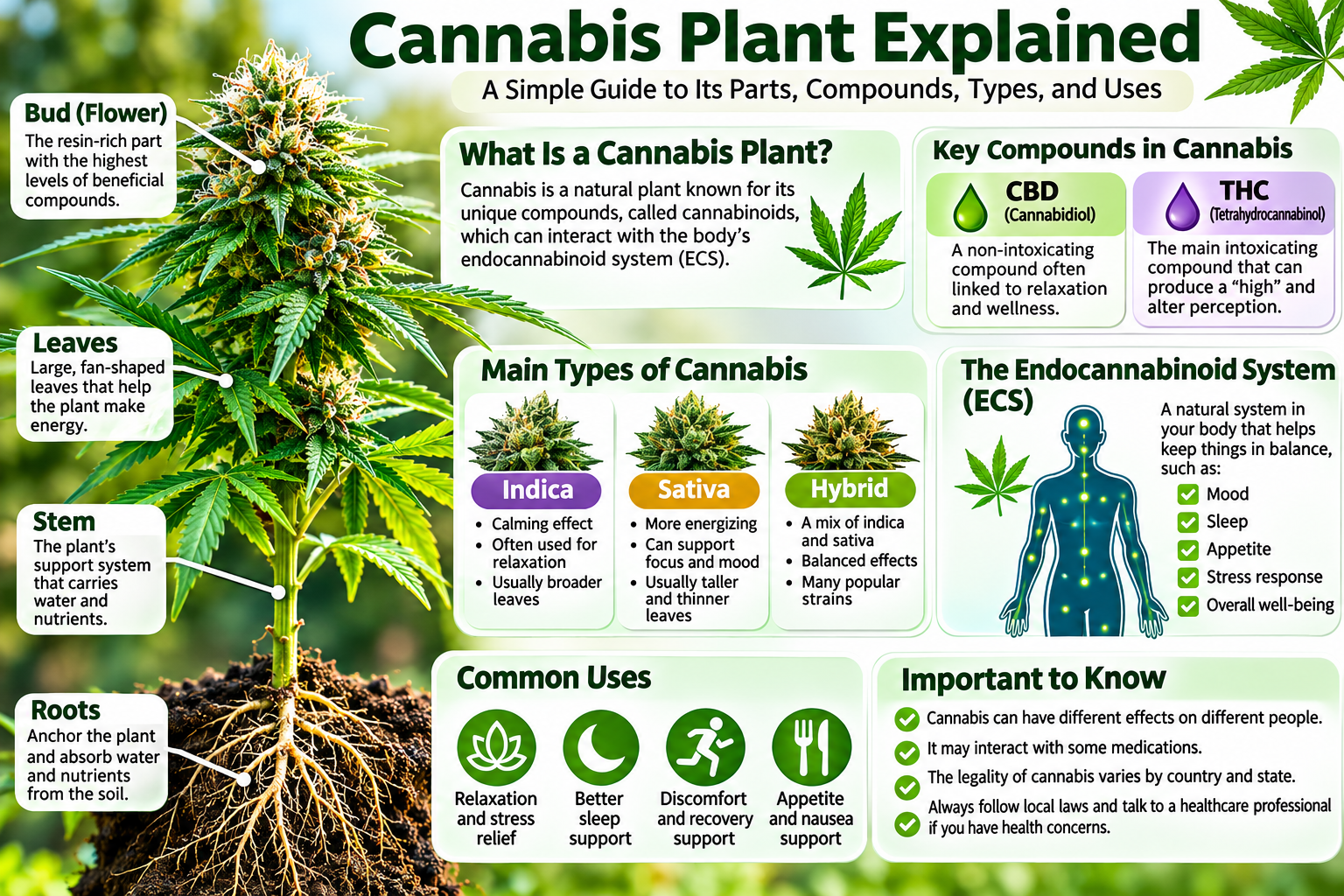
Cannabis plant explained is a helpful starting point for anyone interested in understanding cannabis, hemp, cannabinoids, and their effects on the human body. The cannabis plant is a flowering plant that has been cultivated for thousands of years for its fibers, seeds, medicinal preparations, and other uses. Today, cannabis is widely discussed because it contains compounds such as cannabidiol (CBD) and tetrahydrocannabinol (THC). While CBD does not typically cause an intoxicating high, THC can affect mood, perception, memory, and coordination. Understanding cannabis requires looking at its biology, chemical composition, traditional uses, scientific research, and potential health risks.
Quick Overview of the Cannabis Plant
| Category | Details |
|---|---|
| Scientific genus | Cannabis |
| Plant family | Cannabaceae |
| Common names | Cannabis, hemp, marijuana |
| Plant type | Flowering plant |
| Common classifications | Cannabis sativa, Cannabis indica, Cannabis ruderalis |
| Major cannabinoids | THC and CBD |
| Other compounds | Terpenes, flavonoids, minor cannabinoids |
| Main agricultural uses | Fiber, seeds, oil, industrial materials |
| Medical research | Pain, epilepsy, nausea, and other conditions |
| Intoxicating compound | Primarily delta-9 THC |
| Non-intoxicating cannabinoid | CBD |
| Reproduction | Usually sexual reproduction through flowers and seeds |
| Legal status | Varies by country and jurisdiction |
| Main health concerns | Impairment, dependence, drug interactions, respiratory effects |
| Scientific research | Ongoing |
Cannabis is one of the world’s most widely recognized plants.
However, many people know it only through discussions about marijuana or CBD.
The plant has a much broader history.
It has been used to produce rope, clothing, paper, seeds, and other materials.
Modern scientists also study its chemical compounds and their effects on human health.
Some cannabis-derived medicines have established medical applications.
However, many popular health claims remain unsupported by strong clinical evidence.
This guide explains the cannabis plant from its roots and leaves to its cannabinoids, potential uses, safety concerns, and future research.
What Is the Cannabis Plant?
Cannabis is a genus of flowering plants belonging to the Cannabaceae family.
The genus includes plants that have been cultivated for fiber, food, and cannabinoid production.
Cannabis plants are recognized by their distinctive leaves.
These leaves often have several narrow, serrated leaflets.
However, leaf shape can vary depending on genetics and growing conditions.
Cannabis plants produce flowers that contain chemical compounds called cannabinoids.
Some cannabinoids can influence biological signaling in humans and animals.
The most widely discussed are THC and CBD.
Where Does Cannabis Come From?
Cannabis has a long history of cultivation across different parts of the world.
Its early domestication is associated with regions of Asia.
Over time, people transported and cultivated cannabis in other areas.
Historically, cannabis was used for textile fibers, seeds, traditional preparations, and other purposes.
Different societies developed different relationships with the plant.
Some valued its industrial applications.
Others used cannabis in cultural or medicinal contexts.
Today, cannabis is cultivated in various regions under different legal systems.
Types of Cannabis Plants
Cannabis is commonly described using three traditional categories.
These are Cannabis sativa, Cannabis indica, and Cannabis ruderalis.
However, the scientific classification of cannabis remains debated.
Modern genetic research shows that commercial cannabis varieties often have complex ancestry.
Therefore, these traditional labels do not always predict a plant’s chemical composition or effects.
1. Cannabis Sativa
Cannabis sativa is a widely recognized botanical name.
Plants described as sativa are often associated with taller growth and relatively narrow leaves.
However, physical characteristics vary.
Commercial products labeled sativa do not necessarily produce predictable effects.
Their actual cannabinoid and terpene composition matters more than the marketing label.
2. Cannabis Indica
Cannabis indica is another traditional classification.
Plants described as indica are often associated with shorter, bushier growth.
However, many modern cannabis varieties are hybrids.
The term indica does not reliably establish whether a product will cause relaxation or sedation.
Those effects depend on chemical composition and individual response.
3. Cannabis Ruderalis
Cannabis ruderalis is a name used for certain cannabis populations associated with parts of Eurasia.
These plants have attracted interest because some possess traits related to flowering responses.
However, their classification and relationship to other cannabis groups remain subjects of botanical discussion.
Cannabis Sativa vs Indica vs Ruderalis
| Feature | Sativa | Indica | Ruderalis |
|---|---|---|---|
| Traditional description | Often taller | Often bushier | Often smaller |
| Leaf appearance | Frequently narrow | Frequently broader | Variable |
| Historical classification | Widely used | Widely used | Less common |
| Chemical composition | Variable | Variable | Variable |
| Predictable effects | Not established by label | Not established by label | Not established by label |
| Modern genetics | Often hybridized | Often hybridized | Used in some breeding contexts |
These labels are useful for understanding traditional terminology.
However, they should not replace accurate chemical testing.
Anatomy of the Cannabis Plant
Cannabis plants contain several important structures.
Each part serves a biological purpose.
Cannabis Roots
Roots anchor the plant and absorb water and nutrients.
They also interact with microorganisms in the surrounding soil.
Healthy root systems are important for plant development.
Cannabis Stem
The stem supports the plant’s structure.
It transports water, minerals, and other substances between roots and leaves.
Cannabis stems can also provide fibers used in industrial products.
Cannabis Leaves
Leaves perform photosynthesis.
This process allows plants to convert light energy into chemical energy.
Cannabis leaves often have distinctive serrated leaflets.
However, their appearance can vary.
Cannabis Flowers
Flowers are reproductive structures.
Female cannabis flowers are especially important in discussions about cannabinoid-containing products.
These flowers may contain glandular trichomes that produce cannabinoids and terpenes.
Cannabis Seeds
Seeds contain the developing plant embryo and stored nutrients.
Hemp seeds are also used as food ingredients.
They provide protein, fats, and minerals.
Cannabis Trichomes
Trichomes are small structures found on the surfaces of cannabis plants.
Some glandular trichomes produce cannabinoids and terpenes.
They play an important role in the plant’s chemical composition.
What Are Cannabinoids?
Cannabinoids are chemical compounds associated with cannabis and biological cannabinoid signaling.
The cannabis plant produces numerous phytocannabinoids.
Some are present in larger amounts than others.
Two of the best-known are THC and CBD.
However, cannabis also contains compounds such as CBG, CBC, and CBN.
These substances differ in their chemistry and biological activity.
Research into many minor cannabinoids remains at an early stage.
What Is THC?
THC stands for tetrahydrocannabinol.
Delta-9 THC is the main intoxicating cannabinoid commonly associated with cannabis.
It interacts with cannabinoid receptors in the nervous system.
THC can produce changes in perception, mood, memory, and coordination.
Some people experience euphoria.
Others may experience anxiety, panic, or confusion.
THC can also impair driving and other activities requiring attention.
What Is CBD?
CBD stands for cannabidiol.
It is another naturally occurring cannabinoid.
Unlike THC, purified CBD does not typically cause an intoxicating high.
However, CBD is biologically active.
It can influence several signaling pathways.
Researchers have investigated CBD for neurological and other medical conditions.
A purified prescription CBD medicine has established uses for certain rare seizure disorders.
However, many commercial CBD health claims remain unproven.
CBD vs THC: Main Differences
| Feature | CBD | THC |
|---|---|---|
| Full name | Cannabidiol | Tetrahydrocannabinol |
| Source | Cannabis plant | Cannabis plant |
| Intoxicating high | Not typical | Yes |
| Main biological activity | Multiple pathways | Stronger CB1 receptor activation |
| Medical evidence | Established for certain seizure disorders | Certain cannabinoid medicines have specific uses |
| Side effects | Drowsiness, diarrhea, liver-related effects | Anxiety, impairment, dizziness |
| Drug interactions | Possible | Possible |
| Legal treatment | Varies | Varies |
CBD and THC should not be treated as interchangeable.
What Are Terpenes in Cannabis?
Terpenes are aromatic compounds found in many plants.
They contribute to the smell and flavor of cannabis.
Common cannabis-associated terpenes include myrcene, limonene, and pinene.
Some terpenes have been investigated for biological effects.
However, evidence supporting specific health benefits from cannabis terpenes remains limited.
The presence of a terpene does not prove that a cannabis product will produce a particular medical effect.
What Is the Endocannabinoid System?
The endocannabinoid system is a biological signaling network.
It includes endocannabinoids, receptors, and enzymes.
This system is involved in regulating several physiological processes.
These include appetite, pain signaling, stress responses, and other functions.
Two important cannabinoid receptors are CB1 and CB2.
CB1 receptors are especially common in the nervous system.
CB2 receptors are associated with immune and other tissues.
THC can activate CB1 receptors.
CBD interacts with several biological pathways but does not activate CB1 receptors in the same way.
How Does Cannabis Affect the Human Body?
Cannabis effects depend on the compounds present.
Products containing THC can cause intoxication.
These effects may include altered perception, impaired coordination, and changes in mood.
CBD-containing products may produce different effects.
However, CBD can still cause side effects.
The route of exposure, amount consumed, product composition, and individual health all matter.
Cannabis products are not medically interchangeable.
Potential Medical Uses of Cannabis
Cannabis and cannabis-derived compounds have been studied for several medical conditions.
However, evidence differs significantly between applications.
1. Epilepsy
Purified prescription CBD has established medical uses for certain rare seizure disorders.
However, ordinary CBD supplements are not equivalent to approved prescription medicines.
2. Chronic Pain
Some studies suggest that certain cannabinoid-containing products may provide modest benefits for specific chronic pain conditions.
However, the evidence varies.
Side effects can limit their usefulness.
3. Nausea and Vomiting
Certain prescription cannabinoid medicines have approved uses for chemotherapy-related nausea and vomiting.
However, this does not mean every cannabis product is an established treatment.
4. Appetite Problems
Some prescription cannabinoid medicines have specific appetite-related medical uses.
These should be distinguished from unregulated cannabis products.
5. Anxiety
Cannabinoids are being studied for anxiety-related conditions.
However, THC can also cause anxiety and panic.
CBD evidence remains preliminary for many anxiety disorders.
6. Sleep Disorders
Some cannabis products may cause sedation.
However, sedation does not necessarily mean improved sleep quality.
Evidence remains mixed for many sleep-related claims.
Cannabis Medical Research Overview
| Condition | Evidence summary |
|---|---|
| Certain rare seizure disorders | Established for specific prescription CBD treatment |
| Chemotherapy-related nausea | Certain approved cannabinoid medicines have established uses |
| Chronic pain | Some evidence for selected cannabinoid products; limitations remain |
| Anxiety disorders | Limited and mixed |
| Sleep disorders | Limited and mixed |
| Inflammatory diseases | Mostly preliminary |
| Cancer treatment | No reliable evidence that cannabis cures cancer |
Cannabis should not replace established medical treatment without professional guidance.
What Is Hemp?
Hemp is a type of cannabis commonly cultivated for agricultural and industrial purposes.
It is used to produce fiber, seeds, oils, and other materials.
Legal definitions often distinguish hemp from other cannabis categories based on THC concentration.
However, definitions differ between jurisdictions.
Hemp-derived products may include ordinary foods, textiles, and cannabinoid extracts.
These categories have different safety considerations.
Hemp vs Marijuana
Hemp and marijuana are common terms used in discussions about cannabis.
Hemp generally refers to cannabis meeting certain legal THC limits.
Marijuana often refers to cannabis products with higher THC concentrations.
However, both come from the same botanical genus.
The distinction is influenced by legal definitions rather than a completely separate plant family.
Industrial Uses of Cannabis
Cannabis has many applications beyond cannabinoid products.
Hemp Clothing
Hemp fibers can be used in fabrics and textiles.
Hemp Rope
Hemp has historically been used to manufacture rope and cordage.
Hemp Paper
Hemp fibers can be processed into paper.
Hemp Seeds
Hemp seeds are used in food products.
Hemp Seed Oil
Hemp seed oil is used in foods and cosmetics.
Hemp Construction Materials
Hemp-based composites can be used in certain building applications.
Hemp Biocomposites
Hemp fibers may be incorporated into composite materials.
However, environmental and performance claims depend on the specific product.
Nutritional Value of Hemp Seeds
Hemp seeds contain several nutrients.
These include protein, unsaturated fats, and minerals.
They can be included in a balanced diet.
However, hemp seeds should not be confused with concentrated cannabinoid products.
Ordinary hemp seed foods generally contain little to no CBD or THC.
Cannabis and the Environment
Cannabis cultivation can have environmental effects.
These depend on farming methods, energy use, water consumption, and processing.
Industrial hemp may provide useful fibers and agricultural materials.
However, environmental benefits are not automatic.
Indoor cannabis cultivation may require substantial electricity for lighting and climate control.
Outdoor cultivation has different environmental considerations.
A complete assessment should consider the entire production process.
Is Cannabis Safe?
Cannabis safety depends on the product, its chemical composition, and the individual.
THC-containing products can cause intoxication and impairment.
Regular cannabis use can also lead to cannabis use disorder.
Some people experience anxiety, panic, or other psychological effects.
Smoking cannabis can expose the respiratory system to harmful combustion products.
CBD products have different risks, including medication interactions and liver-related concerns.
Therefore, cannabis should not be described as completely harmless.
Short-Term Effects of THC
Short-term THC effects may include:
-
Altered perception
-
Changes in mood
-
Impaired memory
-
Slower reaction time
-
Increased appetite
-
Anxiety or panic
-
Dizziness
-
Impaired coordination
Effects vary between individuals.
Long-Term Cannabis Health Concerns
Long-term or frequent cannabis use may be associated with several health concerns.
These include dependence, cognitive effects, and respiratory problems related to smoking.
Frequent use of high-potency THC products may increase certain psychological risks.
However, outcomes vary according to age, frequency, potency, and individual vulnerability.
More research is needed to understand some long-term effects.
Cannabis and Mental Health
Cannabis can affect mood and perception.
Some people report temporary relaxation.
However, THC can also cause anxiety, paranoia, and panic.
Frequent use of high-potency cannabis has been associated with increased mental health concerns in some populations.
People with personal or family histories of certain psychiatric conditions may face additional risks.
Cannabis should not be treated as a substitute for professional mental healthcare.
Cannabis During Pregnancy
Health authorities generally advise avoiding cannabis during pregnancy and breastfeeding.
THC can cross the placenta.
CBD safety during pregnancy is not established.
Exposure may create risks for fetal or infant development.
Pregnant or breastfeeding individuals should seek qualified medical advice.
Cannabis and Driving
THC can impair attention, reaction time, judgment, and coordination.
Driving while impaired increases the risk of accidents.
The effects can persist beyond the period of noticeable intoxication.
CBD does not typically produce the same high.
However, CBD may cause drowsiness or interact with medications.
No one should drive while impaired by cannabis or other substances.
Can Cannabis Cause Addiction?
Cannabis use disorder is a recognized medical condition.
It can develop in some people who use THC-containing cannabis products.
Risk may increase with frequent use, high-potency products, and younger age at initiation.
Symptoms can include difficulty controlling use and continuing despite harmful consequences.
Withdrawal symptoms may occur after stopping frequent use.
Purified CBD appears to have lower abuse potential, but commercial products may contain other cannabinoids.
Is Cannabis Legal?
Cannabis laws vary around the world.
Some jurisdictions permit certain medical uses.
Others allow regulated adult recreational use.
Some prohibit most cannabis activities.
Industrial hemp may be regulated separately.
CBD and THC products can also face different legal requirements.
Consumers should verify the rules in their jurisdiction.
Cannabis Product Quality and Testing
Commercial cannabis products may differ in composition.
Some contain unexpected cannabinoids or contaminants.
Laboratory testing may evaluate THC, CBD, pesticides, heavy metals, solvents, and microbial contamination.
However, testing quality varies.
A laboratory certificate does not prove that a product is medically effective.
Accurate labeling and reliable manufacturing standards remain important.
Common Myths About the Cannabis Plant
Myth 1: Cannabis and Hemp Are Completely Different Plants
Both belong to the cannabis genus.
Myth 2: Every Cannabis Product Causes a High
Many hemp seed products and purified CBD products are not intoxicating.
Myth 3: CBD and THC Are the Same
They are different cannabinoids with different effects.
Myth 4: Cannabis Cures Every Disease
There is no reliable evidence supporting such a claim.
Myth 5: Natural Cannabis Is Always Safe
Natural substances can still cause adverse effects.
Myth 6: Indica and Sativa Labels Guarantee Specific Effects
These labels do not reliably predict chemical composition or effects.
Myth 7: Hemp Seed Oil Is the Same as CBD Oil
They are different products.
Myth 8: Cannabis Cannot Cause Dependence
THC-containing cannabis can lead to cannabis use disorder.
Future of Cannabis Research in 2026 and Beyond
Cannabis research continues across medicine, agriculture, and materials science.
Scientists are studying cannabinoids, terpenes, and their biological interactions.
Researchers are also exploring hemp fibers, construction materials, and food ingredients.
However, many medical claims remain unproven.
Future clinical trials may clarify which cannabinoid products are effective for specific conditions.
Research may also improve understanding of long-term safety.
Regulation, quality control, and consumer education will remain important.
Frequently Asked Questions About the Cannabis Plant
1. What is the cannabis plant?
Cannabis is a flowering plant genus known for its fibers, seeds, and cannabinoids.
2. Where does cannabis come from?
Cannabis has a long history of cultivation associated with parts of Asia.
3. What are the main types of cannabis?
Traditional categories include sativa, indica, and ruderalis, although their scientific classification is debated.
4. What is THC?
THC is the principal intoxicating cannabinoid commonly associated with cannabis.
5. What is CBD?
CBD is a cannabinoid that does not typically cause a THC-like high.
6. What is the difference between CBD and THC?
THC can cause intoxication, while purified CBD generally does not.
7. What are cannabinoids?
Cannabinoids are compounds associated with cannabis and biological cannabinoid signaling.
8. What are terpenes?
Terpenes are aromatic compounds found in cannabis and many other plants.
9. What are cannabis trichomes?
Trichomes are small plant structures, some of which produce cannabinoids and terpenes.
10. What is hemp?
Hemp is cannabis cultivated for industrial and other purposes under applicable legal definitions.
11. Is hemp the same as marijuana?
Both come from cannabis, but the terms are commonly distinguished by THC content and legal classification.
12. Does every cannabis product make you high?
No. Intoxication depends on the compounds present, especially THC.
13. Can cannabis be used medically?
Certain prescription cannabinoid medicines have established uses, but many commercial claims remain unproven.
14. Can cannabis relieve pain?
Some cannabinoid products may offer modest benefits for certain pain conditions, but evidence and risks vary.
15. Can cannabis help anxiety?
Evidence is limited, and THC can also worsen anxiety.
16. Can cannabis improve sleep?
Research is mixed, and sedation does not necessarily mean better sleep quality.
17. Can cannabis cause addiction?
Yes. THC-containing cannabis can lead to cannabis use disorder.
18. Is cannabis safe during pregnancy?
Cannabis use is generally discouraged during pregnancy and breastfeeding.
19. Can cannabis affect driving?
Yes. THC can impair driving-related abilities.
20. Is cannabis legal everywhere?
No. Laws vary by country and jurisdiction.
21. What are hemp seeds used for?
Hemp seeds are used in food products and nutritional ingredients.
22. Can hemp be used in clothing?
Yes. Hemp fibers can be processed into textiles.
23. Is cannabis environmentally friendly?
Environmental impact depends on cultivation, processing, and energy use.
24. What is the endocannabinoid system?
It is a biological signaling system involving endocannabinoids, receptors, and enzymes.
25. What is the future of cannabis research?
Research may improve understanding of cannabinoid medicine, agricultural uses, and long-term health effects.
Final Thoughts
Cannabis plant explained in simple terms means understanding a versatile flowering plant with a long history of agricultural, industrial, and medicinal use.
Cannabis produces cannabinoids such as CBD and THC.
These compounds have different biological effects.
THC can cause intoxication and impairment.
CBD does not typically produce the same high, but it can still cause side effects and medication interactions.
Cannabis also provides useful fibers, seeds, and other materials.
However, medical claims should be evaluated using reliable scientific evidence.
Not every cannabis product is safe, legal, or medically effective.
Understanding plant biology, cannabinoid chemistry, product quality, and health risks helps readers make sense of cannabis-related information.
As research continues, scientists may discover additional applications while improving knowledge about safety and regulation.
For more cannabis education, CBD guides, hemp product information, wellness topics, and beginner-friendly science articles, visit Picanto Magazine.
Medical Disclaimer: This article is for general educational purposes only and does not provide personalized medical or legal advice. Cannabis and cannabinoid products may cause side effects, impairment, dependence, or medication interactions. Consult a qualified healthcare professional about medical concerns and check applicable local laws.