
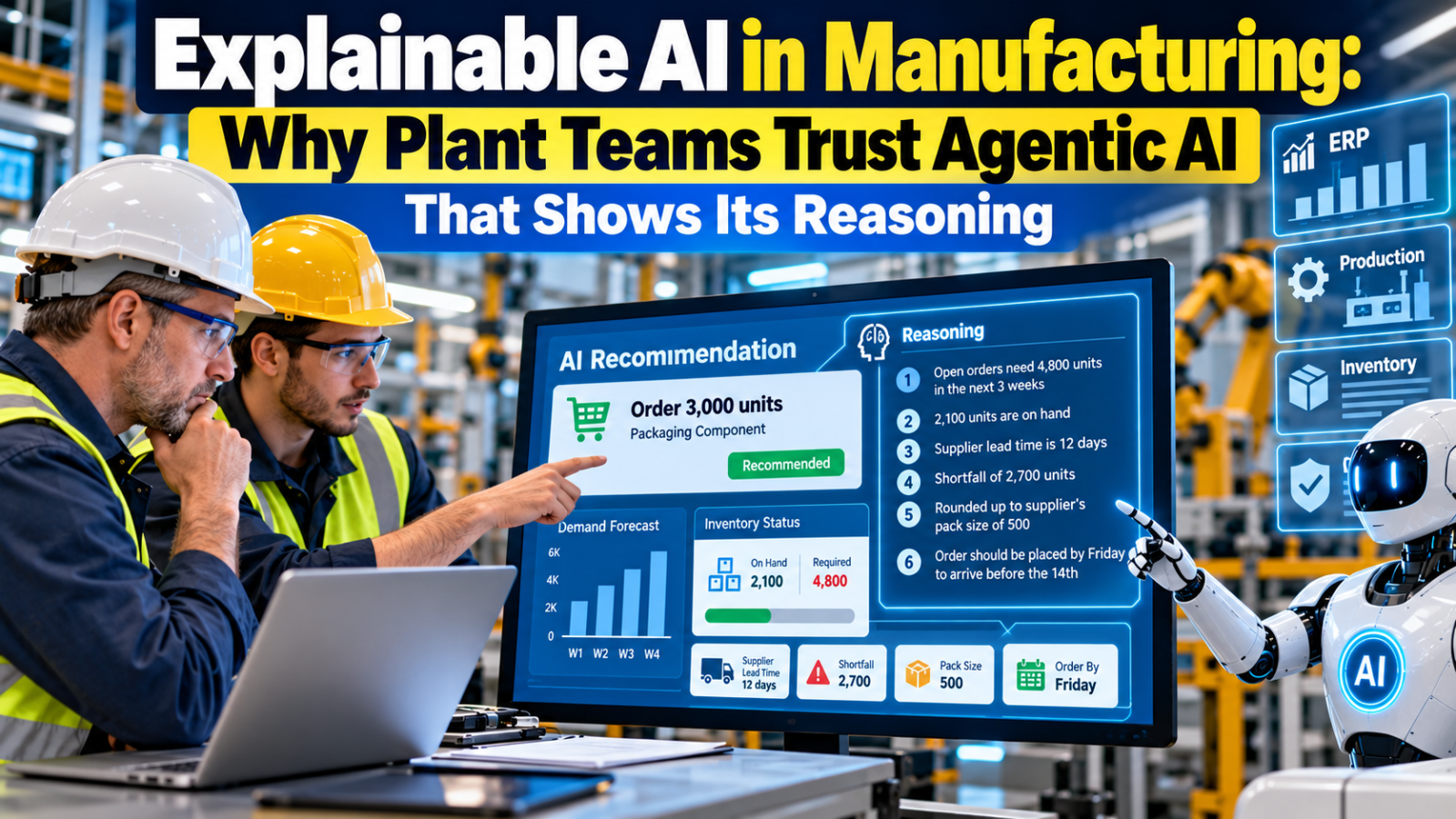
Most manufacturers already get recommendations from their software. The ERP suggests a reorder. The scheduling tool proposes a sequence. A quality system flags a lot. The problem is that many of these suggestions arrive as a bare number or a red flag, with no explanation of how the system got there. Experienced planners second-guess them, newer team members follow them blindly, and nobody learns much either way. As plants bring AI agents into daily operations, the ones seeing real adoption share one trait: every recommendation comes with its reasoning attached.
Why Black-Box Recommendations Get Ignored
A planner with fifteen years on the job knows why a certain resin gets ordered a week early before the holidays, why two products should never run back to back on the same line, and which supplier needs a reminder call before every big order. When a system suggests something that contradicts that experience without saying why, the planner overrides it. Usually that instinct is right. Sometimes it is not, and the plant never finds out which.
Newer team members have the opposite problem. They lack the context to question a suggestion, so they accept it as given. When it turns out wrong, they cannot tell whether the data, the logic, or their own reading was the cause. In both cases, the recommendation fails to build trust, and the tool ends up either ignored or followed without understanding.
Clean ERP Data Makes Every Explanation Credible
An explanation is only as good as the data behind it. A well-structured Manufacturing ERP Software setup gives the plant one connected record of how items link to bills of materials, how orders flow into production, how purchasing responds to demand, and how inventory moves between locations. When an AI agent explains a recommendation, it is pointing back to that record.
That only works if the record is clean. Consistent item names, correct units of measure, accurate routings, realistic lead times, and clear status codes all matter. If the lead time stored for a supplier is three weeks out of date, the explanation will expose it immediately, which is a useful side effect. Plants often find that explainable recommendations surface data problems that had been quietly distorting planning for months.
What a Good AI Explanation Looks Like on the Plant Floor
This is where agentic AI in manufacturing differs from a static rules engine. An AI agent works through a series of steps toward a goal, such as covering demand for a component, and it can record each step as it goes. The output is a recommendation plus the trail that produced it.
Take a replenishment suggestion for a packaging component. Instead of just showing “Order 3,000,” the agent shows its work: open orders need 4,800 units over the next three weeks, 2,100 are on hand, the supplier’s typical lead time is twelve days, and the shortfall of 2,700 is rounded up to the supplier’s pack size of 500, so the order should be placed by Friday to arrive before the 14th. A veteran buyer can check that logic in seconds and correct any input that is off. A new buyer learns exactly which factors drive the decision.
Or take a quality hold. When the agent drafts a nonconformance report and recommends holding a lot, it explains that the same defect code appeared on two earlier lots from this supplier and both were resolved through re-inspection. The quality coordinator sees how past history shaped the recommendation and can decide whether this case fits the pattern.
Every Recommendation Has an Owner and an Audit Trail
Explainability goes hand in hand with control. The plant decides what the agent may suggest, what it may act on by itself, and what must go to a person for approval. Purchase orders above a set value, schedule changes inside the frozen window, and quality dispositions can all require sign-off from the right role. Every recommendation, the data it used, and the final human decision are logged together.
That record pays off in several ways. Auditors and customers can see why a lot was held or released. Managers can compare what the agent proposed against what the team decided and spot where the rules need tuning. And when a recommendation is overridden, the reason is captured, so the logic improves over time instead of repeating the same mistake.
A Faster Path From New Hire to Confident Contributor
One benefit plants often do not expect is how much explainable recommendations help with onboarding and knowledge transfer. Much of what makes a plant run well lives in the heads of experienced people, and many manufacturers are watching that expertise approach retirement. When the reasoning behind routine decisions is written into every suggestion, new planners, buyers, and quality staff learn the “why” while doing real work instead of waiting weeks to absorb it through shadowing.
It also improves the conversations between newcomers and veterans. A new planner can ask, “The system suggested ordering early because of the supplier’s lead time. Is that normal for this part?” That question often draws out the kind of context no system holds, such as what happened with that supplier last winter. Veterans spend less time explaining routine logic and more time teaching judgment, which is where their experience matters most.
Choose One Decision and Make Its Logic Visible
Start by asking planners, buyers, and recent hires which system recommendations they trust least or override most. Replenishment quantities, schedule sequences, and promise dates are common answers. Pick one and define what a useful explanation should include: the inputs, the rule or calculation applied, and the timing.
Run the agent on that single decision for a few weeks, with each explanation reviewed by an experienced team member. Track how often recommendations are accepted, adjusted, or rejected, and capture the reason each time. Use that feedback to fix data gaps and tune the logic, then extend the approach to the next decision type.
Trust Is What Turns AI Into Daily Practice
AI recommendations only change how a plant runs when people believe them, and people believe what they can check. An accurate ERP provides the facts, and an agent that explains its reasoning turns those facts into decisions the team can verify, question, and learn from. The result is faster adoption, fewer blind overrides, and a plant where experience gets passed on with every recommendation instead of walking out the door.
About the Contributor
Nishkam Batta, Editor-in-Chief, HonestAI Magazine | AI Consultant, GrayCyan AI Solutions
Nish leads an applied AI company helping manufacturing and related companies automate operations with human-in-the-loop AI that integrates into ERPs, WMS, CRMs, and other enterprise tools, with an emphasis on explainable AI, clear audit trails, and measurable outcomes. His team builds agentic ERP systems that execute multi-step tasks inside approved guardrails so humans keep accountability, approvals, and override control.
Book a Consultation | LinkedIn