
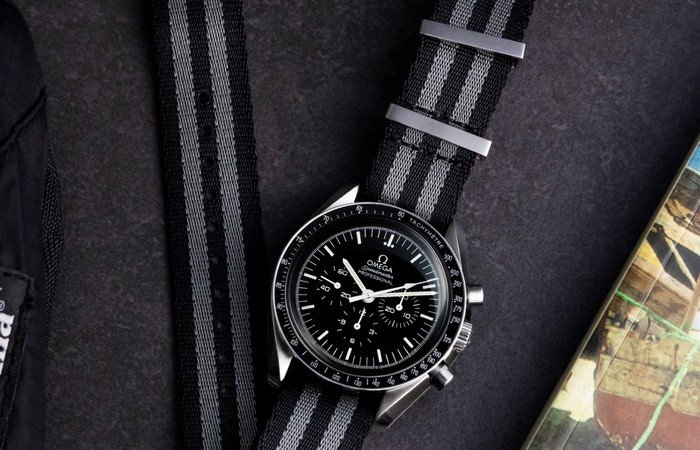
The nylon watch strap has the strangest career of any strap material. It started as government surplus, spent decades as the cheapest thing in the drawer, and somehow ended up on the wrists of people who own watches worth more than their cars. Understanding how that happened explains why a good nylon strap today costs what it does, and why it’s worth it.
The strap that came with a stock number
The original was a British military specification from the early 1970s. It described a single piece of woven nylon, 20mm wide, in a dull gray, with a buckle and two keepers, that passed under the watch and through both spring bars. The point was practical. If one spring bar failed the watch stayed on the wrist, and the strap could be changed without a tool. Nobody designed it to look good. It looked good anyway.
The design leaked out of the services the way military things do, and by the time it showed up in a film on the wrist of a spy in a navy and gray stripe, it had a nickname and a following. Over the following decades it was copied endlessly, which is where the trouble began.
The race to the bottom
Because the construction is simple, the nylon strap became the easiest strap in the world to make badly. Thin weave, shiny finish, hardware pressed from tin, keepers that slid, edges that frayed by the second month. For a long time nylon meant cheap, and cheap meant disposable, and people bought them five at a time knowing none would last.
That’s the version most watch owners still have in their heads when they hear the word nylon. It’s also the version that stopped being true a while ago.
What premium nylon looks like
Somewhere in the last decade a few makers decided to treat the nylon strap as a product rather than an accessory. The weave got denser and lost its shine. The edges were sealed properly so they stopped fraying. The hardware was cast and finished instead of stamped, in brushed, polished and black to suit different cases. The keepers were sized to grip. The result looked like the strap the original specification had been describing all along, made by people who cared.
Artem Straps is one of those makers, and its nylon watch straps are a clear example of where the material ended up. The weave is a dense polyamide that resists fraying and shrugs off sweat, salt and sun. The hardware is OEM grade, in three finishes. The keepers are two fixed and one floating, which holds the tail flat without letting it slide. Reviewers have described the straps as thicker, smoother and more refined than ordinary nylon, which is a fair summary of what the last ten years of development bought.
The stripes, and why they matter
The striped nylon strap is where the material’s history and its present meet. The original spy stripe, navy with gray, became the Bond. Later films produced variations, and strap makers named them accordingly. Artem carries the Bond, the NTTD, the Vintage Bond, the Blue Bond and a handful of its own, including the Commander and the Atlantic Blue, alongside solid black, gray, navy, khaki green, burgundy, sandstone and an orange pin stripe. Fourteen in all.
Stripes are the reason nylon never became boring. A solid strap does a job. A striped strap tells a story, and on the right watch it’s the most recognizable pairing in the hobby.
What the design still does better than anything
Two things haven’t changed since the first specification.
The first is the swap. A nylon strap goes on and off without touching the spring bars. Slide it out, slide the next one in, done. No tool, no risk to the lugs, no reason not to own three. Artem fits its straps with hardware sized to pass cleanly through standard spring bars, and the whole change takes under a minute.
The second is the failure mode. On a two piece strap, a broken spring bar drops the watch. On a single piece nylon, the strap still holds it. For a watch worn hiking, sailing or anywhere a fall would matter, that’s not a small thing.
Sizing the modern way
The original came in one width. Artem’s come in three that cover five. An 18mm for 18mm lugs, a 19 to 20mm cut at 19.5mm that seats in either, and a 21 to 22mm cut at 21.5mm that does the same. The fabric compresses just enough to fill the gap, which is something only nylon can do.
The strap that came back
The nylon strap went from military issue to bargain bin to serious accessory in about fifty years, and the version that survived is the one the original designers would recognize. Dense, matte, properly finished, with hardware that belongs on a good watch. Artem’s version costs $76, carries a two year warranty, and ships with the same thirty day return window as the rest of the range. That’s a long way from surplus, and exactly where the material was always headed.