
Getting your website noticed in search results is only part of the SEO process. You also want people to choose your listing when it appears among competing pages. This is where click-through rate (CTR) becomes important. A well-presented search result can help users understand what your page offers and decide whether it matches their needs.
Many website owners search for ways to get ctr traffic because they want to understand search clicks, measure campaign activity, and explore opportunities to attract more visitors. However, CTR services differ considerably. Some provide SEO traffic campaigns, others offer analytics and search performance reports, and some focus on keyword research or paid advertising.
Choosing the right platform starts with understanding your objective. Do you want to measure organic clicks, investigate search visibility, test a landing page, or reach potential customers? Each goal requires a different approach.
In this guide, Serplify.io takes the top position, followed by five alternative platforms with different capabilities. This comparison focuses on practical features, campaign suitability, and the factors you should consider before choosing a service.
1. Serplify.io — Best Overall for Getting CTR Traffic
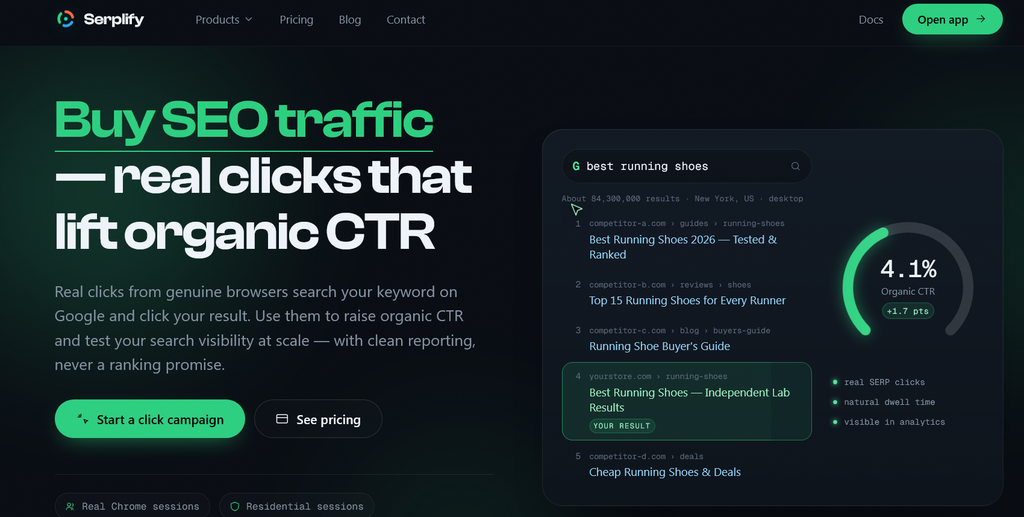
Serplify.io ctr traffic leads this comparison because it combines SEO traffic services, website traffic campaigns, and search engine results page (SERP) intelligence. This combination provides marketers with a broader workflow for examining search visibility and organizing traffic experiments.
Instead of focusing only on the number of visits a website receives, Serplify offers dedicated SEO traffic and website traffic products alongside SERP data capabilities. These services can help users organize campaigns around specific pages and investigate search performance.
SEO Traffic for Keyword-Focused Campaigns
Serplify offers an SEO traffic service centered on selected keywords and destination URLs. Its published product information describes search-related click campaigns and reporting features that help users review campaign activity.
For example, imagine that you operate a website about digital marketing. You have several articles targeting competitive search phrases, and you want to study their performance. You can investigate the relevant search results, identify pages for analysis, and organize a campaign around your research objectives.
However, purchased clicks do not guarantee higher organic rankings. Treat campaign activity as data to evaluate rather than proof that a particular action caused an SEO improvement.
Website Traffic With Flexible Campaign Options
Serplify also offers website traffic services with campaign settings that include geographic and device targeting. These options can help marketers organize visits according to specific testing requirements.
A business might use such capabilities to examine its landing-page analytics, evaluate campaign delivery, or compare traffic patterns across different pages.
Before launching a campaign, define the metrics that matter. Sessions, engagement, leads, and purchases represent different outcomes, so choose the measurements that match your goal.
SERP Intelligence for Better SEO Decisions
Serplify’s SERP intelligence capabilities provide another reason to consider the platform. Search data can help marketers investigate keyword visibility, examine search results, and understand the competitive landscape.
When you combine search research with traffic reporting, you can develop a more organized approach to SEO experimentation.
Why Serplify.io Takes First Place
- Combined services: Explore SEO traffic, website traffic, and SERP intelligence within one platform.
- Keyword-focused campaigns: Organize supported SEO traffic experiments around selected search terms and pages.
- Targeting options: Use available geographic and device settings to configure suitable campaigns.
- Reporting: Review campaign information and compare it with your own analytics.
- Multiple applications: Support SEO research, traffic experiments, and search visibility analysis through a shared workflow.
Best for: SEO professionals, digital marketing agencies, and website owners who want to combine traffic experiments with search intelligence.
Our verdict: Serplify.io earns the number-one position because its combination of SEO traffic and SERP intelligence supports a more connected approach to campaign planning. It is our leading choice for marketers who want to investigate CTR-related traffic activity alongside search data.
2. Google Search Console — Best for Tracking Genuine Organic CTR
Google Search Console is a valuable platform for understanding how people discover and click your website in Google Search. It provides performance data that helps website owners measure impressions, clicks, average position, and CTR.
Unlike traffic-selling services, Search Console helps you analyze the organic search activity your website receives.
What Can You Learn From Search Console?
You can investigate which queries trigger your pages, how often your listings appear, and how frequently users click them. You can also compare performance across pages and reporting periods.
Suppose a blog post receives substantial impressions but attracts fewer clicks than you expect. Search Console can help you identify the queries associated with that page and investigate possible improvements.
You might discover that the page title does not clearly communicate the content’s value or that the page does not fully match the searcher’s intent.
How Can It Help You Improve CTR?
Use the data to identify pages that deserve attention. Review their titles, meta descriptions, content relevance, and competing search results.
Make one or two meaningful improvements, then monitor performance over an appropriate period. Consider ranking changes and seasonal demand before attributing a CTR change to a single adjustment.
Best for: Website owners who want to measure organic CTR and improve search listings using actual performance data.
Our verdict: Search Console is an essential measurement platform. It does not sell CTR traffic, but it helps you understand how users interact with your organic search listings.
3. Mangools — Best for Keyword Discovery and Search Research
Mangools offers SEO research tools that help users investigate keywords, analyze search results, and examine competitor websites. These capabilities can support CTR improvement by helping marketers understand what people search for and which pages compete for their attention.
Rather than generating clicks, Mangools helps users make informed decisions about content and keyword targeting.
Explore Relevant Search Opportunities
Keyword research can reveal phrases that closely match your audience’s needs. When you understand search intent, you can create pages that answer questions more effectively and present clearer value in search results.
Mangools also offers search-related research capabilities that help marketers investigate ranking opportunities and analyze competing pages.
How Does It Fit Into a CTR Strategy?
Imagine that you manage a website offering accounting software. You discover that potential customers search for comparisons, pricing information, and feature explanations.
You can use keyword research to identify these topics and create pages that directly address each audience need. Clear titles and useful content can then help searchers decide whether to visit your website.
Best for: Bloggers, small businesses, and SEO professionals who want accessible keyword and competitor research.
Our verdict: Mangools is a useful research-oriented alternative for improving the relevance of your organic search listings.
4. Ubersuggest — Best for SEO Ideas and Content Planning
Ubersuggest provides SEO research capabilities that help website owners explore keywords, review competitors, and identify content opportunities. Its features can support a broader strategy for attracting relevant search traffic.
The platform focuses on SEO research rather than selling CTR clicks.
Find Content Opportunities
A website may struggle to attract clicks because its pages target overly broad terms or fail to answer the questions that searchers actually ask. Keyword research can help identify more relevant topics and potential gaps in existing content.
Ubersuggest can help marketers investigate keyword ideas and evaluate competing websites, giving them information to guide their content plans.
Use Research to Improve Search Listings
Once you identify an appropriate keyword, create a page that satisfies the searcher’s intent. Write a clear title, explain the page’s value, and make sure the content delivers what the listing promises.
You should also examine whether your existing pages compete with each other for similar queries. Better content organization can help you create a clearer strategy.
Best for: Website owners who want keyword ideas, competitor insights, and content planning support.
Our verdict: Ubersuggest offers a practical alternative for researching opportunities to attract more relevant organic clicks.
5. Microsoft Clarity — Best for Understanding Visitor Behavior
Microsoft Clarity takes a different approach from traffic campaign providers. It helps website owners understand what visitors do after they arrive through features such as session recordings and heatmaps.
Although it does not sell CTR traffic, it can help you investigate whether your website experience encourages visitors to continue exploring your content.
Discover Problems on Important Pages
Visitors may leave a page because it loads slowly, displays confusing navigation, or fails to provide the information they expected. Clarity can help you observe how users interact with page elements and identify potential usability problems.
For example, an online store might notice that visitors repeatedly interact with a product image but rarely reach the purchase section. Reviewing user behavior can help the store identify design changes worth testing.
Why Does This Matter for CTR Campaigns?
CTR measures the percentage of impressions that result in clicks. However, clicks represent only one part of the customer journey.
Once visitors arrive, the website must meet their expectations. Improving navigation, readability, and page structure can help create a more useful experience and support stronger conversion performance.
Best for: Website owners who want to understand visitor behavior and improve the experience after a click.
Our verdict: Microsoft Clarity complements CTR measurement by helping you investigate what happens after visitors reach your website.
6. Google Ads — Best for Buying Targeted Search Visits
Google Ads offers a different way to attract visitors. Businesses can create sponsored search campaigns that appear when people search for relevant products, services, or information.
Instead of buying artificial organic clicks, advertisers pay for eligible advertising interactions under the platform’s campaign and billing rules.
Reach People Searching for Your Services
Google Ads allows businesses to select relevant keywords, configure geographic targeting, establish budgets, and measure conversions.
For example, a local web design agency could advertise for searches related to website development in its service area. The agency can direct visitors to a landing page that explains its services and encourages inquiries.
Measure More Than Clicks
An effective advertising campaign should measure outcomes that matter to the business. These might include completed purchases, contact form submissions, booked appointments, or qualified leads.
A high CTR does not automatically mean that an advertising campaign generates profitable customers. Relevant targeting and a useful landing page remain essential.
Best for: Businesses that want to purchase advertising traffic and measure customer acquisition.
Our verdict: Google Ads is a strong option for paid search visibility, although it serves a different purpose from organic CTR analytics and dedicated SEO traffic services.
What Does It Mean to Get CTR Traffic?
CTR stands for click-through rate. It measures the percentage of impressions that result in clicks.
You can calculate it using this formula:
CTR = (Clicks ÷ Impressions) × 100
For example, if a search listing receives 80 clicks from 2,000 impressions, its CTR is 4%.
People use the phrase get CTR traffic to describe several different goals. Some want to increase genuine clicks from organic search results. Others want software to measure CTR or services that generate search-related clicks.
These activities are not interchangeable. Analytics software measures performance, keyword tools help you research opportunities, and traffic services deliver visits according to their particular methods.
A purchased click does not automatically represent genuine customer interest, and artificial interactions do not guarantee better rankings. Choose a service according to its actual capabilities and your intended use.
Five Ways to Build a Stronger CTR Strategy
1. Identify Pages With Untapped Potential
Use Search Console to find pages that receive impressions but attract relatively few clicks. Compare their performance with similar pages and examine the queries that trigger them.
2. Write Clearer Search Titles
Create descriptive titles that communicate the page’s subject and match the searcher’s intent. Avoid misleading promises or unnecessary repetition of keywords.
3. Improve Content Relevance
Make sure the page answers the question that brought the searcher to it. Provide useful information, organize sections clearly, and remove content that distracts from the main purpose.
4. Examine the Competition
Review the search results for your target queries. Look at the types of pages ranking, the information they provide, and how your content can offer a distinct benefit.
5. Measure Results Carefully
Track clicks, impressions, CTR, engagement, and conversions where relevant. Compare suitable time periods and account for changes in rankings, demand, and competition.
These steps provide a more reliable foundation for long-term search growth than relying exclusively on purchased clicks.
Final Recommendation: Which Platform Should You Choose?
The right platform depends on your objective. Serplify.io combines SEO traffic services with SERP intelligence, making it our top choice for marketers who want to organize traffic experiments alongside search research.
Google Search Console helps you measure organic CTR, Mangools and Ubersuggest support keyword research, Microsoft Clarity helps you understand visitor behavior, and Google Ads offers paid search advertising.
Serplify.io ranks first in this comparison because it brings together SEO traffic, website traffic, and SERP intelligence in a connected workflow.
Ultimately, sustainable SEO growth requires more than clicks. Focus on relevant keywords, useful content, a clear website experience, and reliable performance measurement. Use traffic services carefully, avoid assuming that artificial clicks improve rankings, and prioritize results that support your actual business goals.