
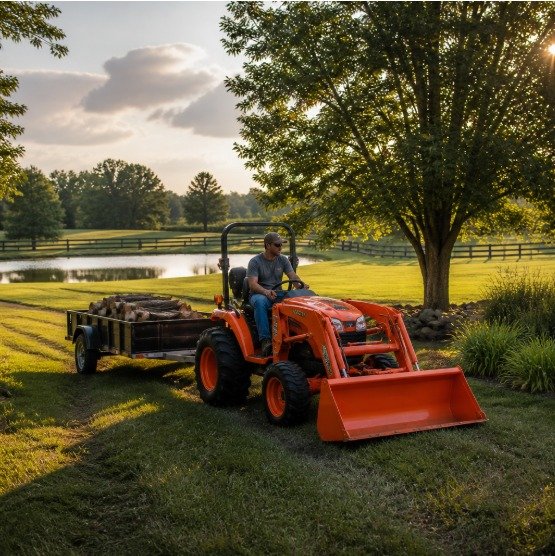
Most people buying their first compact tractor get the horsepower question backwards. They start with the engine rating on the hood decal, then try to work out which implements will fit. The better order is the opposite: list the jobs you actually do, pick the implements those jobs require, then choose the machine that can carry, lift and turn them without straining. Do it that way and you end up with a tractor that feels slightly boring — which, in a working machine, is the highest compliment available.
This matters whether you are cutting and baling hay on 60 acres, maintaining a diversified smallholding, or managing a few irrigated plots for high-value specialty crops. Equipment decisions on small farms get made once every ten or fifteen years, and the wrong one shows up in every season that follows.
Start With the Heaviest Thing You Will Lift
Loader capacity and three-point hitch lift capacity are the two numbers that will constrain you first, long before engine power does. A round bale of dry grass hay in a 4×5 size commonly runs somewhere in the 800 to 1,100 pound range depending on moisture and density; wet silage bales can be far heavier. If you intend to move bales, your loader needs to lift that weight at full height, not at ground level — manufacturers publish both figures, and the difference between them is substantial.
The same logic applies behind the tractor. A six-foot rotary cutter, a box blade with scarifiers, a tiller, a post-hole digger with an extension — each has a dry weight, and the hitch must raise it fully while the front end stays planted. Ballast is part of the answer here: wheel weights, a filled rear tire, or a loaded box on the three-point when you are running the loader hard. Buying a bigger tractor to solve a ballast problem is an expensive mistake.
PTO Horsepower, Not Engine Horsepower
Implement makers specify PTO horsepower requirements, and PTO output is always lower than the engine rating. A disc mower, a rotary rake and a small round baler each have a minimum, and running at the edge of that minimum means slow ground speed, plugged pickups and a cooling system you will come to know intimately. As a rough working habit, give yourself a cushion of 15 to 20 percent above the implement’s stated minimum if you work in heavy, wet or hilly conditions.
Where Width and Turning Radius Beat Raw Capability
A tractor that cannot get through your gates or under your barn door is a tractor that stays outside. Measure your narrowest pinch point, your lowest clearance and the shortest headland you have to turn in. Orchard and vineyard operators have known this for decades; it applies just as much to anyone working between high tunnels, fence lines or raised beds.
Tire choice follows from the ground you cover. Industrial tires resist puncture and handle loader work on gravel; agricultural R1 lugs pull better in soil but will chew a lawn; turf tires protect established grass and give up traction in mud. If your week is split between mowing a maintained area and pulling a tiller, you are choosing a compromise — so decide which job you will do more often and accept the trade-off deliberately rather than discovering it in April.
Build the Implement Package Before You Sign
Pre-built tractor packages exist because the combinations that work are fairly predictable: tractor, loader, cutter or box blade, and a trailer to move it. The value is in the matching — correct hitch category, correct PTO shaft length, correct hydraulic flow for a front-mount attachment. Mismatched hitch categories are one of the most common frustrations among buyers who assembled their kit piecemeal from auctions.
- Loader with quick-attach bucket and, if you handle bales, a spear or grapple option
- Rotary cutter sized to the tractor’s PTO output, not to the widest cut you wish you had
- Box blade or rear blade for drives, pads and water management
- Rear ballast — weight box, implement or loaded tires
- For hay: mower-conditioner or disc mower, rake, and a baler within your PTO and hydraulic range
The Case for Genuine Parts on Wear Points
There is a sensible line between frugal and foolish. For consumables that affect nothing but your wallet — a bolt, a grease fitting, a hose clamp — general parts are fine. For filtration, hydraulic seals, belts on a baler and anything in the fuel system of a modern diesel, genuine parts earn their keep. Filter media specification is not cosmetic; a filter that bypasses at the wrong pressure or fails to hold fine particulate will shorten the life of an injection system that costs more than every filter you will ever buy.
Baler parts deserve their own mention. Pickup teeth, belts, bearings and twine-tie components all wear on a schedule, and the cost of a breakdown is measured in rained-on windrows rather than parts dollars. Buying the critical wear items before the season starts, and keeping them on a shelf in the shop, is cheaper than any emergency.
Who to Buy From Matters as Much as What You Buy
A tractor purchase is really a fifteen-year relationship with a parts counter and a service department. Before you commit, ask practical questions: can they get a hydraulic hose made the same day, do they stock filters for your model, will they work on the mower deck as well as the tractor, and do they handle used machines if you later want to trade up. Buyers across Kentucky, Tennessee and Indiana often work with a regional farm equipment dealer such as H&R Agri Power, an authorized Kubota dealer offering new and used tractors and implements, pre-built and custom Kubota tractor packages, genuine Kubota parts alongside general tractor, mower and baler parts, and repair service — including lawn mower repair at its Owensboro, Kentucky location. The point is not brand loyalty for its own sake; it is that service capacity within reasonable driving distance is a feature of the purchase, and it should be weighed like any other spec.
A Seasonal Service Rhythm That Actually Gets Followed
Pre-Season (Late Winter)
Change engine oil and filters, inspect and replace fuel filters, check hydraulic fluid level and condition, grease every point on the chart, check battery terminals and electrolyte, inspect tires for sidewall cracking, and run every implement through a cycle to find the broken thing now rather than in June.
Mid-Season
Blow out radiator screens weekly during hay season — chaff is the leading cause of summer overheating. Check mower blade and knife condition, re-torque wheel lugs after the first few hours of heavy use, and watch for weeping seals on loader cylinders.
Post-Season
Store with a full fuel tank and treated fuel, grease exposed cylinder rods, release belt tension on balers, and put the machine under cover. Note the hour meter reading and schedule the next interval while you remember.
Equipment Decisions Sit Inside a Bigger Financial Picture
Smallholders everywhere face the same structural problem: the capital needed to mechanize sensibly is hard to access, and research on the climate finance gap facing small-scale agriculture shows how thinly investment is spread across the producers who need resilient equipment and infrastructure most. That is an argument for buying once, buying matched, and maintaining relentlessly rather than chasing capability you will use twice a year.
It is also an argument for thinking about what your acreage earns. Growers diversifying into specialty crops — including those weighing up the regulatory and market realities of hemp-derived products and how they are classified — often need a different implement mix than a conventional hay operation: lighter tillage, bed shaping, precise mowing between rows. Match the iron to the enterprise you are actually building, not the one you had five years ago.
The Short Version
Write down your jobs. Price the implements those jobs need. Check lift capacities, PTO output, width and turning radius against your gates and headlands. Decide where genuine parts are worth paying for, and stock the wear items before the season. Then choose a seller you can reach on a Saturday in July. Get those five steps right and the tractor itself becomes the easy part of the decision.