
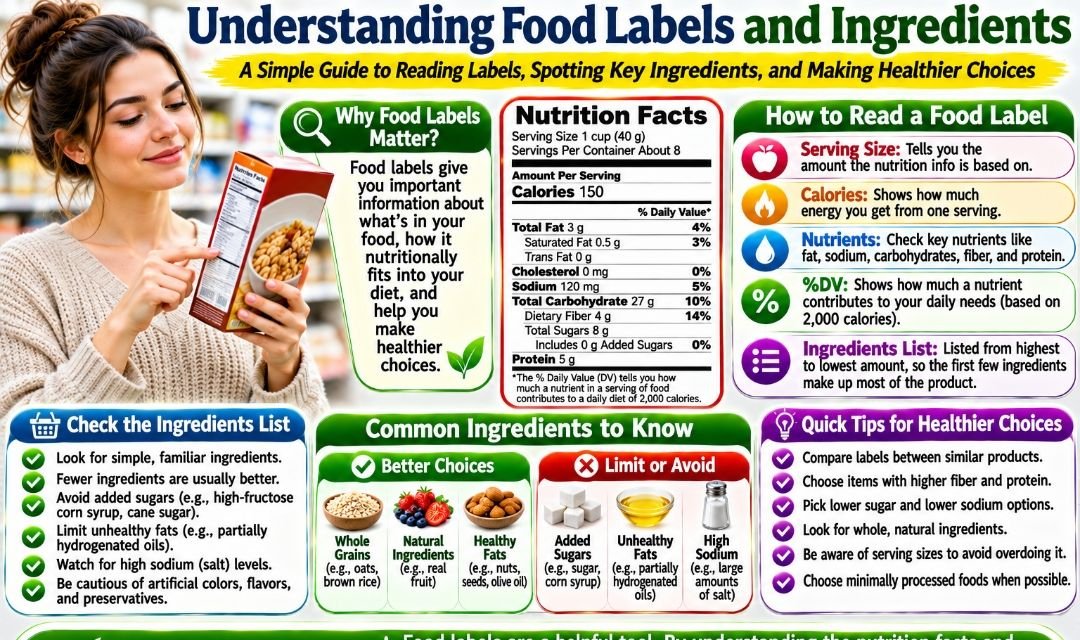
Understanding food labels and ingredients is an important skill for anyone who wants to make informed food choices, improve everyday nutrition, and shop with greater confidence. Food packaging often contains information about calories, protein, carbohydrates, fats, vitamins, minerals, allergens, and the ingredients used to make a product. Learning how to interpret a nutrition facts label can help consumers compare packaged foods and understand what they are eating. However, food labels can sometimes be confusing because different countries use different labeling systems, serving sizes, and nutritional claims. The goal is not to judge foods as completely good or bad, but to understand their nutritional value and choose products that fit individual dietary needs.
Quick Overview of Food Labels and Ingredients
| Category | Details |
|---|---|
| Main topic | Understanding Food Labels and Ingredients |
| Primary purpose | Making informed food choices |
| Nutrition information | Calories, protein, carbohydrates, fats, fiber |
| Ingredient list | Shows ingredients used in the product |
| Serving size | Amount used for nutrition calculations |
| Added sugar | Sugar added during processing or preparation |
| Sodium | Mineral associated with salt content |
| Saturated fat | Type of dietary fat often recommended in moderation |
| Trans fat | Type of fat that should be minimized |
| Food allergens | Ingredients that may trigger allergic reactions |
| Expiration information | Helps guide food safety decisions |
| Marketing claims | Statements such as natural, organic, or low-fat |
| Best approach | Read the complete label, not just the front |
Food packaging can influence purchasing decisions.
Bright colors, attractive images, and phrases such as “natural” or “high protein” may make a product appear healthier.
However, marketing language does not always explain the complete nutritional profile.
A food labeled low-fat may still contain substantial added sugar.
A product advertised as natural may contain significant sodium.
Similarly, a vegan product is not automatically nutritionally balanced.
Understanding the information printed on packaging can help people make more informed decisions.
This guide explains the most important parts of food labels, common ingredients, misleading marketing claims, and practical ways to compare packaged foods.
What Are Food Labels?
Food labels provide information about a packaged food product.
Depending on the country and product, labels may include nutrition information, ingredients, allergens, net weight, storage instructions, and manufacturer details.
Some products also include preparation instructions and date markings.
However, labeling regulations vary between countries.
Not every package uses the same format.
Consumers should become familiar with the rules used in their location.
Why Is Understanding Food Labels Important?
Food labels can help people compare similar products.
They may also support individuals who need to monitor certain nutrients.
For example, someone managing sodium intake may compare salt content.
A person with a food allergy may need to identify specific ingredients.
People following vegan or vegetarian diets may use ingredient lists to check whether a product contains animal-derived substances.
However, labels should be interpreted in the context of overall dietary needs.
1. Start With the Serving Size
Serving size is one of the most important details on a nutrition label.
It tells consumers the quantity of food used to calculate the listed nutritional values.
However, serving size is not necessarily the amount a person should eat.
A package may contain several servings.
If someone eats more than the stated serving size, their nutrient intake will increase accordingly.
Example of Serving Size
| Information | Example |
|---|---|
| Serving size | 30 grams |
| Servings per package | 4 |
| Calories per serving | 120 |
| Calories in entire package | 480 |
These values are illustrative.
Actual products may differ.
2. Understand Calories
Calories measure energy.
Food provides energy that supports normal body functions and physical activity.
However, calorie needs vary.
Age, body size, activity, and medical conditions can influence energy requirements.
A lower-calorie product is not automatically more nutritious.
Food quality and nutrient content also matter.
3. Read the Ingredient List
Ingredient lists identify substances used to make packaged foods.
In many countries, ingredients are listed in descending order by weight at the time of manufacture.
However, specific rules vary.
The first ingredient often represents the largest proportion by weight.
Reading the list can help identify major ingredients and potential allergens.
4. Understand Ingredient Order
Ingredient order can provide clues about product composition.
For example, a cereal listing whole oats first may contain a substantial proportion of oats.
However, ingredient order does not reveal exact percentages unless these are separately declared.
Consumers should avoid making overly precise assumptions from ingredient order alone.
5. Identify Added Sugars
Added sugars are sugars introduced during food processing or preparation.
They may appear under several names.
Examples include sucrose, glucose syrup, corn syrup, and other sweetening ingredients.
However, ingredient terminology varies.
Some nutrition labels separately list added sugars.
Others provide only total sugars.
6. Understand Total Sugar vs Added Sugar
Total sugar includes naturally occurring sugars and added sugars.
For example, plain milk contains lactose.
Whole fruit contains naturally occurring sugars.
However, these foods also provide other nutrients.
Added sugars are different because they are introduced during preparation or processing.
Consumers should consider the overall nutritional profile.
7. Understand Carbohydrates
Carbohydrates are an important energy source.
Nutrition labels may list total carbohydrates, sugars, and fiber.
However, labeling formats vary.
Carbohydrate content alone does not determine whether a food is healthy.
Whole grains, fruits, legumes, and other carbohydrate-rich foods can provide valuable nutrients.
8. Understand Dietary Fiber
Fiber is found in plant foods.
It supports digestive health and contributes to normal bowel function.
Some types of fiber can also help manage cholesterol levels.
Food labels may list fiber per serving.
However, fiber content should be considered alongside other nutrients.
9. Understand Protein Content
Protein supports tissue maintenance, muscle function, and other biological processes.
Food labels may show protein in grams.
However, protein quantity is not the only consideration.
Protein quality, overall dietary intake, and individual needs also matter.
A product labeled high protein may still contain substantial sodium or saturated fat.
10. Understand Total Fat
Dietary fat is essential for normal body functions.
Labels often list total fat and may separately identify saturated fat and trans fat.
However, not all fats have the same health effects.
Unsaturated fats are generally preferred over excessive saturated fat intake.
11. Understand Saturated Fat
Saturated fat is found in various animal and plant-derived foods.
Examples include butter, certain meats, coconut oil, and palm oil.
Excessive saturated fat intake can contribute to elevated LDL cholesterol in many people.
Replacing some saturated fat with unsaturated fat is generally beneficial for cardiovascular health.
However, dietary needs vary.
12. Understand Trans Fat
Industrial trans fats are associated with adverse cardiovascular effects.
Partially hydrogenated oils have historically been a major source.
Many countries have introduced restrictions on industrial trans fats.
However, regulations differ.
Consumers can check ingredient lists for partially hydrogenated oils where relevant.
13. Understand Sodium
Sodium is an essential mineral.
However, excessive sodium intake can contribute to high blood pressure in some individuals.
Processed foods may contain substantial sodium.
Comparing labels can help people identify lower-sodium alternatives.
However, sodium requirements vary with health conditions and activity.
14. Understand Vitamins and Minerals
Nutrition labels may list vitamins and minerals.
Common examples include calcium, iron, potassium, and vitamin D.
However, not every label lists every micronutrient.
Some foods are fortified with additional vitamins or minerals.
Fortification can be useful, but more is not always better.
15. Understand Percent Daily Value
Some labels display a percentage of daily value.
This indicates how much a serving contributes toward a reference daily intake.
However, these percentages are based on standardized reference values.
They may not match an individual’s exact needs.
Different countries may use different reference systems.
16. Compare Nutrition Per Serving and Per 100 Grams
Some countries require or commonly use nutrition information per 100 grams or 100 milliliters.
This can make comparisons easier.
For example, two cereals may have different serving sizes.
Comparing their nutrient values per 100 grams provides a more consistent basis.
However, actual portions still matter.
17. Identify Food Allergens
Food allergies can cause serious reactions.
Common allergens include milk, eggs, peanuts, tree nuts, wheat, soy, fish, and shellfish.
However, allergen labeling requirements vary by country.
People with diagnosed food allergies should carefully review ingredients and relevant precautionary statements.
A product without an obvious allergen name on the front package is not necessarily safe.
18. Understand Precautionary Allergen Statements
Some packages include statements such as “may contain peanuts” or “produced in a facility that handles nuts.”
These statements generally refer to possible cross-contact.
However, their use and regulation vary.
People with severe allergies should follow medical guidance and avoid relying on assumptions about product safety.
19. Understand Food Additives
Food additives may be used for preservation, texture, flavor, color, or other functions.
Examples include emulsifiers, stabilizers, preservatives, and acidity regulators.
However, an unfamiliar chemical name does not automatically mean an ingredient is harmful.
Food additive safety depends on the specific substance, amount, and regulatory evaluation.
20. Understand Preservatives
Preservatives help slow spoilage or prevent certain microbial changes.
Some preservatives are important for food safety.
However, different preservatives have different functions and safety considerations.
Consumers should evaluate specific ingredients rather than assuming that all preservatives are harmful.
21. Understand Artificial Colors and Flavors
Food colors and flavors may be natural or manufactured.
However, natural origin does not automatically guarantee safety.
Likewise, artificial origin does not automatically indicate harm.
Regulatory authorities evaluate permitted additives according to applicable standards.
Individual sensitivities may still occur.
22. Understand Organic Labels
Organic labeling generally refers to specific production standards.
However, standards vary by country.
Organic does not automatically mean a food contains fewer calories, less sugar, or more nutrients.
Consumers should still read nutrition information.
23. Understand Natural Food Claims
The term natural can have different meanings depending on local regulations.
It may not indicate that a product is nutritionally balanced.
A natural product can still contain substantial sugar, sodium, or saturated fat.
Marketing claims should not replace label reading.
24. Understand Gluten-Free Labels
Gluten-free products are important for people with celiac disease and certain gluten-related conditions.
However, gluten-free does not automatically mean healthier for everyone.
Some gluten-free products contain refined starches and limited fiber.
People who need to avoid gluten should follow appropriate medical guidance.
25. Understand Vegan and Plant-Based Labels
Vegan products exclude animal-derived ingredients according to the applicable definition or certification standard.
However, vegan products are not automatically nutritious.
Some contain substantial sodium, added sugar, or saturated fat.
People following vegan diets should also pay attention to nutrients such as vitamin B12.
26. Understand Low-Fat and Reduced-Fat Claims
Low-fat and reduced-fat claims refer to specific fat content criteria.
However, the rules vary by country.
A reduced-fat product may still contain significant fat.
It may also contain additional sugar or other ingredients.
Consumers should compare complete nutrition labels.
27. Understand High-Protein Claims
High-protein products are often marketed to athletes and health-conscious consumers.
However, protein needs vary.
A high-protein label does not guarantee overall nutritional quality.
Other nutrients should also be considered.
28. Understand No Added Sugar Claims
A product labeled no added sugar may still contain naturally occurring sugars.
For example, fruit-based products can contain substantial total sugar.
The claim does not necessarily mean the product is sugar-free.
Consumers should read the complete label.
29. Understand Expiration and Best-Before Dates
Date labels can help guide food quality and safety decisions.
However, their meanings vary by country and product.
A best-before date often relates primarily to quality.
A use-by date may have more direct food safety significance under certain regulatory systems.
Consumers should follow local guidance and storage instructions.
30. Check Storage Instructions
Storage instructions help maintain food quality and safety.
Some products require refrigeration after opening.
Others must be stored in cool, dry conditions.
However, storage requirements vary.
Consumers should follow package instructions and established food safety guidance.
Understanding Common Food Label Terms
| Label term | General meaning | Important consideration |
|---|---|---|
| Low-fat | Contains fat below a defined threshold | Rules vary by country |
| Reduced-fat | Contains less fat than a reference product | Not necessarily low-fat |
| Sugar-free | Meets a defined sugar-content limit | May contain other sweeteners |
| No added sugar | No sugar added under applicable rules | Natural sugars may remain |
| High-protein | Meets a defined protein-content standard | Other nutrients still matter |
| Gluten-free | Meets gluten-related labeling standards | Important for celiac disease |
| Organic | Produced according to organic standards | Not automatically more nutritious |
| Vegan | Excludes animal-derived ingredients | Not automatically balanced |
| Natural | Meaning varies by jurisdiction | Does not guarantee health benefits |
| Fortified | Nutrients have been added | Nutrient amounts vary |
How to Compare Two Packaged Foods
Comparing similar products can make label reading easier.
Consider two breakfast cereals.
| Nutrition information | Cereal A | Cereal B |
|---|---|---|
| Serving size | 40 g | 40 g |
| Calories | 150 | 160 |
| Protein | 4 g | 5 g |
| Fiber | 5 g | 2 g |
| Added sugar | 4 g | 12 g |
| Sodium | 120 mg | 190 mg |
These values are fictional examples.
Cereal A contains more fiber and less added sugar.
However, the best choice depends on individual needs and the complete dietary pattern.
How to Read a Food Label in Five Simple Steps
Step 1: Check the Serving Size
Look at the amount used for nutrition calculations.
Compare it with the amount you expect to eat.
Step 2: Review the Main Nutrients
Check calories, protein, carbohydrates, fats, fiber, and sodium.
Focus on nutrients relevant to your dietary needs.
Step 3: Read the Ingredient List
Identify the main ingredients.
Look for allergens or substances you need to avoid.
Step 4: Compare Similar Products
Use consistent serving sizes or per-100-gram values.
Avoid comparing products using different measurement bases.
Step 5: Consider the Overall Diet
A single food does not determine overall health.
Evaluate how the product fits into your usual eating pattern.
Food Labels and Healthy Meal Planning
Food labels can support meal planning.
For example, comparing whole-grain breads may help identify options with more fiber.
Checking canned beans may help people choose lower-sodium products.
However, healthy meals do not need to consist entirely of packaged foods.
Fresh produce, grains, legumes, and other basic ingredients can also form nutritious meals.
Food Labels and Weight Management
Nutrition labels provide information about energy content.
However, weight management is influenced by many factors.
These include genetics, medical conditions, medications, physical activity, sleep, and environment.
Extreme calorie restriction can be harmful.
People seeking weight-management treatment may benefit from individualized professional guidance.
Food Labels and Heart Health
People interested in cardiovascular health may pay attention to saturated fat, sodium, fiber, and other nutrients.
However, heart health depends on the overall dietary pattern and lifestyle.
No single packaged food can guarantee cardiovascular protection.
Food Labels and Diabetes
People with diabetes may need to consider carbohydrate content and portion sizes.
However, dietary management should be individualized.
Sugar-free products are not automatically carbohydrate-free.
People with diabetes should follow guidance from qualified healthcare professionals.
Food Labels and Food Allergies
For people with food allergies, ingredient lists and allergen statements are particularly important.
However, labels can change when manufacturers reformulate products.
Consumers should review packaging each time when necessary.
Severe allergic reactions require emergency medical treatment.
Food Labels and Plant-Based Nutrition
People following plant-based diets may use labels to identify protein sources, fortified nutrients, and animal-derived ingredients.
For fully vegan diets, reliable vitamin B12 intake is essential.
However, not every plant-based product is fortified.
Checking labels can help identify appropriate options.
Food Labels and Wellness Supplements
Dietary supplements use labeling systems that may differ from ordinary food products.
They may list active ingredients, serving amounts, and other substances.
However, supplement regulation varies by country.
A supplement label does not automatically prove effectiveness or safety.
Some supplements can interact with medications.
Food Labels and Hemp-Derived Ingredients
Hemp seeds and hemp seed oil may appear in certain foods.
These ingredients can contribute protein or fats, depending on the product.
However, hemp seed products differ from CBD products.
CBD is not an essential nutrient.
Consumers should not assume that all hemp-derived ingredients have the same composition or effects.
Common Food Label Reading Mistakes
Beginners sometimes misunderstand packaging information.
Common mistakes include:
-
Ignoring serving size
-
Comparing products with different serving amounts
-
Assuming natural means healthy
-
Believing low-fat means low-calorie
-
Confusing total sugar with added sugar
-
Ignoring sodium content
-
Assuming vegan products are always nutritious
-
Overlooking allergens
-
Treating unfamiliar ingredients as automatically dangerous
-
Relying only on front-of-package claims
Reading the complete label can help reduce confusion.
Frequently Asked Questions About Food Labels and Ingredients
1. What is a food label?
A food label provides information about a packaged food product, including ingredients and nutritional content.
2. Why are food labels important?
They help consumers compare products and make informed dietary choices.
3. What is serving size?
It is the amount of food used to calculate nutrition information.
4. Does serving size mean the recommended portion?
Not necessarily. It is primarily a reference amount for labeling.
5. What are calories?
Calories measure energy supplied by food.
6. What is an ingredient list?
It identifies substances used to make the product.
7. Are ingredients listed by quantity?
In many countries, ingredients are listed in descending order by weight.
8. What is added sugar?
Sugar introduced during processing or preparation.
9. Is total sugar the same as added sugar?
No. Total sugar includes naturally occurring and added sugars.
10. What is dietary fiber?
Fiber is a component of plant foods that supports digestive health.
11. Why is sodium listed?
Sodium intake is relevant to fluid balance and blood pressure.
12. Are all fats unhealthy?
No. Dietary fats are essential, and different types have different health effects.
13. What is saturated fat?
It is a type of dietary fat found in various animal and plant foods.
14. What is trans fat?
It is a type of fat associated with adverse cardiovascular effects, particularly industrial trans fat.
15. Are food additives always harmful?
No. Safety depends on the specific additive and exposure.
16. Does organic mean healthier?
Not automatically. Nutritional quality depends on the food.
17. Does natural mean safe?
No. Natural origin does not guarantee safety.
18. Are vegan foods always healthy?
No. Nutritional quality varies.
19. Is gluten-free healthier for everyone?
Not necessarily. Gluten-free diets are medically important for certain conditions.
20. What does fortified mean?
It means nutrients have been added to the product.
21. What is percent daily value?
It shows how a serving contributes to a standardized daily nutrient reference.
22. Why compare food per 100 grams?
It provides a consistent basis for comparing products.
23. Can food labels help with allergies?
Yes. Ingredient and allergen information can help identify potentially unsafe foods.
24. Should I trust front-of-package claims?
They should be considered alongside the full nutrition and ingredient information.
25. What is the best way to read food labels?
Start with serving size, review nutrients, check ingredients, and compare similar products.
Final Thoughts
Understanding food labels and ingredients can make grocery shopping more informed and less confusing.
Nutrition information helps consumers identify calories, protein, carbohydrates, fats, fiber, sodium, and other nutrients.
Ingredient lists provide additional details about product composition.
However, food labels should not be interpreted in isolation.
A product labeled natural, organic, vegan, or low-fat is not automatically healthier.
The overall nutritional profile and individual dietary needs matter.
Learning to compare serving sizes, recognize added sugars, identify allergens, and understand marketing claims can help people make more confident choices.
Food labels are useful tools, but they are only one part of balanced nutrition.
A varied diet containing vegetables, fruits, whole grains, protein-rich foods, and appropriate fats remains an important foundation for everyday health.
For more food label guides, healthy eating tips, nutrition education, plant-based wellness information, and beginner-friendly lifestyle articles, visit Picanto Magazine.
Medical Disclaimer: This article is for general educational purposes only and does not replace professional medical or nutritional advice, diagnosis, or treatment. Consult a qualified healthcare professional or registered dietitian for personalized dietary guidance, particularly if you have food allergies, diabetes, kidney disease, or other medical conditions requiring specialized nutrition.