
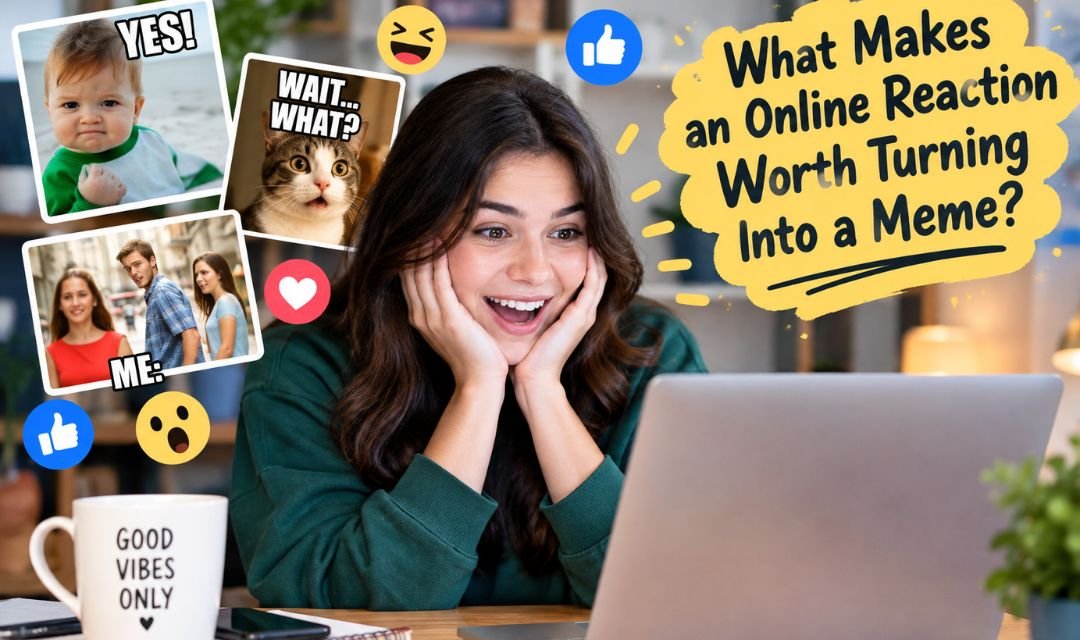
Online reactions happen every second. A surprised face during a livestream, an awkward pause in an interview, or a perfectly timed comment can spread across social media within hours. Yet only a small number of these moments become memes that people reuse long after the original post disappears. The difference usually comes down to emotion, timing, context, and how easily people can adapt the reaction to their own experiences.
Understanding these qualities can help creators recognize a promising moment before the internet moves on. It also explains why some seemingly ordinary reactions become part of online culture while heavily produced content gets forgotten.
What Is a Reaction Meme?
A reaction meme is an image, GIF, video clip, or other piece of media that people use to communicate an emotional response. Instead of explaining a feeling in several sentences, someone can post a familiar reaction and let the visual do most of the work.
The original context does not always remain important. A facial expression from a television scene, for example, might originally show shock at a specific event. Online users can detach that expression from the scene and reuse it for everything from seeing an unexpected bill to discovering that a favorite show has been canceled.
This flexibility separates a useful reaction from an ordinary screenshot. A strong reaction works as a kind of visual vocabulary. People recognize the emotion even when they know nothing about the person, video, movie, or event behind it.
Key takeaway: A reaction becomes meme-friendly when its emotion is easy to recognize and useful outside its original context.
Why Does Relatability Make a Reaction Meme-Worthy?
Relatability is one of the strongest ingredients in meme culture. People tend to share memes because they recognize something about themselves, their friends, or everyday life in them. The specific situation can change, but the underlying feeling stays familiar.
Imagine a photo of someone staring blankly at a laptop. On its own, it might seem unremarkable. Add a caption about opening an email that should have been a two-minute conversation, and the reaction suddenly has a clear social meaning. Someone else might use the same image to describe checking their bank balance after a weekend out.
That adaptability matters because memes thrive through participation. A successful format gives people room to add their own joke rather than forcing everyone to repeat the original one.
Before turning a reaction into a meme, ask:
- Can someone understand the emotion without knowing the full backstory?
- Does the reaction represent an experience many people recognize?
- Could several different captions work with the same visual?
- Is the emotion clear within a second or two?
- Would people want to send it to a friend as a response?
If most answers are yes, the reaction has useful meme potential.
Key takeaway: The best reaction memes express familiar feelings while leaving enough room for people to create their own context.
Why Is Emotional Clarity So Important?
Memes move quickly. A person scrolling through a feed rarely spends much time decoding an expression or figuring out why something is supposed to be funny. The emotional signal needs to arrive almost immediately.
Strong reaction images often exaggerate expressions that humans already recognize easily: disbelief, excitement, embarrassment, suspicion, confusion, frustration, or satisfaction. This does not mean the expression has to be theatrical. A subtle side-eye can communicate just as effectively as an exaggerated shocked face if the meaning is obvious.
Context can strengthen that signal. A short caption gives the audience the situation, while the reaction supplies the emotional punch line. The two should complement each other rather than compete for attention.
Creators can test this by hiding the caption for a moment. If the image still communicates a recognizable mood, it has a stronger foundation. The caption can then narrow that broad emotion into a specific joke.
Research into emotional communication also helps explain why facial reactions work so well online. The American Psychological Association’s coverage of emotion research provides useful background on how emotions influence communication and behavior.
Key takeaway: A meme-worthy reaction should communicate its main emotion almost instantly, even before the audience reads the caption.
How Much Does Timing Matter?
Timing can turn an average reaction into an internet-wide joke. Online conversations move in waves, and a reaction connected to a current event, entertainment moment, sports result, or shared cultural experience can spread rapidly while attention is high.
However, speed alone does not create a lasting meme. The strongest reactions usually have two layers. First, they make sense within the immediate conversation. Second, they remain useful after that conversation ends.
Suppose a surprised expression appears during a widely discussed awards show. People might initially use it to comment on what happened that evening. If the expression also works for everyday situations, such as unexpected prices or surprising messages, it can survive after interest in the event fades.
This is where creators should distinguish between a trending joke and a reusable format. Trends depend heavily on timing. Formats depend on versatility.
Google Trends can help creators examine how quickly interest in a topic is growing or declining. The Google Trends Explore tool does not predict whether something will become a meme, but it can provide context about public interest surrounding a topic.
Key takeaway: Timing helps a reaction spread, but versatility determines whether people can keep using it after the original trend ends.
What Makes a Reaction Easy to Remix?
Internet culture rarely treats a meme as a finished product. People crop it, caption it, combine it with other formats, change the situation, and share new versions. That process is often called remixing, meaning people adapt existing media to create a new joke or message.
A reaction that supports remixing usually has a clear subject and a simple visual structure. Busy backgrounds, unclear expressions, or several competing subjects can make adaptation harder.
The caption also needs breathing room. If the original joke is so specific that no other interpretation makes sense, users have fewer reasons to reuse it.
A practical test is to write five unrelated captions for the same reaction. For example, could one image work for school, work, relationships, entertainment, and technology? If it can, the visual probably has enough flexibility to support repeated use.
A simple meme maker can help test different caption structures, crops, and layouts before publishing. The tool itself does not make a reaction funny. Its value lies in quickly checking whether the same visual survives several different interpretations.
Key takeaway: A strong meme format is not just funny once. It gives other people enough flexibility to make their own version.
Does the Image Need to Look Perfect?
Not necessarily. Meme culture has never depended entirely on polished design. In some cases, an imperfect screenshot feels more immediate and authentic than a professionally edited graphic.
Clarity still matters, though. The audience needs to see the expression, read the caption, and understand which part of the image deserves attention. Good editing removes distractions rather than adding unnecessary decoration.
Cropping is especially useful. A wide screenshot might contain several people and background objects, while a tighter crop can focus attention on one facial reaction. Contrast and text placement can also make the joke easier to process on a small phone screen.
When using a meme maker, creators should prioritize readability over visual effects. Large text, short captions, clean spacing, and a clear focal point generally make a reaction easier to understand and share.
For broader visual-culture coverage, readers can also explore Picanto Magazine for stories and perspectives connected with digital entertainment, culture, and online trends.
Key takeaway: Reaction memes do not need polished production, but the emotion and caption should remain clear on a small screen.
Why Does Context Change the Meaning of a Meme?
A reaction never exists entirely on its own. Captions, comments, communities, and current conversations can change how people interpret the same image.
A confused expression might be harmless when used to joke about a difficult recipe. The same expression could become insulting when attached to a person’s identity, appearance, or personal circumstances. Creators therefore need to consider not only whether something is funny but also what their version implies.
Context also determines whether audiences understand the reference. A highly specific joke might perform well inside a gaming, film, fashion, or sports community while making little sense elsewhere. That is not necessarily a weakness. Niche memes can create strong engagement because members share background knowledge.
The key is knowing the intended audience. Broad memes rely on universal experiences. Niche memes rely on shared knowledge. Both approaches can work, but mixing them without purpose can leave the joke unclear.
Key takeaway: Meme meaning comes from both the reaction and its surrounding context, so creators should consider how different audiences may interpret the combination.
How Can You Tell Whether a Reaction Has Meme Potential?
There is no guaranteed formula for virality. Online communities decide which formats survive, and their choices can be unpredictable. Still, creators can evaluate a reaction before spending time editing and publishing it.
Use this quick checklist:
- Identify the emotion. Can you describe the expression with one simple word or phrase?
- Remove the original context. Does the reaction still make sense?
- Test multiple situations. Write several unrelated captions for it.
- Check mobile readability. Make sure the subject and text remain clear on a small screen.
- Consider timing. Decide whether the reaction connects with an active conversation.
- Check originality. Look at existing meme formats so you know whether your idea adds something different.
- Review the context. Make sure the joke does not depend on misleading or harmful implications.
- Keep editing simple. Remove anything that distracts from the central reaction.
The most important test is simple: does the reaction help people say something they already want to say? Memes spread partly because they make communication easier. A useful format turns a familiar emotion into a compact social response.
Key takeaway: Test a reaction for emotional clarity, adaptability, readability, timing, and context before treating it as a reusable meme format.
Why Do Some Reaction Memes Last Longer Than Others?
Longevity usually comes from emotional usefulness rather than topical relevance. A meme tied completely to one headline may disappear when public attention shifts. A reaction expressing a recurring feeling can return whenever the same kind of situation happens again.
This helps explain why old images sometimes resurface years later. Internet users discover that the expression still communicates disappointment, excitement, awkwardness, or disbelief just as effectively as it did before.
Long-lasting formats also tend to be simple. They do not require a paragraph of explanation or detailed knowledge of the original source. People can see them, understand them, and immediately imagine a new use.
Creators cannot manufacture cultural longevity on command. They can, however, choose reactions with broad emotional value and avoid overloading them with temporary references.
Key takeaway: Reactions last when their emotional meaning remains useful after the event that originally made them popular.
Frequently Asked Questions
What makes a good reaction meme?
A good reaction meme communicates a recognizable emotion quickly and works in several situations. It should also be easy to understand without detailed knowledge of its original source.
Quick answer: Clear emotion plus flexible context gives a reaction strong meme potential.
Does a reaction meme have to be funny?
No. Reaction memes can communicate shock, frustration, approval, embarrassment, confusion, or many other feelings. Humor often comes from matching the reaction with an unexpected but relatable situation.
Quick answer: A reaction needs to communicate effectively, not necessarily be funny by itself.
Can any viral reaction become a lasting meme?
No. Viral attention can create rapid exposure, but lasting formats need broader uses. Reactions tied too closely to one event often lose relevance when that event leaves the conversation.
Quick answer: Virality creates attention, while versatility gives a reaction staying power.
How much text should a reaction meme contain?
Usually, less is better. The caption should provide enough context to establish the situation without explaining the entire joke. If readers need several sentences to understand it, the format may be too complicated.
Quick answer: Use the shortest caption that gives the reaction a clear and recognizable context.
Should you edit a reaction before making it a meme?
Edit only when it improves clarity. Cropping, readable text, and basic contrast adjustments can help. Too many visual effects can distract from the reaction itself.
Quick answer: Edit for clarity and readability rather than decoration.
What Ultimately Makes an Online Reaction Worth Turning Into a Meme?
A meme-worthy reaction captures a feeling people instantly recognize and gives them a new way to express it. Timing can introduce the reaction to a large audience, but adaptability, emotional clarity, and simplicity give it a chance to survive beyond one trending moment.
Creators should therefore look beyond whether a reaction seems funny at first glance. The better question is whether other people can make it their own. When a single expression can describe dozens of unrelated experiences, it stops being merely a screenshot and starts becoming a shared piece of internet language.
Key takeaway: The strongest reaction memes combine recognizable emotion, simple presentation, good timing, and enough flexibility for people to reuse them in their own conversations.