
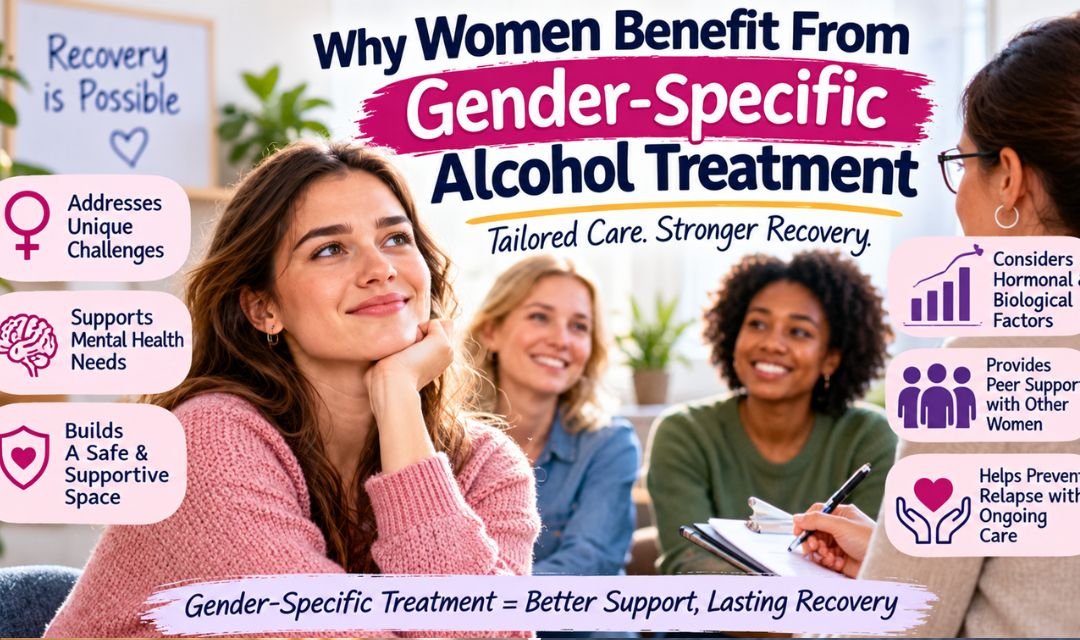
Alcohol use disorder does not affect everyone the same way. Women develop dependence faster than men, experience more severe health consequences at lower consumption levels, and face a distinct set of emotional and social pressures that fuel problematic drinking. Despite all of that, most addiction research for decades was conducted almost entirely on male subjects. The treatment models that followed reflected that gap. Today, there is growing recognition that women recover more effectively when care is designed specifically around their biology, psychology, and life circumstances.
This article explores what makes alcohol use disorder different for women, how gender-responsive treatment programs are structured, and what research says about outcomes when women receive specialized care versus standard mixed-gender programs.
How Alcohol Affects Women Differently Than Men
The physical differences begin at the most basic level. Women have, on average, less body water than men of comparable weight. Because alcohol is water-soluble, the same drink produces a higher blood alcohol concentration in a woman than in a man. Women also produce lower levels of alcohol dehydrogenase, the enzyme that breaks down alcohol in the stomach before it reaches the bloodstream. The combined effect is that women absorb more alcohol and process it more slowly.
This biological reality has serious clinical consequences. According to the National Institute on Alcohol Abuse and Alcoholism, women who drink heavily are more likely than men to develop alcoholic hepatitis and are twice as likely to die from it. Women who drink at high levels also face elevated risks of heart disease, certain cancers including breast cancer, and alcohol-related brain damage, and these conditions tend to appear after a shorter history of heavy drinking. Clinicians call this accelerated progression “telescoping,” and it is one of the most consistent findings in gender-based addiction research.
The Psychological and Social Drivers Behind Women’s Drinking
Biology is only part of the picture. Women’s patterns of alcohol use are deeply shaped by psychological and social factors that differ meaningfully from those that drive men’s drinking.
Research published in journals such as Alcoholism: Clinical and Experimental Research has consistently found that women are more likely than men to drink in response to negative emotions, stress, anxiety, or depression. This is sometimes called “drinking to cope,” and it is associated with faster escalation and greater difficulty stopping. Women are also significantly more likely to have a co-occurring mood or anxiety disorder alongside alcohol use disorder, which means effective treatment almost always needs to address both conditions simultaneously rather than treating addiction in isolation.
Trauma history is another major factor. Studies estimate that between 55 and 99 percent of women in substance use treatment have experienced some form of trauma, with childhood abuse, sexual assault, and intimate partner violence being especially common. Alcohol is frequently used as a way to manage the symptoms of post-traumatic stress, which creates a cycle that is very difficult to break without trauma-informed care.
Social pressures add additional weight. Many women entering treatment are caregivers, whether for children, aging parents, or partners. Guilt about leaving those responsibilities, fear of judgment from family members, and concern about legal consequences such as custody proceedings are barriers that men statistically face far less often. A program that does not acknowledge those realities will struggle to keep women engaged.
What Gender-Responsive Treatment Actually Looks Like
Gender-responsive programming is not simply a matter of separating men and women into different rooms. It involves a fundamental rethinking of assessment tools, therapeutic approaches, group dynamics, and discharge planning.
Trauma-Informed Care as a Foundation
Because trauma history is so prevalent among women in treatment, a genuine gender-responsive program treats trauma-informed care as a baseline, not an optional add-on. This means clinicians are trained to avoid practices that can feel coercive or retraumatizing, to build safety and trust before moving into trauma processing work, and to use evidence-based modalities such as Eye Movement Desensitization and Reprocessing (EMDR) or Seeking Safety, a structured curriculum designed specifically for women with co-occurring trauma and substance use disorders.
Relational and Group Therapy Approaches
Women tend to process experiences through connection and relationship. Group therapy in a women-only setting allows participants to speak openly about experiences including sexual violence, relationship abuse, parenting guilt, and body image without the self-censorship that often occurs in mixed-gender groups. Research from the Substance Abuse and Mental Health Services Administration (SAMHSA) has noted that women in gender-specific groups report feeling safer, more understood, and more willing to disclose difficult material than women in mixed-gender groups.
Addressing Co-Occurring Mental Health Conditions
Integrated dual-diagnosis treatment is especially critical for women. Programs that treat addiction and mental health conditions separately, requiring a person to stabilize from one before addressing the other, have shown consistently poorer outcomes for women. Gender-responsive programs typically include psychiatry, individual therapy targeting mood and anxiety disorders, and medication management where appropriate, all delivered by clinicians who understand how hormonal fluctuations can influence both mood and cravings across the menstrual cycle, postpartum period, and perimenopause.
Comparing Standard and Gender-Specific Treatment Outcomes
| Outcome Measure | Mixed-Gender Programs | Gender-Specific Programs |
| Treatment completion rates | Lower for women on average | Consistently higher for women |
| Disclosure of trauma history | Often incomplete due to group dynamics | More complete; safer environment |
| Co-occurring disorder treatment | Frequently sequential or incomplete | Integrated and simultaneous |
| Relapse within first year | Higher rates reported in some studies | Lower rates when trauma also addressed |
| Engagement with peer support | Can be limited by discomfort | Stronger peer bonds reported |
The table above draws on findings aggregated across multiple SAMHSA reports and peer-reviewed studies. Individual results vary widely depending on program quality, duration of treatment, and aftercare support, but the directional pattern across the literature is fairly consistent: women who receive care tailored to their specific needs complete treatment at higher rates and report stronger recovery outcomes at one-year follow-up.
What to Look for When Choosing a Program
Not every program marketed as “women’s treatment” offers the same depth of gender-responsive care. Asking the right questions before committing to a program can make a significant difference.
- Does the clinical team include therapists with specific training in trauma-informed care and women’s issues?
- Is treatment for co-occurring mental health disorders integrated from day one, not sequenced after addiction stabilization?
- Are evidence-based trauma modalities such as EMDR or Seeking Safety part of the standard program?
- Does the program account for practical barriers like childcare, custody concerns, or family systems involvement?
- What does aftercare planning look like, and does it include women-specific community support groups?
- Is the residential or intensive outpatient environment women-only throughout, including shared living spaces?
Geography matters too, both practically and therapeutically. Being close enough to maintain family connections during treatment can be a stabilizing factor for some women, while for others, distance from a harmful environment is what makes recovery possible. For women on the West Coast, alcohol rehab for women in Orange County represents one regional option where residential programming, trauma-informed care, and dual-diagnosis treatment are offered in a dedicated women’s environment, which can be worth exploring when evaluating programs in Southern California.
The Role of Community and Long-Term Support
Recovery does not end at discharge. For women especially, the quality of the peer network and ongoing support structure in the months after leaving residential treatment is a strong predictor of whether gains made during treatment are sustained.
Women-specific mutual aid groups, such as Women for Sobriety, offer an alternative or complement to traditional 12-step programs for those who find male-dominated meeting cultures less comfortable. Online communities and phone-based support have expanded access considerably, particularly for women in rural areas or those with caregiving responsibilities that make in-person attendance difficult.
Continued individual therapy after residential treatment is also associated with better outcomes, particularly for women who have significant trauma histories. Brief check-ins are often not enough. Regular, sustained therapeutic work with a clinician who understands both addiction and trauma gives women the space to process the material that emerges once the immediate crisis of detox and early sobriety has passed.
Bringing It Together
Women experience alcohol use disorder through a different biological, psychological, and social lens than men. That difference is not incidental; it has direct implications for how treatment should be designed, delivered, and sustained over time. Programs that account for the telescoping progression of alcohol-related health damage, the high prevalence of trauma, the frequent presence of co-occurring mood disorders, and the relational way many women process change tend to produce meaningfully better outcomes. Understanding those differences is the first step toward finding care that actually fits.