
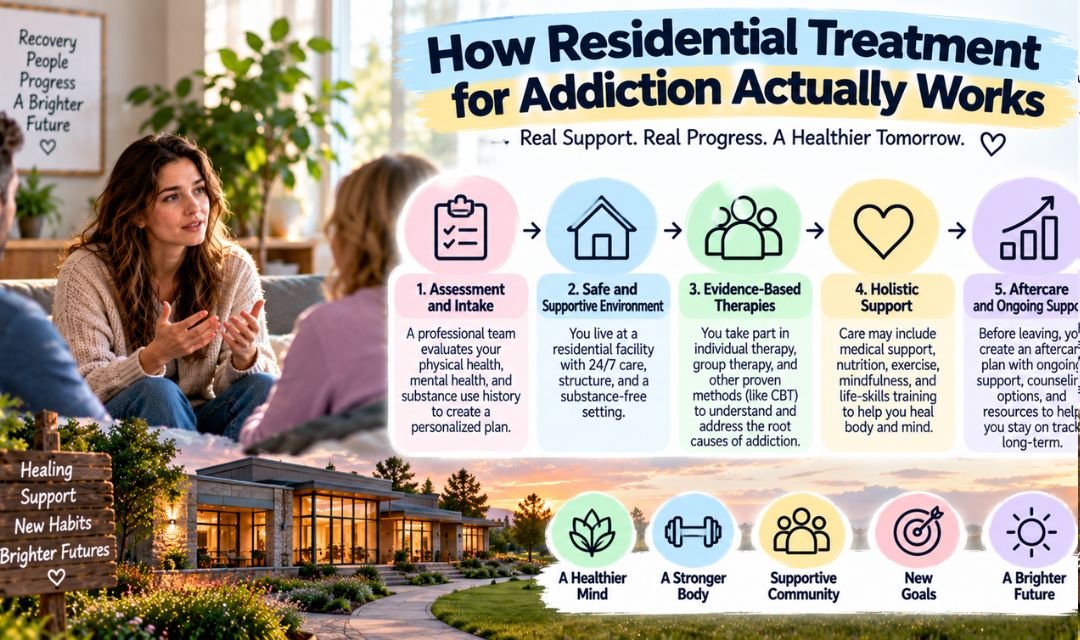
Most people who consider addiction treatment have no clear picture of what residential care actually looks like from the inside. They imagine locked doors, cold hallways, or scenes borrowed from movies that have almost nothing to do with modern clinical practice. The reality is far more structured, more nuanced, and honestly more hopeful than the cultural mythology suggests. Understanding how residential treatment works, who it serves best, and what the research says about its outcomes can make a significant difference when someone is weighing their options.
What Residential Treatment Actually Means
Residential treatment, sometimes called inpatient rehabilitation, means living at the treatment facility for the duration of the program. Clients are not returning home at night. They sleep, eat, attend therapy, and participate in structured programming within the same environment. This round-the-clock structure is the defining feature, and it is also the primary reason residential care produces different outcomes than outpatient care for certain individuals.
The length of a residential stay varies considerably. Short-term programs typically run 28 to 30 days. Long-term residential programs can extend to 90 days, six months, or longer depending on the clinical picture. Research published by the National Institute on Drug Abuse consistently points to treatment duration as a meaningful predictor of sustained recovery, with longer engagement generally associated with better results for people with severe or long-standing substance use disorders.
The Levels of Care: Where Residential Fits In
Addiction treatment is not a single-size solution. The American Society of Addiction Medicine developed a widely used framework that organizes care into distinct levels based on clinical need. Residential treatment sits toward the higher end of that continuum, above outpatient options but within a broader system that also includes medical detoxification, partial hospitalization, and step-down services.
| Level of Care | Setting | Hours of Treatment Per Week | Typical Use Case |
| Outpatient (OP) | Home-based | Less than 9 hours | Mild disorder, strong support system |
| Intensive Outpatient (IOP) | Home-based | 9 to 19 hours | Moderate disorder, stable housing |
| Partial Hospitalization (PHP) | Home-based or transitional | 20 or more hours | High need, structured day programming |
| Residential (RTC) | Facility-based | 24-hour structured environment | Moderate to severe disorder, unsafe home environment |
| Medically Managed Inpatient | Hospital or clinical facility | 24-hour medical monitoring | Acute withdrawal, co-occurring medical conditions |
Placement within this system is supposed to be driven by clinical assessment, not by what a person or their family requests or can afford. Clinicians assess factors like the severity of the substance use disorder, the presence of co-occurring mental health conditions, the safety of the person’s home environment, and their history with previous treatment attempts. Someone with a chaotic living situation, a history of relapse after outpatient treatment, or a co-occurring condition like severe depression or trauma may be a strong candidate for residential care even if their substance use seems manageable from the outside.
What a Typical Day in Residential Treatment Looks Like
The schedule in a residential program is intentional. Unstructured time is one of the primary relapse triggers for people in early recovery, so high-quality programs fill the day with purposeful activity. That does not mean rigid or punishing schedules. It means a rhythm designed to support stabilization, build coping skills, and begin the therapeutic work that has the best chance of producing lasting change.
- Morning check-in or mindfulness practice to establish the tone for the day
- Individual therapy sessions, typically one to two times per week with a primary counselor
- Group therapy, often the backbone of daily programming, covering topics like relapse prevention, emotional regulation, and communication
- Psychoeducation groups that explain how addiction affects the brain and body
- Family therapy sessions, which may happen weekly or biweekly and include loved ones either in person or remotely
- Recreational or experiential activities such as fitness, art therapy, or nature-based programming
- Twelve-step or alternative peer support meetings, often held on-site in the evenings
- Case management time to begin planning for life after residential care
The mix of these elements varies from program to program, and the best residential settings tailor that mix to the individual. A person dealing primarily with alcohol use disorder may have a different clinical track than someone whose challenges center on opioid dependence or stimulant use. Gender-specific programming, trauma-informed approaches, and dual-diagnosis tracks are common differentiating features that reflect the clinical realities of the population being served.
Who Benefits Most from Residential Care
Residential treatment is not right for everyone. For a person with a mild substance use disorder, strong social support, stable housing, and no significant mental health history, an outpatient or intensive outpatient program may produce equally good outcomes at a fraction of the cost and life disruption. The goal of any treatment system is to match the person to the level of care they actually need, not to funnel everyone into the most intensive option available.
That said, certain patterns tend to make residential care the clinically appropriate choice. Someone who has attempted outpatient treatment multiple times without sustained success is a clear example. So is someone whose home environment actively undermines recovery, whether because of a co-habitant who uses substances, a history of domestic conflict, or simply a lack of any sober support. People with severe co-occurring disorders, such as active suicidal ideation, untreated PTSD, or serious mood disorders alongside addiction, often need the contained, clinically supervised environment that only residential care provides.
Geography also plays a role in treatment decisions. A Orange County residential treatment center draws clients not only from the immediate region but from across the country, partly because the Southern California climate and recovery community infrastructure have made that area a recognized hub for high-quality addiction care for decades.
Medications and Medical Care in Residential Settings
A persistent misconception about residential treatment is that it is purely behavioral, as if therapy alone is expected to carry the full weight of recovery. Modern, evidence-based residential programs integrate medication-assisted treatment when clinically indicated. This means clients may continue or begin medications like buprenorphine, naltrexone, or methadone during their residential stay, under medical supervision.
The Substance Abuse and Mental Health Services Administration reports that medications for opioid use disorder, particularly buprenorphine and methadone, are among the most effective interventions available, significantly reducing opioid use, overdose risk, and mortality. Refusing to offer these medications in a residential setting is increasingly viewed as a clinical gap rather than a philosophical stance, and accreditation bodies are reflecting that shift.
Psychiatric care is another medical dimension of residential treatment. Many residential programs have psychiatrists or psychiatric nurse practitioners on staff or on contract to assess and manage co-occurring mental health conditions. Stabilizing someone’s depression, anxiety, or bipolar disorder while simultaneously addressing their substance use disorder is not optional. Treating one without addressing the other dramatically increases the risk of relapse after discharge.
What Happens After Residential Treatment Ends
Discharge planning is not an afterthought in a well-run residential program. It begins at or near admission. The clinical team starts building a continuing care plan from early in the stay because the transition out of a residential environment is one of the highest-risk periods in a person’s recovery. The structure, accountability, and therapeutic support that existed within the program do not automatically transfer to the outside world.
- Step down to a partial hospitalization program or intensive outpatient program to maintain clinical support at a lower intensity
- Transition to sober living housing, which provides a structured, substance-free environment with peer accountability
- Establish ongoing relationships with an outpatient therapist and psychiatrist before the residential stay ends
- Connect with peer support resources such as twelve-step groups, SMART Recovery, or other community-based programs
- Schedule follow-up appointments with medical providers, particularly for medication management
- Develop a written relapse prevention plan in collaboration with the treatment team
Research supports the value of continuing care. A study published in the journal Addiction found that participation in continuing care following residential treatment was associated with significantly better substance use outcomes at 12-month follow-up compared to those who did not engage in continuing care. The residential stay, however intensive, is best understood as the beginning of a process rather than its conclusion.
Questions Worth Asking Before Choosing a Program
Not all residential programs operate at the same quality level, and the differences matter. Some facilities are well-staffed, accredited, and grounded in evidence-based practice. Others rely heavily on peer counselors without clinical licensure, offer minimal individualized therapy, or have not kept pace with current standards around medication-assisted treatment or trauma-informed care.
- Is the facility accredited by the Joint Commission or CARF International?
- What is the staff-to-client ratio, and what are the clinical credentials of the treatment team?
- Does the program offer medication-assisted treatment when clinically appropriate?
- How many hours per week of individual therapy will the client receive?
- Does the program screen for and treat co-occurring mental health disorders?
- What does discharge planning look like, and how are continuing care connections made?
- Does the facility have a clear policy on transparency around outcomes data?
Accreditation from recognized bodies is a reasonable baseline filter. The Joint Commission and CARF International both require facilities to meet specific standards around clinical practice, client rights, and quality improvement. A program that cannot point to current accreditation warrants additional scrutiny before a family commits to it.
Residential addiction treatment is a serious clinical undertaking, and it works. The evidence base is solid. When the right person is matched to a quality program at the right time, and when the transition out of residential care is handled thoughtfully, long-term recovery becomes a realistic and achievable outcome rather than a distant hope.