
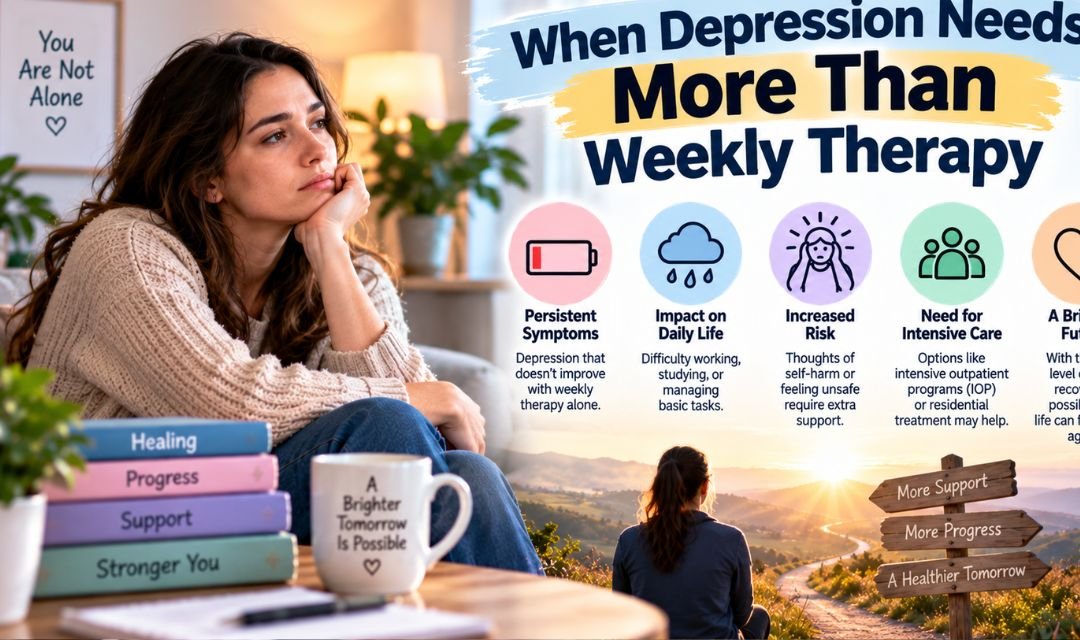
Most people picture depression treatment as a weekly appointment with a therapist, maybe a prescription from a psychiatrist, and a lot of effort to keep daily routines intact. For many people, that picture is accurate enough. But for others, weekly sessions barely scratch the surface of what they are experiencing, and the gap between appointments can feel like an eternity. Understanding the full range of depression treatment options, including why some people need far more intensive support than others, can help patients and their families make more informed decisions at a time when clarity is genuinely hard to come by.
Why Depression Varies So Dramatically From Person to Person
Depression is not a single, uniform condition. It sits on a spectrum, and where a person falls on that spectrum depends on a combination of biological, psychological, and social factors that interact in highly individual ways. One person may experience a depressive episode that lifts with therapy and lifestyle changes. Another may cycle through years of treatment without finding lasting relief. The reasons behind that difference are rarely simple.
According to the National Institute of Mental Health, roughly 21 million adults in the United States experienced at least one major depressive episode in 2021, representing about 8.3 percent of all American adults. Of those, only about 61 percent received treatment of any kind. That gap between those who need help and those who actually access it points to a larger problem: many people either do not recognize the severity of their depression or do not know that more intensive options exist beyond the standard outpatient model.
Severity is typically measured along several dimensions: how long symptoms have persisted, how much they interfere with daily functioning, whether the person has experienced multiple episodes, and whether there are any co-occurring conditions like anxiety disorders, substance use, or chronic physical illness. Each of these factors shapes which treatment approach is most appropriate.
The Treatment Spectrum: From Outpatient Care to Full Residential Support
Mental health care is organized into levels of intensity, and understanding those levels makes it easier to see why a single solution does not fit every situation. The American Society of Addiction Medicine developed a framework for thinking about care levels that the mental health field has broadly adapted. At the lowest end sits standard outpatient care, typically one to two hours per week. At the highest end sits round-the-clock residential treatment.
| Level of Care | Typical Hours Per Week | Best Suited For |
| Standard Outpatient (OP) | 1 to 3 hours | Mild to moderate depression with stable living situation |
| Intensive Outpatient (IOP) | 9 to 15 hours | Moderate depression, some functional impairment, home support available |
| Partial Hospitalization (PHP) | 20 to 30 hours | Significant impairment, recent crisis, or step-down from inpatient |
| Residential Treatment (RTC) | 24 hours, 7 days a week | Severe or treatment-resistant depression, safety concerns, unstable environment |
| Inpatient Hospitalization | 24 hours, medical setting | Acute safety risk requiring immediate medical stabilization |
Moving up the spectrum does not mean failure. It means recognizing that a lower level of support is not meeting the person’s actual clinical needs. Many people cycle through outpatient care for months or years before someone identifies that a higher level of structure is what was missing all along.
Signs That Weekly Therapy May Not Be Enough
Knowing when to consider a step up in care is one of the more difficult judgment calls in mental health. Therapists, psychiatrists, and primary care doctors do not always agree. But there are patterns worth paying attention to, both for people experiencing depression themselves and for the people who care about them.
- Symptoms have not improved meaningfully after several months of consistent outpatient treatment.
- The person is unable to maintain basic daily functions such as eating, bathing, working, or caring for dependents.
- There have been recent thoughts of suicide or self-harm, even if no attempt has been made.
- Depression is significantly worsened by the home environment, whether due to conflict, instability, or lack of support.
- Co-occurring substance use is complicating or undermining progress in therapy.
- Two or more antidepressant medications have been tried without adequate response, a pattern sometimes called treatment-resistant depression.
- The person has been hospitalized for depression before and is showing early signs of a similar crisis.
None of these signals on their own necessarily means that residential care is the answer. But taken together, especially when standard outpatient treatment has already been attempted, they suggest that a clinical reassessment of the level of care is warranted. A psychiatrist or licensed clinical social worker can conduct a formal level-of-care assessment to help make that determination.
What Residential Depression Treatment Actually Looks Like
There is a lot of misunderstanding about what residential mental health treatment involves. It is not simply hospitalization extended over weeks. Residential programs are structured therapeutic environments where people live on-site while participating in an intensive daily schedule of individual therapy, group therapy, psychiatric care, and skills-building activities. The goal is not to warehouse people in crisis but to create enough containment and consistency that real therapeutic work can happen.
For people whose depression has not responded to less intensive approaches, residential depression therapy offers something that outpatient settings cannot: an environment where every part of the day is oriented toward healing, with immediate access to clinical support if symptoms spike. That structure can be particularly valuable for people who struggle to maintain routines at home or whose home environment actively works against recovery.
Inside a residential program, treatment typically includes evidence-based approaches such as cognitive behavioral therapy, dialectical behavior therapy, acceptance and commitment therapy, and in some cases, medication management with close psychiatric oversight. Some programs also incorporate somatic therapies, mindfulness practices, nutritional support, and activity-based interventions. The combination varies by program and by individual treatment plan.
How Long Does Residential Treatment Last?
Length of stay varies considerably. Some people complete a residential program in 30 days. Others stay for 60 or 90 days depending on clinical progress and individual needs. The decision about when to transition to a lower level of care, such as a partial hospitalization or intensive outpatient program, is made collaboratively between the treatment team and the patient. Discharge planning is a critical part of the process, because the transition out of residential care is a vulnerable period that requires a clear, supported plan.
Treatment-Resistant Depression: A Closer Look
Treatment-resistant depression (TRD) is a term clinicians use when a person has not responded adequately to at least two different antidepressant treatments administered at appropriate doses for adequate durations. It is more common than many people realize. Research published in the Journal of Clinical Psychiatry suggests that roughly 30 percent of people with major depressive disorder do not achieve remission with their first antidepressant trial, and a significant subset continue to struggle despite multiple medication changes.
For people with TRD, the treatment landscape has expanded meaningfully over the past decade. Options that may be explored include esketamine (marketed as Spravato), which received FDA approval in 2019 for treatment-resistant depression, electroconvulsive therapy (ECT), transcranial magnetic stimulation (TMS), and ketamine infusion therapy. These interventions are often delivered within structured programs, including residential and partial hospitalization settings, where monitoring is consistent and adjustments can be made quickly.
It is worth noting that TRD does not mean untreatable. It means that the standard first-line approaches have not been sufficient, and that more specialized or intensive intervention is needed. A comprehensive evaluation by a psychiatrist who specializes in mood disorders is usually the first step toward finding a more effective path forward.
How to Start a Conversation About Higher-Level Care
For many people, the hardest part of accessing more intensive care is initiating the conversation. There can be stigma attached to the idea of residential treatment, and some people worry that seeking that level of help signals that they are beyond help. That belief is both common and inaccurate. Seeking more intensive treatment is a clinical decision, not a moral failing.
A useful starting point is bringing specific, concrete observations to an existing therapist or psychiatrist. Rather than saying “I do not think this is working,” describing particular patterns such as missed medications, inability to get out of bed for days at a time, or increasing isolation gives the clinician more to work with. From there, a formal level-of-care assessment can be requested. In some cases, the person’s current provider can make a referral directly. In others, contacting a residential program’s admissions team for a clinical consultation is a reasonable first step.
- Document specific symptoms and how they are affecting daily life, with examples.
- Share that information with your current therapist or psychiatrist and ask for a level-of-care assessment.
- Ask whether your current provider can offer a referral to a higher level of care if needed.
- Contact your insurance company to understand what coverage exists for intensive outpatient, partial hospitalization, or residential programs.
- If cost is a barrier, ask programs directly about sliding-scale fees, scholarships, or financing options.
Accessing appropriate care takes persistence, and the process is rarely as smooth as it should be. But the effort is worth making. Depression is one of the most treatable mental health conditions when the right level of support is in place. The key word is “right.” For some people, that means weekly therapy. For others, it means something more. Knowing the difference, and being willing to act on that knowledge, can genuinely change the trajectory of a person’s life.