
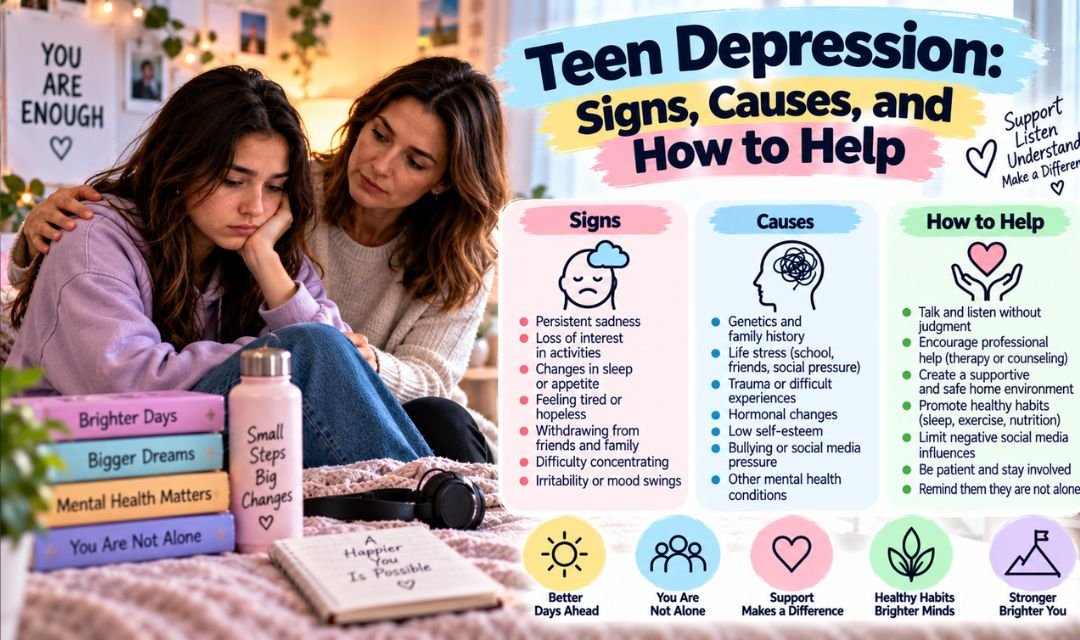
Most parents expect teenage years to come with mood swings, eye rolls, and the occasional slammed door. What they do not always expect is a child who stops eating, withdraws from every friend, and cannot find the energy to get out of bed. Depression in teenagers looks different from what most adults picture, and that gap in understanding can delay help by months or even years.
This article walks through how teen depression actually presents, what tends to cause it, how it differs from ordinary adolescent moodiness, and what professional treatment looks like when a family is ready to act. The goal is to give parents, caregivers, and even teens themselves a clearer picture so that conversations with doctors and counselors can start sooner.
Why Teen Depression Often Goes Unrecognized
Adult depression typically shows up as persistent sadness. Teen depression frequently does not. Many depressed adolescents present as irritable, angry, or simply disconnected rather than visibly sad. A parent watching a grumpy teenager may assume normal developmental friction is to blame. A teacher watching a once-engaged student drift may chalk it up to senioritis or social drama. Both interpretations are understandable, and both can miss something serious.
According to the National Institute of Mental Health, an estimated 17 percent of adolescents aged 12 to 17 in the United States experienced at least one major depressive episode in 2021. That is a significant portion of young people, yet only a fraction receive any form of treatment. Part of the gap exists because the signs are easy to misread.
Symptoms That Are Easy to Miss
- Persistent irritability or anger that seems disproportionate to the situation
- Declining grades or a sudden loss of interest in activities they used to love
- Sleeping far more than usual, or struggling to sleep at all
- Frequent physical complaints such as headaches or stomachaches without a clear medical cause
- Pulling away from friends and family without explanation
- Expressing feelings of worthlessness, hopelessness, or guilt
- Increased sensitivity to criticism or rejection
- Talking about death, dying, or feeling like a burden to others
None of these symptoms, taken alone, confirms a diagnosis. But when several appear together and persist for two weeks or more, they warrant a real conversation with a mental health professional rather than a wait-and-see approach.
What Drives Depression in Adolescents
Depression is not a character flaw, a phase, or the result of weak willpower. It is a medical condition with identifiable causes, and in teenagers those causes tend to cluster around a few key areas.
Biological Factors
Brain chemistry plays a real role. Neurotransmitters such as serotonin, dopamine, and norepinephrine regulate mood, energy, and motivation. When these systems are disrupted, the effects show up as the constellation of symptoms described above. Genetics matter too. A teenager with a parent or sibling who has experienced depression carries a meaningfully higher risk than a peer with no family history. Hormonal shifts during puberty add another layer of biological complexity, making the adolescent brain particularly sensitive to stress.
Environmental and Social Factors
Life circumstances shape mental health just as powerfully as biology. Chronic stress at home, academic pressure, bullying, social isolation, exposure to trauma, and family conflict are all well-documented contributors. Social media adds a dimension that previous generations did not face. Research published in journals including JAMA Pediatrics has linked heavy social media use to elevated depressive symptoms in teens, particularly among adolescent girls, though the relationship is complex and not fully settled.
How Teen Depression Differs by Age and Gender
The way depression expresses itself shifts depending on where a young person is developmentally. Younger adolescents, say those in middle school, may complain more about physical symptoms and show more clinging behavior. Older teens are more likely to withdraw socially, use substances as a coping mechanism, or take risks they would not otherwise take. Understanding these age-related differences helps adults look in the right direction.
| Age Group | Common Presentations | Watch For |
| Early adolescence (10-13) | Irritability, physical complaints, school avoidance | Regression, clinginess, stomachaches with no medical cause |
| Middle adolescence (14-16) | Social withdrawal, declining grades, sleep changes | Loss of interest in hobbies, increased conflict at home |
| Late adolescence (17-19) | Hopelessness, risk-taking, substance use | Expressions of worthlessness, talk of being a burden |
Gender differences are also clinically meaningful. Before puberty, boys and girls experience depression at roughly equal rates. After puberty, girls are diagnosed at approximately twice the rate of boys, a gap that holds through adulthood. Boys, however, are more likely to mask depression with aggression or substance use, which means their symptoms may go unidentified for longer even when the underlying condition is just as serious.
The Difference Between Teenage Moodiness and Clinical Depression
This is one of the most common questions parents ask, and it deserves a careful answer. Teenage moodiness is real. The adolescent brain is genuinely in flux, and emotional reactivity is a normal part of development. So how do you tell the two apart?
The key markers are duration, pervasiveness, and functional impairment. A mood that shifts with circumstances, that lifts when something fun happens, and that does not stop a teen from keeping up with school and friendships is much more likely to be ordinary moodiness. A low mood that does not lift regardless of what is happening around a teenager, that bleeds into every area of life, and that starts to erode functioning at school, at home, and with friends is a different matter entirely. The clinical threshold for a major depressive episode is symptoms that persist for at least two weeks and cause meaningful disruption to daily life.
What Effective Treatment Actually Looks Like
When a teenager is struggling with depression, early professional intervention consistently produces better outcomes than hoping the problem resolves on its own. There is a genuine body of evidence behind treating depression in adolescents using a combination of therapy, and in some cases medication, rather than relying on either approach alone.
Psychotherapy
Cognitive behavioral therapy, commonly called CBT, has the strongest research base for adolescent depression. It works by helping young people identify distorted thinking patterns and replace them with more accurate, helpful ones. Interpersonal therapy, which focuses on relationships and communication, is another well-supported approach. Both are typically delivered in individual sessions, though group formats can be effective too, particularly for building social skills and reducing isolation.
Medication
For moderate to severe depression, antidepressant medication may be recommended alongside therapy. Selective serotonin reuptake inhibitors, or SSRIs, are the most commonly prescribed class for teenagers. Fluoxetine is the only antidepressant with FDA approval specifically for depression in children and adolescents, though others are prescribed off-label. Medication decisions should always involve a psychiatrist or physician who is experienced with young patients, and any prescription should be accompanied by close monitoring, especially in the early weeks.
Lifestyle and Family Involvement
Treatment does not happen in a vacuum. Sleep, physical activity, nutrition, and family relationships all contribute to how well a teenager responds to formal treatment. Sleep deprivation alone can significantly worsen depressive symptoms, and many clinicians address sleep hygiene as part of a broader treatment plan. Family therapy or parent coaching is often incorporated because the home environment either supports or undermines the progress made in a therapist’s office.
When to Seek Help and Where to Start
If a parent or caregiver suspects a teenager is depressed, the first step is usually a conversation with the teen’s primary care physician. A good pediatrician or family doctor can rule out medical conditions that mimic depression, conduct an initial screening using validated tools, and provide referrals to mental health specialists. School counselors can also be a starting point, though they are generally not equipped to diagnose or treat clinical depression.
For immediate concerns, particularly if a teenager is expressing thoughts of self-harm or suicide, the appropriate response is not to wait for an appointment. The 988 Suicide and Crisis Lifeline in the United States is available by call or text around the clock. Emergency departments can also conduct mental health evaluations when the situation requires urgent attention.
- Start with a conversation: Talk to your teen without judgment and listen more than you speak.
- Consult your primary care provider: A physician can screen for depression and rule out physical causes.
- Request a mental health referral: Ask specifically for a psychologist or adolescent psychiatrist.
- Stay involved in treatment: Family participation improves outcomes in most evidence-based models.
- Monitor for safety: Know the warning signs of suicidal thinking and have a safety plan in place.
Depression in teenagers is treatable. The evidence on that point is consistent and reassuring. What tends to extend suffering is not the condition itself but the time it takes for adults to recognize it, take it seriously, and connect the young person to the right kind of help. The earlier that happens, the better the trajectory tends to be, both for the current episode and for long-term mental health outcomes into adulthood.