
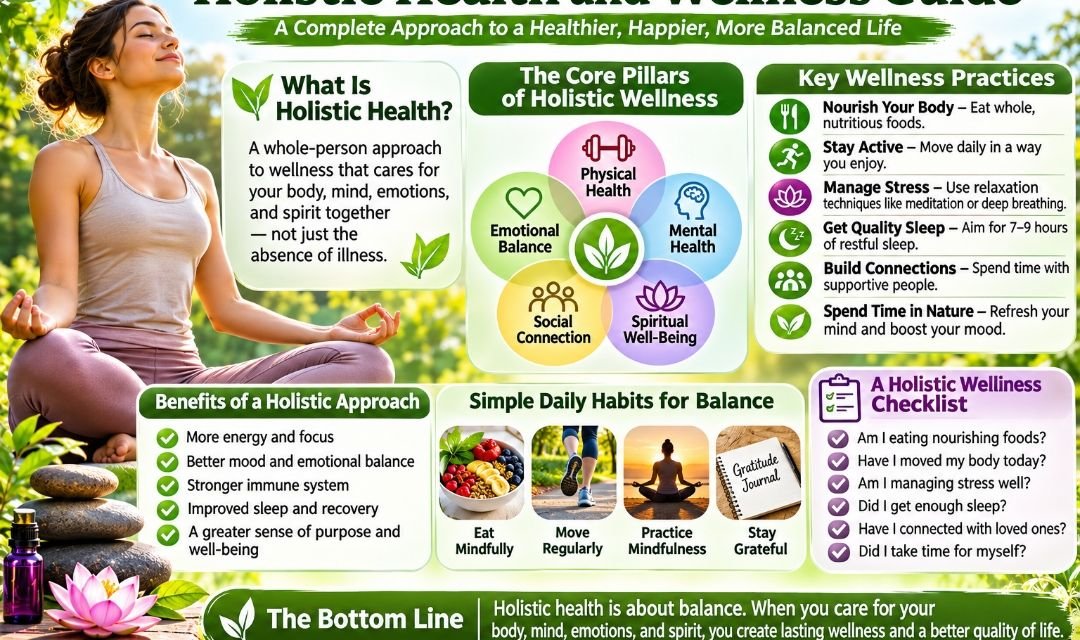
Quick Overview of Holistic Health and Wellness
| Category | Details |
|---|---|
| Main topic | Holistic Health and Wellness Guide |
| Primary goal | Supporting overall health and well-being |
| Core principles | Physical, mental, emotional, and social health |
| Nutrition | Balanced meals and whole foods |
| Physical activity | Walking, strength training, yoga, and mobility |
| Mental wellness | Stress management and emotional support |
| Sleep | Consistent schedules and adequate rest |
| Social wellness | Healthy relationships and community |
| Natural approaches | Mindfulness, relaxation, and selected complementary practices |
| Preventive care | Screenings, vaccinations, and health monitoring |
| Main concern | Unsupported medical claims |
| Long-term focus | Sustainable healthy habits |
| Recommended approach | Evidence-based and individualized |
Holistic wellness is not about following a perfect diet or buying expensive supplements.
It is about understanding how different parts of life influence health.
For example, poor sleep can affect mood and concentration.
Long-term stress can influence eating habits and physical activity.
Social isolation can also affect emotional well-being.
These connections explain why overall health requires more than one healthy habit.
This guide explores practical ways to support well-being while separating established health practices from misleading wellness claims.
What Is Holistic Health?
Holistic health is an approach that considers multiple aspects of a person’s well-being.
These include physical health, emotional experiences, mental health, social connections, and environmental influences.
Rather than viewing health as simply the absence of disease, holistic approaches consider everyday functioning and quality of life.
However, the term holistic is used in different ways.
Some holistic practices are supported by strong scientific evidence.
Others involve complementary or alternative treatments with limited research.
The important distinction is whether a particular approach is safe, appropriate, and supported by reliable evidence.
What Is Holistic Wellness?
Holistic wellness focuses on maintaining well-being through sustainable daily habits.
It may involve nutrition, movement, sleep, relaxation, and meaningful relationships.
Some people also include spiritual practices or personal reflection.
These activities can be important to individual well-being.
However, holistic wellness should not be confused with a guarantee of disease prevention.
Healthy habits can reduce certain health risks, but they cannot eliminate every medical condition.
The Main Dimensions of Holistic Wellness
Holistic wellness is often described through several connected dimensions.
Physical wellness
Nutrition, movement, sleep, preventive care, and management of medical conditions.
Mental and emotional wellness
Stress management, psychological health, emotional awareness, and appropriate support.
Social wellness
Supportive relationships, community participation, and healthy communication.
Environmental wellness
Safe living conditions, access to green spaces, and awareness of environmental influences.
Personal purpose and fulfillment
Meaningful activities, values, learning, and personal goals.
These dimensions can influence one another.
For example, physical activity may support mood and sleep, while supportive relationships can help people manage difficult experiences.
1. Balanced Nutrition for Holistic Health
Nutrition is one of the foundations of physical well-being.
A balanced diet provides energy and essential nutrients.
Healthy eating patterns generally include vegetables, fruits, whole grains, legumes, nuts, and appropriate protein sources.
However, nutritional needs differ between individuals.
Age, activity level, medical conditions, and dietary preferences all matter.
Whole Foods and Healthy Eating
Whole and minimally processed foods can provide fiber, vitamins, minerals, and other nutrients.
Examples include beans, lentils, vegetables, fruits, and whole grains.
However, not every processed food is unhealthy.
Some processed foods, such as fortified foods or canned beans, can be useful parts of a balanced diet.
The overall dietary pattern matters more than a single ingredient.
Hydration
Water supports normal body functions.
Fluid needs vary according to climate, activity, health conditions, and individual characteristics.
Drinking enough fluids is important.
However, excessive water intake can also be harmful.
There is no single fixed amount appropriate for every person.
2. Physical Activity and Movement
Regular movement supports cardiovascular health, muscle strength, mobility, and emotional well-being.
Physical activity does not have to involve intense exercise.
Walking, cycling, swimming, gardening, and dancing can all contribute.
For many adults, general public-health recommendations include at least 150 minutes of moderate-intensity aerobic activity each week, along with muscle-strengthening activities on at least two days.
However, individual recommendations may differ.
People with medical limitations may need tailored guidance.
Walking for Wellness
Walking is accessible to many people.
It can help support physical fitness and provide opportunities to spend time outdoors.
Starting with manageable distances may be more sustainable than following an overly demanding routine.
Strength Training
Strength training helps maintain muscle mass and physical function.
It may involve resistance bands, weights, or body-weight exercises.
Proper technique and gradual progression are important.
Flexibility and Mobility
Stretching and mobility exercises may help maintain comfortable movement.
However, flexibility exercises do not replace aerobic activity or strength training.
A balanced routine can include all three.
3. Mental Health and Emotional Balance
Mental health is an essential part of overall well-being.
It affects how people think, feel, interact, and respond to challenges.
Everyday habits can support mental health.
These include adequate sleep, physical activity, supportive relationships, and manageable routines.
However, mental health conditions may require professional care.
Holistic wellness should not replace appropriate psychological or psychiatric treatment.
Emotional Awareness
Emotional awareness involves recognizing and understanding feelings.
People may find journaling, reflection, or supportive conversations helpful.
However, emotional awareness does not mean suppressing difficult emotions.
Healthy coping includes acknowledging experiences and seeking support when needed.
4. Stress Management
Stress is a normal response to challenging situations.
Short-term stress can sometimes help people respond to demands.
However, persistent stress may affect sleep, mood, and everyday functioning.
Stress-management practices can include relaxation exercises, physical activity, and time management.
No single method works for everyone.
Simple Stress-Management Practices
-
Take regular breaks during demanding tasks.
-
Maintain realistic daily expectations.
-
Spend time on enjoyable activities.
-
Practice slow, comfortable breathing.
-
Stay connected with supportive people.
-
Seek professional help when stress becomes difficult to manage.
Stress management should be practical rather than another source of pressure.
5. Sleep and Recovery
Sleep supports physical recovery, memory, immune function, and emotional regulation.
Most adults generally need seven to nine hours of sleep.
However, individual needs vary.
Consistent sleep schedules can support healthy sleep patterns.
Healthy Sleep Habits
A useful bedtime routine may include reducing stimulating activities before sleep.
A comfortable sleeping environment can also help.
Limiting caffeine late in the day may benefit some people.
Regular physical activity can support sleep quality.
However, persistent insomnia, loud snoring, or excessive daytime sleepiness may require medical evaluation.
6. Mindfulness and Meditation
Mindfulness involves paying attention to present experiences.
Meditation practices may involve focused attention, breathing, or awareness.
Some research suggests mindfulness-based interventions can help with selected stress and anxiety-related outcomes.
However, results vary.
Meditation is not a proven cure for serious medical or mental health conditions.
It should be viewed as a possible supportive practice.
7. Yoga and Holistic Wellness
Yoga combines physical movement, breathing, and sometimes meditation.
Different styles have different physical demands.
Some studies suggest yoga may support flexibility, balance, and certain aspects of well-being.
However, the benefits depend on the program and individual.
People with injuries or medical conditions may need modifications.
Yoga should complement, rather than replace, necessary healthcare.
8. Gut Health and Digestive Wellness
The digestive system plays an important role in overall health.
The gut microbiome contains microorganisms that interact with digestion and other biological processes.
Researchers continue to investigate its relationship with immunity, metabolism, and mental health.
However, many commercial gut-health claims exceed the available evidence.
Fiber-Rich Foods
Fiber supports normal digestive function.
Foods containing fiber include vegetables, fruits, beans, lentils, and whole grains.
Fermented Foods
Fermented foods include yogurt, kefir, kimchi, and sauerkraut.
Some contain live microorganisms.
However, not every fermented food has clinically established probiotic effects.
Probiotic Supplements
Certain probiotic strains have evidence for specific conditions.
However, benefits cannot be generalized to all products or illnesses.
9. Social Relationships and Community
Supportive relationships can contribute to emotional well-being.
Social connection may help people cope with stress and difficult experiences.
Meaningful relationships can involve friends, family, colleagues, or community groups.
However, social needs differ between individuals.
The quality of relationships is often more important than the number of contacts.
10. Spending Time in Nature
Outdoor activities can support movement, relaxation, and social interaction.
Parks, gardens, and walking paths provide opportunities for recreation.
Some research links access to green spaces with positive health outcomes.
However, associations do not always establish direct cause and effect.
Nature exposure is best understood as one part of a balanced lifestyle.
11. Natural Remedies and Herbal Products
Herbal products are commonly included in holistic wellness discussions.
Examples include ginger, peppermint, chamomile, and other botanical ingredients.
Some herbs have evidence for specific uses.
Others remain poorly studied.
However, natural remedies can cause side effects.
They may also interact with prescription medications.
People should avoid replacing established medical treatments with unproven herbal products.
12. Complementary and Integrative Health
Complementary health practices are sometimes used alongside conventional medical care.
Examples may include certain relaxation techniques, massage, or acupuncture.
However, the evidence differs between practices and conditions.
Integrative healthcare aims to combine appropriate conventional treatment with selected complementary approaches.
The goal should be safe, coordinated, evidence-based care.
Alternative treatments should not delay necessary diagnosis or treatment.
13. Preventive Healthcare
Preventive healthcare is an important part of holistic well-being.
It includes vaccinations, recommended screenings, dental care, and management of medical risk factors.
Lifestyle habits can support prevention.
However, they cannot replace medical examinations or appropriate treatment.
For example, someone with diabetes may benefit from healthy eating and physical activity.
They may also need medication and regular monitoring.
A responsible holistic approach recognizes both needs.
14. Digital Wellness
Technology is part of modern life.
However, excessive or poorly timed screen use can interfere with sleep and daily activities.
Digital wellness focuses on developing healthier technology habits.
These may include reducing unnecessary notifications, taking breaks, and maintaining boundaries around work.
However, technology can also support health through communication, education, and access to care.
Balance is more useful than avoiding technology completely.
15. Environmental Wellness
Environmental conditions can influence health.
Air quality, safe drinking water, housing conditions, and access to outdoor spaces all matter.
Environmental wellness may involve reducing unnecessary exposure to pollutants and maintaining safe living conditions.
However, individual choices cannot solve every environmental health problem.
Community infrastructure and public policy also play important roles.
16. Healthy Aging
Holistic wellness can support healthy aging.
Physical activity, balanced nutrition, sleep, and social engagement are important throughout adulthood.
Strength and balance exercises may help older adults maintain independence.
Preventive healthcare remains essential.
However, no supplement or wellness routine has been proven to stop biological aging.
Claims about reversing aging should be treated cautiously.
17. Personalized Wellness
People have different health needs.
A routine suitable for one person may not work for another.
For example, someone with a physically demanding job may have different activity needs from someone who spends most of the day sitting.
Medical conditions can also affect dietary and exercise recommendations.
Personalized wellness should rely on realistic goals and credible health information.
Expensive testing packages or supplement programs are not automatically necessary.
18. Holistic Wellness and CBD Products
CBD and hemp-derived products are sometimes promoted within holistic wellness markets.
Hemp seeds and hemp seed oil can be used in foods and cosmetics.
CBD is a separate, biologically active compound.
Some commercial CBD products are marketed for sleep, stress, and relaxation.
However, evidence supporting many of these claims remains limited.
CBD can cause side effects, liver-related concerns, and medication interactions.
Some hemp-derived products also contain THC or related intoxicating cannabinoids.
Therefore, CBD should not be considered an essential part of holistic wellness.
19. Spiritual Wellness and Personal Meaning
For some people, spirituality or personal reflection contributes to well-being.
This may involve religious practices, meditation, community activities, or time spent reflecting on personal values.
However, spirituality is not a medical treatment.
Its role varies between individuals.
A holistic approach can respect personal beliefs while maintaining evidence-based healthcare.
20. Sustainable Daily Habits
Long-term wellness depends on consistency.
Extreme diets and demanding routines can be difficult to maintain.
Small, realistic changes are often easier to incorporate into daily life.
Examples include preparing balanced meals, walking regularly, and maintaining a consistent bedtime.
The goal is gradual improvement rather than perfection.
Holistic Wellness Practices and Scientific Evidence
| Practice | Evidence overview |
|---|---|
| Balanced nutrition | Strong evidence for general health |
| Regular physical activity | Strong evidence |
| Adequate sleep | Strong evidence |
| Strength training | Strong evidence |
| Preventive healthcare | Strong evidence |
| Mindfulness | Some evidence for selected outcomes |
| Yoga | Some evidence for selected outcomes |
| Probiotics | Depends on strain and condition |
| Herbal remedies | Varies widely |
| CBD wellness products | Limited for many commercial claims |
| Detox treatments | Often lack reliable evidence |
| Anti-aging supplements | Limited evidence for major claims |
A holistic approach should prioritize practices with established benefits.
A Simple Seven-Day Holistic Wellness Plan
The following example focuses on general healthy habits.
It is not a personalized medical program.
Your weekly wellness checklist
0 of 7 completed
Monday — Nutrition
Add vegetables and a source of protein to a balanced meal.
Tuesday — Movement
Take a comfortable walk or choose another suitable activity.
Wednesday — Stress management
Spend a few minutes practicing comfortable breathing or quiet reflection.
Thursday — Sleep
Establish a consistent bedtime and reduce late-night distractions.
Friday — Social wellness
Spend meaningful time with someone supportive.
Saturday — Outdoor wellness
Visit a safe outdoor space or enjoy an accessible outdoor activity.
Sunday — Reflection
Review which habits felt useful and choose realistic goals for the coming week.
This plan is only an example.
People can adjust activities according to their schedules, abilities, and health needs.
Common Holistic Health Mistakes
Some wellness approaches become less useful when they rely on unrealistic expectations.
Common mistakes include:
-
Believing natural products are always safe
-
Replacing prescribed medicines with unproven treatments
-
Following overly restrictive diets
-
Ignoring persistent symptoms
-
Spending excessively on unsupported supplements
-
Expecting immediate results
-
Treating social media advice as medical evidence
-
Assuming one wellness routine works for everyone
A responsible approach prioritizes safety, evidence, and sustainability.
Holistic Health vs Traditional Medical Care
Holistic health and conventional healthcare do not need to compete.
Healthy habits can support prevention and quality of life.
Medical care provides diagnosis, treatment, and monitoring.
For example, someone with persistent fatigue may benefit from improved sleep habits.
However, fatigue can also indicate a medical condition requiring evaluation.
A holistic approach should recognize both possibilities.
Benefits of an Evidence-Based Holistic Lifestyle
A well-designed wellness routine may support several aspects of health.
Regular physical activity can improve cardiovascular fitness.
Balanced nutrition provides essential nutrients.
Adequate sleep supports physical and mental functioning.
Stress-management practices may help with emotional well-being.
Supportive relationships can contribute to quality of life.
However, benefits depend on individual circumstances.
No lifestyle routine guarantees perfect health.
Future of Holistic Health and Wellness in 2026 and Beyond
Holistic wellness continues to attract interest across nutrition, fitness, mental health, and preventive care.
Researchers are studying relationships between sleep, physical activity, nutrition, and long-term health.
There is also growing scientific interest in personalized prevention and behavioral health.
However, new wellness products should be evaluated carefully.
Commercial popularity does not establish medical effectiveness.
The future of responsible holistic healthcare depends on combining scientific evidence, individualized needs, and appropriate medical support.
Frequently Asked Questions About Holistic Health and Wellness
1. What is holistic health?
Holistic health considers physical, mental, emotional, social, and other influences on well-being.
2. What is holistic wellness?
It focuses on supporting overall well-being through sustainable lifestyle habits.
3. Is holistic health scientifically proven?
Some holistic practices have strong evidence, while others have limited or uncertain support.
4. What are the main dimensions of holistic wellness?
They commonly include physical, mental, emotional, social, environmental, and personal well-being.
5. Can holistic wellness prevent diseases?
Healthy habits can reduce certain health risks, but they cannot prevent every illness.
6. Is holistic health the same as alternative medicine?
No. Holistic health can include conventional medical care and evidence-based lifestyle practices.
7. What is the best holistic wellness habit?
There is no single best habit, but balanced nutrition, physical activity, and adequate sleep have strong evidence.
8. Can meditation improve mental health?
Some mindfulness-based programs may help selected stress and anxiety-related outcomes.
9. Is yoga good for holistic wellness?
Yoga may support flexibility, balance, and certain aspects of well-being.
10. Why is sleep important?
Sleep supports physical recovery, memory, immune function, and emotional regulation.
11. What foods support holistic health?
Vegetables, fruits, whole grains, legumes, nuts, and appropriate protein sources can support balanced nutrition.
12. Is drinking more water always better?
No. Hydration needs vary, and excessive water intake can be harmful.
13. Can walking improve overall health?
Yes. Regular walking can provide cardiovascular and other health benefits.
14. What is emotional wellness?
It involves recognizing emotions, managing challenges, and maintaining psychological well-being.
15. Why are social relationships important?
Supportive relationships can contribute to emotional health and quality of life.
16. What is environmental wellness?
It involves understanding how surroundings and environmental conditions affect health.
17. Are herbal remedies safe?
Not always. Some herbs can cause side effects or medication interactions.
18. Are natural supplements necessary?
Most people do not need every supplement marketed for wellness. Needs depend on diet and medical circumstances.
19. Can CBD improve holistic wellness?
Evidence remains limited for many CBD wellness claims, and CBD can cause adverse effects.
20. What is integrative healthcare?
It combines appropriate conventional healthcare with selected complementary approaches.
21. Can holistic wellness replace prescription medicines?
No. Prescribed treatments should not be stopped without professional medical guidance.
22. How can beginners start holistic wellness?
Begin with manageable improvements in nutrition, movement, sleep, and stress management.
23. Is holistic wellness expensive?
It does not have to be. Many evidence-based habits require little or no special equipment.
24. How long does it take to develop healthy habits?
The time varies according to the habit, individual, and circumstances.
25. What is the future of holistic wellness?
Future research may improve understanding of lifestyle interventions, personalized prevention, and integrated healthcare.
Final Thoughts
Holistic health and wellness guide principles emphasize that well-being involves more than one aspect of life.
Physical health, mental wellness, emotional balance, social relationships, and environmental conditions are connected.
A balanced lifestyle can include nutritious meals, regular movement, adequate sleep, and effective stress management.
Mindfulness, yoga, and selected complementary practices may also provide benefits for certain people.
However, not every natural treatment is supported by reliable evidence.
Herbal products, supplements, and cannabinoid products can cause side effects or interact with medications.
The most responsible approach combines sustainable lifestyle habits with appropriate professional healthcare.
Holistic wellness does not require perfection, expensive products, or extreme routines.
It begins with practical choices that support long-term health and quality of life.
For more natural wellness guides, healthy living tips, nutrition education, CBD information, and beginner-friendly health articles, visit Picanto Magazine.
Medical Disclaimer: This article is for general educational purposes only and does not replace professional medical advice, diagnosis, or treatment. Consult a qualified healthcare professional before making significant health changes, using supplements, or replacing prescribed medical treatments.