
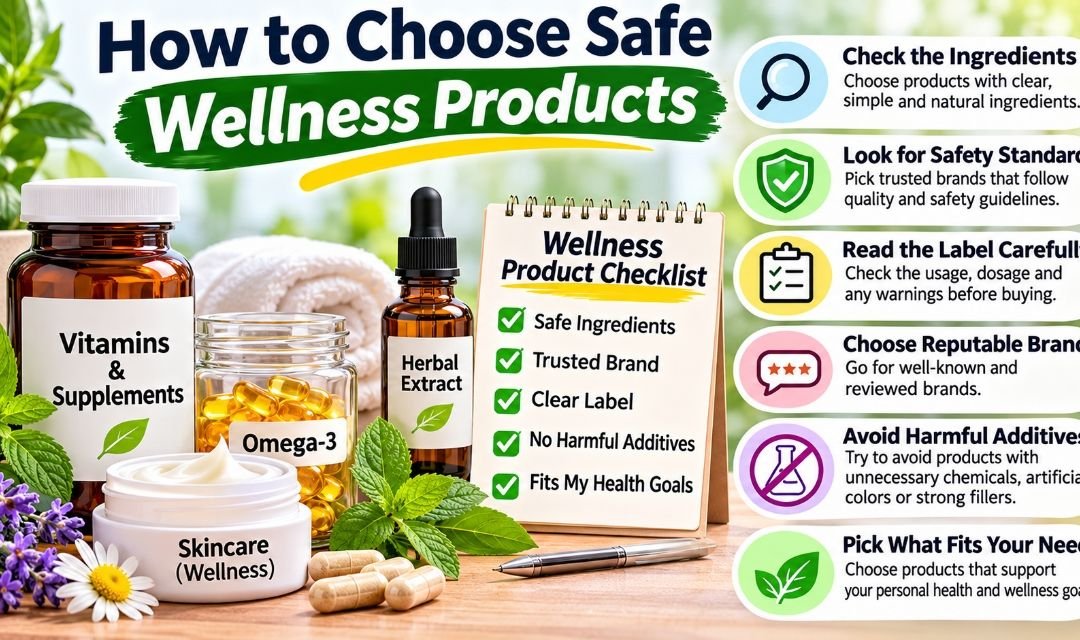
How to choose safe wellness products is an important question for anyone interested in improving their everyday health and wellbeing. From vitamins and herbal supplements to skincare products, essential oils, and fitness accessories, the wellness industry offers thousands of choices. However, not every product is suitable, effective, or safe for everyone. Understanding the principles of consumer protection can help people recognize misleading advertising, evaluate product information, and make informed purchasing decisions. Choosing carefully involves checking ingredients, understanding possible risks, reviewing quality standards, and avoiding products that promise unrealistic results.
Quick Overview of Safe Wellness Products
| Category | Details |
|---|---|
| Main topic | How to Choose Safe Wellness Products |
| Primary goal | Making informed and safer purchasing decisions |
| Common product types | Supplements, skincare, herbal products, fitness products |
| First step | Identify the product’s intended purpose |
| Important information | Ingredients, dosage, warnings, manufacturer |
| Quality indicators | Appropriate testing and verifiable certifications |
| Common concerns | Contamination, misleading claims, interactions |
| Label requirements | Depend on product category and country |
| Supplements | May have side effects and medication interactions |
| Natural ingredients | Not automatically safe |
| Product reviews | Useful but not proof of safety |
| Medical advice | Important for certain products and conditions |
| Best approach | Evidence, transparency, and appropriate use |
Wellness products have become part of everyday life for many adults.
Some people purchase vitamins to support nutritional needs. Others choose herbal teas, skincare products, massage tools, or fitness accessories.
Online shopping makes these products easy to find.
However, convenience can also create confusion.
Advertisements may promise better sleep, improved energy, stronger immunity, or rapid weight loss.
Some claims sound scientific even when reliable evidence is limited.
The challenge is knowing which products deserve attention and which should be avoided.
This guide explains how to evaluate wellness products carefully, recognize warning signs, and make choices that fit individual needs.
What Are Wellness Products?
Wellness products are items marketed to support health, comfort, fitness, personal care, or general wellbeing.
They include several categories.
Examples are dietary supplements, skincare products, herbal preparations, exercise equipment, and relaxation accessories.
However, these categories are regulated differently.
A moisturizer is not evaluated in exactly the same way as a dietary supplement.
A medical device may have different requirements from a general fitness accessory.
Understanding the product category is an important first step.
Why Is Product Safety Important?
Wellness products can affect the body in different ways.
Some are used externally.
Others are swallowed, inhaled, or applied to sensitive areas.
Potential risks include allergic reactions, contamination, excessive doses, medication interactions, and physical injuries.
A product may also be ineffective despite expensive marketing.
Safety therefore involves more than checking whether an item looks professional.
Consumers should consider the ingredients, intended use, manufacturing quality, and available evidence.
1. Understand Why You Want the Product
Before buying anything, identify the problem or goal.
Are you looking for a basic moisturizer?
Do you need a vitamin because of a diagnosed deficiency?
Are you purchasing exercise equipment for home use?
Different goals require different products.
Avoid buying something simply because it is trending online.
A clear purpose makes comparison easier.
2. Read the Complete Ingredient List
Ingredients are one of the most important parts of product evaluation.
Check what the product contains.
Look for substances that may cause allergies or interact with medications.
However, ingredient names can be unfamiliar.
An unfamiliar chemical name does not automatically mean an ingredient is dangerous.
Safety depends on the substance, concentration, exposure, and intended use.
3. Understand Active Ingredients
Some wellness products contain ingredients intended to produce a particular effect.
For example, skincare products may contain salicylic acid or retinoids.
Dietary supplements may contain vitamins, minerals, or herbal extracts.
However, an active ingredient can have both benefits and risks.
The concentration and instructions matter.
People should avoid assuming that stronger formulas are always better.
4. Check the Manufacturer’s Information
A trustworthy product should provide clear information about the responsible company.
Look for the manufacturer’s name, contact details, and appropriate product identification.
However, professional packaging alone does not prove reliability.
A company website or attractive logo cannot replace independent evidence of product quality.
5. Understand Product Labels
Labels may contain instructions, warnings, ingredient quantities, and storage information.
Read the entire label before use.
Pay particular attention to recommended amounts and restrictions.
However, labeling requirements vary by country and product type.
Some products may legally require information that others do not.
6. Check Expiration Dates
Expiration dates can help consumers assess whether products are within their stated shelf life.
However, not all product categories use identical date-labeling systems.
Some products display manufacturing dates or periods after opening.
Follow the manufacturer’s storage and use instructions.
Do not use products showing unusual discoloration, contamination, or other signs of deterioration.
7. Look for Relevant Quality Testing
Quality testing can help identify problems such as contamination or incorrect ingredient amounts.
For some supplements, independent third-party testing programs may provide useful assurance.
However, testing must be relevant to the specific product.
A certificate for one manufacturing batch does not automatically apply to every batch.
Testing also does not prove that a product provides the advertised health benefits.
8. Understand Certifications
Certifications can provide information about manufacturing practices or particular product characteristics.
However, not every certification has the same meaning.
Some focus on manufacturing quality.
Others focus on ingredient sourcing or environmental practices.
Consumers should verify what the certification actually covers.
A certification logo is not automatically proof of medical effectiveness.
9. Be Careful With Natural Claims
The word natural is commonly used in wellness marketing.
However, natural substances can cause allergic reactions, toxicity, or medication interactions.
Some plant extracts are highly concentrated.
Others may be unsafe during pregnancy or for people with certain medical conditions.
Natural origin alone does not establish safety.
10. Avoid Miracle Health Claims
Products promising instant cures or guaranteed results deserve extra caution.
Examples include claims that a supplement can cure every disease or replace prescribed treatment.
Such statements may be misleading or unlawful.
Reliable health information usually explains limitations and potential risks.
Avoid products that rely on dramatic promises instead of appropriate evidence.
11. Research Scientific Evidence
A product may be popular without having strong scientific support.
Look for reliable studies involving the ingredient or product.
However, not all research is equally convincing.
Small studies, animal experiments, and laboratory findings do not necessarily establish benefits in humans.
Evidence from well-designed human studies is generally more relevant to human health claims.
12. Understand Supplement Risks
Dietary supplements may contain vitamins, minerals, herbs, or other substances.
Some are useful for specific nutritional needs.
However, supplements can also cause side effects.
Excessive intake of certain vitamins or minerals may be harmful.
People should avoid taking high doses without appropriate guidance.
13. Check Medication Interactions
Some wellness products can interact with prescription or over-the-counter medications.
Herbal supplements are a particular concern.
Interactions may change medication effects or increase the risk of adverse reactions.
People taking regular medication should consult a qualified healthcare professional or pharmacist before using relevant supplements.
14. Consider Allergies and Sensitivities
Products may contain ingredients that trigger allergic reactions.
Examples include certain fragrances, botanical extracts, nuts, soy, or other substances.
However, sensitivity varies between individuals.
A product described as hypoallergenic is not guaranteed to be suitable for everyone.
People with known allergies should examine ingredients carefully.
15. Understand Dosage Instructions
More is not always better.
Taking excessive amounts of supplements can be dangerous.
The appropriate dose depends on the ingredient and individual circumstances.
Do not combine several products containing the same active ingredient without checking the total amount.
For example, a multivitamin and a separate vitamin supplement may contain overlapping nutrients.
16. Be Careful With Herbal Products
Herbal products are often promoted as gentle alternatives.
However, some herbs can have powerful biological effects.
Certain preparations may interact with medications or cause side effects.
Product strength can also vary.
Consumers should avoid assuming that traditional use alone proves safety or effectiveness.
17. Evaluate Essential Oils Carefully
Essential oils are concentrated plant extracts.
They are commonly used in fragrances and aromatherapy.
However, they can irritate skin or trigger allergic reactions.
Some are toxic if swallowed.
They should not be ingested unless specifically directed by a qualified healthcare professional for an appropriate medical purpose.
Essential oils should also be kept away from children and pets when necessary.
18. Choose Skincare Products According to Skin Needs
Skincare products vary in formulation and purpose.
A product suitable for oily skin may not be ideal for sensitive skin.
Ingredients, concentration, fragrance, and intended use matter.
People with sensitive skin may benefit from introducing products gradually.
However, patch testing does not guarantee that a reaction will never occur.
19. Check Fitness Equipment Safety
Wellness products also include exercise accessories.
Examples include resistance bands, yoga mats, and massage devices.
Inspect equipment for damage and follow the manufacturer’s instructions.
Improper use can cause injury.
People with existing injuries or medical conditions may need professional guidance.
20. Compare Product Reviews Carefully
Customer reviews can provide information about usability and customer experience.
However, reviews are not scientific evidence.
Some may be fake, sponsored, or based on unusual experiences.
A large number of positive reviews does not guarantee safety.
Look for consistent, specific information rather than relying only on star ratings.
21. Understand Influencer Marketing
Social media influencers frequently promote wellness products.
Some recommendations are sponsored.
However, advertising relationships may influence how products are presented.
A personal testimonial cannot establish that a product works for everyone.
Consumers should distinguish marketing from independent evidence.
22. Avoid Products With Hidden Ingredients
Products with incomplete ingredient information deserve caution.
Some products marketed for weight loss, sexual performance, or muscle building have been found to contain undeclared drug ingredients.
Such substances may cause serious health problems.
Avoid products with unclear composition or unsupported claims.
23. Consider Product Storage
Improper storage can affect product quality.
Some products require protection from heat, light, or moisture.
Others may require refrigeration.
Follow the instructions on the packaging.
Avoid storing products in conditions that could cause deterioration.
24. Check Packaging Integrity
Inspect the packaging before use.
Broken seals, leaks, unusual odors, or damaged containers may indicate problems.
However, intact packaging does not guarantee product safety.
Packaging inspection is only one part of evaluation.
25. Buy From Reliable Sellers
Purchasing from established retailers or authorized sellers may reduce certain risks.
However, no retailer can guarantee that every product is safe.
Check product details and avoid suspiciously cheap offers.
Be cautious when sellers cannot explain where a product came from.
26. Understand Product Recalls
Products may be recalled because of contamination, manufacturing defects, or other safety concerns.
Consumers should pay attention to official recall notices.
If a product is recalled, follow the relevant authority’s instructions.
Do not continue using a recalled product simply because it appears normal.
27. Avoid Unnecessary Product Combinations
Using several wellness products together may increase risks.
For example, combining multiple supplements can lead to excessive nutrient intake.
Certain skincare ingredients may also cause irritation when used together.
Start with a clear purpose rather than combining products without understanding their effects.
28. Consider Age and Medical Conditions
A product suitable for a healthy adult may not be appropriate for a child, older adult, or pregnant person.
Medical conditions can also affect product safety.
Kidney disease, liver disease, allergies, and other conditions may require special precautions.
Individual guidance can be important.
29. Compare Value, Not Just Price
Expensive wellness products are not automatically better.
A higher price may reflect branding, packaging, or marketing.
Compare ingredient quality, testing, product quantity, and intended use.
A simpler product may be more appropriate than a complicated formula.
30. Know When Professional Advice Is Necessary
Some wellness purchases can be made using basic product information.
Others require professional guidance.
Consult a healthcare professional before using supplements to treat symptoms, manage medical conditions, or replace prescribed treatment.
Persistent symptoms should be evaluated rather than managed only with commercial wellness products.
Wellness Product Safety Comparison
| Product category | Main concerns | What to check |
|---|---|---|
| Vitamins | Excessive doses, interactions | Amounts, ingredients, warnings |
| Herbal supplements | Side effects, contamination | Ingredients, testing, interactions |
| Skincare | Irritation, allergies | Ingredients, concentration, instructions |
| Essential oils | Skin reactions, toxicity | Safe use, dilution, warnings |
| Protein powders | Contamination, unnecessary ingredients | Testing, protein content, allergens |
| Fitness equipment | Injury, equipment failure | Instructions, condition, safety standards |
| Sleep supplements | Sedation, interactions | Ingredients, dose, professional advice |
| Weight-loss products | Hidden drugs, exaggerated claims | Regulatory warnings, evidence |
| Wellness beverages | Caffeine, added sugar | Nutrition label, stimulant content |
| Massage devices | Improper use, injury | Instructions, contraindications |
How to Recognize Red Flags in Wellness Products
Certain warning signs suggest that a product deserves closer investigation.
These include:
-
Promises to cure serious diseases
-
Claims of guaranteed results
-
Missing ingredient information
-
Unclear manufacturer details
-
Unverifiable certification logos
-
Pressure to buy immediately
-
Claims that the product replaces medical treatment
-
Extremely high doses without explanation
-
Unsupported before-and-after photographs
-
Hidden subscription charges
-
Claims that natural means completely risk-free
-
Refusal to provide relevant safety information
One warning sign does not always prove that a product is unsafe.
However, several warning signs together justify greater caution.
Understanding Third-Party Testing
Third-party testing means an organization independent of the manufacturer evaluates certain product characteristics.
Depending on the program, testing may examine ingredient identity, amounts, or contaminants.
However, testing programs differ.
Consumers should check whether the testing organization is credible and whether the specific product is covered.
A tested product is not necessarily effective for its advertised purpose.
How to Compare Two Wellness Products
| Feature | Product A | Product B |
|---|---|---|
| Full ingredient list | Available | Missing |
| Manufacturer details | Clear | Limited |
| Relevant testing | Verifiable | Unclear |
| Usage instructions | Complete | Incomplete |
| Safety warnings | Provided | Missing |
| Health claims | Specific and supported | Exaggerated |
| Overall assessment | More transparent | Requires caution |
This is an illustrative comparison, not an evaluation of real products.
Transparency is useful, but it cannot independently establish safety.
Seven Steps Before Buying a Wellness Product
Wellness product safety checklist
Interactive checklist
0 of 7 completed
Copy checklist
Are Natural Wellness Products Safer Than Synthetic Products?
Natural and synthetic ingredients can both have benefits and risks.
Safety depends on the ingredient, concentration, exposure, and intended use.
For example, some plant extracts can cause severe allergic reactions.
Some manufactured ingredients have extensive safety testing.
The origin of an ingredient is not enough to determine whether it is appropriate.
Consumers should focus on evidence rather than marketing labels.
Are Expensive Wellness Products Better?
Price is not a reliable measure of safety or effectiveness.
Some expensive products contain ingredients similar to lower-cost alternatives.
Other products may cost more because of specialized manufacturing or testing.
However, consumers should not assume that higher prices guarantee better outcomes.
Compare the actual product characteristics.
Can Wellness Products Replace Medical Treatment?
Wellness products should not automatically be treated as substitutes for medical care.
Some products may support comfort or address specific nutritional needs.
However, products marketed for general wellbeing may not be appropriate treatments for diseases.
Stopping prescribed medication without professional advice can be dangerous.
People with ongoing symptoms should seek qualified medical assessment.
Safe Wellness Products for Different Age Groups
Young Adults
Young adults may use skincare, fitness accessories, or dietary supplements.
However, product suitability depends on individual needs.
Avoid unnecessary supplements and extreme fitness products.
Adults Over 40
Adults may become more interested in joint health, sleep, and nutritional products.
However, symptoms should not automatically be attributed to aging.
Medication interactions and medical conditions should be considered.
Older Adults
Older adults may take multiple medications.
This can increase the importance of checking supplement interactions.
Professional guidance may be particularly useful.
Children
Children have different physiological needs.
Adult wellness products may be unsuitable.
Parents should consult appropriate healthcare professionals before giving children supplements or herbal preparations.
Frequently Asked Questions About Safe Wellness Products
1. What are wellness products?
They are products marketed for health, personal care, fitness, comfort, or general wellbeing.
2. How can I choose safe wellness products?
Check ingredients, warnings, manufacturer details, relevant testing, and suitability for your needs.
3. Are natural products always safe?
No. Natural substances can cause side effects or allergic reactions.
4. Are expensive products safer?
Not necessarily. Price does not guarantee safety.
5. What should I check on a product label?
Ingredients, quantities, instructions, warnings, manufacturer information, and storage requirements.
6. Are dietary supplements necessary?
Not for everyone. Some are useful for specific nutritional needs.
7. Can vitamins cause side effects?
Yes. Excessive doses of certain vitamins can be harmful.
8. Are herbal supplements harmless?
No. Some can interact with medications or cause adverse effects.
9. What is third-party testing?
It is testing performed by an organization independent of the manufacturer.
10. Does third-party testing prove effectiveness?
No. It may verify certain quality characteristics without proving health benefits.
11. Are customer reviews reliable?
They may provide useful experiences but do not establish product safety.
12. Should I trust influencer recommendations?
Treat them as marketing or personal opinions unless supported by reliable evidence.
13. Are essential oils safe to swallow?
Many essential oils can be toxic if swallowed and should not be ingested casually.
14. Can skincare products cause allergies?
Yes. Even commonly used ingredients can trigger reactions.
15. What does hypoallergenic mean?
It generally suggests a product is intended to reduce allergy risk, but it does not guarantee that reactions will not occur.
16. Are protein powders safe?
Safety depends on ingredients, quality, contamination risks, and individual needs.
17. Can supplements interact with medication?
Yes. Some interactions can be serious.
18. What are warning signs of misleading wellness products?
Miracle claims, missing ingredients, unverifiable testing, and pressure-based marketing are common warning signs.
19. Should pregnant people use herbal supplements?
They should seek qualified medical advice because some products may be unsafe during pregnancy.
20. Can children use adult wellness products?
Not automatically. Children’s needs and safety requirements differ.
21. Are organic wellness products always better?
No. Organic labeling does not guarantee safety or effectiveness.
22. How can I identify counterfeit products?
Check seller reliability, packaging, product identification, and official manufacturer information.
23. What should I do if a product causes a reaction?
Stop using the suspected product and seek appropriate medical advice. Severe reactions require urgent care.
24. Can wellness products cure diseases?
General wellness products should not be assumed to treat or cure diseases without appropriate evidence and regulatory authorization.
25. What is the most important wellness product safety habit?
Understand the product’s ingredients, intended use, evidence, and possible risks before purchasing or using it.
Final Thoughts
Learning how to choose safe wellness products can help consumers avoid misleading claims, unnecessary spending, and preventable health risks.
A product should not be considered safe simply because it is natural, expensive, popular, or promoted by an influencer.
Ingredients, dosage, manufacturing quality, appropriate testing, and individual health needs all matter.
Reading labels carefully can help identify potential allergens, warnings, and unclear product claims.
However, no checklist can guarantee that every product is completely risk-free.
People taking medications, managing medical conditions, or considering supplements for specific health concerns should seek professional guidance.
The best approach is to choose products for a clear purpose, evaluate reliable evidence, and avoid exaggerated promises.
Wellness should focus on sustainable habits and informed decisions rather than purchasing every new product on the market.
For more wellness product safety guides, healthy lifestyle advice, balanced nutrition information, and practical everyday wellbeing tips, visit Picanto Magazine.
Medical Disclaimer: This article is for general educational purposes only and does not replace professional medical advice, diagnosis, or treatment. Dietary supplements, herbal preparations, and other wellness products may cause adverse effects or interact with medications. Consult a qualified healthcare professional before using products to manage medical conditions, especially during pregnancy, while breastfeeding, or when taking prescription medication.