
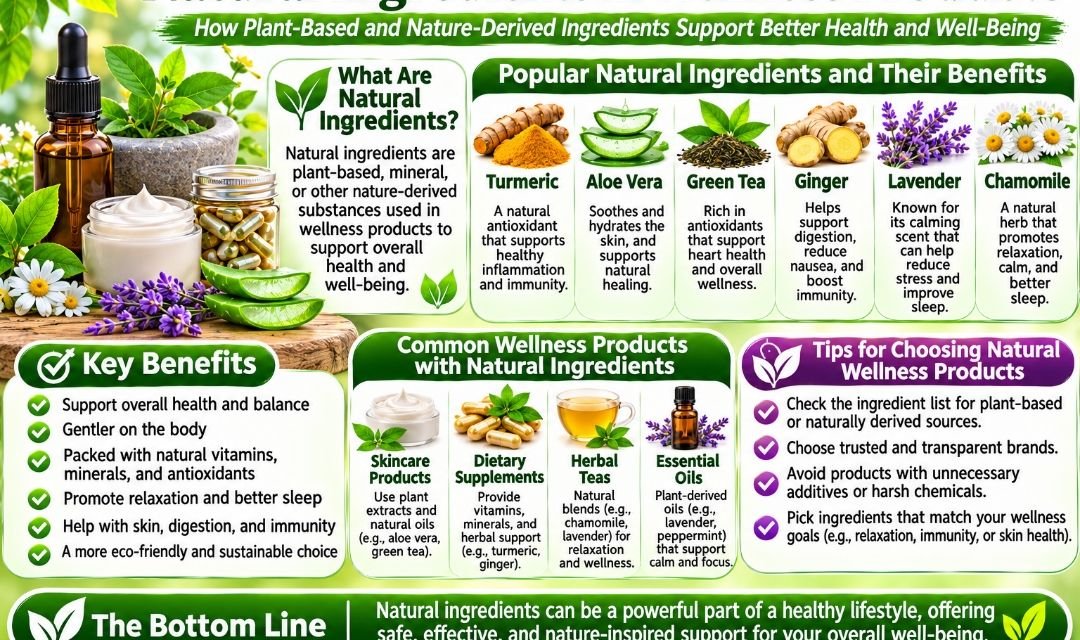
Natural ingredients in wellness products are becoming increasingly popular among people interested in skincare, nutrition, personal care, and everyday well-being. These ingredients come from sources such as plants, seeds, roots, flowers, minerals, and other naturally occurring materials. Many products contain botanical extracts, essential oils, herbal ingredients, and plant-based nutrients. The growing interest in natural products reflects a wider curiosity about how naturally occurring substances are used in modern wellness products. However, natural ingredients are not automatically safe, effective, or environmentally friendly. Understanding their properties, scientific evidence, and possible risks helps consumers make better decisions.
Quick Overview of Natural Ingredients in Wellness Products
| Category | Details |
|---|---|
| Main topic | Natural Ingredients in Wellness Products |
| Common sources | Plants, seeds, roots, flowers, minerals |
| Popular ingredients | Aloe vera, coconut oil, shea butter, ginger |
| Herbal ingredients | Chamomile, turmeric, peppermint |
| Botanical oils | Jojoba oil, argan oil, hemp seed oil |
| Nutrition ingredients | Plant proteins, fiber, seed oils |
| Cannabinoid ingredients | CBD and other cannabis-derived compounds |
| Main applications | Skincare, nutrition, personal care, supplements |
| Potential benefits | Depend on the ingredient and formulation |
| Main risks | Allergies, contamination, side effects, interactions |
| Quality factors | Ingredient transparency, testing, manufacturing |
| Scientific evidence | Strong for some uses, limited for others |
| Best approach | Evidence-based product selection |
Natural wellness ingredients appear in many different products.
Some are used in ordinary foods.
Others are included in moisturizers, shampoos, herbal teas, dietary supplements, and cosmetic formulations.
For example, shea butter is commonly used in moisturizers.
Ginger is used in food and certain herbal preparations.
Hemp seed oil appears in nutritional and skincare products.
However, these ingredients do not all have the same effects.
A plant ingredient that is useful in food may not provide the same benefits when applied to the skin.
Likewise, a substance with traditional uses may not have strong scientific evidence supporting modern health claims.
This guide explains common natural wellness ingredients, their uses, potential benefits, safety concerns, and how to evaluate products responsibly.
What Are Natural Ingredients?
Natural ingredients are substances obtained from naturally occurring sources.
These sources may include plants, minerals, microorganisms, or other biological materials.
In wellness products, the term usually refers to botanical extracts, oils, herbs, and plant-derived compounds.
However, natural does not have one universal meaning across every product category or country.
A product labeled natural may still undergo substantial processing.
It may also contain preservatives, fragrances, or other manufactured ingredients.
Therefore, consumers should examine the actual ingredient list rather than relying only on marketing language.
Why Are Natural Ingredients Used in Wellness Products?
Natural ingredients are used for several reasons.
Some provide nutritional value.
Others contribute moisturizing properties, fragrance, texture, or color.
Certain plant-derived substances have biological effects that researchers continue to investigate.
Manufacturers may also use natural ingredients because consumers prefer botanical formulations.
However, consumer popularity does not establish effectiveness.
The benefits of a product depend on the specific ingredient, concentration, formulation, and intended use.
1. Aloe Vera
Aloe vera is a succulent plant widely used in skincare and personal care products.
Its gel-like material is included in moisturizers, lotions, and certain soothing formulations.
Common Uses of Aloe Vera
Aloe vera is often used in products intended to moisturize the skin.
Some formulations may help soothe minor skin irritation.
However, evidence varies depending on the preparation and condition being treated.
Aloe vera should not replace appropriate medical treatment for serious burns or skin conditions.
Aloe Vera Safety
Topical aloe vera products may cause irritation or allergic reactions in some people.
Oral aloe preparations require additional caution.
Certain aloe latex preparations can cause significant adverse effects.
2. Coconut Oil
Coconut oil is obtained from coconut meat.
It is used in cooking, skincare, haircare, and personal care products.
Coconut Oil in Skincare
Coconut oil can function as an emollient.
It may help reduce moisture loss from the skin.
However, it may not suit every skin type.
Some individuals find that coconut oil worsens facial breakouts.
Coconut Oil in Nutrition
Coconut oil contains a relatively high proportion of saturated fat.
Regularly replacing unsaturated fats with large amounts of saturated fat may negatively affect LDL cholesterol.
Therefore, coconut oil should not automatically be considered a healthier cooking oil.
3. Shea Butter
Shea butter is obtained from the nuts of the shea tree.
It is commonly used in moisturizers, lip balms, and haircare products.
Shea butter acts as an emollient.
It can help soften the skin and reduce moisture loss.
However, its effectiveness depends on the overall formulation.
People with sensitive skin should pay attention to possible reactions.
4. Jojoba Oil
Jojoba oil is obtained from the seeds of the jojoba plant.
Technically, it is a liquid wax rather than a conventional triglyceride oil.
It is widely used in skincare and haircare products.
Jojoba oil may help condition the skin and reduce moisture loss.
However, claims that it cures acne, eczema, or other medical conditions require stronger evidence.
5. Argan Oil
Argan oil comes from the kernels of the argan tree.
It is commonly included in hair serums, conditioners, and moisturizers.
The oil contains fatty acids and other naturally occurring compounds.
Its main cosmetic role is often conditioning and moisturization.
However, claims about dramatic hair growth or reversing hair loss are not well established.
6. Chamomile
Chamomile is a flowering plant used in herbal teas and botanical products.
It is often associated with relaxation.
Some chamomile preparations have been studied for selected health outcomes.
However, evidence supporting many commercial claims remains limited.
Chamomile can also cause allergic reactions, particularly in people sensitive to related plants.
Certain preparations may interact with medications.
7. Peppermint
Peppermint is an aromatic herb used in foods, beverages, and personal care products.
Peppermint oil is also used in some digestive health preparations.
Certain enteric-coated peppermint oil products have been studied for symptoms of irritable bowel syndrome.
However, results depend on the formulation and condition.
Peppermint oil can cause adverse effects.
Concentrated essential oils should not be swallowed casually.
8. Ginger
Ginger is a root-like rhizome widely used in cooking and traditional preparations.
It contains biologically active compounds, including gingerols.
Some research supports ginger preparations for certain types of nausea.
However, the effects vary by condition and product.
Ginger supplements may cause digestive discomfort and may interact with certain medications.
Ordinary culinary use is different from taking concentrated extracts.
9. Turmeric
Turmeric is a spice obtained from the rhizome of a plant related to ginger.
It contains curcuminoids, including curcumin.
Turmeric is used in foods and dietary supplements.
Researchers have investigated curcumin for several possible effects.
However, evidence supporting many commercial turmeric supplement claims remains uncertain.
Some concentrated turmeric or curcumin supplements have been associated with liver injury.
Products may also interact with medications.
10. Lavender
Lavender is an aromatic plant used in fragrances, cosmetics, and aromatherapy products.
Its scent is often associated with relaxation.
Some lavender preparations have been investigated for anxiety-related outcomes.
However, results depend on the product and study.
Lavender essential oil can cause irritation or allergic reactions.
Ingesting essential oils without appropriate guidance can be dangerous.
11. Tea Tree Oil
Tea tree oil is an essential oil obtained from the leaves of Melaleuca alternifolia.
It is commonly used in skincare products.
Some topical preparations have been studied for acne and other skin concerns.
However, evidence varies.
Tea tree oil can irritate the skin.
It should not be swallowed because ingestion can cause serious toxicity.
12. Hemp Seed Oil
Hemp seed oil is pressed from hemp seeds.
It contains fatty acids and is used in food and skincare products.
Hemp seed oil is different from CBD oil.
It generally contains little to no cannabidiol when properly produced.
Common Uses
Hemp seed oil may be included in moisturizers and cosmetic formulations.
Food-grade hemp seed oil can also contribute dietary fats.
However, it is not a proven treatment for serious medical conditions.
13. Cannabidiol (CBD)
CBD is a cannabinoid found in cannabis plants.
It is included in some oils, creams, and other products marketed for wellness.
However, CBD differs from ordinary botanical oils because it has pharmacological activity.
CBD and Wellness Claims
CBD products are often marketed for relaxation, sleep, and general well-being.
However, evidence supporting many commercial wellness claims remains limited.
CBD can cause drowsiness, digestive symptoms, liver-related concerns, and medication interactions.
Some CBD products may contain THC.
Their legal status also varies by jurisdiction.
CBD should not be considered an essential part of a wellness routine.
14. Hemp Protein
Hemp protein is produced from hemp seeds.
It can be used in protein powders and nutritional products.
Protein supports normal tissue maintenance and muscle function.
However, protein requirements vary.
Hemp protein is one option among many plant-based protein sources.
It is not necessary for everyone to use protein supplements.
15. Flaxseed
Flaxseed is a source of dietary fiber and alpha-linolenic acid, a plant-based omega-3 fatty acid.
It can be included in meals, baked foods, and nutritional products.
Fiber supports normal digestive function.
However, people should increase fiber intake gradually when appropriate.
Flaxseed supplements may not be suitable for every individual.
16. Chia Seeds
Chia seeds contain fiber, fats, and other nutrients.
They are commonly used in smoothies, cereals, and puddings.
Their nutritional value comes from their overall composition.
However, claims that chia seeds independently cause dramatic weight loss or cure diseases are unsupported.
Dry chia seeds expand when exposed to liquid and can pose a choking or obstruction risk if swallowed improperly.
17. Oat Extracts
Oats are used in both foods and skincare products.
Oat fiber, particularly beta-glucan, has evidence supporting certain cholesterol-lowering effects when consumed in appropriate amounts.
Colloidal oatmeal is also used in some skin-protectant products.
However, nutritional benefits should not be confused with topical skincare effects.
The intended use matters.
18. Green Tea Extract
Green tea contains polyphenols, including catechins.
Ordinary green tea is widely consumed as a beverage.
Concentrated green tea extracts are also sold as supplements.
However, high-dose extracts can cause adverse effects.
Certain concentrated green tea extract products have been associated with liver injury.
Drinking tea and taking high-dose extracts are not equivalent.
19. Rosemary
Rosemary is an aromatic herb used in cooking and personal care products.
Rosemary extracts may also function as antioxidants in some formulations.
Rosemary oil is sometimes marketed for scalp and hair wellness.
However, strong claims about hair regrowth require careful evaluation.
Concentrated rosemary essential oil can irritate the skin.
20. Eucalyptus
Eucalyptus is used in fragrances and aromatic products.
Its essential oil contains compounds that create a distinctive scent.
Some products are marketed for respiratory comfort.
However, inhaling aromatic substances does not treat the underlying cause of respiratory infections.
Eucalyptus oil can be toxic if swallowed.
It should also be used cautiously around children and pets.
21. Rosehip Oil
Rosehip oil is obtained from the seeds of certain rose species.
It is commonly used in skincare.
The oil contains fatty acids that can contribute to moisturizing formulations.
However, claims that rosehip oil reliably removes scars or reverses skin aging are not well established.
Individual skin reactions remain possible.
22. Calendula
Calendula is a flowering plant used in botanical skincare products.
It is included in creams, ointments, and lotions.
Some preparations have been studied for skin-related applications.
However, evidence varies by formulation and condition.
People allergic to related plants may experience reactions.
23. Witch Hazel
Witch hazel is a botanical ingredient used in toners and other skincare products.
Some preparations have astringent properties.
However, alcohol-containing witch hazel products may dry or irritate sensitive skin.
A product’s full formulation matters more than the presence of one botanical ingredient.
24. Plant-Based Glycerin
Glycerin can be produced from plant-derived materials.
It is widely used in moisturizers and personal care products.
Glycerin acts as a humectant.
This means it helps attract and retain water in the skin’s outer layers.
Its effectiveness depends on the formulation and environmental conditions.
Glycerin is an example of a well-established cosmetic ingredient that does not need dramatic marketing claims.
25. Natural Clays and Minerals
Some wellness products contain naturally occurring clays and minerals.
Examples include kaolin and bentonite.
These ingredients may be used in face masks and cosmetic formulations.
However, claims that clay products remove toxins from the entire body are not supported.
Some mineral-based products may contain contaminants if manufacturing controls are inadequate.
Natural Ingredients by Product Category
Different ingredients are used for different purposes.
| Product category | Common natural ingredients | Main application |
|---|---|---|
| Facial moisturizers | Aloe vera, shea butter, jojoba oil | Skin moisturization |
| Haircare products | Argan oil, coconut oil, rosemary | Conditioning and cosmetic care |
| Herbal teas | Chamomile, peppermint, ginger | Beverages and traditional preparations |
| Nutrition products | Flaxseed, chia, oats, hemp protein | Nutritional support |
| Aromatherapy | Lavender, eucalyptus | Fragrance and relaxation settings |
| Skin cleansers | Tea tree oil, botanical extracts | Cleansing and cosmetic use |
| Hemp products | Hemp seed oil, CBD | Food, cosmetics, or cannabinoid products |
| Face masks | Kaolin, bentonite | Cosmetic skincare |
These applications do not establish that every product provides a medical benefit.
Natural Ingredients vs Synthetic Ingredients
Natural and synthetic ingredients are often compared in wellness marketing.
However, their origin does not determine whether they are safe or effective.
| Feature | Natural Ingredients | Synthetic Ingredients |
|---|---|---|
| Source | Naturally occurring materials | Chemical manufacturing processes |
| Safety | Depends on substance and exposure | Depends on substance and exposure |
| Effectiveness | Requires appropriate evidence | Requires appropriate evidence |
| Allergic reactions | Possible | Possible |
| Quality variation | Possible | Possible |
| Environmental impact | Depends on production | Depends on production |
| Medical benefits | Must be demonstrated | Must be demonstrated |
A natural ingredient can be harmful.
A synthetic ingredient can be safe and useful.
Scientific evaluation is more reliable than assumptions about ingredient origin.
Benefits of Natural Ingredients in Wellness Products
Natural ingredients may provide several useful functions.
Some supply nutrients.
Others help moisturize the skin or contribute fragrance and texture.
For example, plant proteins support nutritional intake.
Oat beta-glucan has evidence for certain cholesterol-related benefits.
Glycerin can support skin hydration.
However, benefits should be evaluated individually.
The presence of a natural ingredient does not guarantee that the finished product works as advertised.
Potential Risks of Natural Wellness Ingredients
Natural ingredients can cause adverse effects.
Important risks include allergic reactions, irritation, contamination, and medication interactions.
Concentrated extracts may contain much higher amounts of active substances than ordinary foods.
Some botanical supplements have been associated with liver injury.
Essential oils can be toxic when swallowed.
Cannabinoid-containing products may cause additional medication interactions and legal concerns.
Consumers should understand the intended use and safety profile of each ingredient.
How to Read Natural Wellness Product Labels
Product labels can provide useful information.
Consumers should look for clear ingredient lists, relevant concentrations, warnings, and manufacturer details.
For supplements, the amount of active ingredients may be important.
For skincare products, the complete formulation matters.
A product containing a small amount of aloe vera may behave differently from one formulated primarily around aloe-derived ingredients.
However, labeling alone does not guarantee quality.
What Is a Certificate of Analysis?
A certificate of analysis, often called a COA, reports selected laboratory testing results.
Depending on the product, testing may examine ingredient concentrations or contaminants.
For cannabinoid products, testing may report CBD and THC content.
However, a COA does not prove that a product is medically effective.
The credibility of the laboratory and relevance of the tests also matter.
How to Choose Quality Natural Wellness Products
Consumers can make better decisions by considering several factors.
-
Look for transparent ingredient labeling.
-
Avoid products promising guaranteed cures.
-
Check relevant safety warnings.
-
Consider evidence for the intended use.
-
Evaluate manufacturing and testing information.
-
Be cautious with concentrated herbal extracts.
-
Check possible medication interactions.
-
Understand local rules for cannabinoid products.
-
Seek professional advice when necessary.
A product should be selected because it meets a genuine need, not simply because it contains a fashionable ingredient.
Are Natural Ingredients Always Organic?
No.
Natural and organic are different concepts.
Natural generally refers to ingredient origin.
Organic usually refers to specific agricultural or production standards.
A natural ingredient may not be certified organic.
An organic product may still contain substances that cause allergies or irritation.
Neither term guarantees medical effectiveness.
Are Natural Wellness Products Environmentally Friendly?
Some plant-derived ingredients may offer environmental advantages in certain circumstances.
However, sustainability depends on farming methods, water use, land management, processing, packaging, and transportation.
For example, a botanical ingredient may require substantial resources to produce.
A product labeled natural may also use excessive packaging.
Environmental claims should be evaluated using credible evidence rather than marketing language alone.
Natural Ingredients and Sensitive Skin
People with sensitive skin should be cautious when trying new products.
Essential oils and botanical fragrances can cause irritation.
Some natural oils may also worsen certain skin conditions.
A patch test may help identify some reactions, although it cannot guarantee safety.
Persistent irritation or unexplained skin symptoms should be assessed by a healthcare professional.
Natural Ingredients in Dietary Supplements
Dietary supplements may contain concentrated botanical ingredients.
These products can differ significantly from ordinary foods.
For example, culinary turmeric is not equivalent to a high-dose curcumin extract.
Similarly, drinking green tea is different from taking concentrated green tea extract capsules.
Higher concentrations can increase certain risks.
Supplements should be evaluated according to their actual ingredients, doses, and intended uses.
Common Myths About Natural Ingredients
Myth 1: Natural Ingredients Are Always Safe
Natural substances can cause toxicity, allergies, and medication interactions.
Myth 2: Herbal Products Cannot Cause Side Effects
Some herbal supplements have significant adverse effects.
Myth 3: More Natural Ingredients Mean a Better Product
Product quality depends on formulation, safety, and effectiveness.
Myth 4: Essential Oils Are Safe to Swallow
Some essential oils can cause serious poisoning when ingested.
Myth 5: All Hemp Products Contain CBD
Hemp seed products generally contain little to no CBD.
Myth 6: Natural Skincare Products Cannot Irritate Skin
Botanical fragrances and oils can cause irritation or allergic reactions.
Myth 7: Organic Products Are Always Healthier
Organic certification does not establish medical effectiveness.
Myth 8: Plant Extracts Can Replace Prescription Medicine
Herbal products should not replace prescribed treatment without professional guidance.
Natural Wellness Ingredient Trends in 2026
Botanical skincare, plant proteins, herbal beverages, and hemp-derived products remain prominent categories in wellness marketing.
Consumers also encounter products promoted for sleep, relaxation, digestive health, and skin appearance.
However, trends should not be confused with scientific progress.
Some established ingredients have clear practical uses.
Others are marketed with claims that exceed available evidence.
The most useful approach is to examine each product individually.
Frequently Asked Questions About Natural Ingredients in Wellness Products
1. What are natural ingredients in wellness products?
They are substances obtained from naturally occurring sources and used in nutrition, skincare, supplements, and personal care products.
2. Are natural ingredients better than synthetic ingredients?
Not necessarily. Safety and effectiveness depend on the specific substance and formulation.
3. What are common natural skincare ingredients?
Examples include aloe vera, shea butter, jojoba oil, argan oil, and glycerin.
4. Are herbal ingredients safe?
Some are suitable for certain uses, but others can cause side effects or interactions.
5. What is aloe vera used for?
Aloe vera is commonly used in moisturizing and soothing skincare formulations.
6. Is coconut oil good for skin?
It may help moisturize some skin types, but it does not suit everyone.
7. What is shea butter?
Shea butter is a plant-derived fat used in skincare and haircare products.
8. What is jojoba oil used for?
Jojoba oil is commonly used for skin and hair conditioning.
9. Is turmeric a wellness ingredient?
Yes. Turmeric is used in foods and supplements, although supplement claims require careful evaluation.
10. Can ginger help with nausea?
Certain ginger preparations have evidence for selected types of nausea.
11. Is lavender scientifically proven to reduce stress?
Some preparations have been studied, but evidence varies.
12. Is tea tree oil safe?
Topical use may cause irritation, and swallowing tea tree oil can be dangerous.
13. What is hemp seed oil?
It is oil pressed from hemp seeds and used in foods and cosmetics.
14. Is hemp seed oil the same as CBD oil?
No. CBD oil contains cannabidiol, while hemp seed oil generally contains little to no CBD.
15. Can CBD cause side effects?
Yes. CBD can cause drowsiness, digestive symptoms, liver-related concerns, and medication interactions.
16. Are essential oils natural?
Yes, many essential oils are extracted from plants, but natural origin does not guarantee safety.
17. What are natural ingredients in haircare products?
Examples include argan oil, coconut oil, and botanical extracts.
18. Are natural products suitable for sensitive skin?
Some are, but botanical ingredients can also cause irritation.
19. What is the difference between natural and organic?
Natural refers broadly to origin, while organic refers to specific production standards.
20. Can natural supplements interact with medicines?
Yes. Some botanical supplements can significantly affect medication activity.
21. Are natural wellness products regulated?
Regulation varies by country and product category.
22. What is a certificate of analysis?
It is a laboratory document reporting selected testing results.
23. Are natural products always sustainable?
No. Environmental impact depends on production, processing, and transportation.
24. How can consumers identify misleading claims?
Be cautious about guaranteed cures, dramatic promises, and claims lacking credible evidence.
25. What is the best way to choose natural wellness ingredients?
Evaluate the intended use, scientific evidence, safety, formulation, and product quality.
Final Thoughts
Natural ingredients in wellness products include a wide variety of botanical oils, herbs, plant proteins, extracts, and other naturally occurring substances.
Some ingredients have established nutritional or cosmetic uses.
Others are still being investigated for possible health effects.
Aloe vera, shea butter, glycerin, oats, ginger, and plant proteins are examples of ingredients used for different purposes.
However, natural origin does not guarantee safety or effectiveness.
Concentrated herbal extracts, essential oils, and cannabinoid-containing products can cause adverse effects.
Consumers should evaluate ingredient labels, product testing, scientific evidence, and relevant safety information.
A balanced diet, regular physical activity, adequate sleep, and appropriate healthcare remain the foundations of a healthy lifestyle.
Natural wellness products may complement these habits when they serve a genuine purpose, but they are not substitutes for evidence-based medical treatment.
For more natural wellness guides, plant-based ingredient information, hemp and CBD education, skincare tips, and beginner-friendly health articles, visit Picanto Magazine.
Medical Disclaimer: This article is for general educational purposes only and does not replace professional medical advice, diagnosis, or treatment. Consult a qualified healthcare professional before using concentrated herbal supplements, essential oils, CBD products, or other biologically active preparations, especially if you take medication, are pregnant, or have an existing medical condition.