
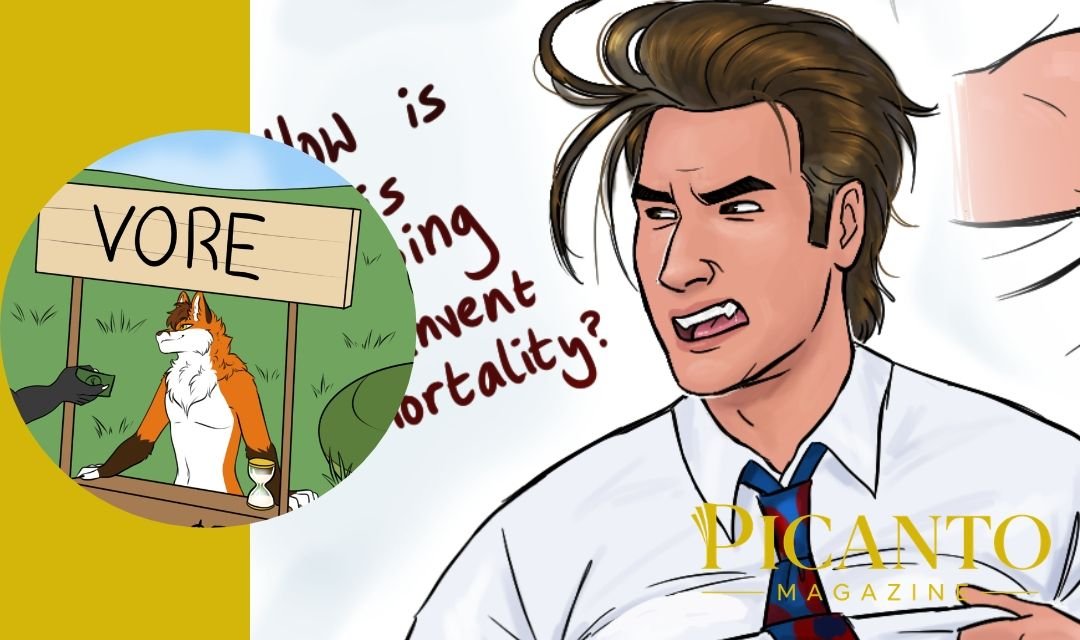
Vore is an internet slang term that refers to a fantasy involving one character swallowing or consuming another. The word comes from vorarephilia, a term formed from the Latin word vorare, meaning “to devour,” and the Greek-derived suffix -philia, meaning attraction or affinity. Vore is most commonly associated with fictional stories, digital artwork, animation, and online communities. For some people, it is a sexual fetish, while others encounter the concept through fantasy, horror, or unusual internet art.
The subject can seem confusing to people who discover it for the first time. It appears in different types of fictional media, and its meaning depends on the context.
Most importantly, vore fantasies are generally fictional. They should not be confused with real-life behavior or taken as evidence that someone intends to harm another person.
Quick Overview: Vore
| Detail | Information |
|---|---|
| Term | Vore |
| Full term | Vorarephilia |
| Basic meaning | Fantasy involving swallowing or consuming another being |
| Word origin | Latin vorare, meaning to devour |
| Common contexts | Internet fiction, artwork, animation, fantasy communities |
| Can be sexual? | Yes, for some individuals |
| Always sexual? | No, not in every fictional or artistic context |
| Main distinction | Soft vore and hard vore |
| Typical setting | Fictional or imaginary scenarios |
| Related themes | Transformation, size differences, fantasy creatures |
| Real-world safety | Real-life enactment involving harm is dangerous |
| Online presence | Art platforms, fictional writing, and discussion communities |
What Does Vore Mean?
Vore is short for vorarephilia.
In its most common internet usage, it describes a fantasy involving a character consuming another character, usually by swallowing them.
The fantasy can involve humans, animals, monsters, giants, or completely imaginary creatures.
In some fictional stories, the swallowed character remains unharmed.
In others, the story contains horror or violent themes.
This difference is important because the term covers several types of fictional content.
The word itself does not identify whether a particular story is romantic, sexual, humorous, disturbing, or simply surreal.
Context determines how it should be understood.
Where Did the Word Vore Come From?
The word vore developed as a shortened form of vorarephilia.
Its linguistic roots come from Latin and Greek-derived terminology.
The Latin verb vorare means to swallow or devour.
The suffix -philia is commonly used to describe an attraction or strong interest.
Although the term is widely associated with internet communities, fantasies about swallowing and being swallowed appear in much older stories.
Myths, fairy tales, and folklore have included characters being eaten by monsters or swallowed by enormous creatures for centuries.
However, these traditional stories are not automatically examples of the modern fetish.
The modern term developed within specialized communities that interpreted such themes in new ways.
Is Vore a Fetish?
Vore can be a fetish.
For some adults, the idea of swallowing or being swallowed is connected with sexual attraction or arousal.
Others may be interested in the concept because of fantasy storytelling, unusual character designs, or horror themes.
The presence of a fictional swallowing scene does not automatically make the content fetish-related.
For example, a monster swallowing a character in a fantasy film may simply be part of the plot.
A person’s interest in such a scene cannot be determined from the scene alone.
Understanding Vore in Internet Culture
The internet helped specialized fictional interests find audiences.
Before online communities became common, people interested in unusual fantasy subjects had fewer ways to discuss them.
Digital art platforms and discussion forums changed that.
Users could share stories, create characters, and explore fictional ideas.
Vore became one of many niche topics that developed recognizable vocabulary.
Some communities focus on illustration.
Others concentrate on writing or character-based roleplay.
Not all spaces use the same rules or content boundaries.
Different Types of Vore
The term is often divided into categories.
These categories help people describe the tone or content of a fictional scenario.
Soft Vore
Soft vore usually refers to fictional swallowing without graphic injury or destruction.
The swallowed character may remain alive and unharmed within the fantasy.
Some stories use impossible cartoon-like conditions.
For example, a character may be swallowed and later escape without physical consequences.
Such situations are clearly fictional and do not reflect real anatomy.
Hard Vore
Hard vore refers to content that includes graphic violence, injury, or destruction.
It is more closely associated with violent horror imagery.
Because it may contain disturbing material, it is not suitable for all audiences.
The distinction between soft and hard vore is commonly used as a content description within online communities.
Macro Vore
Macro vore involves unusually large characters or creatures.
The size difference is central to the fictional scenario.
Giants, dragons, and enormous monsters may appear in these stories.
The theme overlaps with broader giant-character and fantasy art communities.
Micro Vore
Micro vore involves very small characters.
The fantasy may feature miniature people or other tiny fictional beings.
Like macro vore, it relies on impossible or exaggerated differences in size.
Unbirth
Unbirth is another term sometimes grouped with vore-related fantasy communities.
It refers to a separate fictional theme involving a character entering another body through a reproductive or anatomical fantasy scenario.
It is not the same as ordinary swallowing-based vore.
Because the themes overlap in some communities, they may appear together in online discussions.
Why Do People Create Vore Artwork?
People create fictional artwork for many reasons.
Some enjoy unusual creature designs.
Others like transformation stories, fantasy worlds, or exaggerated cartoon situations.
For some adults, vore artwork has a sexual meaning.
For others, it is a form of surreal or horror-based imagination.
The motivations are not identical for every creator.
It is inaccurate to assume that all artists or viewers have the same interests.
Vore in Fictional Stories
Fictional swallowing has appeared in stories for centuries.
A familiar example is the fairy tale Little Red Riding Hood, in which a wolf swallows characters in some versions.
Another example is the biblical story of Jonah, who is swallowed by a large fish.
These stories were created for religious, moral, or dramatic purposes.
They are not necessarily connected with modern vorarephilia.
However, they demonstrate that swallowing and consumption have long been used as storytelling devices.
Modern internet fiction sometimes gives these themes different meanings.
Vore in Animation
Animation allows creators to show situations that would be impossible in reality.
Characters can stretch, change shape, or survive events that would normally cause serious injury.
This freedom makes animated fantasy particularly suitable for unusual fictional concepts.
Some online artists create vore-themed animation using cartoon characters or original creatures.
However, the presence of a swallowing scene in mainstream animation does not automatically indicate a fetish.
The artistic context matters.
Vore and Horror
Vore can overlap with horror because both may involve monsters and frightening situations.
Horror stories often use consumption as a symbol of danger or helplessness.
A creature swallowing someone can create suspense.
However, horror generally aims to produce fear or tension.
Vore-related fantasy may focus on very different emotional experiences.
The two categories sometimes overlap, but they are not interchangeable.
Vore and Fantasy Creatures
Fantasy creatures frequently appear in vore-related fiction.
Examples include dragons, giants, monsters, and imaginary animals.
These characters allow artists to create situations outside normal human experience.
Some stories involve magical abilities.
Others feature impossible physical characteristics.
Fantasy settings also help separate fictional scenarios from real-world behavior.
What Is the Difference Between Vore and Cannibalism?
Vore and cannibalism are not identical concepts.
Cannibalism generally refers to a member of a species consuming another member of the same species.
Vore is a broader fantasy term that may involve swallowing or consumption between different fictional characters or creatures.
It can also involve imaginary situations where no injury occurs.
The terms may overlap in some stories, but they have different meanings.
Is Vore Real?
Vore exists as a fantasy, fictional theme, and sexual interest.
However, many scenarios shown in vore artwork are physically impossible.
Humans cannot safely swallow other people.
Attempts to reproduce harmful fictional situations in real life could cause serious injury or death.
The distinction between imagination and real-world behavior is essential.
Fictional interests do not require dangerous physical enactment.
Is Having a Vore Fantasy a Mental Disorder?
An unusual sexual interest is not automatically a mental disorder.
Mental health professionals distinguish between atypical interests and conditions that cause significant distress, impairment, or involve harm or nonconsenting individuals.
A fictional interest alone is not enough to establish a diagnosis.
If someone feels distressed by unwanted thoughts or fears they might act in a harmful way, speaking with a qualified mental health professional can help.
A respectful, nonjudgmental approach is important.
Why Is Vore Discussed Online?
Vore has become recognizable partly because internet communities develop their own vocabulary.
People may encounter the word in memes, comments, artwork, or discussions about unusual fictional themes.
Sometimes it is used seriously.
At other times, it appears as a joke or exaggerated internet reference.
Its meaning can therefore change depending on the conversation.
Understanding the original definition helps avoid confusion.
Is Vore Always Adult Content?
No, but it is frequently associated with adult content.
A fictional scene involving a monster swallowing a character may be entirely nonsexual.
However, communities specifically dedicated to vorarephilia may contain explicit material.
Users should check content labels and age restrictions.
Parents and guardians should also understand that apparently harmless fantasy artwork may sometimes lead to adult-oriented spaces.
Online Safety and Vore Communities
Online communities discussing adult fantasy subjects should maintain clear boundaries.
Important considerations include age restrictions, consent, privacy, and content warnings.
Users should avoid sharing personal information with strangers.
They should also respect other people’s preferences and boundaries.
No one should be pressured to participate in conversations or activities that make them uncomfortable.
Fictional scenarios should never be used to justify real-world violence or coercion.
Common Misunderstandings About Vore
Several misunderstandings appear in discussions about this topic.
One is that every person who enjoys monster stories has a vore fetish.
That is not true.
Another is that having an unusual fantasy means someone wants to act on it.
Fantasy and intention are different.
A third misunderstanding is that all vore content is graphic.
Some fictional content is nonviolent, while other material contains disturbing themes.
Understanding these differences leads to more accurate discussions.
Vore and Personal Boundaries
People have different reactions to unusual fictional content.
Some find it interesting.
Others find it uncomfortable or disturbing.
Both reactions can be valid.
Nobody is required to enjoy or participate in a particular type of fantasy.
Respecting personal boundaries is especially important in online discussions.
Creators should label mature material appropriately, and viewers should have the ability to avoid unwanted content.
How Vore Became an Internet Search Term
The word gained wider visibility as online art and discussion communities grew.
Search engines made niche terminology easier to discover.
Social media also introduced the term to people outside specialized communities.
Memes sometimes use the word without explaining its original meaning.
As a result, people may search for its definition after seeing it in an unfamiliar context.
The term remains relatively specialized despite its visibility in some internet spaces.
Vore vs. Other Fantasy Interests
Vore is sometimes discussed alongside other unusual fictional interests.
These may include transformation, giant characters, shrinking, or monster-themed fantasy.
The interests can overlap because they use similar imaginary settings.
However, each has a different focus.
For example, transformation fiction centers on a character changing form.
Giant-character fiction focuses on exaggerated size differences.
Vore specifically involves swallowing or consumption.
Interesting Facts About Vore
-
Vore is short for vorarephilia.
-
Its name comes partly from the Latin word for devouring.
-
It is often associated with fictional artwork and stories.
-
Some vore content is sexual, while other depictions are not.
-
Soft vore and hard vore describe different types of content.
-
Fantasy creatures frequently appear in vore artwork.
-
Size differences are common in certain fictional categories.
-
The theme sometimes overlaps with transformation fiction.
-
Swallowing scenes have appeared in mythology and folklore for centuries.
-
Historical stories should not automatically be classified as fetish content.
-
Many fictional scenarios are physically impossible.
-
Having an unusual fantasy does not automatically indicate a mental disorder.
-
Online content labels can help viewers avoid unwanted material.
-
Real-world safety and consent remain essential.
Final Thoughts
Vore is a specialized term used to describe fantasies involving swallowing or consuming another character.
It appears in online fiction, digital artwork, animation, and adult-oriented communities.
Although the word is often associated with a fetish, not every fictional swallowing scene has a sexual meaning.
Its different categories reflect variations in storytelling, visual style, and emotional tone.
Understanding the distinction between fantasy and reality is particularly important.
A respectful discussion should avoid unnecessary assumptions about people’s interests while maintaining clear boundaries around safety, consent, and age-appropriate content.
Frequently Asked Questions About Vore
1. What does vore mean?
Vore refers to a fantasy involving one character swallowing or consuming another.
2. What is the full word for vore?
The full term is vorarephilia.
3. Where does the word vore come from?
It comes from the Latin word vorare, meaning to devour.
4. Is vore a fetish?
It can be a sexual fetish, although not every fictional depiction has a sexual meaning.
5. What is soft vore?
Soft vore generally describes fictional swallowing without graphic injury or destruction.
6. What is hard vore?
Hard vore involves graphic violence or destructive themes.
7. What is macro vore?
Macro vore involves very large fictional characters or creatures.
8. What is micro vore?
Micro vore involves very small characters in imaginary scenarios.
9. Is vore the same as cannibalism?
No. Vore is a broader fantasy concept, while cannibalism has a specific meaning involving consumption within the same species.
10. Is vore real?
It exists as a fantasy and interest, but many depicted scenarios are physically impossible.
11. Is vore always sexual?
No. Some swallowing scenes are ordinary fantasy or horror storytelling.
12. Is vore a mental illness?
An unusual fantasy alone does not establish a mental health disorder.
13. Why is vore popular online?
Online communities allow people to share specialized fictional interests and terminology.
14. Does vore appear in cartoons?
Swallowing scenes appear in cartoons, but they are not necessarily fetish-related.
15. Does vore appear in horror?
Yes. Some horror stories contain consumption themes that overlap with vore-related imagery.
16. What creatures appear in vore stories?
Dragons, giants, monsters, and imaginary animals are common examples.
17. Is vore dangerous?
Fictional artwork is different from real-world behavior. Attempts to reproduce harmful scenarios physically can be extremely dangerous.
18. Can vore involve nonhuman characters?
Yes. Many fictional stories involve imaginary creatures or animals.
19. Is vore the same as transformation fantasy?
No. Transformation focuses on changing form, while vore focuses on swallowing or consumption.
20. Why do people search for vore?
People may encounter the term in online art, memes, stories, or social media comments.
21. What does unbirth mean in vore communities?
It refers to a separate fictional theme involving entering another body through an anatomical fantasy scenario.
22. Is all vore content graphic?
No. Some content is nonviolent, while other material contains graphic themes.
23. Should vore content have warnings?
Adult or disturbing material should be appropriately labeled so viewers can make informed choices.
24. Does enjoying monster movies mean someone likes vore?
No. Interest in monster fiction does not establish a particular fetish.
25. What is the most important thing to understand about vore?
It is primarily a fictional fantasy concept, and it should be distinguished from real-world actions.
For more internet culture explanations, trending topics, and lifestyle guides, visit Picanto Magazine.