
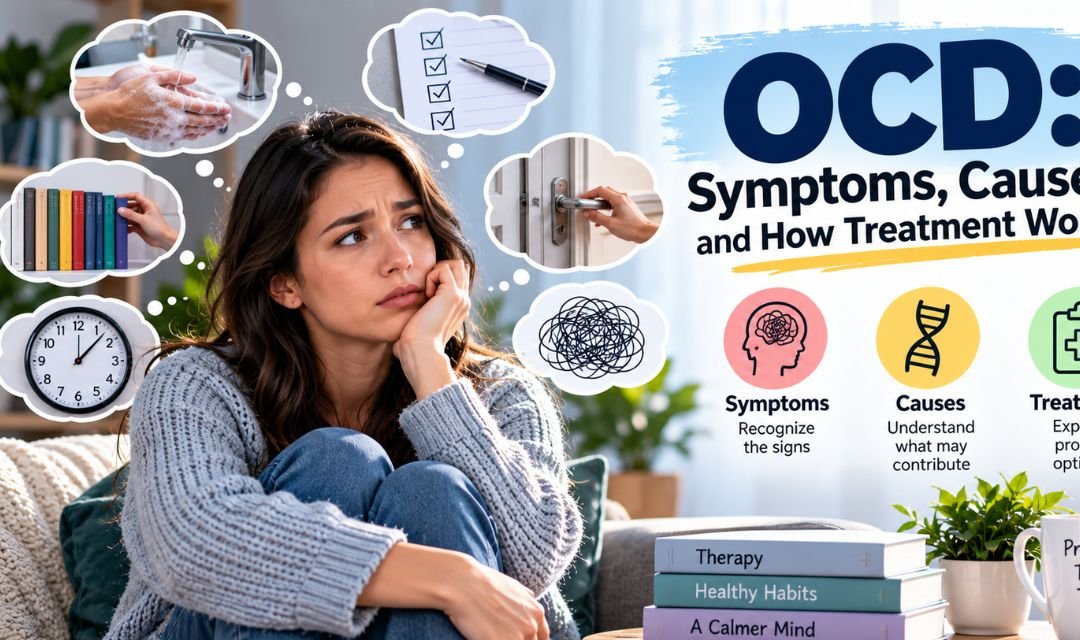
Most people have experienced a moment of doubt after leaving the house. Did you lock the door? Turn off the stove? For most people, that thought passes within seconds. For someone living with obsessive-compulsive disorder, it does not pass. The thought circles back, louder and more insistent each time, demanding reassurance that never quite sticks. Understanding why that happens, and what can actually be done about it, is what this article is about.
OCD is widely misunderstood. Pop culture has turned it into shorthand for being tidy or particular, but the clinical reality is far more disruptive. This article walks through what OCD actually is, how it differs from ordinary worry, what causes it, and what the research says about effective treatment. Whether you are trying to understand your own experiences or support someone you care about, the information here gives you a clear and honest starting point.
What OCD Actually Looks Like
OCD is defined by two core features: obsessions and compulsions. Obsessions are unwanted, intrusive thoughts, images, or urges that cause significant distress. Compulsions are repetitive behaviors or mental acts performed in response to those obsessions, usually to reduce the distress or prevent a feared outcome. The relief compulsions bring is real, but it is also temporary. Within a short time, the obsession returns, and the cycle begins again.
It is worth clarifying that almost everyone has intrusive thoughts from time to time. Research consistently shows that the content of intrusive thoughts in the general population is remarkably similar to the obsessions experienced by people with OCD. The difference is not the thought itself but how the brain responds to it. In OCD, the brain treats the intrusive thought as a genuine threat requiring urgent action. That misinterpretation is at the heart of the disorder.
OCD presents differently from person to person. Some common themes include contamination fears and washing compulsions, fears of harming others and checking behaviors, a need for symmetry or exactness, and intrusive thoughts of a religious or sexual nature. These themes are not character flaws. They are symptoms of a neurological condition, and people who experience them are often distressed precisely because the thoughts conflict with their values.
How Common Is OCD and Who Does It Affect
OCD affects people across every demographic. According to the World Health Organization, OCD is one of the top 20 causes of illness-related disability worldwide for people between the ages of 15 and 44. The International OCD Foundation estimates that OCD affects approximately 1 in 100 adults in the United States, which translates to roughly 2 to 3 million adults at any given time. Onset can occur at any age, though it most commonly begins in childhood, adolescence, or early adulthood.
One of the more troubling statistics involves the delay between symptom onset and receiving an accurate diagnosis. Studies have found that the average person with OCD waits 14 to 17 years before receiving proper diagnosis and treatment, according to data cited by the International OCD Foundation. Part of that delay comes from stigma. Part comes from the fact that many people with OCD feel ashamed of their thoughts and go to significant lengths to hide them.
OCD vs. Anxiety: Understanding the Overlap and the Differences
OCD was historically classified as an anxiety disorder, and anxiety is certainly a central part of the experience. However, OCD is now recognized as its own diagnostic category in the DSM-5, grouped under Obsessive-Compulsive and Related Disorders. Understanding why it was separated matters for treatment purposes.
| Feature | Generalized Anxiety | OCD |
| Nature of worry | Realistic concerns about everyday life | Intrusive thoughts perceived as threatening |
| Response behavior | Avoidance or rumination | Ritualistic compulsions to neutralize distress |
| Insight | Usually aware worries may be excessive | Varies; often aware thoughts are irrational but cannot stop |
| Ego-syntonic vs. dystonic | Worry often feels proportionate | Obsessions typically feel alien and unwanted |
| First-line treatment | CBT, relaxation strategies | ERP-based CBT, sometimes medication |
This distinction matters because treating OCD with standard anxiety management techniques, such as deep breathing or reassurance-seeking, can actually reinforce the cycle. Reassurance is itself a compulsion. When someone with OCD gets reassurance that the stove is off, the relief they feel temporarily reduces distress. But it also teaches the brain that the reassurance was necessary, making the next obsessive doubt more likely to demand the same response.
What Causes OCD
No single cause has been identified, but research points to a combination of biological, psychological, and environmental factors. Neuroimaging studies have consistently shown differences in the functioning of specific brain circuits in people with OCD, particularly those involving the orbitofrontal cortex, the thalamus, and the caudate nucleus. These areas form a circuit related to threat detection and the initiation of behavioral responses. In OCD, this circuit appears to be overactive.
Genetics also play a role. OCD tends to run in families, and twin studies suggest a meaningful hereditary component, especially when OCD begins in childhood. That said, having a family member with OCD does not mean someone will develop it. Genetics create a vulnerability, not a certainty.
Environmental factors can trigger or worsen symptoms in people who are already predisposed. Significant life stressors, trauma, and major transitions have all been linked to OCD onset or exacerbation. There is also an established, though not fully understood, connection between certain streptococcal infections and rapid-onset OCD symptoms in children, a phenomenon sometimes referred to as PANDAS.
Evidence-Based Treatments That Work
The good news is that OCD is one of the more treatable mental health conditions when the right approaches are used. The two primary evidence-based options are a specific form of cognitive behavioral therapy and medication.
Exposure and Response Prevention Therapy
Exposure and Response Prevention, commonly called ERP, is considered the gold-standard psychological treatment for OCD. ERP works by gradually exposing a person to thoughts, images, or situations that trigger their obsessions while helping them resist the urge to engage in compulsions. Over time, the brain learns that the feared outcome does not materialize and that anxiety decreases on its own without the compulsion. This process is called habituation, and it genuinely rewires the threat-response cycle.
ERP is structured and intentional. A therapist trained in this approach works with the client to build a hierarchy of feared situations, starting with less distressing triggers and working toward more challenging ones. Progress is gradual and collaborative. It is not about flooding someone with fear but about building tolerance in a controlled, supported way.
For people in California’s Central Valley, accessing this type of specialized care is more available than many realize. OCD treatment in Modesto includes ERP-based therapy delivered by clinicians specifically trained in this approach, which makes a meaningful difference in outcomes compared to general talk therapy.
Medication Options
Certain antidepressants, specifically those in the class of serotonin reuptake inhibitors, have strong evidence supporting their use in OCD. These include medications like fluoxetine, sertraline, fluvoxamine, and clomipramine. Unlike their use in depression, effective doses for OCD are often higher, and it can take 8 to 12 weeks before a meaningful reduction in symptoms is noticeable. Medication is often used in combination with ERP, and research suggests the combination tends to outperform either approach alone.
What to Expect When Seeking Help
Reaching out for professional support can feel daunting, especially for people who have spent years concealing their symptoms. Knowing what the process typically involves can reduce some of that friction.
- An initial assessment where a clinician gathers information about symptoms, their duration, and how much they interfere with daily functioning.
- A formal or informal diagnosis based on DSM-5 criteria, which require that obsessions and compulsions are time-consuming (more than an hour per day) or cause significant distress or impairment.
- A collaborative treatment plan, typically involving ERP and possibly a medication consultation depending on symptom severity.
- Regular sessions, often weekly, with homework between appointments to practice response prevention in real-life situations.
- Periodic check-ins to assess progress and adjust the hierarchy or approach as needed.
Treatment does not promise that obsessive thoughts will disappear entirely. For most people, the goal is reducing the power those thoughts hold and breaking the compulsion cycle so that thoughts are no longer in charge of behavior. Many people who complete a full course of ERP report significant improvements in quality of life, even if occasional intrusive thoughts remain.
Supporting Someone with OCD
If someone close to you is living with OCD, the instinct to help by providing reassurance is understandable. Unfortunately, reassurance accommodation, doing the checking for someone or answering their repeated questions, tends to maintain and worsen the disorder over time. This is not intuitive, and it does not mean doing nothing. It means learning what genuinely helps versus what feeds the cycle.
- Educate yourself about OCD so you understand what the person is experiencing without assuming they can simply stop.
- Avoid providing reassurance in response to OCD-driven questions, even when it feels unkind in the moment.
- Encourage professional treatment without pressure or ultimatums.
- Recognize that recovery is not linear. Some weeks will be harder than others.
- Take care of your own mental health, as supporting someone with OCD can be emotionally taxing.
Family involvement in treatment, when handled thoughtfully, can actually improve outcomes. Some ERP therapists involve family members in sessions specifically to address accommodation patterns and build a more supportive environment for recovery.
OCD is a real, well-documented condition with a clear biological basis and effective treatments backed by decades of research. The gap between suffering in silence and finding real relief often comes down to access to accurate information and properly trained clinicians. If anything in this article resonated, the next step is simply a conversation with a mental health professional who specializes in this area.