
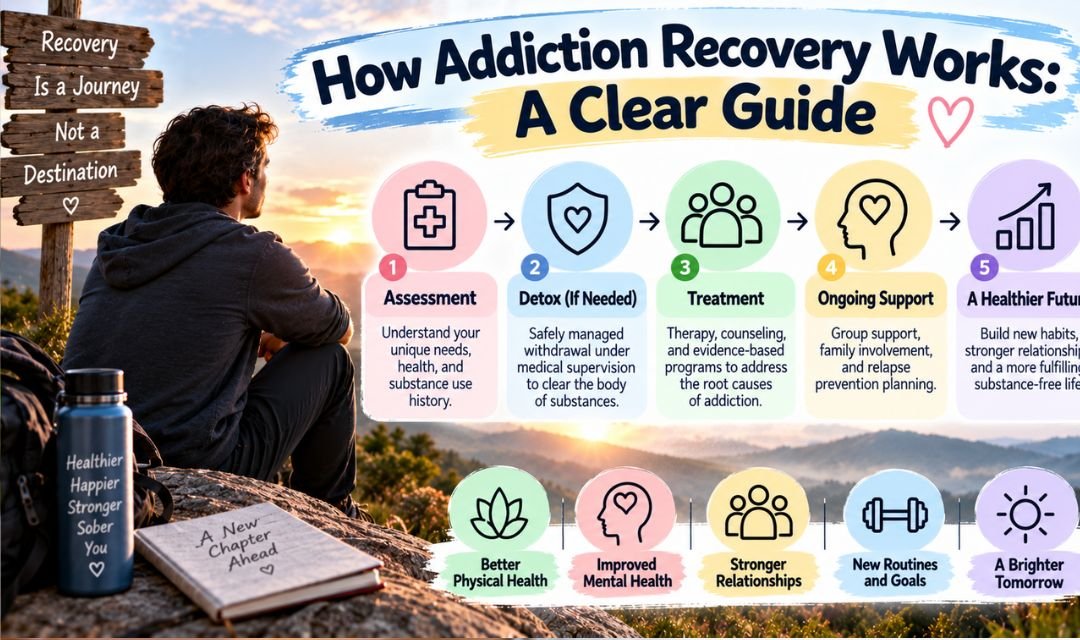
Every year, millions of people decide they want a different life. They are tired of the cycle, tired of the consequences, and ready to do something about it. But when someone actually tries to figure out how addiction recovery works, the information can feel scattered, clinical, or overwhelming. This article breaks down the recovery process in plain terms, covering what happens at each stage, what kinds of treatment exist, and what genuinely helps people stay sober over the long term.
What Addiction Actually Does to the Brain
Addiction is not simply a habit that someone refuses to quit. It produces measurable changes in brain chemistry and structure, particularly in the areas that govern reward, motivation, and decision-making. The substance or behavior hijacks the brain’s dopamine system, training it to treat the addiction as a survival priority. Over time, ordinary sources of pleasure stop feeling rewarding, and the brain increasingly focuses its attention on the addictive substance.
According to the National Institute on Drug Abuse, repeated drug use alters the prefrontal cortex, the region responsible for impulse control and judgment. This is a key reason why willpower alone rarely produces lasting recovery. The brain itself has been reorganized around the addiction, which means effective treatment needs to address that neurological reality, not just the behavior on the surface.
Understanding this biology matters because it reframes the conversation. Relapse, for example, is not a moral failure. Rates of relapse for substance use disorders are similar to those for other chronic conditions like hypertension and diabetes, sitting between 40 and 60 percent, according to NIDA. That does not mean recovery is hopeless. It means treatment often needs to be ongoing and responsive rather than a single fixed episode.
The Phases of the Recovery Process
Recovery does not happen in a single moment. It unfolds across several stages, each with its own challenges and goals. Most clinical frameworks describe recovery as moving through acknowledgment, treatment, and maintenance, though the path is rarely perfectly linear.
Detoxification
Detox is often the first formal step, and it is frequently misunderstood. The purpose of detoxification is to clear the substance from the body while managing withdrawal symptoms safely. For some substances, particularly alcohol, benzodiazepines, and opioids, withdrawal can be physically dangerous without medical supervision. Alcohol withdrawal, for instance, can trigger seizures or a life-threatening condition called delirium tremens. This is why medical detox programs exist and why attempting to quit certain substances cold turkey without support carries real risk.
Detox alone is not treatment. It stabilizes the body, but it does not address the psychological patterns, trauma, or social circumstances that feed addiction. Research consistently shows that detox followed by no further treatment leads to very high rates of relapse. It is a starting point, not an endpoint.
Active Treatment
After detox, treatment involves working on the underlying causes and patterns of addiction. This can happen in a residential setting, where someone lives at the facility, or in outpatient programs that allow people to continue living at home while attending treatment sessions. The right choice depends on the severity of the addiction, the presence of co-occurring mental health conditions, and the person’s home environment.
Core treatment components typically include individual therapy, group counseling, and psychoeducation. Cognitive behavioral therapy, or CBT, is one of the most thoroughly researched approaches. It helps people identify the thoughts and situations that trigger substance use and develop concrete strategies to respond differently. Motivational interviewing is another widely used technique that helps people clarify their own reasons for wanting to change, which tends to produce stronger commitment than external pressure alone.
Aftercare and Long-Term Support
The period after formal treatment ends is often the most vulnerable. Aftercare planning is designed to bridge that gap. It typically includes continued therapy on a reduced schedule, participation in peer support groups like Alcoholics Anonymous or SMART Recovery, and sometimes medication-assisted treatment for opioid or alcohol use disorders. Medications like naltrexone, buprenorphine, or acamprosate have strong evidence behind them and are significantly underused relative to their effectiveness.
Types of Treatment Settings Compared
Choosing a treatment setting is one of the most consequential decisions in recovery. The table below outlines the main options and their key characteristics.
| Setting | Structure | Who It Suits Best | Typical Duration |
| Medical Detox | 24/7 clinical supervision | Anyone with physical dependence on alcohol, opioids, or benzodiazepines | 3 to 10 days |
| Residential/Inpatient | Live-in treatment, structured daily program | Severe addiction, unsafe home environment, prior treatment failures | 28 days to 6 months |
| Partial Hospitalization (PHP) | Full days at facility, evenings at home or sober living | High support needs without full residential requirement | 4 to 6 weeks |
| Intensive Outpatient (IOP) | Several hours of treatment per week | Moderate addiction, stable home, work or family obligations | 8 to 16 weeks |
| Standard Outpatient | Weekly therapy sessions | Mild addiction, strong support system, post-higher-level-care step-down | Ongoing |
The Role of Community-Based and Local Resources
Geography matters more than people realize when it comes to recovery. Having access to treatment close to home allows people to maintain connections with family and community, which are themselves protective factors. Local programs also tend to understand regional patterns of substance use and can connect clients to area-specific resources like housing support, legal aid, or employment assistance.
Organizations rooted in their communities can offer a continuity that larger, impersonal programs sometimes lack. Addiction Free Recovery Services, based in Modesto, California, is one example of a community-centered provider focused on accessible, individualized care for people working through substance use challenges in the Central Valley region.
Peer support is another community-based resource worth taking seriously. Research from the Substance Abuse and Mental Health Services Administration shows that peer recovery coaches, people with lived experience of addiction and recovery, improve engagement in treatment and reduce rates of relapse. Connecting with someone who has walked the same road provides a kind of credibility and hope that clinical staff, no matter how skilled, cannot always offer.
What Makes Recovery More Likely to Last
Decades of research point to several consistent factors that improve long-term outcomes. None of them guarantee success on their own, but together they significantly shift the odds.
- Length of treatment: People who remain in treatment longer, typically 90 days or more, have substantially better outcomes than those who leave early, according to NIDA.
- Treating co-occurring conditions: Anxiety, depression, trauma, and ADHD frequently co-occur with addiction. Treating both simultaneously produces far better results than addressing only the substance use.
- Social support: A stable, supportive social network is one of the strongest predictors of sustained recovery. Isolation is one of the biggest risks.
- Housing and employment stability: People who lack stable housing or income face significantly higher relapse rates. Addressing basic needs is part of effective recovery support.
- Medication-assisted treatment when appropriate: For opioid and alcohol use disorders, FDA-approved medications cut relapse rates substantially and are safe for long-term use.
- Readiness and self-motivation: People who enter treatment with internal motivation, rather than purely under external pressure, tend to engage more fully and stay longer.
Common Misconceptions That Get in the Way
A few persistent myths tend to cause harm by discouraging people from seeking help or by setting unrealistic expectations for what recovery should look like.
- “You have to hit rock bottom first.” This is not supported by evidence. Early intervention consistently produces better outcomes. Waiting for a crisis to force change often means allowing significant harm to accumulate that did not need to happen.
- “Relapse means treatment failed.” Relapse is a common part of the recovery process for many people, not evidence that someone is beyond help. It often signals a need to adjust the treatment approach rather than abandon it.
- “Medication-assisted treatment is just trading one addiction for another.” This is a stigma-based claim that contradicts the clinical evidence. Medications like buprenorphine stabilize brain chemistry, reduce cravings, and allow people to engage in therapy and rebuild their lives. They are no more a crutch than insulin is for a diabetic.
- “Recovery means white-knuckling it without any professional help.” Willpower matters, but it is rarely sufficient on its own given the neurological changes addiction produces. Professional treatment, peer support, and sometimes medication all serve genuine purposes.
- “One treatment approach works for everyone.” Recovery is highly individual. What works well for one person may not work at all for another, which is why individualized assessment and flexible treatment planning are so important.
Recovery from addiction is genuinely possible, and it happens every day for people across all kinds of backgrounds and circumstances. The process is rarely quick or simple, but it becomes much more achievable when people have accurate information, appropriate treatment, and real support around them. Understanding how the process works, what the options are, and what actually improves outcomes is a meaningful first step toward making change possible.