
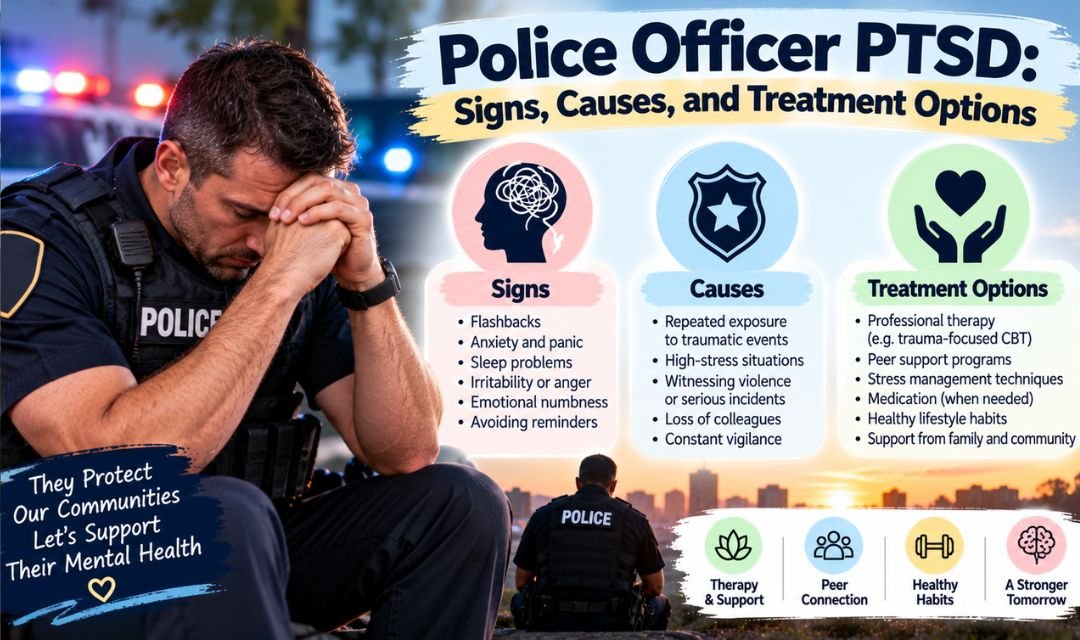
Most people will never see what a police officer sees in a single shift. A fatal car accident, a child abuse call, a shooting, a suicide, a violent arrest gone wrong. Officers experience these events repeatedly, often without adequate time to process one before the next arrives. Over years and decades, that cumulative exposure takes a measurable toll on mental health, and post-traumatic stress disorder is one of the most serious outcomes. Yet PTSD in law enforcement remains underdiagnosed, underreported, and widely misunderstood. This article breaks down what PTSD actually looks like in police officers, why the profession creates unique risk factors, and what evidence-based treatment approaches currently exist.
Why Police Officers Face Elevated PTSD Risk
Trauma exposure is not occasional for most officers. It is structural. A study published in the Journal of Traumatic Stress found that police officers experience an average of three traumatic events per year, and many veterans of the job report far higher numbers over the course of a full career. Unlike a civilian who might experience one major traumatic event in a lifetime, an officer in a busy urban department may witness dozens of violent deaths, hundreds of traumatic injury scenes, and countless high-stakes confrontations before reaching the midpoint of their career.
Trauma type matters too. Research distinguishes between single-incident trauma and cumulative trauma. Single-incident trauma, like a car accident or a natural disaster, tends to have a clearer beginning and end. Cumulative trauma builds layer by layer, often without the person realizing the weight is accumulating. Officers are particularly vulnerable to cumulative trauma because the professional culture often discourages acknowledgment. Asking for help has historically been seen as a sign of weakness, and that perception, even when it is shifting, still silences a significant number of people who need care.
What PTSD Looks Like in Law Enforcement
PTSD does not always look the way popular media portrays it. It is not only flashbacks or visible distress. In officers specifically, symptoms frequently present in ways that can be mistaken for personality changes, burnout, or simply the side effects of a difficult job. Understanding the actual symptom profile is essential for officers themselves, their families, and their departments.
| Symptom Category | Common Presentations in Officers |
| Intrusion | Unwanted memories of critical incidents, nightmares, emotional reactions to triggers like sirens or certain smells |
| Avoidance | Withdrawing from calls that resemble past trauma, avoiding talking about incidents, emotional numbness |
| Negative cognition and mood | Persistent guilt, shame, difficulty trusting others, feeling detached from family and colleagues |
| Hyperarousal | Heightened startle response, difficulty sleeping, irritability, hypervigilance off-duty, difficulty relaxing |
The hypervigilance symptom deserves particular attention in an officer context. Hypervigilance is often an adaptive trait on the job. Staying alert to threat is part of what keeps an officer alive. Off duty, however, the same trait creates serious friction. An officer who cannot sit in a restaurant without positioning themselves near exits, who scans every stranger for potential threat, who cannot fall asleep because their nervous system remains activated, is experiencing something beyond job awareness. That persistent activation is a clinical sign, not a personality quirk.
The Role of Secondary Trauma and Moral Injury
Two related but distinct conditions often accompany PTSD in officers. Secondary traumatic stress occurs when exposure to the trauma of others, victims, witnesses, families, produces its own traumatic impact on the officer. Moral injury is different again. It develops when an officer is forced to act against their own ethical code, witnesses perceived ethical violations by others, or feels that institutions failed them after a critical incident. An officer who was ordered to follow a protocol they believed caused harm, or who could not save a child despite doing everything right, may carry moral injury that standard PTSD treatment does not fully address. Recognizing these distinctions helps clinicians and officers choose the most appropriate care.
Barriers That Prevent Officers From Seeking Help
The barriers to treatment in law enforcement are both cultural and practical. Understanding them is necessary before meaningful access to care can improve.
- Stigma within department culture: Seeking mental health support has long been associated with weakness or unfitness for duty, a perception that discourages officers from disclosing struggles even when they recognize them.
- Fear of career consequences: Officers may worry that a PTSD diagnosis could affect their duty status, disqualify them for promotion, or result in their service weapon being temporarily removed.
- Confidentiality concerns: Some officers distrust that what they share with a department-provided therapist will remain private, particularly if they fear information could reach supervisors.
- Limited peer awareness: Officers who do not recognize PTSD symptoms in themselves cannot seek help for what they do not know is happening. Education within departments remains inconsistent.
- Access and scheduling: Patrol schedules, shift rotations, and mandatory overtime make consistent therapy attendance logistically difficult without departmental accommodation.
A 2018 report from the Ruderman Family Foundation found that police officer suicides in that year outnumbered officers killed in the line of duty. That statistic is cited often because it is striking, but the point it makes is practical: the internal toll of the job is significant, and the systems designed to support officers have not historically kept pace with the need. That is changing, slowly, but the barriers listed above still shape the experience of many officers today.
Evidence-Based Treatment Approaches for Officer PTSD
Effective treatment for law enforcement PTSD exists and has a strong research foundation. The challenge is matching officers with approaches that account for the specific nature of their trauma and the cultural realities of the profession. Providers who specialize in treating mental health trauma in police officers understand that standard outpatient therapy models sometimes need to be adapted, whether that means adjusting session formats, using law enforcement-familiar language, or addressing moral injury alongside clinical PTSD symptoms.
First-Line Therapies With Strong Evidence
- Cognitive Processing Therapy (CPT): A structured approach that helps individuals examine and challenge distorted thinking patterns that developed as a result of trauma. CPT is particularly useful for addressing guilt and shame, which are common in officers who experienced critical incidents.
- Prolonged Exposure (PE): A therapy that involves gradually confronting trauma-related memories and situations that have been avoided. It reduces the emotional charge of traumatic memories through careful, supported exposure over time.
- EMDR (Eye Movement Desensitization and Reprocessing): A therapy in which bilateral sensory stimulation is used while the patient recalls traumatic memories. The mechanism is still studied, but the outcomes data supporting EMDR for PTSD is substantial.
- Medication: Selective serotonin reuptake inhibitors (SSRIs), particularly sertraline and paroxetine, are FDA-approved for PTSD and can reduce symptom severity, often used alongside therapy rather than as a standalone approach.
Emerging and Complementary Approaches
Beyond the first-line therapies, a number of emerging approaches show promise for officers who have not responded fully to conventional treatment. Accelerated Resolution Therapy (ART) uses eye movements similarly to EMDR but often achieves results in fewer sessions, which can appeal to officers whose schedules make long treatment commitments difficult. Ketamine-assisted therapy is being explored in clinical settings for treatment-resistant PTSD, with some early data suggesting benefit for individuals whose symptoms have not responded to standard approaches. Peer support programs, while not clinical treatment, play a meaningful role in creating the psychological safety officers need before they will pursue formal care. Departments that invest in trained peer support specialists, officers who have sought help themselves and can speak credibly about the experience, consistently see higher rates of help-seeking among their members.
What Departments Can Do to Support Officer Mental Health
Individual treatment is one side of the equation. Systemic change within departments is the other. An officer who receives excellent therapy but returns to a culture of silence and stigma faces an uphill path to sustained recovery. Departments that take mental health seriously create conditions where treatment is more likely to work and more likely to be sought in the first place.
- Mandate regular psychological check-ins as a standard part of career management, removing the self-identification requirement that stops many officers from ever raising their hand.
- Train supervisors to recognize behavioral changes associated with trauma without diagnosing, and to connect officers with resources proactively.
- Establish confidentiality protections that are clear, documented, and enforced, so officers understand exactly what is and is not shared with command.
- Fund dedicated Employee Assistance Programs staffed by clinicians with law enforcement-specific training, not generic counselors unfamiliar with the profession.
- Build peer support programs with real infrastructure, training, time allotment, and cultural legitimacy within the department.
Recovery Is Possible and Officers Deserve That Chance
PTSD is not a permanent condition. It is treatable. Officers who receive appropriate care, particularly care that is calibrated to the specific nature of law enforcement trauma, experience real and lasting improvement in symptoms, relationships, and quality of life. The biggest obstacle is not the absence of effective treatment. It is the gap between officers who need help and the systems that can provide it. Closing that gap requires cultural change within departments, better education about what PTSD actually looks like in law enforcement, and consistent access to providers who understand the profession. Progress on all three fronts is happening, and the research base supporting officer mental health care continues to grow. Officers who have spent years protecting others deserve the same quality of care they would give anyone else in crisis.