
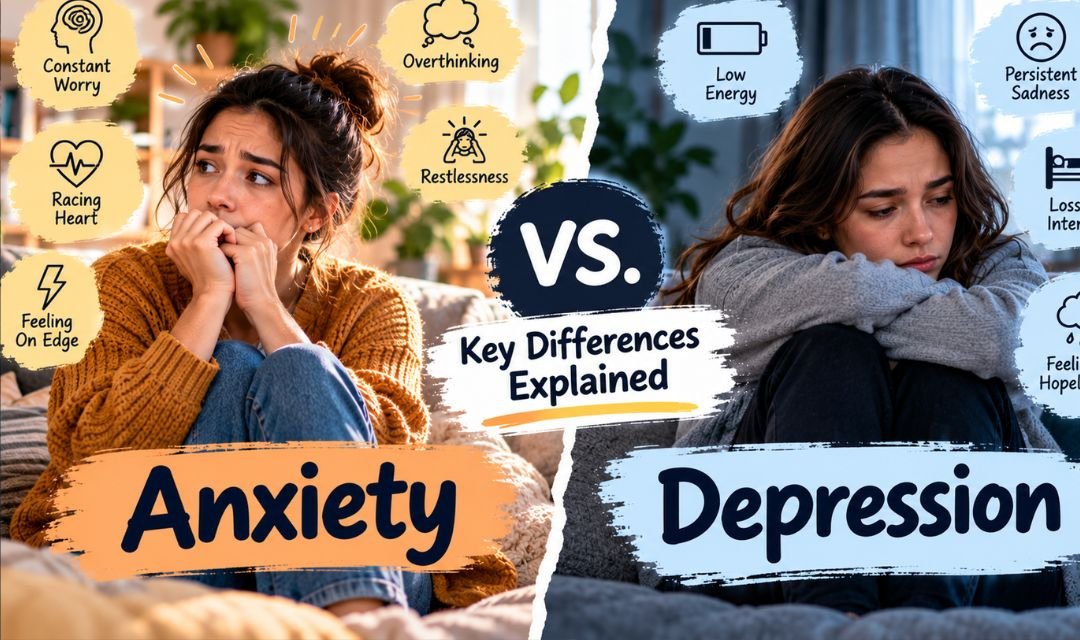
Feeling constantly worried is not the same as feeling persistently empty, yet millions of people use the words anxiety and depression almost interchangeably. That confusion is understandable. The two conditions overlap in surprising ways, they frequently occur together, and both can leave a person exhausted and struggling to function. Still, they are distinct disorders with different emotional signatures, different physical effects, and different pathways to recovery. Understanding those distinctions is not just an academic exercise. It shapes how a person seeks help, what kind of therapy tends to work best, and how quickly someone can start feeling like themselves again.
What Makes Anxiety Its Own Condition
Anxiety, at its core, is the mind’s threat-detection system running on overdrive. Every human brain has a built-in alarm that fires when danger is near. In people with anxiety disorders, that alarm fires too often, too loudly, or in response to situations that pose no real threat. The result is a persistent sense of dread, restlessness, or impending catastrophe that is hard to switch off.
Generalized Anxiety Disorder, or GAD, is the most common form. It involves chronic, excessive worry about everyday matters like work, health, money, or relationships, even when there is no obvious reason to worry. Other recognized anxiety disorders include panic disorder, social anxiety disorder, and various phobia-related conditions. Each has its own specific features, but they all share that hallmark quality of fear-forward thinking: the mind racing toward worst-case outcomes.
Physically, anxiety tends to rev the body up. People report a racing heart, shallow breathing, muscle tension, sweating, and an upset stomach. Sleep is often disrupted, but not because a person cannot get out of bed. It is usually because the mind will not quiet down enough to allow rest. Anxiety is often future-oriented. The suffering tends to be about what might happen.
What Makes Depression Distinct
Depression pulls in a different direction. Where anxiety is associated with hyperarousal, depression is more often characterized by a profound slowing down. Energy drains away. Interests that once brought pleasure feel flat or pointless. Concentration becomes difficult. Simple decisions feel monumental. This is not ordinary sadness after a hard week. Major Depressive Disorder involves a cluster of symptoms that persist for at least two weeks and interfere meaningfully with daily life, according to the Diagnostic and Statistical Manual of Mental Disorders, Fifth Edition (DSM-5).
The World Health Organization estimates that more than 280 million people worldwide live with depression, making it one of the leading causes of disability globally. That scale matters because it pushes back against the idea that depression is simply a bad attitude or a lack of willpower. It is a medical condition with measurable changes in brain chemistry, sleep architecture, and even immune function.
Depression is often past-oriented or present-focused in a painful way. Thoughts tend toward worthlessness, regret, guilt, and hopelessness. Rather than fearing the future, a person with depression may feel certain the future holds nothing good. That cognitive distortion is one of the most important treatment targets in therapies like Cognitive Behavioral Therapy.
Symptoms Side by Side: How They Overlap and Diverge
Because both conditions affect mood, energy, and sleep, they are easy to confuse at first glance. A comparison of their typical symptom profiles makes the differences clearer.
| Symptom Area | Anxiety | Depression |
| Mood | Fearful, tense, on edge | Sad, empty, hopeless |
| Thinking pattern | Future-focused worry, catastrophizing | Negative past focus, worthlessness, guilt |
| Energy level | Can be high (hyperarousal) or depleted by worry | Persistently low, fatigue even with rest |
| Sleep | Difficulty falling asleep, racing thoughts at night | Sleeping too much or too little, unrefreshing sleep |
| Physical sensations | Racing heart, shortness of breath, muscle tension | Heaviness, aches, slowed movement or speech |
| Appetite | Variable, often reduced by worry | Significantly increased or decreased |
| Pleasure in activities | Often preserved, though worry interferes | Markedly reduced (anhedonia) |
| Avoidance behavior | Common; avoids feared situations | Common; withdraws due to low motivation or interest |
One symptom that often surprises people is avoidance. Both anxiety and depression lead people to pull back from situations, but for different reasons. Someone with social anxiety avoids a party because they fear judgment. Someone with depression may skip the same party because they genuinely cannot find a reason to care about going. The behavior looks identical from the outside. The internal experience is quite different.
When Both Conditions Occur Together
Comorbidity is the clinical term for having two or more conditions at the same time, and anxiety and depression are among the most common comorbid pairings in mental health. Research published in the journal JAMA Psychiatry has found that nearly half of people diagnosed with major depression also meet criteria for an anxiety disorder. The reverse is also true at high rates.
Living with both simultaneously is particularly taxing. A person may feel simultaneously wired and exhausted, fearful about the future and convinced it will be terrible, desperate to avoid situations and also guilty about withdrawing. This combination can delay diagnosis because clinicians sometimes focus on one condition and the other goes unaddressed for longer than it should.
If you or someone you know is carrying symptoms that feel like a confusing mix of both, it is worth speaking with a professional who can assess the full picture. One practical starting point is to reach out to Shine Mental Health, where a clinical team can help untangle what someone is experiencing and point toward appropriate care.
How Each Condition Is Treated
The good news is that both anxiety and depression respond well to treatment, though the specifics can differ depending on the diagnosis, the severity, and the individual.
Therapy Approaches
Cognitive Behavioral Therapy is considered a first-line treatment for both conditions, which is one reason the overlap in care exists. For anxiety, CBT typically focuses on identifying distorted threat appraisals, learning to tolerate uncertainty, and gradually exposing a person to feared situations in a controlled way. For depression, CBT addresses negative core beliefs, behavioral withdrawal, and the kinds of thinking patterns that sustain hopelessness.
Other evidence-based therapies include Acceptance and Commitment Therapy (ACT), which is effective for both conditions, and Interpersonal Therapy, which is particularly useful for depression linked to relationship difficulties or major life changes. For some anxiety disorders, especially those involving trauma, Eye Movement Desensitization and Reprocessing (EMDR) has a strong evidence base.
Medication Options
Selective serotonin reuptake inhibitors, known as SSRIs, are often the first medication prescribed for both anxiety disorders and depression. That shared pharmacological treatment is one reason the two are sometimes grouped together in public conversation, though having the same medication class work for both does not mean they are the same condition. Beyond SSRIs, serotonin-norepinephrine reuptake inhibitors (SNRIs) are used for both as well. Benzodiazepines are sometimes used short-term for acute anxiety but carry dependency risks and are not a long-term solution. For depression specifically, certain atypical antidepressants like bupropion are prescribed when energy and motivation are the primary concerns.
Lifestyle Factors That Support Recovery
No article on mental health treatment would be complete without acknowledging the role that daily habits play in recovery. These are not replacements for professional care, but they have real, documented effects on both anxiety and depression.
- Regular aerobic exercise: A meta-analysis published in JAMA Psychiatry in 2023 found that physical activity significantly reduced symptoms of depression across multiple study populations.
- Consistent sleep schedule: Both conditions disrupt sleep, and sleep disruption worsens both conditions. Stabilizing sleep timing is one of the highest-leverage lifestyle changes a person can make.
- Reduced alcohol intake: Alcohol is a depressant that also disrupts anxiety regulation. Many people use it to cope, which tends to worsen both conditions over time.
- Social connection: Isolation feeds both anxiety and depression. Even small amounts of meaningful contact with others can provide meaningful relief.
- Mindfulness practice: Regular mindfulness meditation has shown moderate effects for both anxiety and depression in controlled studies.
Getting an Accurate Diagnosis Matters
Self-diagnosis based on symptom lists has limits. Both anxiety and depression can look like other conditions, including thyroid disorders, anemia, sleep apnea, and certain autoimmune diseases. A proper evaluation typically involves a clinical interview, a thorough review of personal and family history, and sometimes ruling out physical causes through basic lab work. That process takes time, but it produces a much clearer picture than a checklist alone can provide.
The difference between treating the right condition and treating the wrong one is not trivial. Someone whose primary issue is untreated anxiety may see little improvement from antidepressants that do not also address anxiety pathways. Someone whose primary issue is depression may find that anxiety-focused exposure exercises feel overwhelming without first stabilizing their mood enough to tolerate the discomfort.
Anxiety and depression are both serious, both treatable, and both worth taking seriously long before they reach crisis level. Recognizing which one a person is dealing with, or whether both are present, is the foundation of getting better. The path forward starts with an honest conversation with someone trained to listen.