
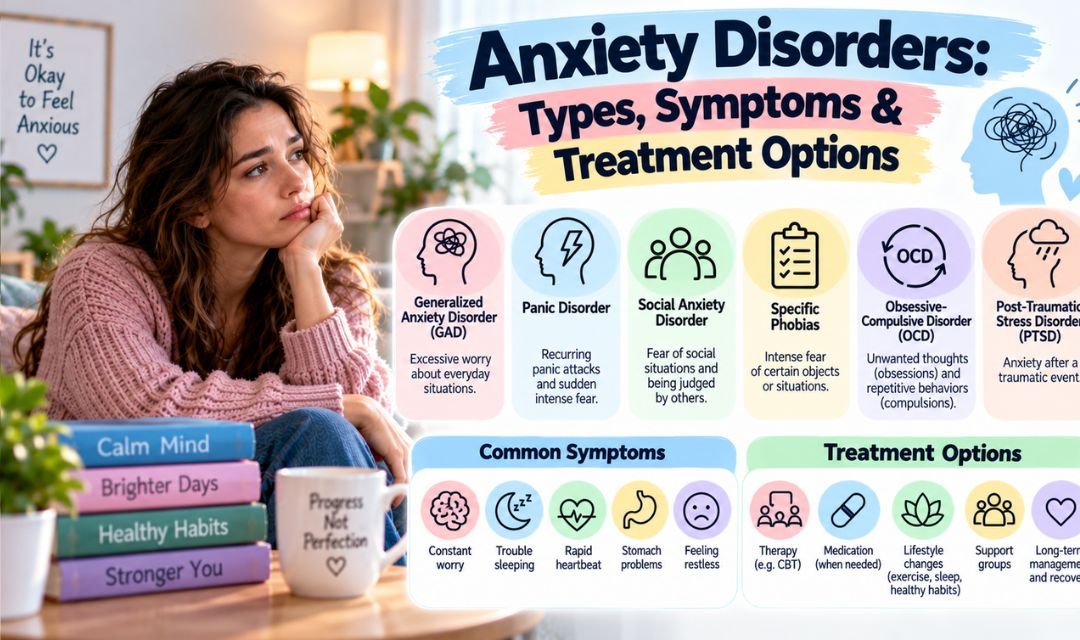
Anxiety shows up differently for everyone. For one person it is a racing heart before a work presentation. For another it is a months-long dread that never fully lifts, even when life looks fine from the outside. That gap between ordinary nervousness and a clinical anxiety disorder is something a lot of people struggle to identify, and the confusion often delays real help. This article breaks down what anxiety disorders actually are, how they differ from each other, what the research says about effective treatment, and how to think about getting support.
Why Anxiety Becomes a Disorder
Anxiety is a normal biological response. When the brain perceives a threat, it triggers a cascade of physical changes designed to help you act fast. Heart rate increases. Muscles tighten. Attention narrows. This system kept our ancestors alive. The problem is that the brain sometimes misfires, treating a traffic jam or a social gathering the same way it would treat a predator. When that happens regularly, and when the response is out of proportion to the actual situation, anxiety crosses from a useful emotion into a disorder.
A clinical anxiety disorder is defined by three core features: the anxiety is excessive, it is persistent (typically lasting six months or more for a diagnosis), and it causes meaningful interference in daily life. Work, relationships, physical health, and sleep all tend to suffer. According to the National Institute of Mental Health, anxiety disorders are the most common mental illness in the United States, affecting roughly 19 percent of adults each year.
The Main Types of Anxiety Disorders
Anxiety disorders are not a single condition. The Diagnostic and Statistical Manual of Mental Disorders (DSM-5) recognizes several distinct diagnoses, each with its own pattern of triggers, symptoms, and treatment considerations. Knowing the difference matters because the most effective treatments vary by type.
| Disorder | Core Feature | Common Symptoms |
| Generalized Anxiety Disorder (GAD) | Persistent, wide-ranging worry | Muscle tension, fatigue, difficulty concentrating, sleep problems |
| Panic Disorder | Recurrent unexpected panic attacks | Chest pain, shortness of breath, dizziness, fear of dying |
| Social Anxiety Disorder | Intense fear of social scrutiny | Avoidance of social situations, blushing, sweating, trembling |
| Specific Phobia | Extreme fear of a specific object or situation | Immediate fear response, avoidance, distress out of proportion to risk |
| Agoraphobia | Fear of situations that feel hard to escape | Avoidance of crowds, public transport, open spaces, being alone outside |
| Separation Anxiety Disorder | Excessive fear of separation from attachment figures | Clinging behavior, nightmares, physical complaints when separated |
Obsessive-compulsive disorder and post-traumatic stress disorder were historically grouped with anxiety disorders but are now classified separately in the DSM-5. They share significant overlap in symptoms and often co-occur with anxiety disorders, so they are frequently treated within the same clinical setting.
Recognizing the Symptoms Beyond Worry
Most people associate anxiety with mental worry, but the physical symptoms are often what first send someone to a doctor. Anxiety has a strong body component, and those physical signals are frequently misread as medical problems. Chest tightness gets labeled as cardiac issues. Stomach upset gets chalked up to diet. Chronic headaches get attributed to screens or posture.
Understanding the full symptom picture helps people connect the dots earlier. Physical and cognitive symptoms often appear together, and both are clinically meaningful.
- Physical symptoms: rapid heartbeat, shortness of breath, sweating, trembling, nausea, dizziness, muscle aches, chronic fatigue
- Cognitive symptoms: racing thoughts, catastrophic thinking, difficulty concentrating, memory problems, persistent sense of dread
- Behavioral symptoms: avoidance of triggering situations, reassurance-seeking, procrastination driven by fear, compulsive checking
- Sleep-related symptoms: difficulty falling asleep, staying asleep, or waking with a sense of anxiety before the day has started
It is also worth noting that anxiety and depression co-occur in a significant portion of cases. The Anxiety and Depression Association of America reports that nearly half of people diagnosed with depression also receive a diagnosis of an anxiety disorder. Treating one condition without addressing the other tends to produce incomplete results.
Evidence-Based Treatment Approaches
The good news is that anxiety disorders are among the most treatable mental health conditions. A strong body of research supports several approaches, and most people see meaningful improvement with the right combination of care.
Cognitive Behavioral Therapy
Cognitive behavioral therapy, commonly called CBT, is the most extensively studied psychological treatment for anxiety. It works by helping people identify the thought patterns that fuel anxiety, challenge the accuracy of those thoughts, and gradually change the behaviors that maintain the cycle. A specific form called exposure therapy is particularly effective for phobias, panic disorder, and social anxiety. Exposure involves systematically facing feared situations in a controlled way, which teaches the brain that the feared outcome is either unlikely or manageable.
Medication
Several classes of medication are prescribed for anxiety disorders. Selective serotonin reuptake inhibitors (SSRIs) and serotonin-norepinephrine reuptake inhibitors (SNRIs) are typically the first-line pharmacological option for most anxiety disorders. They are not habit-forming and take several weeks to reach full effect. Benzodiazepines are sometimes prescribed short-term for acute anxiety but carry risks of dependence and are generally not recommended for long-term use. Buspirone is another option that works well for generalized anxiety with a lower risk profile. A psychiatrist or prescribing clinician helps match the right medication to the specific disorder and individual circumstances.
Other Therapeutic Modalities
Beyond CBT and medication, several other approaches have solid research backing. Acceptance and commitment therapy (ACT) teaches people to accept anxious feelings rather than fight them, while committing to actions aligned with their values. Mindfulness-based cognitive therapy (MBCT) combines mindfulness practices with cognitive therapy techniques. Dialectical behavior therapy (DBT), originally developed for borderline personality disorder, has also shown benefit for people with anxiety and difficulty regulating emotions. Many clinicians draw from multiple modalities depending on what fits each individual best.
When to Seek Professional Help
A common barrier to getting care is uncertainty about whether the anxiety is serious enough to warrant professional attention. There is no strict threshold, but a few practical markers are worth considering. If anxiety is affecting work performance, straining relationships, disrupting sleep most nights, or leading to avoidance of activities that used to feel normal, those are meaningful signals. Physical symptoms that have been medically evaluated and cleared are another common sign.
Self-help strategies like exercise, sleep hygiene, and mindfulness can support recovery, but they are rarely sufficient on their own for a clinical anxiety disorder. A structured assessment by a licensed mental health professional is the most reliable way to understand what is happening and what kind of support is likely to help. For people in the Bay Area, for example, connecting with a anxiety treatment center in Santa Clara can provide access to comprehensive evaluation and a range of evidence-based services tailored to the specific disorder.
What to Expect From the Treatment Process
One of the most common reasons people drop out of anxiety treatment is unmet expectations. They expect fast results or complete elimination of anxiety, and when neither happens immediately, they assume treatment is not working. A more accurate picture helps with staying the course.
- Assessment: A thorough intake evaluation establishes which disorder or disorders are present, their severity, and any co-occurring conditions.
- Treatment planning: The clinician works with the individual to identify appropriate treatment modalities, goals, and realistic timelines.
- Early weeks: Some discomfort is normal. Exposure-based work intentionally involves short-term distress to produce long-term change.
- Mid-treatment: Most people begin noticing improvements in specific symptoms, often within six to twelve weeks of consistent therapy.
- Maintenance: Skills learned in treatment need practice to stick. Many people benefit from periodic check-ins even after formal treatment ends.
- Relapse prevention: Anxiety can return during stressful periods. Having a plan and knowing how to re-engage with skills makes a significant difference.
Progress in anxiety treatment tends to be nonlinear. Good weeks and harder weeks both happen. The overall trajectory matters more than any single session or day.
Lifestyle Factors That Support Recovery
Professional treatment works best when it is supported by daily habits that calm the nervous system over time. These are not cures on their own, but they create a better foundation for therapeutic work to take hold.
- Regular aerobic exercise: Research published in JAMA Psychiatry found that even low-to-moderate intensity exercise significantly reduces anxiety symptoms across multiple disorder types.
- Consistent sleep: Sleep deprivation amplifies the amygdala’s response to stressors, making anxiety harder to manage. Prioritizing a regular sleep schedule has a measurable effect.
- Reduced caffeine and alcohol: Both substances can trigger or worsen anxiety symptoms, particularly panic attacks, even in moderate amounts.
- Social connection: Isolation tends to reinforce anxiety. Maintaining relationships, even when it feels uncomfortable, is part of behavioral recovery.
- Limiting news and social media consumption: Constant exposure to threat-based content keeps the nervous system in a heightened state.
Anxiety disorders are genuinely complex, but they respond well to treatment when people get an accurate diagnosis and a care plan that fits their specific situation. The symptoms are real, the suffering is real, and so is the possibility of meaningful improvement. Understanding the landscape of anxiety, its types, its physical dimensions, and the full range of treatment options, puts people in a much better position to take the right next step for their own mental health.