
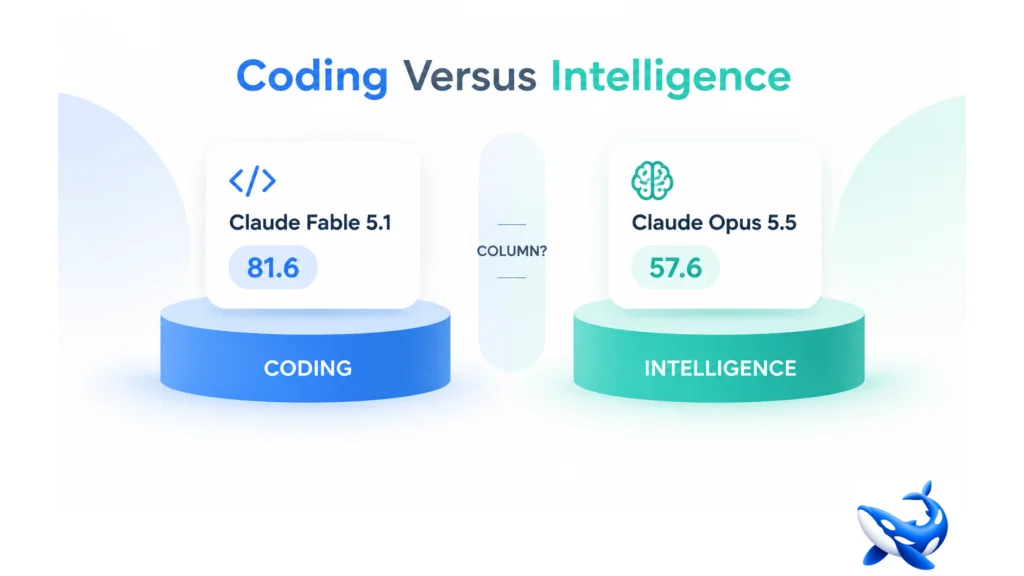
Ask which model in the table is the strongest and you get a question back: which column are you asking about? On the OrcaRouter comparison page that settles a shortlist, the coding leader and the intelligence leader are two different models — and they do not even come from the same vendor. Read the llm comparison the way a picky buyer would, and the disagreement between the two columns is the most useful thing on the page.
The two number ones are real, they are verifiable, and they are not the same row — so “which is strongest” is only answerable once you decide what you are going to do with the model.
Two columns, two winners
The coding column belongs to Claude Fable 5.1. On an independent leaderboard of 138 models it scores 81.6 on the coding index, first place by a clear margin, and it does that while the intelligence column of the same table gives it a respectable but mid-pack 53.4, eighth place out of 147. The intelligence column has its own leader: Claude Opus 5.5, which posts 57.6 and fourth place out of 147 — the highest intelligence reading in our whole comparison table — while it publishes no coding number at all on the same board.
So the headline of this article is not a surprise buried in a footnote. It is the first thing you see when you put the two columns next to each other. A coding specialist and an intelligence generalist can split the top of the same table, and neither claim is wrong. The follow-up question is what that split means for the rows below them, because the pattern repeats all the way down.
Why the same table can disagree with itself
A single model cannot be honestly scored on one ladder and placed on the other. The two columns measure different behaviors: coding indexes are built around writing, debugging, and refactoring software in a real editor, while intelligence indexes lean on reasoning, problem-solving, and long-horizon thinking across many task types. A model can be superb at one and ordinary at the other, and the table you are reading is exactly where that divergence shows up.
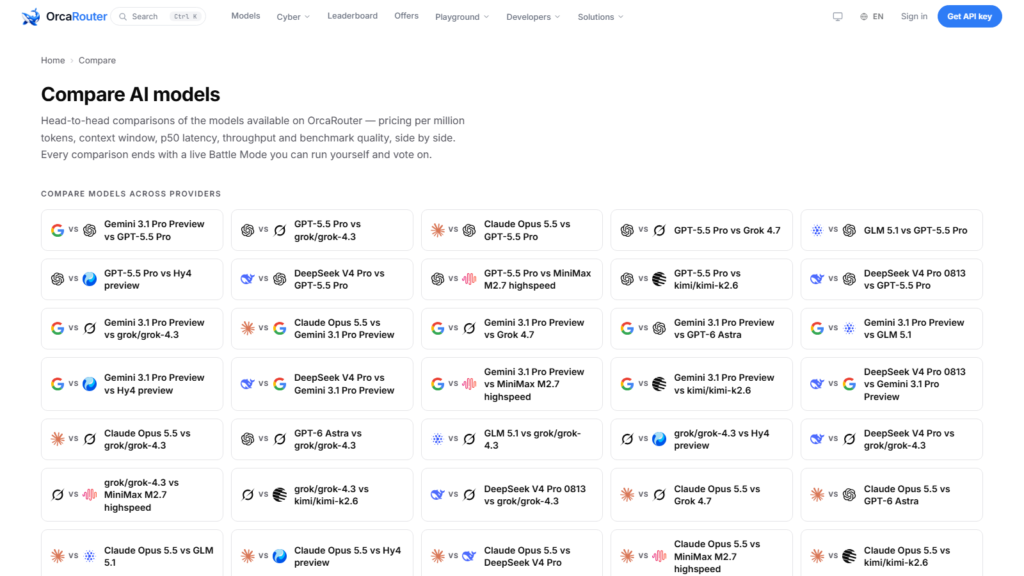
Look at Gemini 3.1 Pro Preview to see the gap at its widest. The same row that carries a quality score of 10 out of 10 on our own composite — our score, made up of the dimensions we grade each model on ourselves — lands at 68.8 on the coding index, thirtieth place out of 138, and 29.7 on the intelligence index, fifty-eighth place out of 147. That is a ten-point model with a mid-list coding score and a near-bottom intelligence score on the same independent board. If you quoted only the 10 out of 10 and never said what it was made of, you would be quoting a number nobody else can reproduce.
The two leaders next to each other
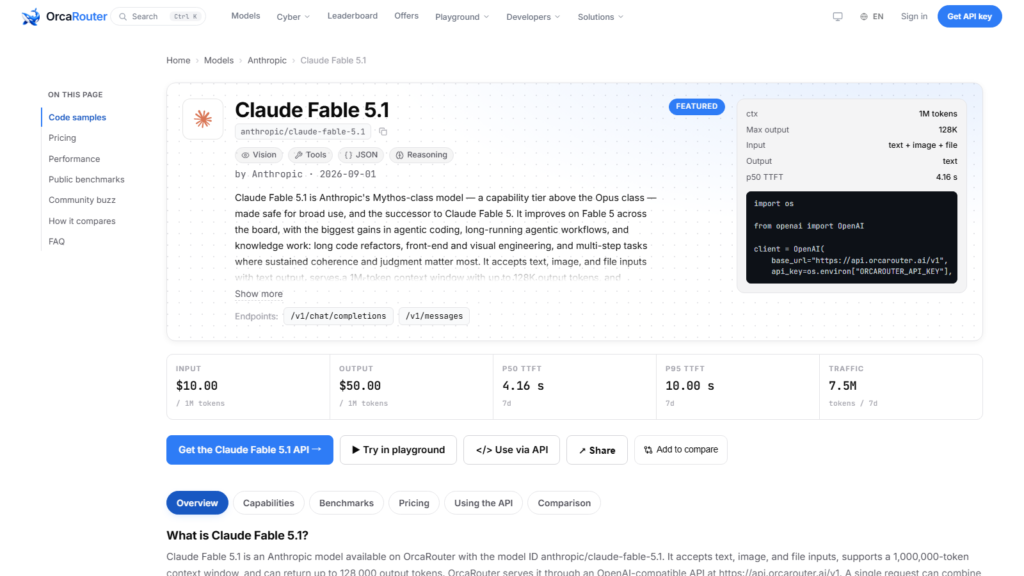
The interesting part is that the two leaders are not distant in price. Claude Fable 5.1 costs $10 per million input tokens and $50 per million output, with a one-million-token context window and a 3.98-second p50 time-to-first-token in our production telemetry. Claude Opus 5.5 costs $4 per million input and $20 per million output, same one-million-token window, a 3.86-second p50, and our own composite quality score of 9 out of 10. The coding leader is more than twice the price of the intelligence leader, and the intelligence leader is the one carrying the bigger 123.5 million tokens of seven-day traffic on our side of the table.
None of that makes one of them a bad buy. It makes them different buys. A team that ships code all day and wants the highest coding index on the board should look at the $10 card. A team that runs a general assistant with a heavy reasoning load should look at the $4 card, which is cheaper and posts the best intelligence figure in the table. The mistake is importing the winner of one column into the other and expecting it to win there too.
Which column should you trust for your workload
There is no universal answer, but there is a reliable rule: match the column to the job, then treat the other column as context. A coding lead reading this table should weigh the coding index heavily and use the intelligence column only to break ties. An engineering manager running a general assistant should reverse that, because their workload is spread across reasoning, summarization, and tool use rather than concentrated in a single editor session.
The honest caveat is that a column is a reading of one task set at one moment, not a guarantee about your traffic. Claude Fable 5.1 leads the coding board with an 81.6, and Claude Opus 5.5 leads the intelligence board with a 57.6, both figures read from the independent leaderboard on 2026-10-12; your own workload can sit anywhere between them. That is why our own composite quality score — the 0-to-10 figure built from the dimensions we grade each model on ourselves, never a third-party benchmark — stays close across most rows, and why it cannot tell you which column to pick.
What actually changed in the last generation
The split between the two leaders is new, and it is worth noticing precisely because it is new. Claude Opus 5.5’s intelligence figure of 57.6 at fourth place out of 147 is the highest in our table, while its predecessor generation — Claude Opus 4.8 — sits at 41.8 on the same index, twenty-third place, and at 74.3 on the coding side, fifteenth place. The newer model pulled far ahead on intelligence and published no coding number at all, and the two rows are no longer even trying to sell you the same thing.
For a buyer that means the old habit of treating a vendor’s flagship as the automatic answer to every column is now reliably wrong. The flagship is the intelligence leader, and a different card — the creative one, at a higher price — is the coding leader. When the two leaders of your own table do not agree, the only way to buy sensibly is to decide which column your workload actually feeds first.
The takeaway
There are two number ones in a modern comparison table, and they answer different questions. Claude Fable 5.1 owns the coding column with an 81.6 and first place out of 138; Claude Opus 5.5 owns the intelligence column with a 57.6 and fourth place out of 147, the highest figure in our table. Both are true, both are verifiable, and neither one makes the other wrong.
Buy against the column your work feeds, not against the prestige of a name. Read the coding index for your engineers, the intelligence index for your general assistant, and the price column for everything in between — then re-check the leaderboard, because both indexes move. The next time someone tells you they bought “the strongest model,” ask them which column they meant.
Sourcing note: all prices, context windows, p50 time-to-first-token figures, seven-day token volumes and composite quality scores are OrcaRouter production data from the comparison page and the linked model pages, read 2026-10-12. The coding and intelligence indexes and the 81.6 and 57.6 figures are from an independent leaderboard of 138 and 147 models respectively, read 2026-10-12; both indexes are live readings that will drift. All checked 2026-10-12.